Connect with us

Economy

Nigerian Economy Exits Recession: Implications and Policy Options

Published

on

Nigerian economy Recession

By FSDH Research

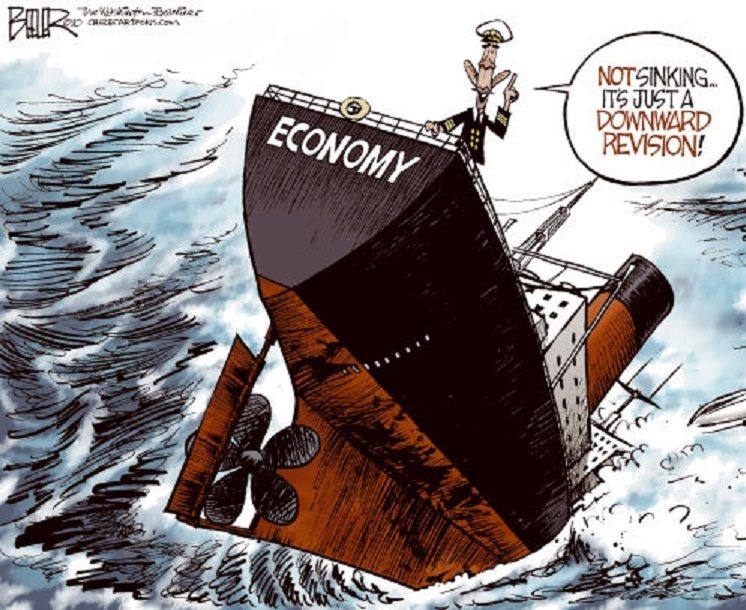
After five consecutive quarters of contraction in the Real Gross Domestic Product (GDP), the Nigerian economy exited the first recession in over two decades. The Q2, 2017 figures that the National Bureau of Statistics (NBS) released on Tuesday, September 05, 2017 shows that the GDP recorded a growth rate of 0.55%. The growth in the GDP was mainly due to the growth recorded in Agriculture, Financial and Insurance, Electricity, Gas, Steam and Air Conditioning Supply, and Mining and Quarrying sectors of the Nigerian economy.

The Oil sector, which grew by 1.64% in Q2, 2017, recorded the first growth since Q4, 2015. The growth in the Non-Oil sector at 0.45% in Q2 2017 decelerated from a growth rate of 0.72% recorded in Q1, 2017.

The Nigerian economy entered into a recession in Q2 2016 following two consecutive quarters of GDP contraction. The recovery in crude oil production and price and the introduction of the Investors’ and Exporters’ foreign exchange window, which increased the supply of foreign exchange to end users, helped to pull the economy out of recession.

We highlight policy options to sustain the growth and to ensure that the growth translates to development.

An analysis of the GDP by sectoral size shows that Agriculture, Trade, and Information and Communication are the three largest sectors of the economy and they contributed 22.97%, 17.1% and 12.39% respectively in Q2, 2017. Trade and Information and Communication contracted by 1.62% and 1.15% respectively. Although Agriculture grew by 3.01% in Q2, 2017, it recorded the lowest growth rate since Q1, 2015. The weak purchasing power in the country occasioned by high unemployment and inflation rates was the main driver of the contraction in the Trade sector.

The performance of the Information and Communication sector was due to the high cost of running communication equipment and services occasioned by the devaluation of the Naira in the face of a fixed tariff regime.

Meanwhile, the series of attacks in the crop producing regions in the country particularly in the Middle-Belt and the North, and the poor infrastructure in transportation and storage facilities led to the deceleration in the growth rate of the Agriculture sector.

The Real Estate sector, which contributed 7.22% to the GDP, also contracted by 3.53% in Q2, 2017 albeit at a much lower rate when compared with the contraction of 5.27% recorded in Q2, 2016.

The Manufacturing sector, which contributed 9.38% to the GDP, recorded a weak growth of 0.64% from a growth of 1.36% recorded in Q1, 2017. This was however a recovery compared with the contraction of 3.36% recorded in Q2, 2016.

There is the need for the Federal Government of Nigeria (FGN) to find a lasting solution to the attacks on farm lands in Nigeria in order to increase production. There should also be incentives in the form of tax reliefs and favourable land acquisition laws for the agro-allied industry in order to boost agriculture.

Additionally, there should be more focus on agricultural training and research institutes in the country to increase farm yields.

Concrete steps should be taken to involve the private sector in the provision of transport and storage facilities to reduce waste and give farm produce easy access to markets.

Government may also consider tax holidays and reduction to companies that make use of local agricultural raw materials in their production process. This will increase both human and material employment of local resources in Nigeria.

It is also important to allow for an adjustment in the communication tariff to boost investments and improve facility maintenance. In order to support the growth of real estate, government at all levels should partner with real estate developers, both local and foreign, to support the development of mass housing projects for low and middle income earners.

These housing units should be made available through long-term financing structures, which should be guaranteed by the government. This would provide both direct and indirect employment opportunities to Nigerians in real estate, construction and manufacturing sectors. In addition, it will help to protect the revenue of the government against the volatility in the oil industry and ultimately guarantee sustainable economic growth and development.


Dipo Olowookere is a journalist based in Nigeria that has passion for reporting business news stories. At his leisure time, he watches football and supports 3SC of Ibadan. Mr Olowookere can be reached via [email protected]

Click to comment

Leave a Reply

Your email address will not be published. Required fields are marked *

Economy

Brent Falls to $87 Per Barrel on Expected US-Iran Peace Deal

Published

on

Brent crude futures

By Adedapo Adesanya

Brent crude prices fell by $3.05 or 3.37 per cent to $87.33 per barrel on Friday, the lowest level since early March, triggered by expectations of an imminent ‌peace agreement between the United States and Iran.

Also, the US West Texas Intermediate (WTI) crude finished at $84.88 a barrel after it gave up $2.83 or 3.23 per cent. It was its lowest level since April 17.

Reuters reported that a memorandum between the US and Iran to halt the war in the Gulf could be signed as soon as Sunday, citing sources.

The sources indicate that the US would immediately begin releasing billions of Dollars in frozen Iranian assets and waive sanctions on its oil exports, in return for Iran opening the strait.

The proposals also include discussion of possible war reparations for Iran and dropping longstanding US demands for limits on Iran’s missile program, the sources were quoted as saying.

Meanwhile, Iranian Foreign Minister Abbas Araqchi said on Friday that a memorandum of understanding had not yet been signed and could still change.

He also said that management of the Strait of Hormuz would not ⁠return to the pre-war era, that sovereignty over the strait belonged to ⁠Iran and Oman, and that Iran would secure safe ⁠passage for ships through it.

US President Donald Trump called off threatened air strikes against Iran on Thursday, while it was reported that final negotiations on the memorandum would focus on nuclear and economic issues but would exclude discussions about Iran’s missile programme.

On Thursday, Iran ‌announced ⁠a complete closure of the Strait of Hormuz, saying it would fire on any ship trying to pass through.

Traffic through the strait, which normally carries a fifth of global oil and liquefied natural gas shipments, has been extremely limited as a result of the war.

The US military, however, said on social media that commercial ships continued to transit the waterway.

Goldman Sachs lowered its 2027 average Brent forecast to $80 a barrel ⁠on higher supply and lower demand, but expects prices to exceed the 2025 average on stockpiling of OECD commercial oil stocks and a security premium for disruptions.

The Organisation of the Petroleum Exporting Countries (OPEC) on Thursday lowered its forecast for 2026 world oil demand growth to 970,000 barrels per day ⁠from a previous 1.17 million barrels per day, its second straight downward revision.

Continue Reading

Economy

Standard Bank Describes Dangote Refinery as Transformational Industrial Project

Published

on

standard bank dangote refinery

By Modupe Gbadeyanka

The Lagos-based Dangote Petroleum Refinery has been described by Standard Bank Group as a transformational industrial project with far-reaching implications for Nigeria and Africa.

The company, which is Africa’s largest financial institution, gave this description after a tour of the facility recently.

Standard Bank, the parent company of Stanbic IBTC Holdings, has promised to support the planned listing of the 650,000 barrels per day refinery and expressed readiness to finance future expansion projects across the continent.

The chief executive of the lender, Mr Sim Tshabalala, said, “We are here because the Dangote Group is a large and important global player and a significant force on the African continent.”

“Standard Bank is the largest financial institution in Africa, and we have partnered with Dangote on a variety of initiatives. We are here to lend support, to see this magnificent refinery and to discuss Vision 2030 and how we can continue supporting the Group’s growth ambitions,” he added.

Mr Tshabalala disclosed that Standard Bank intends to play a leading role in the refinery’s planned Initial Public Offering and future growth initiatives.

“As Dangote lists, there is an IPO coming up, and we are a leading player in that process,” he said, adding that, “As the group continues to expand in Nigeria and across Africa, there will be opportunities for financial advisory services and balance sheet support, and we stand ready to provide both.”

He further described the refinery as “a wonder of the world,” noting that its impact is already being felt through stronger foreign exchange earnings, improved balance-of-payments performance and enhanced energy security.

“This is a wonder to behold. It is massive, productive and transformative. It is already making a significant contribution to Nigeria’s economy through its impact on foreign reserves, the balance of payments and the lives of ordinary Nigerians,” he said.

The Group Vice President for Oil and Gas at Dangote Industries Limited, Mr Devakumar Edwin, said the visit represented a significant milestone in a partnership that began during the refinery’s construction phase.

“The bank visited us during construction and understood the scale of what we were building,” Mr Edwin said. “Today, the refinery is fully operational, and they can see what their support has helped to create. It is like nurturing a tree and eventually seeing it bear fruit.”

He added that both organisations are exploring opportunities to deepen collaboration as Dangote expands its industrial footprint across Africa.

Also speaking, the chief executive of Dangote Petroleum Refinery, Mr David Bird, said the visit highlighted the importance of long-term partnerships in delivering large-scale industrial projects.

“Standard Bank has been one of our strongest supporters throughout the history of the refinery and the broader Dangote Group.

“This visit was an opportunity to demonstrate what that support has enabled. Seeing is believing, and it allows our partners to appreciate the scale of what has been achieved,” Mr Bird stated.

The visit also coincided with a major operational milestone for the refinery, which has now exceeded its original design capacity.

Mr Bird disclosed that the refinery recently completed performance test runs at 700,000 barrels per day, above its nameplate capacity of 650,000 barrels per day.

“We have always believed there was engineering flexibility built into the design,” he said. “Achieving sustained production of 700,000 barrels per day is a testament to the technical capability of our people and the strength of the systems we have built.”

Continue Reading

Economy

Nigeria Pumps 1.53 million Barrels Daily in May to Exceed OPEC Target

Published

on

opec oil output

By Adedapo Adesanya

Nigeria produced about 1.530 million barrels of crude oil per day in May 2026, beating its Organisation of Petroleum Exporting Countries (OPEC) quota by 42,000 barrels per day. In the preceding month, the country only produced 1.489 million barrels per day.

In the latest OPEC’s Monthly Oil Market Report (MOMR), it was also revealed that Iraq in April supplied 1.494 million barrels per day while in May, it produced 1.759 million barrels per day, an increase 265,000 barrels per day; Saudi Arabia, 6.879 million barrels per day in April, 7.010 million barrels per day in May, an increase of 131,000 barrels per day; United Arab Emirate (UAE), 2.021 million barrels per day in April and in May 2.111 million barrels per day, an increase of 90,000 barrels per day while Venezuela, 1.136 million barrels per day in April and 1.179 million barrels per day in May, an increase of 43,000 barrels per day.

Using secondary sources, Nigeria’s production decreased from 1.520 million barrels per day in April to 1.519 million barrels per day; Saudi Arabia, 6.755 million barrels per day in April and 6.912 million barrels per day in May; UAE, 2.023 million barrels per day in April, 2.110 million barrels per day in May; and Venezuela, 1.036 million barrels per day in April and 1.072 million barrels per day in May.

Nigerian Upstream Petroleum Regulatory Commission (NUPRC), in a statement by its Head, Media and Corporate Communications, Mr Eniola Akinkuotu, confirmed that Nigeria, in May, met 102 per cent of OPEC quota as production hit an 11-month high.

According to it, Nigeria’s oil production witnessed an upswing in May 2026, averaging 1,530,354 barrels of crude oil and 170,446 barrels of condensates per day, bringing the total combined production to 1, 700, 800 barrels per day and consolidating Nigeria’s position as Africa’s largest oil producer.

It stated that the average crude oil production recorded in May represents 102 per cent of Nigeria’s 1.5mbpd of production quota allocated by OPEC.

It explained that production performance during the review period remained robust, with combined crude oil and condensate output ranging between a low of 1.51 million barrels per day and a peak of 1.86 million barrels per day.

The organisation added that the May 2026 production figures represented the highest recorded by Nigeria since July 2025, when output surged to 1,712,282.

NUPRC said: “In strict crude oil terms (excluding condensates), the 1.53 million barrels recorded in May 2026 represents the highest Nigeria has witnessed since January 2025 when crude oil production hit 1.538 mbpd.”

“On a month-on-month basis, production rose by 2.77 per cent in May 2026 as against 1.48mbpd in April. The broader production trend over the last five months has also remained positive.

“Combined crude oil and condensate output increased from 1.48 mbpd in February to 1.54 mbpd in March, 1.66 mbpd in April, and then 1.7 mbpd in May, underscoring sustained growth in Nigeria’s hydrocarbon production levels.

“Among production streams, Bonny Terminal led the pack with a total blend of 293,870 bpd, closely followed by Forcados Terminal at 289,900 bpd. Qua Iboe ranked third with 173,360 bpd, while Escravos Oil Terminal contributed 135,470 bpd. Odudu (Amenam Blend) completed the top five production streams, accounting for 63,250 bpd during the month under review.”

The commission attributed the rise in production to a sustained positive momentum as operations remained stable throughout the reporting period with no significant pipeline or facility outages recorded.

Nigeria OPEC quota

Continue Reading

Trending