Connect with us

General

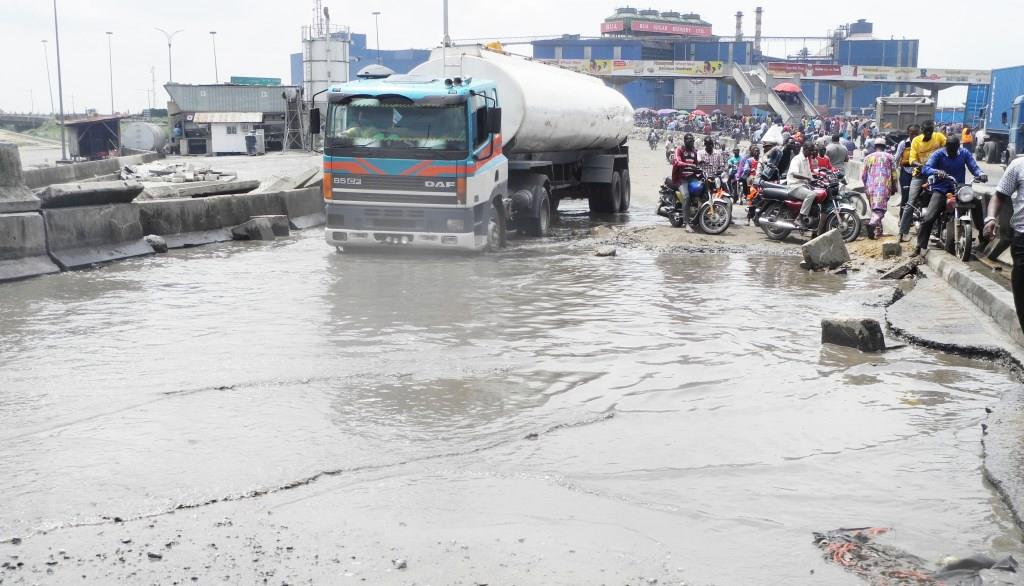
Apapa Gridlock: Ambode Bars Trucks From Entering Lagos

Published

on

apapa roads

**Orders RRS, LASTMA, LASEMA to enforce directive at state borders

By Dipo Olowookere

Governor Akinwunmi Ambode of Lagos State has approved the restriction of trucks entering the metropolis as a way of dealing with the incessant traffic logjams experienced at the Apapa axis of the state.

At a press conference jointly addressed on Friday by officials of the state as well as members of the Association of Maritime Truck Owners (AMATO) at the Bagauda Kaltho Press Centre in Alausa, the state government specifically said owners and operators of articulated vehicles/trailers and petroleum tankers should stay away from Lagos for now.

It regretted that the incessant traffic bottleneck had impacted negatively on the commercial activities of the citizenry, adding that the directive would be enforced to eliminate the current hardship being faced by motorists.

Addressing the briefing, Acting Commissioner for Transportation, Mr Olanrewaju Elegushi, said investigations revealed that the traffic lockdown was a direct result of the challenges being faced by operators of the ports’ which had made it impossible for them to load the articulated vehicles/trailers that has come from the hinterland to evacuate imported items from the ports.

He said the gridlock was worsened by the current rehabilitation of some major roads and other minor roads which necessitated the closure of some roads in Apapa, noting that the situation had led to the traffic bottleneck and backflow of the articulated vehicles to as far as Ojuelegba on the Funsho Williams Avenue, Surulere.

Explaining the reason for the directive, Commissioner for Information and Strategy, Mr Steve Ayorinde, said the Apapa gridlock had also become a reoccurring problem due to constant breakdown of operations at the Ports.

“Clearly, it is the breakdown of operations at the Port that is the monster causing this reoccurring issue. We keep having this issue of gridlock in Apapa because issues that the Ports Authorities and the concessionaires are dealing with are recurrent and the spill over effect of those issues are causing all these.

“If the Ports can’t determine how many trucks they are able to deal with on a daily basis; how they are informed about coming in and going out, then it will be a problem to deal with.

“What we need to do is to keep on engaging with them, we keep on engaging with other states and so on. I mean people who have trucks in other states and already know that there is a logjam in Lagos, why send other trucks to Lagos? While clearing the mess that the Lagos State Government did not cause, can people not consider it logical to wait for few days for us to clear this and this is the reason why we are saying that trucks should stay away from Lagos in the interim.

“The idea is not to say don’t come into Lagos. It is part of what makes the economy of Lagos what it is but we are saying let us deal with the logjam that we have presently and there is no way we can deal with it, we can only deal with the effect because the causes essentially have to do with the operations at the Ports and that is why we are appealing to them,” Mr Ayorinde explained.

He also said that the Nigeria National Petroleum Corporation (NNPC) had been unable to load product from its Mosimi Depot in Ogun State due to vandalisation, noting that tankers hoping to get fuel across to the South West States are stranded in Lagos.

In the interim, the government, however, urged the operators to utilise the Ogere Trailer Park and other parks outside the state to avoid further hardship for motorists on the road, assuring that all measures would be deployed to ensure quick resolution of the situation.

On his part, General Manager of the Lagos State Emergency Management Agency (LASEMA0, Mr Adesina Tiamiyu, said the state government has already instructed the agency alongside Rapid Response Squad (RRS) of the Nigeria Police and the Lagos State Traffic Management Authority (LASTMA) to enforce the order restricting trucks from entering Lagos for now, noting that the enforcement will subsist pending when the spill over of traffic is cleared.

He urged residents not to hesitate to immediately alert State authorities through the 112 and 767 toll free lines in the eventuality of any danger lurking.

Also speaking, President of AMATO, Mr Remi Ogungbemi said the present situation was worrisome as it is a time bomb waiting to explode if unchecked.

He urged the Federal Government to take a cue from the Lagos State government and collaborate to resolve the crisis as soon as possible.

While pledging the readiness of members of his association to support efforts geared to restore sanity, Mr Ogungbemi also called for a regulatory system in place to manage call-up of trucks through technology.

Recall that this week, the Lagos State House of Assembly appealed to the NNPC to relocate tank farms in Apapa to other less populated areas so as to ease hectic traffic situation in the area.


Dipo Olowookere is a journalist based in Nigeria that has passion for reporting business news stories. At his leisure time, he watches football and supports 3SC of Ibadan. Mr Olowookere can be reached via [email protected]

General

Church Confirms Release Of 151 Abducted Members in Kaduna

Published

on

Cherubim and Seraphim Movement Church Worldwide

By Adedapo Adesanya

The Cherubim and Seraphim Movement Church Worldwide, Ayo Ni O, has confirmed the release and safe return of 151 of its members abducted from Iburu community in Kajuru Local Government Area of Kaduna State.

The abduction, which affected about 177 people, occurred on January 18, 2026. It was initially denied by the Nigeria Police Force and other government agencies, but was later confirmed.

In a statement issued by the Conference Secretary General of the church, Mr Anthony Olusesan Samaiye, it was disclosed that the release of the abducted persons was confirmed through reports from its liaison officers in Kaduna.

According to the statement, Mr Emmanuel Abiodun Adewale Alogbo (JP), described the release as a victory for faith, prayer and dialogue, noting that the breakthrough followed an emergency visit to Kaduna by its leadership and a series of high-level engagements aimed at securing the freedom of the abducted worshippers.

The Cherubim and Seraphim Church expressed gratitude to the Kaduna State government, particularly Governor Uba Sani, for what it described as his commitment to dialogue and the coordination of state resources that contributed to the successful outcome.

Special appreciation was also extended to the Governor’s Chief of Staff, Mr Sani Liman Kila, and the Senior Special Assistant on Religious Affairs (Christian Matters), Mr Ishaya Jangado, for facilitating engagement between the church and the state government.

The church noted that the incident demonstrated the importance of cooperation between religious leaders and government authorities in addressing security challenges and protecting citizens.

It also acknowledged prayers and support from the Christian Association of Nigeria (CAN), the Organisation of African Instituted Churches (OAIC), the international community and Christians worldwide.

While celebrating the release, the church said it was mindful of the trauma experienced by the victims and disclosed that its welfare and medical teams had been mobilised to provide psychosocial support and care to the affected members and their families.

The church called for sustained peace in Kaduna State and across Nigeria, urging authorities to continue efforts to ensure the safety of all citizens, regardless of religious affiliation.

Continue Reading

General

2027 Elections: I Won’t be Vice Presidential Candidate—Peter Obi Insists

Published

on

peter obi tax system

By Adedapo Adesanya

As activities for the 2027 general elections begin to take shape, the former presidential candidate of the Labour Party in the 2023 presidential poll, Mr Peter Obi, has again ruled out the possibility of contesting as a vice presidential candidate next year, saying he is contesting to be on the ballot.

Speaking ahead of the Abuja Municipal Area Council (AMAC) election in the Federal Capital Territory, he said, “You see this coming election, support us in AMAC; it will help me. Your support in AMAC is critical to our journey. I am involved and contesting the coming election as number one. When I come back, you will see. I assure you.”

Mr Obi vied for the 2023 presidency on the LP platform, emerging third overall behind Mr Atiku Abubakar and President Bola Tinubu.

In December 2025, he defected to the African Democratic Congress (ADC), where his teeming supporters popularly known as Obidients have urged him to only pursue the presidential ticket.

Mr Abubakar, who chose Mr Obi as his vice presidential candidate in the 2019 polls, is also a member of the ADC. The men finished in second and third places, respectively in the last presidential election, which President Tinubu won with 37 per cent of the votes.

Speaking at the campaign venue, Mr Obi emphasised to his supporters the importance of backing the ADC candidate in the AMAC election, noting that their support at the grassroots would go a long way in bolstering his national political journey.

The ADC coalition includes many former allies of Mr Tinubu, including Mr Nasir El Rufai, the former governor of Kaduna State; Mr David Mark, a former Senate President who is serving as the National Chairman of the party, and Mr Rauf Aregbesola, a former Osun Governor and currently the National Secretary of ADC.

The party will be hoping to emulate the success of the ruling All Progressives Congress (APC), which was formed by an alliance of opposition politicians (including Mr Abubakar) in 2013 and caused the ouster of former President Goodluck Jonathan, the first-ever defeat of an incumbent Nigerian president in 2015.

Continue Reading

General

CPPE Urges FG to Create Farm Price Stabilisation Plan for Food Security

Published

on

Price of Food

By Adedapo Adesanya

The Centre for the Promotion of Private Enterprise (CPPE) has called on the federal government to urgently establish a National Farm Price Stabilisation and Farmer Income Protection Framework to safeguard Nigeria’s long-term food security.

This was contained in a policy brief signed by the chief executive of the think tank, Mr Muda Yusuf, on Sunday.

The group warned that while recent import surges have lowered food prices to the delight of consumers, they have simultaneously inflicted severe financial losses on farmers and agricultural investors, creating what it described as “troubling trade-offs and unintended consequences.”

He advised that Nigeria cannot afford a policy regime that undermines confidence in agriculture, one of the country’s most strategic sectors and largest employers of labour.

“The welfare gains from cheaper food have been profound and should be acknowledged. However, the cost to farmers and other investors across the agricultural value chain is equally high and cannot be ignored,” Mr Yusuf stated.

The CPPE boss emphasised the urgent need to strike a sustainable balance between keeping food affordable for consumers and protecting farmers’ incomes, while safeguarding agricultural investment.

According to the policy document, recent import surges of staples such as rice, maize and soybeans have caused serious dislocations in the agricultural investment ecosystem, inflicting severe hardship on farmers and weakening production incentives.

“Although consumers have welcomed the decline in food prices, the long-term consequences are adverse: farmer incomes fall, production declines over time, investment confidence weakens, and the country risks returning to cycles of scarcity and higher prices,” the document warned.

The CPPE identified several structural factors driving recurring farm price collapses in Nigeria, beyond the immediate impact of food imports.

The think tank warned that harvest glut remains a major challenge, with many farmers harvesting the same crops within the same period, causing sudden oversupply. This is compounded by the limited availability of storage facilities, drying centres and cold-chain systems, which forces farmers to sell immediately regardless of market conditions.

The organisation said this is also affected by weak rural logistics, characterised by poor roads, insecurity, high transport costs, and limited aggregation hubs, which make it difficult to move produce efficiently from production zones to high-demand markets.

Continue Reading

Trending