Connect with us

Economy

Asian Stocks Jump as Investors Shrug off Global Trade War Concerns

Published

on

By Investors Hub

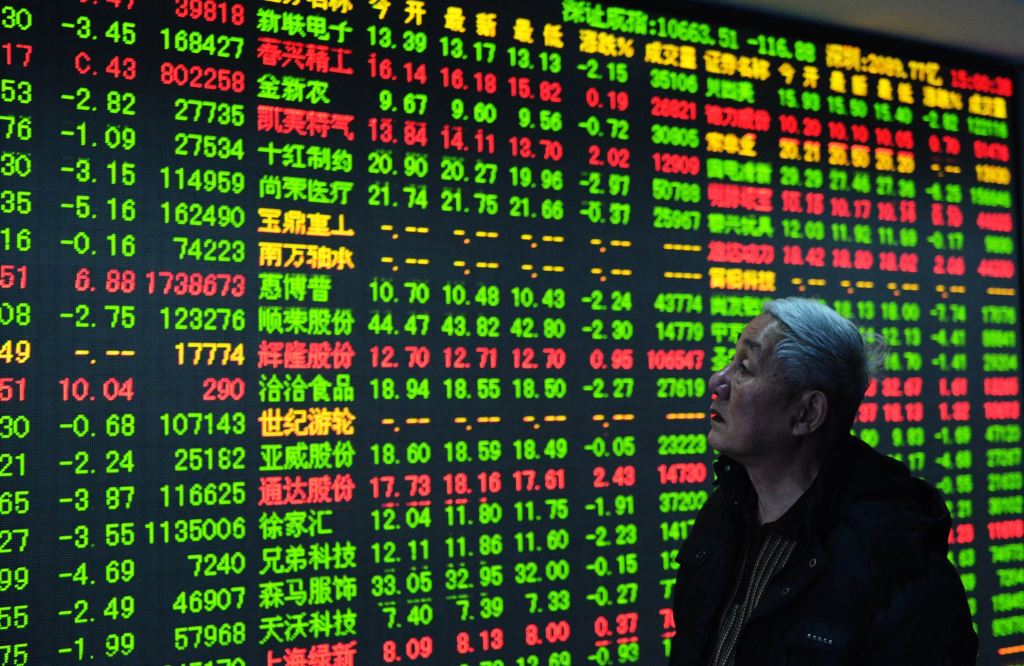
Asian markets ended mostly higher on Monday, with investors shrugging off concerns about a global trade war and looking ahead to the outcome of a historic meeting between President Donald Trump and the North Korean leader Kim Jong Un.

However, gains were modest in most of the markets in the region amid largely thin volumes ahead of crucial monetary policy meetings by the Bank of Japan, the European Central Bank, and the U.S. Federal Reserve.

Japanese stocks ended moderately higher, although trading activity was relatively light. Japan?s Nikkei 225 Index climbed 109.54 points or 0.5 percent to 22,804.04.

In economic news, core machine orders in Japan soared a seasonally adjusted 10.1 percent to 943.1 billion yen in April, according to the data released by the Cabinet Office. That beat expectations for a gain of 2.4 percent following the 3.9 percent decline in March. On a yearly basis, core machine orders jumped 9.6 percent, beating forecasts for 3.8 percent increase.

The Bank of Japan said the M2 money supply in Japan was up 3.2 percent on year in May, coming in at 1,003.2 trillion yen. That was unchanged from the April reading following a downward revision from 3.3 percent.

Hong Kong?s Hang Sang Index rose 105.49 points or 0.3 percent to 31,063.70. Tancent Holdings, China Resources Power Holdings, Sands China, Galaxy Entertainment and Cnooc were among the notable gainers in the Hong Kong market.

Meanwhile, Australia?s benchmark S&P/ASX 200 Index ended down 12.10 points or 0.2 percent at 6,045.20. The broader All Ordinaries Index dipped 12.60 points or 0.2 percent to 6,156.80.

Metals and industrials stocks were among the prominent losers in the Australian market.

Retail Food Group plunged 9 percent. Aurizon Holdings and Asaleo Care both ended lower by about 4 percent. Newcrest Mining, Santos, Mineral Resources, Pilbara Minerals and Lynas were among the other notable losers.

Nanosonics, Donino’s Pizza, Seven West Media, Mayne Pharma, Sigma Pharma, Tabcorp Holdings, Graincorp, Coca-Cola Amatil and Whitehaven Coal ended stronger by 1 to 6 percent.

The Chinese market also extended its losses to a third successive session amid growing concerns about a lack of liquidity.

The Shanghai Composite Index drifted down by 14.79 points or 0.5 percent to 3,052.36, with technology, travel and media stocks posting losses.


Dipo Olowookere is a journalist based in Nigeria that has passion for reporting business news stories. At his leisure time, he watches football and supports 3SC of Ibadan. Mr Olowookere can be reached via [email protected]

Economy

Gains in Sovereign Trust Insurance, Aradel Lift Stock Exchange by 0.26%

Published

on

domestic stock exchange

By Dipo Olowookere

The last trading session of the week on the floor of the Nigerian Exchange (NGX) Limited ended on a positive note with a 0.26 per cent growth on Friday.

It was the first trading day after the two-day break observed on Wednesday and Thursday for Sallah celebrations by Muslims.

Market participants returned to Customs Street yesterday in high spirits, though keeping an eye on happenings in the macroeconomic environment.

This resulted in the market breadth index closing bearish after recording 32 price gainers and 33 price losers, implying weak investor sentiment.

Sovereign Trust Insurance and Zichis gained 10.00 per cent each to sell for N2.75 and N33.00 apiece, International Energy Insurance rose by 9.98 per cent to N4.52, McNichols grew by 9.85 per cent to N8.70, and Aradel Holdings increased by 9.59 per cent to N1,933.80.

Conversely, the trio of CAP, Austin Lax, and Premier Paints lost 10.00 per cent each to settle at N179.10, N3.96, and N33.75 apiece, LivingTrust Mortgage Bank decreased by 9.89 per cent to N4.01, and John Holt fell by 9.84 per cent to N16.95.

As for the performance of the key market sectors yesterday, the banking space shed 2.51 per cent, the consumer goods index depleted by 1.26 per cent, and the industrial goods sector tumbled by 0.05 per cent.

However, bargain-hunting raised the energy segment by 4.38 per cent and lifted the insurance counter by 0.86 per cent.

Consequently, the All-Share Index (ASI) closed higher by 646.63 points to 250,385.47 points from 249,738.84 points, and the market capitalisation improved by N415 billion to N160.509 trillion from N160.094 trillion.

A total of 1.2 billion stocks worth N43.4 billion exchanged hands in 93,626 deals during the session compared with the 564.1 million stocks valued at N27.2 billion traded in 65,666 deals in the preceding session. This showed that the trading volume, value, and number of deals went up by 112.73 per cent, 59.56 per cent, and 42.58 per cent, respectively.

Fidelity Bank ended the day as the busiest equity with a turnover of 483.0 million units valued at N8.7 billion, Access Holdings transacted 133.3 million units worth N3.2 billion, The Initiates sold 81.7 million units for N2.2 billion, Chams exchanged 43.9 million units valued at N173.8 million, and Dangote Sugar traded 28.4 million units worth N2.0 billion.

Continue Reading

Economy

Naira Strengthens Marginally to N1,375.25/$ in Official Market

Published

on

yuan-naira $10bn

By Adedapo Adesanya

The Naira returned from a two-day break on Friday, May 29, stronger against the United States Dollar by 16 Kobo or 0.01 per cent in the Nigerian Autonomous Foreign Exchange Market (NAFEX), trading at N1,375.25/$1 compared with N1,375.41/$1 it was exchanged on Tuesday.

The local currency also appreciated in the same market window against the Pound Sterling during the trading session by N3.62 to sell for N1,848.62/£1 versus N1,852.26/£1, but lost N2.16 against the Euro to close at N1,601.48/€1 compared with the previous rate of N1,599.32/€1.

The official forex market was closed on Wednesday and Thursday for the Sallah break.

A look at the GTBank FX desk showed that the Naira gained N4 against the Dollar yesterday to quote at N1,379/$1, in contrast to Tuesday’s closing value of N1,383/$1, and at the black market, it improved its value by N5 to N1,380/$1 versus the preceding session’s N1,385/$1.

Market analysts noted that the Nigerian Naira outlook remains stable, citing the latest round of FX inflows, which have lifted gross external reserves to $49.259 billion. Some projected that the domestic currency will close the first half of 2026 stronger as the Central Bank of Nigeria (CBN) continues to inject FX inflows into the official market.

Also supporting expected stability is the continued government signal of growth. In his third year in office, in a speech on Friday, President Bola Tinubu inherited severe economic and structural challenges in 2023, including exchange-rate distortions, which he said have since been reformed.

“Multiple exchange rate windows and forex arbitrage created massive distortions, with Nigeria losing more than N8 trillion over three years to rent-seeking and speculative practices.”

According to the president, the situation required urgent and courageous decisions to avert a deeper economic crisis and fiscal collapse.

In the cryptocurrency market, US-Iran ceasefire hopes have failed to pull Bitcoin (BTC) and Ethereum (ETH) higher, with the two largest cryptocurrencies losing almost 3 per cent as cooling spot bitcoin ETF inflows reinforced the pullback. BTC dropped 0.3 per cent to sell for $73,456.95, while ETH dipped 0.1 per cent to trade at $2,013.29.

Further, TRON (TRX) went down by 2.1 per cent to $0.3427, and Cardano (ADA) dipped 0.4 per cent to close at $0.2348.

On the other hand, Binance Coin (BNB) jumped 4.7 per cent to $667.52, Ripple (XRP) grew by 2.00 per cent to $1.34, and Solana (SOL) expanded by 0.1 per cent to $82.27, while the US Dollar Tether (USDT) and the US Dollar Coin (USDC) remained unchanged at $1.00 each.

Continue Reading

Economy

Possible Ease in Middle East Tensions Calms Crude Oil Market by Over 2%

Published

on

crude oil market

By Adedapo Adesanya

The crude oil market shrank by more than 2 per cent on Friday as traders awaited a possible ceasefire deal among the United States, Israel and Iran.

Brent crude ‌settled at $92.05 a barrel after it lost $1.66 or 1.8 per cent, while the US West Texas Intermediate (WTI) finished at $87.36 a barrel, down $1.54 or 1.7 per cent.

The latest reports as of Friday suggest that the US and Iran are set to extend the ceasefire, which will include the reopening of the Strait of Hormuz. However, such an extension would need to be endorsed by U.S. President Donald Trump.

The US and Iran reportedly reached ​a tentative agreement on Thursday ⁠to extend a ceasefire and lift restrictions on shipping through the Strait of Hormuz.

The three-month war between the US and Iran has been marked ​by frequent chatter of an impending end to the conflict that would open the crucial Strait of Hormuz, used to ​transit one-fifth of the world’s oil and gas supply. Even with both sides suggesting an agreement was forthcoming, ⁠their characterisations of the deal were still somewhat different.

The closure of the waterway has driven energy prices sharply higher worldwide. Recent sessions have been volatile, with swings by as much as $6 for both ​benchmarks on conflicting signals over a potential reopening of the strait.

Traffic through the maritime chokepoint remains a small fraction of levels before the conflict, with analysts saying a reopening ​of the waterway would offer some immediate relief to the oil market, but a recovery is ​still uncertain.

Japan, which relies ⁠heavily on oil from the Middle East, last month registered a 66 per cent drop in crude oil imports compared with April last year.

Prices plunged by 19 per cent in May as traders and speculators bet on an extended ceasefire and an eventual US-Iran deal despite the biggest physical supply disruption in history. The slump in prices in May follows the biggest monthly surge in history in April, when oil rallied amid the worst supply disruption ever.

Traders spent most of the week looking beyond current supply shortages and focusing on the possibility that a ceasefire agreement could eventually bring barrels back to market, leading to selloffs.

US crude, petrol, and distillate stockpiles fell ​last week, according to the Energy Information Administration (EIA), as demand from refiners and consumers rose, while exports fell by 1.16 million barrels per day to 4.4 million barrels per day.

Continue Reading

Trending