Connect with us

Jobs/Appointments

Nigerians Trust Their Employers More—Report

Published

on

2019 Edelman Trust Barometer

A new report has shown that of the four mainstream institutions of government, business, media and non-governmental organisations, Nigerians trust more in business and believe that their employers should take the lead on change rather than waiting for the government to initiate it.

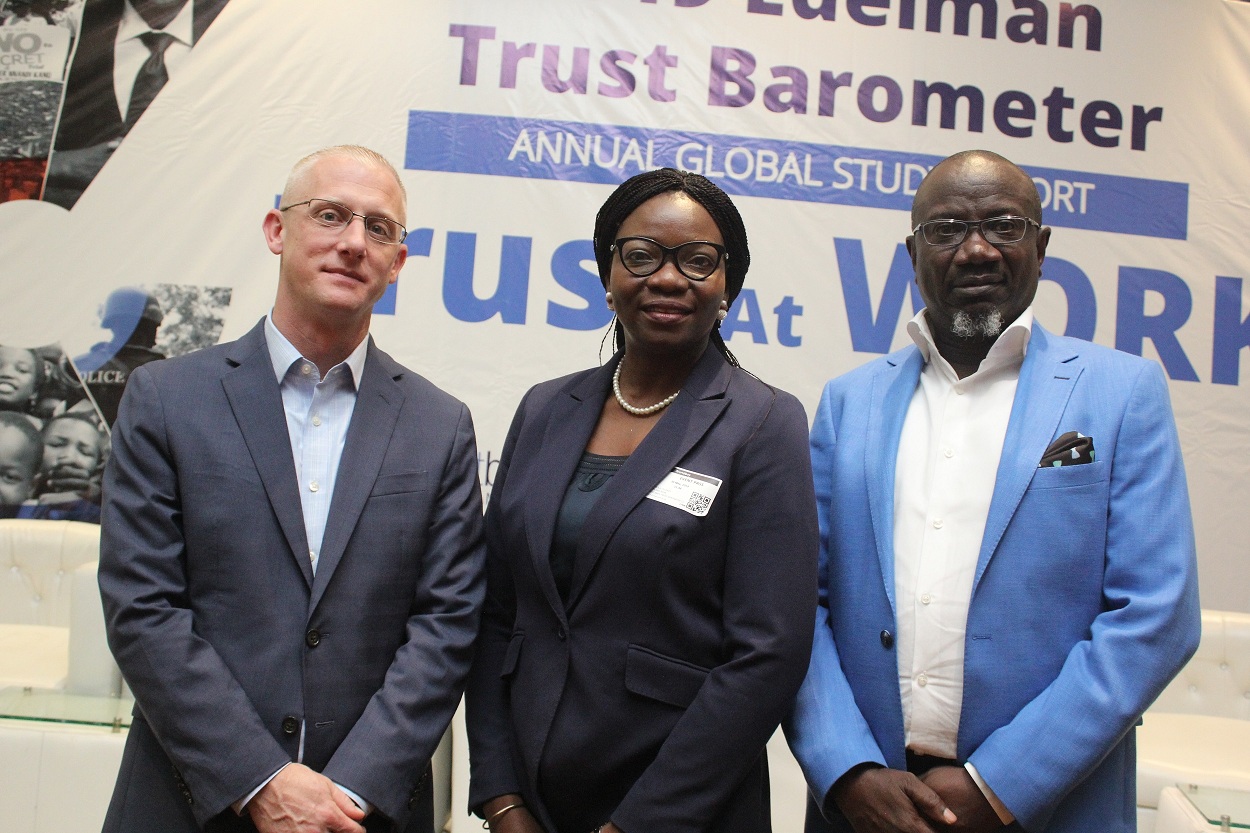
This revelation amongst others was contained in the 19th Edelman Trust Barometer Survey Report unveiled by Edelman and its Exclusive Nigerian Affiliate and the Preferred West African Partner, Chain Reactions Nigeria, in Lagos on Thursday, May 30, 2019.

Edelman Trust Barometer launched in 2001 is the annual global trust and credibility online survey conducted by Edelman Intelligence, the independent research arm of the Edelman global network, testing how well people trust the institutions of government, business, media and nongovernmental organisations to do what is right.

Presenting the data from the Nigeria Trust Breakout, Managing Director, Edelman Africa, Jordan Rittenberry, said, “Ninety-five per cent of respondents agreed that employers can create positive change in skills training, while 93 percent said that CEOs can influence economic prosperity in Nigeria. 88 percent agreed that their employers can create positive change in job creation while another 83 percent believed in the ability of their employers to initiate positive change in discrimination.”

The survey conducted by Edelman Intelligence between October 19 to November 16, 2018, further revealed that 72 percent of the Nigerian respondents see their employers as a trustworthy source on the global economy while 58 percent perceive business as a reliable source on technology.

Rittenberry added that, “Fifty-eight percent of respondents look to their employer to be a trustworthy source of information about social issues and other important topics on which there is not general agreement. A further 77 percent believe that a company can take specific actions that both increase profits and improve the economic and social conditions in the communities where it operates.”

He revealed further that trust across the four mainstream institutions in the country decreased by 24 percent from 2018 with a drop from 66 percent to 42 percent and that in Africa in general, trust fell four points from 2018 to 2019.

Rittenberry disclosed that in Nigeria and nine other African countries included in the survey, “government is the least trusted institution while trust in media amongst the 10 African countries exceeds the global average of trust in media at 47 percent. Business is the most trusted institution amongst the 10 African countries, while NGOs are trusted in six of the 10 African Markets.”

The 2019 Edelman Trust Barometer with the theme, ‘Trust at Work’, is the second exclusive deck on Nigeria, the first being that of year 2018 survey while this year also made it the third time the report was presented in Nigeria. 2017 was the first time the report was ever presented in Nigeria although Nigeria was not included in the study then. The other African countries surveyed are South Africa, Egypt, Ghana, Kenya, Morocco, Cote’d Ivoire, Ethiopia, Tanzania and Angola.

Speaking further, Rittenberry disclosed that for the media in Nigeria, search engines were the most trusted at 84 per cent followed by earned media (69%), social media (64%) and traditional media at 60%. Online media was the least trusted with 56 per cent.

“Trust in government is really low while trust in media is fairly balanced; business is the most trusted institution in Africa while trust in NGOs varies across the continent”, he said.

Earlier in his welcome address, Managing Director/Chief Strategist, Chain Reactions Nigeria, Mr Israel Jaiye Opayemi, affirmed that the importance of trust could not be over-stated, noting that trust played a key role in the last general elections and called on government to invest in its trust quotient.

“Trust is built by what we say as well as by what we do and so for a government like ours, perhaps this is an auspicious time for those who are responsible for managing the institutions of government in Nigeria to begin to think about investing in that asset of trust.

“My admonition to President Muhammadu Buhari and his Vice, Prof Yemi Osinbajo is to make a deliberate effort to earn the trust of Nigerians in their second tenure of four years.

“For them to earn our trust as Nigerian citizens, one of the things my experience has taught me on this job is, perhaps, we need to rethink the entire communication architecture of government once more. I ask that fundamental question, ‘in what way has the present architecture helped the government to earn the trust of the people?’ And President Muhammadu Buhari, our appeal (this morning) is that as you select the next set of ministers, you must reign them in. What we saw in the last four years was that there were too many people speaking for your government.”

To curb the increasing menace fake news in the media, Mr Opayemi suggested self-censorship for professionals. “Can we begin to do what our colleagues are doing in other countries? That weekly, we do a compilation of all the false stories and the fake news that newspapers have published or that TV and radio stations have broadcast and name and shame them. This is going on with a lot of impunity. Let us generate ideas on how to tame this monster that’s in our society,” he advised.

He also urged businesses and NGOs to invest in trust, noting that, “how well can businesses further invest in this asset of trust the same way they invest in machinery and other things?”

The highpoint of the presentation ceremony was a panel discussion featuring eminent professionals drawn from business, government, media and NGOs, who shared their perspectives on the report.

They included publisher of BrandCrunch, O’Lekan Babatunde; Assistant Director, Programmes, Radio Nigeria, Lagos Operations, Funke Treasure-Durodola; Coordinator, Campaign Against Impunity, Shina Loremikan and Executive Chairman, Centre for Anti-Corruption and Open Leadership, Debo Adeniran.

The others were former sole administrator, Eti-Osa East Local Council Development Area of Lagos State, Prince Babatunde Ayo Ayeni; Head, Brand Communications, SUNU Assurance Plc, Oluwayemisi Mafe and Bukola Oluyadi, Enterprise Transformation/Corporate Planning and Strategy, Polaris Bank Limited. The TV personality, Oscar Oyinsan, moderated the session.

Founder and chairman, Proshare Nigeria Limited, Mr Olufemi Awoyemi, in his brief keynote speech, said trust was paramount in all aspects of life and that trust issue is not only a Nigerian problem, but generally a common problem across human society.

Chairman, Nigerian Institute of Public Relations, Lagos State chapter, Mr Olusegun McMedal and President, Public Relations Consultants Association of Nigeria, (PRCAN), Mr John Ehiguese, also gave goodwill speeches at the event.

Mr McMedal expressed happiness that Nigeria was considered in the global report for the second time and noted that the report is perfect for Africa.


Dipo Olowookere is a journalist based in Nigeria that has passion for reporting business news stories. At his leisure time, he watches football and supports 3SC of Ibadan. Mr Olowookere can be reached via [email protected]

Advertisement
Click to comment

Leave a Reply

Your email address will not be published. Required fields are marked *

Jobs/Appointments

Binance Names Co-Founder Yi He as Co-CEO Amid Ongoing Restructuring

Published

on

Binance Yi He

By Adedapo Adesanya

Global blockchain ecosystem behind the world’s largest digital asset exchange by trading volume and users, Binance, has appointed its co-founder, Ms Yi He, as its co-CEO.

“Yi has been an integral part of the executive leadership team since the launch of Binance. Her innovative and user-focused approach has been instrumental in shaping the company’s vision, culture, and bottom-up business strategy,” said Binance CEO, Mr Richard Teng. “This appointment is a natural progression and she will continue to guide the organization from strength to strength.”

“We remain dedicated to being the most trusted and regulated exchange in the world, always putting our users first. Yi plays a critical role in growing our community and driving product innovation as we work to reach one billion users. Together, we are focused on building the Web3 infrastructure and promoting financial freedom, empowering people to participate in a more open and fair financial system,” added Mr Teng.

“I am honored to build alongside Richard, who brings decades of experience in regulated financial markets and was among the first to regulate crypto in its early days,” said Ms He. “Together, we bring diverse perspectives and are confident in leading the future of the industry during this pivotal time, as we responsibly expand our global presence and drive sustainable innovation with our users always at the center.”

Binance remains one of the world’s largest players in crypto trading, and leadership changes within the company continue to draw attention due to its scale and influence.

The appointment of a co-CEO adds structure during a period when global exchanges emphasize compliance, operational clarity and more formal management frameworks.

The company did not announce changes to its product lineup or platform priorities alongside the leadership update, and no financial terms were disclosed. The addition of a co-CEO role reflects an internal effort to distribute responsibilities as the firm works with regulators and seeks stability in a competitive and closely watched industry.

Continue Reading

Jobs/Appointments

AFRIPERF Adopts Nigeria as Headquarters, Picks Komolafe as Chairman

Published

on

Gbenga Komolafe NUPRC

By Adedapo Adesanya

The African Petroleum Regulators Forum (AFRIPERF) has chosen Nigeria as its official headquarters and also elected the chief executive of the Nigerian Upstream Petroleum Regulatory Commission (NUPRC), Mr Gbenga Komolafe, as its chairman.

Recall that in September, 16 countries, led by Nigeria, gathered in Accra, Ghana, to witness the signing of the charter establishing the forum, which seek to harmonise oil regulation in Africa.

Others include Ghana, Somalia, Gambia, Madagascar, Sudan, Guinea, and Togo among others.

The decisions were announced at the inaugural executive committee meeting of the forum which took place virtually on December 2, 2025. The meeting which was attended by the 16 African countries, was convened to pick its leadership, headquarters and logo.

Prior to his endorsement as the substantive pioneering chairman, Mr Komolafe acted in interim capacity.

Also, Mrs Eyoanwan Ndiyo-Aiyetan also emerged as the secretary of AFRIPERF.

According to a statement on Wednesday, NUPRC notes that the development affirms Nigeria’s central role in the African petroleum regulatory space and as Africa’s largest producer of crude oil.

In his acceptance speech, Mr Komolafe thanked his African counterparts for the trust and honour, promising to ensure that no member country is left behind.

AFRIPERF aims to strengthen regional petroleum governance by fostering collaboration, cooperation and coordination among member regulators.

Its mission includes creating standards, enhancing transparency and addressing cross-border challenges such as gas trade, emissions, and digitalisation while making the African continent energy sector attractive for crucial investments.

Continue Reading

Jobs/Appointments

Tinubu Nominates General Christopher Musa as New Defense Minister

Published

on

CDS Christopher Musa

By Adedapo Adesanya

The immediate past Chief of Defence Staff (CDS), General Christopher Gwabin Musa, has been nominated by President Bola Tinubu as the new Minister of Defence, replacing Mr Mohammed Badaru Abubakar.

The erstwhile minister resigned from his position with immediate effect for health reasons, the president’s spokesman, Mr Bayo Onanuga, had said on Monday night.

The 63-year-old’s departure coincides with a period of heightened security challenges across Nigeria, with the government under pressure to deal with a spate of mass kidnappings.

In a letter to Senate President, Mr Godswill Akpabio, President Tinubu conveyed Mr Musa’s nomination as the successor to Mr Abubakar, according to statement on Tuesday by Mr Onanuga, the Special Adviser to the President on Information and Strategy.

The 58-year-old retired military chief is described as a distinguished soldier who served as the CDS from 2023 until October 2025. He won the Colin Powell Award for Soldiering in 2012.

Born in Sokoto in 1967, Mr Musa received his primary and secondary education there before attending the College of Advanced Studies in Zaria. He graduated in 1986 and enrolled at the Nigerian Defence Academy the same year, earning a Bachelor of Science degree upon graduation in 1991.

He was commissioned into the Nigerian Army as a Second Lieutenant in 1991 and has since had a distinguished career. His appointments included General Staff Officer 1, Training/Operations at HQ 81 Division; Commanding Officer, 73 Battalion; Assistant Director, Operational Requirements, Department of Army Policy and Plans; and Infantry Representative/Member, Training Team, HQ Nigerian Army Armour Corps.

In 2019, he served as Deputy Chief of Staff, Training/Operations, Headquarters Infantry Centre and Corps; Commander, Sector 3, Operation Lafiya Dole; and Commander, Sector 3 Multinational Joint Task Force in the Lake Chad Region.

In 2021, Mr Musa was appointed Theatre Commander, Operation Hadin Kai. He later became Commander of the Nigerian Army Infantry Corps before being appointed CDS by President Tinubu in 2023.

In the letter to the Senate, Mr Tinubu expressed confidence in Mr Musa’s ability to lead the Ministry of Defence and further strengthen Nigeria’s security architecture.

If confirmed by the upper legislative chamber, he will take up the ministry at a crucial time when security challenges including terror and kidnappings are plaguing the country.

Continue Reading

Trending