

Economy
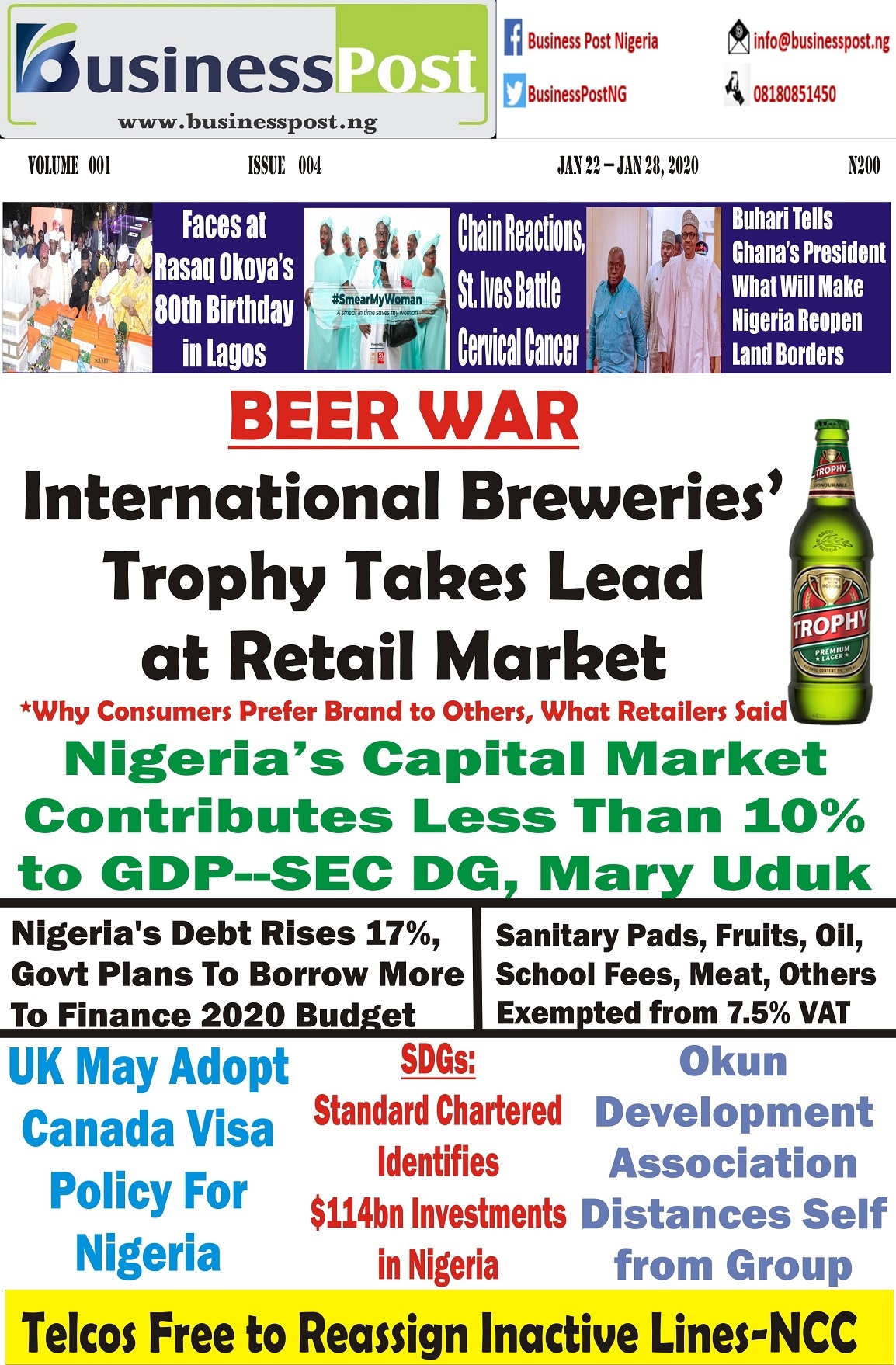
Beer War: International Breweries’ Trophy Takes Lead at Retail Market

By Adedapo Adesanya
Choice drives consumption. This is a hack that most manufacturers know and for a country like Nigeria, where many love their brew, the three major breweries in Nigeria; International Breweries, Nigerian Breweries, and Guinness, produce different categories of the products tailored to suit preferences of many consumers.
Choices are driven by many factors,; some go for their favourite drinks because of the price, some pick quality, and some choose to what to drink based on its sentimental value. But for many, affordability trumps all, and that is why the Big Three in Nigerian beer sector produce different categories of beer brands in two distinct classes – the premium and the low category.
For companies like International Breweries, the makers of Trophy, Budweiser, Castle Lite, Eagle Lager, Hero to mention a few, Trophy has found more appeal in the retail world. As for Nigerian Breweries, which has Gulder, Star, Heineken, Goldberg, Star Lite, 33, Legend among others in its catalogue, it banks on varieties that drinkers get to choose from; while Guinness Nigeria, which has brands like Harp, Guinness, Satzenbrau, and Orijin in the market, has one thing working for it, customer loyalty.
Business Post gathered from a survey it conducted in Lagos that in certain areas, majority of beer consumers are driven mainly by price, which must be low, before thinking of any loyalty to a particular brand, especially since many drinkers vary by age – some have been drinking from a very young age and because they have developed loyalty to a particular brand, it is difficult to switch even when prices are increased, while some have had to make the necessary adjustments to be able to satisfy themselves. However, some relatively young drinkers are more driven by factors like price and even cut down on consumption.
For Mr Olisa Zakariat, the operator of Ema Fine Bar, an establishment founded by his mother in 1987 in the Egbeda area of Lagos State, but has now been inherited by him, Nigerian Breweries has more strength in the market than its counterparts due to the varieties it offers consumers.
“Presently, I cannot say International Breweries sells more than Nigerian Breweries because only one of their products has more advantage than other brands which is Trophy.
“As for Nigerian Breweries, products like Gulder, Heineken, Legend, Turbo King, are consumed here more than any other brands. The only area I am having difficulty with them is Star,” Mr Zakariat told Business Post while sampling his opinion on the beer brands in the retail market and what drive people tp consumer.
He noted that Trophy’s dominance cannot be overlooked and as more people consumed it. According to him, he decided to do a price slash with a Nigerian Breweries’ equivalent, Goldberg, which used to be for N220 at his establishment.
The bar operator said when he brought the price of both brands, Trophy and Goldberg, to the same unit price of N200, he discovered that people started consuming more Goldberg instead of Trophy, making him to conclude that there was lesser push for Trophy, which was still the highest, compared with before. He said this made him to realise that price cannot be overlooked as a major factor if the producers want to compete.
According to him, brands like Heineken (N300) under Nigerian Breweries are pushed more by loyalty rather than price, which he said some consumers consider very expensive, saying only a calibre of people are known to patronise the brand, while some other brands like Guinness (Guinness), Legend and Turbo King (Nigerian Breweries) find appeal because most customers see them as having strong stimulant properties as agreed by many consumers that were asked by this newspaper.
He noted that products of Guinness Nigeria give him more profit per unit price when compared with products from International Breweries and Nigerian Breweries, but stressed when viewed from turnover, he makes more profit than the others because he sells at least a minimum of 10-15 crates of Trophy every three days, which does not happen with Guinness at his bar.
Trophy’s large drive in the market can be attributed to it being marketed as a regional brand, a beer curious tech analyst, Mr Olumuyiwa Oluwagboyega, told Business Post during this research.
He said, “People won’t stop drinking because there’s no money, they’ll find cheaper alternatives.”
For him, he believes brands from International Breweries like Trophy and Hero were marketed as regional beers and that they are something people can relate with. He said Trophy has displaced Star as consumers’ favourite. According to him, Star from Nigerian Breweries used to be the yardstick for beer during his student days, but not anymore.
He noted that Star’s promotion was unrivalled then, as they sponsored music shows and events, but that people, who started drinking beer in the past decade, latched onto more friendly brands, which is why the brand in his opinion had a lesser drive like it did before.
However, according to Mr Bayo Sa’ad, the Branch Manager at Jendol Superstores located at Egbeda, Lagos, as a retail store, people already know what they want and are more driven by brand loyalty, especially for products like Trophy (N230), which is the most sold beer brand at the store. He said to his understanding, Trophy and Star are doing solid numbers based on loyalty.
“No matter what happens, people will stick to their brands. Even when we reduce the price for one particular product, they will just have a taste and still go back to their preferred brand,” he said.
Mr Sa’ad said this has been noticed by makers of these brands and they are making moves, using tool such as branding to push their goods to the top of the consumption chain.
One of such method of branding that has been put in place to push the patronisation of their different brands, according to Mr Godwin, who answered for his boss at one of the many nameless bars found by the roadside in Iyana Ipaja area of Lagos State, is the provision of refrigerators and chillers as well as branded tables and chairs at their establishment.
This, he feels is so because brewery companies know that one way to move their products was not to only satisfy the end user of their products but also keep their brands in the minds of drinkers.
“They are the ones who gave us these chillers. They are responsible for repairing it,” he said.
According to him, Nigerian Breweries has used this system to its advantage to outweigh others like International Breweries and Guinness. He noted that Trophy is the beer that moves most at their establishment, but stressed that other products from the company, International Breweries, are yet to replicate this when peered with Nigerian Breweries products such as Heineken, Goldberg and 33.
For Budweiser, a product of International Breweries, which came into the Nigerian beer market in 2018, Mr Zakariat, the proprietor at Ema Fine Bar, said consumer rarely ask for the drink at his bar, which has made him to stopped stocking the product. He blames this on less promotion in low-income earning areas, where Trophy, from the stable of same company, is king.
However, Mr Zakariat’s view on Budweiser was rubbished by several bartenders of hotels, who spoke with Business Post during this survey conducted between December 2019 and January 2020.
According to a bartender at The Remys Hotel in Gowon Estate, who begged this reporter not to mention his name in the report, Budweiser finds more appeal from women who frequented the establishment due to its light taste compared with other Nigerian Breweries products like Heineken, Star, and Goldberg, which are the most consumed after Trophy.
He described Trophy as the “hot cake” around the area, noting that brands under Guinness Nigeria like Harp and Satzenbrau are less consumed compared to the Guinness varieties. He added that the consumption of Orijin has slowed from when it used to be in high demand.
This was backed up by Miss Wumni, who manages Gemini Hotel in Ipaja Ayobo, from which it was gathered that Trophy was the go-to beer for many in the area. She said the price (N200) was considerate to many, adding that Budweiser (N250) was also largely consumed around there.
Meanwhile, for Mr Francis or as he is popularly known, Alhaji, the sole proprietor of a medium scale bar, Alhaji’s Place, his customers on average are driven by brand loyalty.
He said his loyal customers – those whom he can permit credit sales for – are driven largely by their brand loyalty and as such, price doesn’t move them. Making a case study with one of the such recognised customers, whom he said has a preference for Guinness Extra Stout, he said this customer of his will only consider other brand when Guinness Extra Stout was out of stock, but will quickly switch to his preferred choice whenever it was available.
For him, he wouldn’t as an entrepreneur gauge which brand outperformes the other, but on aggregate, the variety of Nigerian Breweries brands from Gulder to Star to Heineken to Goldberg are all favourites of customers. However, he stressed that Trophy is really doing well at his establishment.


