Economy
Sub-Saharan Africa Could Recover by 2.1% in 2021—World Bank
By Adedapo Adesanya
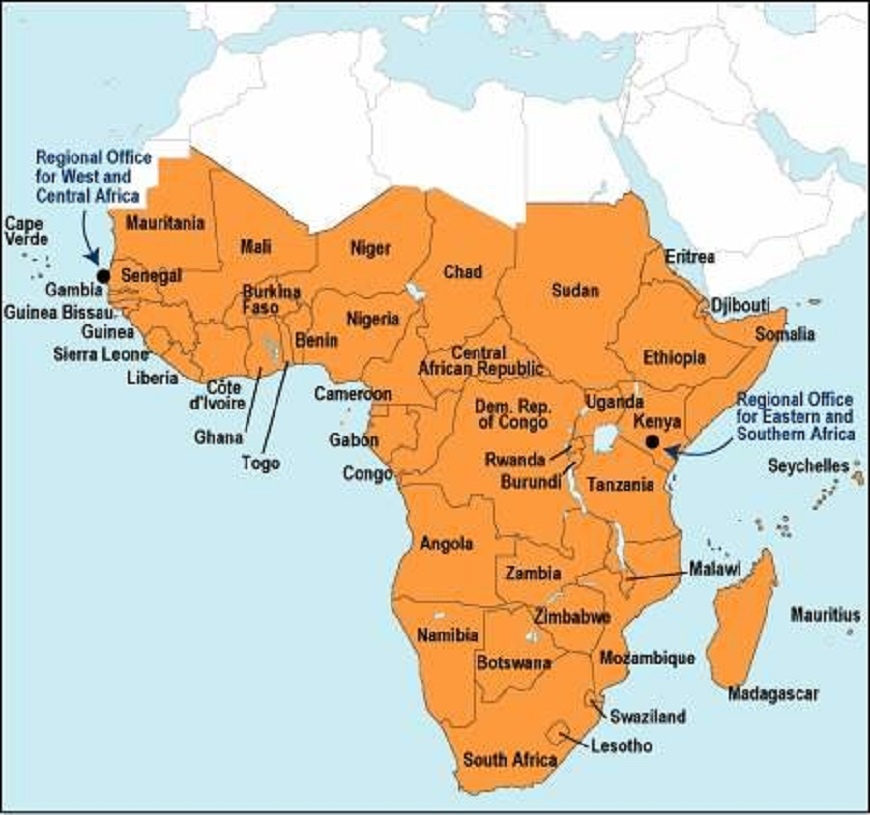
The World Bank has said that Sub-Saharan Africa will reverse an economic contraction next year and could grow by 2.1 per cent as countries in the region begin to ease movement restrictions induced by the coronavirus pandemic.
It, however, noted that the impact of the coronavirus will endure for years to come as many as 40 million people could be pushed into extreme poverty, erasing five years of gains fighting poverty.
The Bretton Wood lender made the disclosure on Thursday, noting that the region’s gross domestic product (GDP) is on track to shrink 3.3 per cent this year as a result of the double-edged sword of the disease and lower oil and commodities prices.
Though it noted that the fallout that rose from the pandemic could be hard to predict, it said the growth of about 2.1 per cent could follow in 2021 and 3.2 per cent in 2022.
It explained that if the outbreak is more prolonged or if there’s a second wave, sub-Saharan Africa’s economy may expand by only 1.2 per cent in 2021 and 2.1 per cent in 2022.
It projected that by the end of 2021, the region’s real per-capita GDP may have regressed to 2007 levels.
The region will lose at least $115 million in output this year and long-term losses are expected with the level of real per-capita GDP expected to contract by 2.1 per cent and 5.1 per cent, confirming earlier forecasts that sub-Saharan Africa will suffer its first recession in a quarter of a century in 2020.
While East Africa and Southern Africa are expected to experience slower growth in 2020 compared with West and Central Africa, their economies may expand faster next year at 2.7 per cent versus 1.3 per cent in West and Central Africa.
The lender noted that oil-exporting countries have been hit hardest, with growth expected to drop by more than 4 per cent in Angola and Nigeria.
It noted that to help alleviate the effect on Africa’s poorest countries, the World Bank and the International Monetary Fund (IMF) have proposed suspending debt servicing this year.
However, that would address only a fraction of total debt, and debt relief from private creditors is likely needed as well, the lender said.
Economy
Naira Weakens to N1,371/$1 at Official Market
By Adedapo Adesanya
The last trading session of the week at the Nigerian Autonomous Foreign Exchange Market (NAFEX) ended on a negative note for the Naira on Friday, May 15, as it lost N15 Kobo or 0.1 per cent against the Dollar to trade at N1,371.04/$1 compared with the previous day’s N1,370.89/$1.
However, it further appreciated against the Pound Sterling in the same market segment yesterday by N20.77 to close at N1,830.61/£1 versus Thursday’s value of N1,851.38/£1, and gained N7.91 against the Euro to settle at N1,595.07/€1 versus N1,602.98/€1.
At the GTBank FX desk, the Naira lost N2 against the US Dollar during the session to sell at N1,383/$1 compared with the preceding session’s N1,381/$1, and at the black market, it remained unchanged at N1,385/$1.
The Naira is forecast to be broadly stable, supported by Dollar sales by the Central Bank of Nigeria (CBN) amid steady, higher oil receipts, with the market settling into a balance.
Policy direction is also expected to give the market some boost as the CBN said the new edition of the FX market guidelines will deepen liquidity, improve transparency and strengthen confidence in the country’s foreign exchange market.
According to the Governor of the CBN, Mr Yemi Cardoso, the update is due to changing global economic realities, domestic reforms and the need for a more coherent and forward-looking regulatory framework. According to him, the last edition of the FX manual was issued in 2018, making the latest review both timely and necessary.
Meanwhile, the cryptocurrency market plunged into the red zone as rising bond yields hit risk assets across markets, while traders are increasingly betting the Federal Reserve may need to raise rates again. Rising energy prices and resurging inflation could force central banks back into tightening mode.
Cardano (ADA) shrank by 4.4 per cent to $0.2557, Dogecoin (DOGE) slid by 3.7 per cent to $0.1104, Ripple (XRP) depreciated by 3.5 per cent to $1.41, Solana (SOL) crashed by 3.5 per cent to $87.81, and Binance Coin (BNB) slumped by 3.4 per cent to $659.64.
Further, Bitcoin (BTC) declined by 2.6 per cent to $78,547.49, Ethereum (ETH) lost 2.1 per cent to quote at $2,209.19, and TRON (TRX) tumbled by 0.7 per cent to $0.3509, while the US Dollar Tether (USDT) and the US Dollar Coin (USDC) traded flat at $1.00 each.
Economy
Oil Prices Jump 3% as Trump, Iran FM’s Comments Raise Tensions
By Adedapo Adesanya
Oil prices gained more than 3 per cent on Friday, after comments by US President Donald Trump and Iran’s foreign minister further dented hopes of a deal.
Brent crude settled at $109.26 a barrel after chalking up $3.54 or 3.35 per cent, and the US West Texas Intermediate (WTI) finished at $105.42 a barrel, up $4.25 or 4.2 per cent. Over the week, Brent has climbed 7.84 per cent and WTI 10.48 per cent on uncertainty over the shaky ceasefire in the Iran war.
President Trump said he was running out of patience with Iran and has agreed with Chinese President Xi Jinping that the Middle East nation cannot be allowed to have a nuclear weapon and must reopen the Strait of Hormuz, which is the waterway where about a fifth of the world’s oil and liquefied natural gas normally passes.
On his part, Iran’s Foreign Minister Abbas Araqchi said on Friday that it does not trust the US and is interested in negotiating only if the US is serious, adding that Iran is prepared to go back to fighting but also prepared for diplomatic solutions.
On the US-China front, while the Chinese President did not directly make a comment on Iran, a statement from the foreign ministry spoke out against the conflict.
Among the deals the market was looking for from the US-China summit, President Trump said China wants to buy oil from the US, also saying he could lift sanctions on Chinese companies that buy Iranian oil.
Iran’s Revolutionary Guards said 30 vessels had crossed the strait between Wednesday evening and Thursday, far from 140 a day that was typical before the war. Two of the 30 vessels that reportedly cleared the Strait of Hormuz earlier this week were tankers, one en route to Japan and the other headed to China.
A prolonged closure of the Strait of Hormuz points toward tighter physical markets, potential refined product shortages, and upward pressure on prices in the coming weeks and months.
Even though the Organisation of the Petroleum Exporting Countries and its allies (OPEC+) announced production increases in recent weeks, traders saw little immediate benefit because many barrels still cannot move efficiently through the Gulf region.
Economy
S&P Upgrades Nigeria’s Credit Rating First Time Since 2012
By Adedapo Adesanya
Nigeria received its first credit rating upgrade since 2012 from S&P Global Ratings, driven by improved oil market conditions and the country’s growing ability to refine and export crude locally.
The credit ratings agency upgraded the country’s rating by one notch to B, five levels below investment grade, according to a statement on Friday.
It raised its long-term foreign and local currency sovereign credit ratings on Nigeria to ‘B’ from ‘B-‘ and affirmed its ‘B’ short-term ratings. It also raised its long- and short-term Nigeria national scale ratings on the sovereign to ‘ngA+/ngA-1’ from ‘ngBBB+/ngA-2’.
S&P also cited Nigeria’s decision to liberalise the exchange rate as crucial to the development, and changed the outlook to stable.
The decision also comes as the federal government ruled out the reintroduction of subsidies on refined petroleum products, in order to avoid a return to larger budgetary deficits and drains on foreign currency (FX) liquidity.
S&P projected the general government deficit will widen to over 4 per cent of GDP on average during 2026 and 2027, a year of a general election.
It added that the implementation of reforms to broaden the tax base from very narrow levels is underpinning a steady decline in Nigeria’s debt-to-revenue ratio to 338 per cent in 2026 versus 500 per cent in 2023.
The agency said it could raise ratings over the next two years if fiscal outcomes improve significantly, either due to fiscal consolidation or structurally higher revenue, resulting in lower debt service costs.
It, however, warned that it could also lower the ratings if the implementation of Nigeria’s reform programme, particularly the series of critical steps taken to liberalise the exchange rate in 2023, reverses.
On the oil production forecast, S&P expects 2026 production to average approximately 1.66 million barrels per day, including condensates.
-
Feature/OPED6 years agoDavos was Different this year
-
Travel/Tourism10 years ago
Lagos Seals Western Lodge Hotel In Ikorodu
-
Showbiz3 years agoEstranged Lover Releases Videos of Empress Njamah Bathing
-
Banking8 years agoSort Codes of GTBank Branches in Nigeria
-
Economy3 years agoSubsidy Removal: CNG at N130 Per Litre Cheaper Than Petrol—IPMAN
-
Banking3 years agoSort Codes of UBA Branches in Nigeria
-
Banking3 years agoFirst Bank Announces Planned Downtime
-
Sports3 years agoHighest Paid Nigerian Footballer – How Much Do Nigerian Footballers Earn