Economy
Firm Builds Gas Plant in Lagos to Deepen LPG Penetration
By Adedapo Adesanya
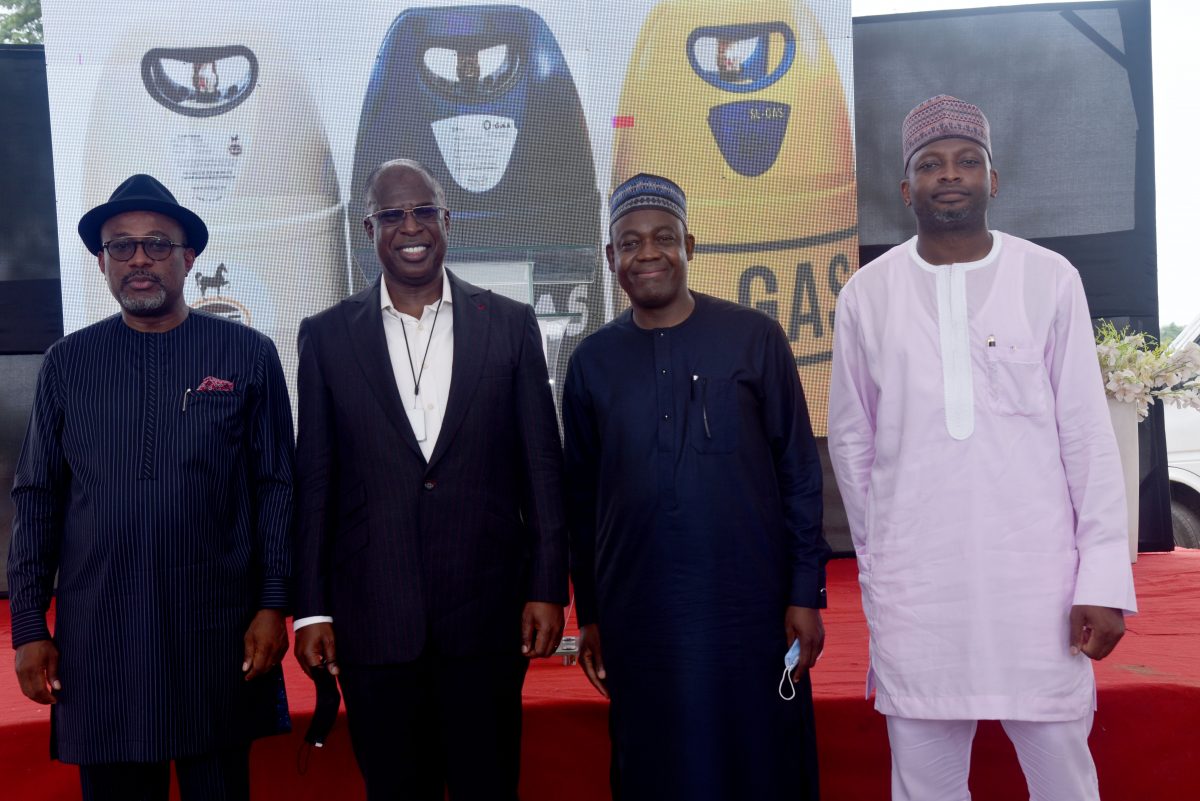
The federal government, in line with its goal to expand its footprint in the manufacturing of Liquified Petroleum Gas (LPG) or cooking gas, over the weekend announced the groundbreaking of Rungas ALFA plant.
The event was performed by the Minister of State for Petroleum Resources, Mr Timipre Sylva, at Alaro City, Free Trade Zone, Epe, Lagos State.
It was gathered that plant, alongside its sister plant – Rungas Prime in Polaku, Bayelsa State, is being developed with equity investments by the Nigerian Content Development and Monitoring Board (NCDMB).
The federal government said upon its completion, the plant will have a combined capacity of over 1.2 million cylinders per annum, surpassing the record held by a European firm that produces 900 cylinders.
The Minister described the cylinder plants as key to achieving deeper penetration of LPG and Compressed Natural Gas (CNG), in line with the Federal Government’s commitment to ensure economic diversification.
He stated that cylinders are the most visible element of the LPG value chain and the manufacturing facilities will not only bring affordable and durable cylinders to Nigeria but also create countless direct and indirect jobs for citizens.
Mr Sylva also commended NCDMB for recording another milestone in the drive to enhance domestic participation and capacity building of indigenous companies in the oil and gas industry.
On his part, the Executive Secretary of NCDMB, Mr Simbi Kesiye Wabote noted that the expected completion date of the facility would be about 12 months and noted that he was confident that the Board will successfully deliver on any project it participates in.
He said the ground-breaking event confirms that Private-Public Partnership is an effective model for putting in place the needed infrastructure, facilities, and manufacturing base, to position Nigeria for the opportunities that abound in the region and continent.
Mr Wabote also affirmed the board’s excitement for being an active participant and a front-runner in taking practical steps to deliver on lofty goals of the ‘’Decade of Gas’’ that is being championed by the Minister of State for Petroleum Resources.
Other interventions by the board in the gas value-chain include the development of LPG storage terminals and jetties, inland gas processing for the production of LPG and propane, infrastructure for gas gathering and injection into gas pipeline networks and CNG facilities.
He said NCDMB was deliberate in going for the Type-3 Composite LPG cylinders considering the unique features such as safety, lightweight, and durability.
In his words, “Our handshake with the Rungas Group will catalyse the transition away from the heavy metallic LPG cylinders. It will also address the issue of high importation of LPG cylinders with the attendant economic losses.”
Other benefits of the project include helping to eliminate deaths and illnesses caused by smoke and wood fumes associated with cooking with firewood and bringing the products closer to end-users.
The NCDMB Chief noted that its interests in equity investments in strategic oil and gas projects were because the Nigerian Oil and Gas Industry Content Development (NOGICD) Act mandates the Board to build capacities in the oil and gas industry and harness opportunities to create jobs.
“You cannot create jobs if you do not get involved in projects. We expect that during the construction phase, hundreds of people will be involved and during the operations phase, direct and indirect jobs will be created. There is no way to create jobs if you do not create the opportunity.
“As a country, we cannot continue to sit and wait for people to bring opportunities for us. We must create those opportunities so we can employ our youths.
“We have proven the concept with regards to a modular refinery and today, the Waltersmith modular refinery cannot even meet demand from customers for its products. Imagine that we had done this in the past; today we would not be discussing the issue of fuel availability or scarcity in this country.”
Also speaking, the Chief Executive Officer, Rungas Group, Mr Lanre Runsewe lauded the NCDMB for triggering the local manufacturing of safe cooking gas cylinders and becoming the catalyst for the rapid industrialisation of gas-based Industries.
He stated that “without the NCDMB initial and extended facilitation for the local manufacture of cooking gas cylinders in Nigeria, it would have been more difficult and expensive to implement the imminent National Gas Expansion Programme (NGEP) rollout, due to lack of locally manufactured safe cylinders. The country would have had to resort to importation.”
He also revealed that NCDMB’s participation and the substantial quantity of cylinders to be manufactured had “triggered a clause in our contractual agreements based on one million cylinders with our Italian, Portuguese Original Equipment Manufacturers which will result in direct investments of over $40 million to produce some of our key raw materials in Nigeria. We are currently working in conjunction with our Alaro City Partners to position them in this Free Trade Zone.”
The Chairman, Rungas Group, Mr Shuaibu Ahmed added the facility in Bayelsa was Africa’s first composite cylinder manufacturing plant and expressed hope that the facilities would produce enough products to meet local demand and export to other countries, earning the nation much needed foreign exchange.
Economy
Nigeria’s Gold Holdings Rise to $3.5bn as CBN Diversifies Reserves
By Adedapo Adesanya
The Central Bank of Nigeria (CBN) said it has taken delivery of responsibly sourced gold refined to London Bullion Market Association (LBMA) Good Delivery standards into its foreign reserves, as part of its reserves diversification strategy.
The gold, sourced in Nigeria and aggregated by the Solid Minerals Development Fund (SMDF) through the National Gold Purchase Programme (NGPP), brings the CBN’s total gold holdings to $3.5 billion.
According to the CBN, the programme involves local miners and operates within a responsible sourcing framework aligned with the Organisation for Economic Co-operation and Development (OECD) Due Diligence Guidelines and the World Gold Council’s London Principles.
Speaking at the one-day Workshop on Strategies to Maximise the Economic Benefits of Minerals in Nigeria, the Governor of the apex bank, Mr Yemi Cardoso, disclosed that the lender acquired the monetary-grade gold in Naira at pricing linked to LBMA benchmarks, a structure designed to preserve Nigeria’s foreign exchange holdings while strengthening the nation’s gold reserves.
By purchasing domestically refined gold without deploying foreign currency, he said, the transaction enhances reserve accretion and supports broader macroeconomic stability objectives. Highlighting major shifts in global reserve management strategies, the CBN Governor noted their increasing importance amid rising global economic uncertainties.
He described the event as a reflection of Nigeria’s shared commitment to responsible and strategic management of its mineral resources. He emphasised that the workshop underscores the nation’s readiness to adapt to the realities of an evolving global economy, where resilience, diversification, and prudent governance have become increasingly vital.
He further explained that the session, convened by the CBN’s Corporate Secretariat and Reserve Management Departments, was designed to create a structured platform for engagement with key players in the gold sector and to deepen understanding of the industry’s current landscape, opportunities, and challenges across its value chain.
The governor noted that central banks around the world are prioritising economic resilience amid persistent geopolitical and market uncertainties.
He said gold has regained importance as a hedge against inflation and volatility, while other critical minerals are increasingly shaping global supply chains and advanced industrial development
Mr Cardoso emphasised that Nigeria’s immense natural and human resource potential can only be fully realised through prudence, strategic coordination, and long-term planning. He highlighted the need for strict adherence to internationally recognised standards, stressing that institutional credibility depends on strong governance frameworks.
On her part, the Executive Secretary of the Solid Minerals Development Fund (SMDF), Mrs Fatima Umaru Shinkafi, highlighted that the successful delivery of LBMA standard gold demonstrates the strength of the organisation’s formalisation framework and supply chain due diligence processes.
The World Gold Council’s Director of Central Banks and Public Policy, Ms Kurtulus Taskale Diamondopoulos, commended both the CBN and SMDF for designing the Nigerian Gold Purchase Programme (NGPP) in line with the twelve London Principles for responsible artisanal and small-scale gold sourcing.
She noted that the partnership between the CBN as sole off-taker and the SMDF as fiscal and supply chain manager offers a strong model for other countries seeking to strengthen similar programmes.
The President and CEO of the Africa Finance Corporation (AFC), Ms Samaila Zubairu, reaffirmed AFC’s commitment to financing and formalising Nigeria’s mineral sector, stressing the importance of accurate data and mineral processing infrastructure to attract investment, improve gold recovery, reduce environmental impact and support central bank purchases.
Also speaking, the Executive Vice Chairman of Kian Smith Gold Company, Ms Nere Emiko, underscored the urgent need for Nigeria to build strategic gold reserves and leverage commodity exchanges, noting the country’s low reserve levels relative to peers and calling for greater investment in exploration and transparency.
The Domestic Gold Purchase Programme forms part of the central bank’s broader strategy to enhance reserve quality, reduce external vulnerabilities, and position Nigeria’s mineral wealth as a pillar of long-term economic stability.
Economy
Nigeria Generate N2.96trn from CIT, N2.28trn from VAT In Q3 2025
By Adedapo Adesanya
Nigeria generated N2.96 trillion from company income tax (CIT) in the third quarter of 2025, according to the latest data released by the National Bureau of Statistics (NBS).
The Q3 figure shows an increase of 6.55 per cent on a quarter-on-quarter basis from N2.78 trillion in Q2 2025.
The NBS data revealed that domestic CIT received was N1.21 trillion, while foreign CIT payment was N1.75 trillion in Q3 2025.
The rise came ahead of the January implementation of the tax reform, which analysts said could significantly increase tax revenue. The government hopes to leverage the reform to significantly increase the tax revenue.
On a quarter-on-quarter basis, arts, entertainment and recreation activities recorded the highest growth rate with 41.98 per cent; followed by accommodation and food service activities, and mining and quarrying with 37.11 per cent and 15.36 per cent, respectively.
On a year-on-year basis, CIT collections in Q3 2025 increased by 67.19 per cent from Q3 2024.
On the other hand, activities of households as employers, undifferentiated goods- and services-producing activities of households for own use recorded the least with –83.88 per cent, followed by Financial and insurance activities (–79.72 per cent) and construction (–66.52 per cent).
In terms of Value Added Tax (VAT), collections also rose sharply, reaching N2.28 trillion in Q3 2025 from N1.77 trillion in the same quarter of the previous year, the NBS report showed.
VAT grew by 10.66 per cent quarterly from N2.06 trillion recorded in Q2 2025, driven largely by manufacturing, information and communication and mining/quarrying.
A breakdown of the N2.28 trillion generated in Q3 showed that local payments accounted for N1.12 trillion. Foreign VAT payments stood at N680.23 billion, while import VAT contributed N479.79 billion.
Sectoral analysis revealed that manufacturing recorded the largest share of VAT at 25.89 per cent in Q3 2025. Information and communication followed at 18.77 per cent, while mining and quarrying accounted for 14.85 per cent.
Together, the three sectors contributed more than half of the total VAT generated in the quarter.
In terms of growth performance, administrative and support service activities recorded the highest quarter-on-quarter increase at 89.28 per cent.
Arts, entertainment and recreation followed with 82.49 per cent growth, while human health and social work activities rose by 32.4 per cent.
However, not all sectors recorded gains. Real estate activities posted the sharpest decline, contracting by 51.33 per cent quarter on quarter.
Activities of households as employers and undifferentiated goods and services producing activities of households for own use fell by 36.22 per cent, while other service activities dropped by 20.3 per cent.
The report noted that activities of households as employers and undifferentiated goods and services producing activities of households for own use recorded the lowest VAT share at 0.003 per cent.
This was followed by activities of extraterritorial organisations and bodies, and water supply, sewerage and waste management, which accounted for 0.03 per cent each.
Overall, the year-on-year comparison shows a striking rebound in both corporate and consumption-based tax revenues, signalling stronger taxable activities and improving compliance across key sectors of the Nigerian economy.
Economy
NASD Unlisted Security Index Climbs 0.88%
By Adedapo Adesanya
The NASD Over-the-Counter (OTC) Securities Exchange maintained its upward trajectory with a further 0.88 per cent rise on Wednesday, March 3.
The expansion increased the NASD Unlisted Security Index (NSI) by 36.94 points to 4,256.41 points from 4,219.47 points, and lifted the market capitalisation by N22.10 billion to N2.546 trillion from Tuesday’s N2.524 trillion.
The six price gainers were responsible for the growth achieved by the unlisted securities market yesterday, with MRS Oil Plc adding N20.00 to trade at N230.00 per unit versus the previous day’s N210.00 per share.
Further, FrieslandCampina Wamco Nigeria Plc surged by N11.07 to N128.83 per share from N117.76 per share, Lagos Building Investment Company (LBIC) Plc grew by 37 Kobo to N4.12 per unit from N3.75 per unit, First Trust Mortgage Bank Plc advanced by 19 Kobo to N2.11 per share from N1.92 per share, Acorn Petroleum Plc rose by 1 Kobo to sell at N18.75 per unit versus the preceding day’s N18.74 per unit, and Acorn Petroleum Plc also gained 1 Kobo rise to sell at N1.35 per share versus N1.34 per share.
It was observed that two securities were in red at midweek, with Central Securities Clearing System (CSCS) Plc down by N1.56 to N82.59 per unit from N84.05 per unit, and Industrial and General Insurance (IGI) Plc down by 2 Kobo to 47 Kobo per share from 49 Kobo per share.
Yesterday, the volume of trades went up by 86.2 per cent to 2.6 million units from 1.4 million units, but the value of transactions deflated by 31.4 per cent to N64.1 million from N93.4 million, and the number of deals declined by 22.0 per cent to 46 deals from 59 deals.
CSCS Plc remained the most traded stock by value (year-to-date) with 36.4 million units valued at N2.2 billion, trailed by Okitipupa Plc with 6.3 million units traded for N1.1 billion, and Geo-Fluids Plc with 122.8 million units transacted for N480.4 million.
Resourcery Plc ended the day as the most traded stock by volume (year-to-date) with 1.05 billion units sold for N408.7 million, followed by Geo-Fluids Plc with 122.8 million units traded for N480.4 million, and CSCS Plc with 36.4 million units worth N2.2 billion.
-
Feature/OPED6 years agoDavos was Different this year
-
Travel/Tourism10 years ago
Lagos Seals Western Lodge Hotel In Ikorodu
-
Showbiz3 years agoEstranged Lover Releases Videos of Empress Njamah Bathing
-
Banking8 years agoSort Codes of GTBank Branches in Nigeria
-
Economy3 years agoSubsidy Removal: CNG at N130 Per Litre Cheaper Than Petrol—IPMAN
-
Banking3 years agoSort Codes of UBA Branches in Nigeria
-
Banking3 years agoFirst Bank Announces Planned Downtime
-
Sports3 years agoHighest Paid Nigerian Footballer – How Much Do Nigerian Footballers Earn