Connect with us

Economy

Senate Moves to Protect Local Retail Business Owners

Published

on

Senate Passes 2020 Budget

By Adedapo Adesanya

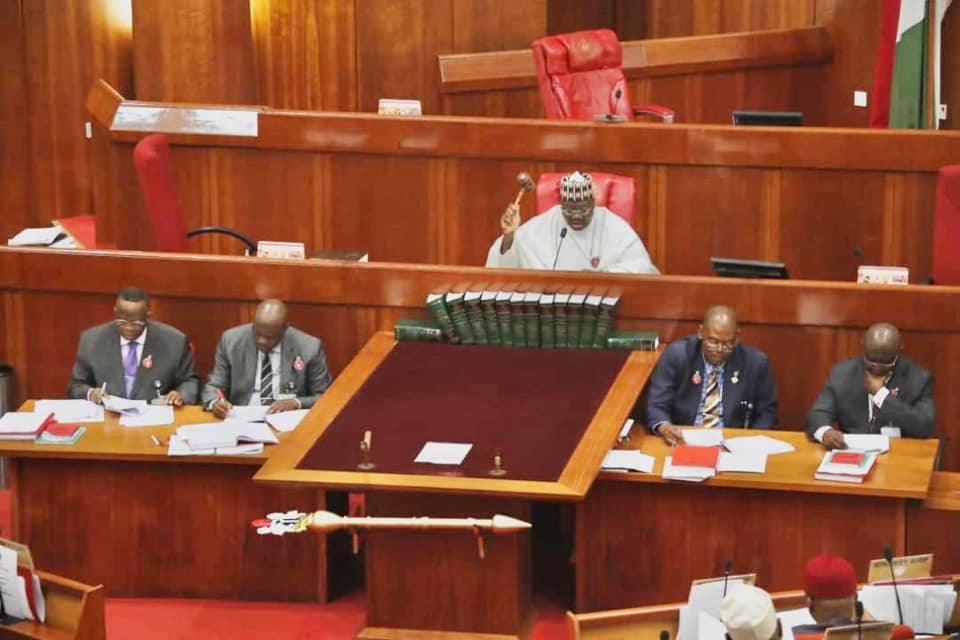
The Nigerian Senate has taken a step to protect local retail business owners, who are getting threatened by the dominance of foreigners.

To achieve this goal, the upper chamber of the National Assembly is reviewing the Indigenous Act and it has charged its Committee on Trade and Investment to look into the matter critically.

In addition, the red arm of the parliament said it will also review other extant policies and institute a legal framework that will provide incentives and protect indigenous retail business investors in the country’s organised sector.

The decision to take this step followed a motion by Senator Ifeanyi Ubah, which called the attention of the legislative arm of government to the “urgent need to investigate the economic and security implication of an unregulated Nigerian retail sector and consider appropriate legislative measures to incentivize and protect indigenous retail traders.”

The Senate called on governments at all levels to put in place acceptable measures to protect traditional or open markets retailers to avoid contravention of environmental and health safety standards, promote revenue collection and prevent harassment constant disruption of retail trade activities by government revenue collectors or environmental and health enforcement officers.

It further mandated its committee on Trade and Investment to engage the Ministry of Trade and investment and other relevant stakeholders with a view to receiving a briefing on the extant policy and legal framework on retail trade in Nigeria and the protection offered to indigenous retail investors and report back within two weeks.

The Senate also asked the committee to engage local retailers on ways to further protect their interests as well as invite foreign retailers to ascertain their legal status.

Mr Ubah in his lead debate noted that the Nigerian retail sector remains unregulated with dire economic and security implications.

He said the Chinese, Indians and Lebanese companies have taken over the retail business from indigenous retailers in markets like Balogun Market, Trade Fair, ASPAMDA, Alaba, Coker, Computer Village, Dei -Dei Market, among others.

He said the foreign investors have shifted from production and wholesaling to retailing, observing that since independence, Nigerian retail businesses have been offering employment to Nigerians and generating revenue to the government via taxes.

He further said many African countries, including ECOWAS member states, such as Ghana, have policies and legislative measures in place to offer minimum protection to indigenous retail traders.

He argued that extant policies and legal frameworks at both national and sub-regional levels do not offer any minimum protection to indigenous retail business operators.

He said the implication was that the organised retail business in Nigeria made up of multiple branch supermarkets, shopping malls were dominated by foreigners through their popular retail outlets.

He expressed concern that if measures were not taken via the enactment of extant protective laws and policies, foreigners may continue to dominate the sector.

Seconding the motion, Mr Francis Fadahunsi, while congratulating the sponsor of the motion, frowned at the domination of the nation’s retail markets by foreign investors saying that government has to take steps to check such anomaly.

The Senate in its further resolutions on the motion called on governments at all levels to put in place acceptable measures to protect traditional or open market retailers to avoid contravention of environmental and health safety standards.


Adedapo Adesanya is a journalist, polymath, and connoisseur of everything art. When he is not writing, he has his nose buried in one of the many books or articles he has bookmarked or simply listening to good music with a bottle of beer or wine. He supports the greatest club in the world, Manchester United F.C.

Advertisement
Click to comment

Leave a Reply

Your email address will not be published. Required fields are marked *

Economy

Oil Prices Climb on Worries of Possible Iran-US Conflict

Published

on

Crude Oil Prices

By Adedapo Adesanya

Oil prices settled higher on Friday as traders worried that this week’s talks between the US and Iran had failed to reduce the risk of a military conflict between the two countries.

Brent crude futures traded at $68.05 a barrel after going up by 50 cents or 0.74 per cent, and the US West Texas Intermediate (WTI) crude futures finished at $63.55 a barrel due to the addition of 26 cents or 0.41 per cent.

Iran and the US held negotiations in Muscat, the capital of Oman, on Friday to overcome sharp differences over Iran’s nuclear programme.

It was reported that the talks had ended with Iran’s foreign minister saying negotiators will return to their capitals for consultations and the talks will continue.

Regardless, the meeting kept investors anxious about geopolitical risk, as Iran wanted to stick to nuclear issues while the US wanted to discuss Iran’s ballistic missiles and support for armed groups in the region.

Any escalation of tension between the two nations could disrupt oil flows, since about a fifth of the world’s total consumption passes through the Strait of Hormuz between Oman and Iran.

Saudi Arabia, the United Arab Emirates, Kuwait and Iraq export most of their crude via the strait, as does Iran, which is a member of the Organisation of the Petroleum Exporting Countries (OPEC).

According to Reuters, Iran objected to the presence of any US Central Command (CENTCOM) or other regional military officials, saying that would jeopardise the process.

The current confrontation was sparked by more than two weeks of unrest in Iran that saw authorities launch a deadly crackdown that killed thousands of civilians and shocked the world. As reports of the deaths trickled out of Iran, US President Donald Trump threatened to strike Iran if any of the tens of thousands of protesters arrested were executed.

Meanwhile, Kazakhstan’s planned oil exports could fall by as much as 35 per cent this month via its main route through Russia, as the country’s top oil company, Tengiz oilfield, slowly recovers from fires at power facilities in January.

ING analysts have pointed out Iran’s neighbour, Iraq, and a disagreement with the US as another bullish factor for oil prices. It seems Iraqi politicians favour Mr Nouri al-Maliki as the country’s next Prime Minister, but the US thinks Mr al-Maliki is too close to Iran. President Trump has already threatened the oil producer with consequences if he emerges as PM.

Continue Reading

Economy

Adedeji Urges Nigeria to Add More Products to Export Basket

Published

on

nigeria Export Basket

By Adedapo Adesanya

The chairman of the Nigeria Revenue Service (NRS), Mr Zacch Adedeji, has urged the country to broaden its export basket beyond raw materials by embracing ideas, innovation and the production of more value-added and complex products

Mr Adedeji said this during the maiden distinguished personality lecture of the Faculty of Administration, Obafemi Awolowo University (OAU), Ile-Ife, Osun State, on Thursday.

The NRS chairman, in the lecture entitled From Potential to Prosperity: Export-led Economy, revealed that Nigeria experienced stagnation in its export drive over three decades, from 1998 to 2023, and added only six new products to its export basket during that period.

He stressed the need to rethink growth through the lens of complexity by not just producing more of the same stuff, lamenting that Nigeria possesses a high-tech oil sector and a low-productivity informal sector, as well as lacking “the vibrant, labour-absorbing industrial base that serves as a bridge to higher complexity,” he said in a statement by his special adviser on Media, Dare Adekanmbi.

Mr Adedeji urged Nigeria to learn from the world by comparative studies of success and failure, such as Vietnam, Bangladesh, Indonesia, South Africa, and Brazil.

“We are not just looking at numbers in a vacuum; we are looking at the strategic choices made by nations like Vietnam, Indonesia, Bangladesh, Brazil, and South Africa over the same twenty-five-year period. While there are many ways to underperform, the path to success is remarkably consistent: it is defined by a clear strategy to build economic complexity.

“When we put these stories together, the divergence is clear. Vietnam used global trade to build a resilient, complex economy, while the others remained dependent on natural resources or a single low-tech niche.

“There are three big lessons here for us in Nigeria as we think about our roadmap. First, avoiding the resource curse is necessary, but it is not enough. You need a proactive strategy to build productive capabilities,” he stated, adding that for Nigeria, which is at an even earlier stage of development and even less diversified than these nations, the warning is stark.

“Relying solely on our natural endowments isn’t just a path to stagnation; it’s a path to regression. The global economy increasingly rewards knowledge and complexity, not just what you can dig out of the ground. If we want to move from potential to prosperity, we must stop being just a source of raw materials and start being a source of ideas, innovation, and complex products,” the taxman stated.

He added that President Bola Tinubu has already begun the difficult work of rebuilding the economy, building collective knowledge to innovate, produce, and build a resilient economy.

Continue Reading

Economy

Nigeria Inaugurates Strategy to Tap into $7.7trn Global Halal Market

Published

on

Halal Market

By Adedapo Adesanya

President Bola Tinubu on Thursday inaugurated Nigeria’s National Halal Economy Strategy to tap into the $7.7 trillion global halal market and diversify its economy.

President Tinubu, while inaugurating the strategy, called for disciplined, inclusive, and measurable action for the strategy to deliver jobs and shared prosperity across the country.

Represented by Vice-President Kashim Shettima, he described the unveiling of the strategy as a signal of Nigeria’s readiness to join the world in grabbing a huge chunk of the global halal economy already embraced by leading nations.

“As well as to clearly define the nation’s direction within the market, is expected to add an estimated $1.5 billion to the nation’s Gross Domestic Product (GDP) by 2027. It is with this sense of responsibility that I formally unveil the Nigeria National Halal Economy Strategy.

“This document is a declaration of our promise to meet global standards with Nigerian capacity and to convert opportunity into lasting economic value. What follows must be action that is disciplined, inclusive, and measurable, so that this Strategy delivers jobs, exports, and shared prosperity across our nation.

“It is going to be chaired by the supremely competent Minister of Industry, Trade and Investment.”

The president explained that the halal-compliant food exports, developing pharmaceutical and cosmetic value chains would position Nigeria as a halal-friendly tourism destination, and mobilising ethical finance at scale,” by 2030.

“The cumulative efforts “are projected to unlock over twelve billion dollars in economic value.

“While strengthening food security, deepening industrial capacity, and creating opportunities for small-and-medium-sized enterprises across our states,” he added.

Allaying concerns by those linking the halal with religious affiliation, President Tinubu pointed out that the global halal economy had since outgrown parochial interpretations.

“It is no longer defined solely by faith, but by trust, through systems that emphasise quality, traceability, safety, and ethical production. These principles resonate far beyond any single community.

“They speak to consumers, investors, and trading partners who increasingly demand certainty in how goods are produced, financed, and delivered. It is within this broader understanding that Nigeria now positions itself.”

Tinubu said many advanced Western economies had since “recognised the commercial and ethical appeal of the halal economy and have integrated it into their export and quality-assurance systems.”

President Tinubu listed developed countries, including the United Kingdom, France, Germany, the Netherlands, the United States, Canada, Australia, and New Zealand.

“They are currently among the “leading producers, certifiers, and exporters of halal food, pharmaceuticals, cosmetics, and financial products.”

He stated that what these developed nations had experienced is a confirmation of a simple truth, that “the halal economy is a global market framework rooted in standards, safety, and consumer trust, not geography or belief.”

The president explained that the Nigeria national halal economy strategy is the result of careful study and sober reflection.

He added that it was inspired by the commitment of his administration of “to diversify exports, attract foreign direct investment, and create sustainable jobs across the federation.

“It is also the product of deliberate partnership, developed with the Halal Products Development Company, a subsidiary of the Saudi Public Investment Fund.

“And Dar Al Halal Group Nigeria, with technical backing from institutions such as the Islamic Development Bank and the Arab Bank for Economic Development in Africa.”

The Minister of Industry, Trade and Investment, Mrs Jumoke Oduwole, said the inauguration of the strategy was a public-private collaboration that has involved extensive interaction with stakeholders.

Mrs Oduwole, who is the Chairperson, National Halal Strategy Committee, said that the private sector led the charge in ensuring that it is a whole-of-government and whole-of-country intervention.

The minister stressed that what the Halal strategy had done for Nigeria “is to position us among countries that export Halal-certified goods across the world.

The minister said, “We are going to leverage the African Continental Free Trade Area (AfCFTA) to ensure that we export our Halal-friendly goods to the rest of Africa and beyond to any willing markets; participation is voluntary. “

She assured that as the Chairperson, her ministry would deliver on the objectives of the strategy for the prosperity of the nation.

The Chairman of Dar Al-Halal Group Nigeria L.td, Mr Muhammadu Dikko-Ladan, explained that the Halal Product Development Company collaborated with the group in developing the strategy.

“In addition to the strategy, an export programme is underway involving the Ministry of Trade and Investment, through which Nigerian companies can be onboarded into the Saudi Arabian market and beyond.£

Mr Dikko-Ladan described the Strategy as a landmark opportunity for Nigeria, as it creates market access and attracts foreign direct investment.

Continue Reading

Trending