General
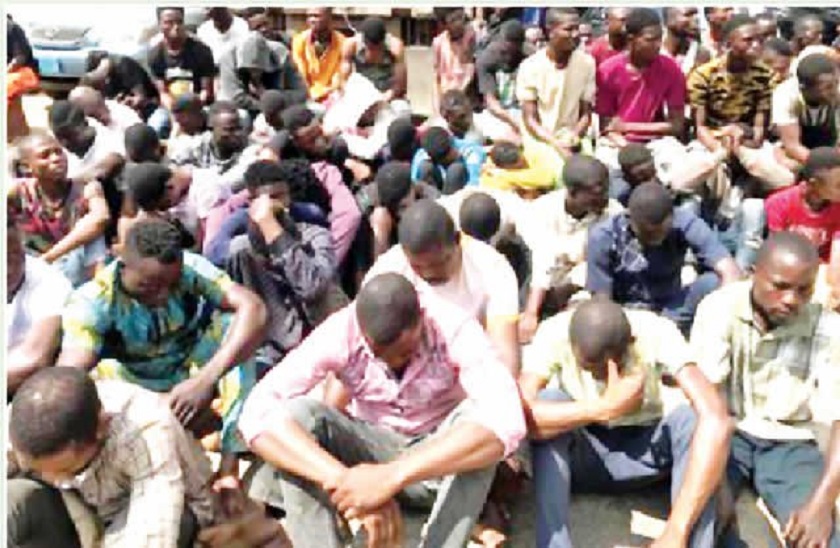
Judge Tells Law Enforcement Agencies to Stop Parading Suspects
By Sodeinde Temidayo David
The law enforcement agencies in Nigeria have been warned to stop parading suspects within the jurisdiction of the Enugu State High Court.
This caution was made by a jurist of the state high court, Mr Cyprian Ajah, at the ongoing three-day training on the Implementation of Administration of Criminal Justice Act (ACJA), 2015 and Human Rights for Officials of Nigerian Correctional Service, Nigeria Police Force and Judiciary in Enugu.
According to the judge, parading suspects goes against fair hearing and the good ethics of the court.
Mr Ajah noted that parading suspects, even when they are seen in the face of the law as innocent, was equivalent to a media trial, which is unfair as it could result in mental torture for accused persons.
As stated by him, parading a suspect or the media trial of a suspect endangers the chances of the suspect getting a fair hearing in the minds of right-thinking members of the public.
The judge noted that the media trial ends up as a psychological torment to the suspect, especially if he is finally proved innocent by the court.
He added that mental torture was deeper and last longer than physical torture, noting that the constitution believes every accused person is innocent until proved guilty from the point of the law.
From his statement, when a person is presented before the public or displayed through the television, radio and newspapers, the public sees such person as a criminal and most times are treated as one.
The law interpreter stated that when the person undergoes court trial and is discharged and acquitted, there will be no opportunity of parading him again to say that he is innocent.
This, as a result, gives no opportunity for the change of face has the public have labelled a suspect to be a criminal.
“The innocent person in question continues to suffer torment and mental torture throughout his lifetime and become a subject of humiliation and scorn even among his own people,” he said.
Mr Ajah further stated that situations like these were unfair, which is bad as the constitution and the laws of the land are wholly against all forms of media and the sensational trial of any suspects outside the court.
He also called for a functional record system within offices of law enforcement agencies and courts in order to properly track activities of criminal elements in the society
Also at the event, the federal government was urged to increase the number of police personnel, adding that having a police strength of about 400,000 in the face of over 200 million people was grossly inadequate.
General
SERAP Sues NNPC Over Missing N22.3bn, $49.7m, £14.3m, €5.2m Oil Funds
By Adedapo Adesanya
The Socio-Economic Rights and Accountability Project (SERAP) has filed a lawsuit against the Nigerian National Petroleum Company (NNPC) Limited over its failure to account for the alleged missing or diverted N22.3 billion, $49.7 million, £14.3 million and €5.2 million oil funds.
Disclosing this in a statement on Sunday, SERAP Deputy Director, Mr Kolawole Oluwadare, said the suit followed the damning allegations documented in the 2022 audited report by the Auditor-General of the Federation, which was published on 9 September 2025.
The suit was filed last Friday at the Federal High Court in Abuja, with the organisation seeking “an order of mandamus to direct and compel the NNPCL to account for the alleged missing or diverted N22.3 billion, $49.7 million, £14.3 million, and €5.2 million oil money.”
It also asked the court to “direct and compel the NNPCL to disclose the specific financial transactions carried out in respect of the alleged missing or diverted N22.3 billion, $49.7 million, £14.3 million and €5.2 million oil money, including details of disbursement, the contractors, and other individuals who collected the money.”
“The diverted or misappropriated oil revenues reflect a failure of NNPCL accountability more generally and are directly linked to the institution’s continuing failure to uphold the principles of transparency and accountability,” SERAP argued, noting that, “Granting the reliefs sought would strike a blow against the impunity of those responsible for the missing or diverted oil money, and ensure that the money is returned for the sake of NNPCL’s victims—Nigerians.”
“The allegations have also undermined the economic development of the country, trapped the majority of Nigerians in poverty and deprived them of opportunities.
“The Auditor-General has for many years documented reports of disappearance of oil money from the NNPCL. Nigerians continue to bear the brunt of these missing oil money meant to provide essential public services for Nigerians,” it added.
SERAP is also arguing that, “Combating the corruption epidemic in the oil sector would alleviate poverty, improve access of Nigerians to basic public goods and services, and enhance the ability of the government to meet its human rights and anti-corruption obligations.”
General
Minister Advocates Coordinated, Trust-Driven Government Communication
By Aduragbemi Omiyale
The Minister of Information and National Orientation, Mr Mohammed Idris, has emphasised that unified government messaging remains very critical to restoring public trust, especially in delivering the Renewed Hope Agenda of President Bola Tinubu.
He said this on Thursday in Abuja at an interactive session with Directors of Information and Resident Information Officers (RIOs) on grade level 14-17, deployed across Ministries, Departments and Agencies (MDAs).
The event, according to a statement issued on Friday by the Director Public Relations and Protocol of the ministry, Mr Suleiman Haruna, was themed Aligning Public Information with the Renewed Hope Agenda: Rebuilding Trust Through Effective, Transparent Communication.
The Minister noted that government officials must adopt a unified, coordinated, and trust-driven approach to government communication.
He posited that public trust remains the most valuable asset of government communication, stressing that information officers must be guided by honesty, credibility, and consistency in their work.
“Public trust is our most important capital. Once credibility is lost, no amount of messaging can fix it,” the Minister said, warning that fragmented messaging and parallel communication channels weaken government credibility and confuse citizens, insisting that the government must speak with a single, clear, and consistent voice.
“We are one government serving one national interest, and our communication must reflect that unity,” he said.
Mr Idris urged Resident Information Officers to see themselves as active partners within their host MDAs rather than passive observers, encouraging them to engage proactively with Ministers, Permanent Secretaries, and agency leadership, noting that professionalism, relevance, and initiative are key to earning trust and influence.
Addressing the growing pressure of misinformation and the speed of digital media, the founder of Blueprint Newspaper stressed the importance of timely and accurate communication, noting that delays often create space for false narratives. While reaffirming the federal government’s commitment to freedom of expression, he said such freedom must be exercised responsibly.
The Minister also outlined steps being taken to strengthen professionalism within the information cadre, including mandatory periodic reporting, improved deployment processes, continuous training, and stronger institutional support. He disclosed that the Federal Government has begun restoring the National Institute of Public Information to boost capacity building for public communicators.
He called for teamwork and mutual respect, reminding participants that they are central to the projection of government policies and achievements and that they must align their work with the priorities of the Renewed Hope Agenda.
General
Senate Forms Seven-Man Committee to Harmonise Electoral Act Amendment Bill
By Adedapo Adesanya
The Senate has constituted a seven-man committee to harmonise contributions and opinions on the Electoral Act Amendment Bill, 2026, with a mandate to present a consolidated report to the chamber next Tuesday.
The decision followed over two hours of consideration of the bill’s provisions during a closed-door session on Thursday.
The committee is chaired by the Chairman of the Senate Committee on Judiciary, Human Rights and Legal Matters, Mr Niyi Adegbomore.
Other members are Senators Adamu Aliero, Aminu Tambuwal, Adams Oshiomhole, Danjuma Goje, Tony Nwoye, and Titus Zam.
The group has three days to conclude its assignment and submit its report for consideration at the next plenary session scheduled for next week.
The Senate on Thursday commenced consideration of the Electoral Act 2022 (Repeal and Re-enactment) Bill 2026, moving into a closed-door session to review documents submitted by the Chairman of the Senate Committee on Electoral Matters, Mr Simon Lalong.
The Electoral Act (Repeal and Enactment) Bill, 2025 would expand voter participation, safeguard against electoral fraud, and strengthen institutional capacity of the Independent National Electoral Commission (INEC).
The closed session was convened to allow lawmakers to thoroughly examine the proposed amendments and supporting documents before engaging in further legislative debate on the bill.
This development comes after the upper chamber deferred consideration of the bill on Wednesday, giving lawmakers time to prepare for a detailed review.
Although the House of Representatives has already passed the bill, Senate President Senator Godswill Akpabio underscored the need for thorough scrutiny, given the bill’s implications for the nation’s electoral process.
“This is a very important bill, especially as it is election time. We must take our time to ensure justice is done to all, so that we do not end up at the tribunal,” he said.
According to the committee’s findings, a clause-by-clause analysis of the bill indicates that enacting the legislation would leave Nigerians with an enduring legacy of electoral integrity, enhance transparency, and boost public confidence.
The bill contains more than 20 key innovations distinguishing it from previous electoral frameworks, including provisions recognising the voting rights of prisoners and mandating INEC to register eligible inmates in correctional facilities nationwide.
It also prescribes sanctions for vote-buying ranging from a fine of N5 million to a two-year jail term, as well as a 10-year ban from contesting elections. It also recommends mandatory jail terms and higher fines for offences such as result falsification and obstruction of election officials.
Others include standardising delegates for indirect party primaries to prevent arbitrary determination of delegate criteria by party leaders, while addressing perennial funding challenges to the Independent National Electoral Commission (INEC) by mandating the release of election funds at least one year before polling day.
-
Feature/OPED6 years agoDavos was Different this year
-
Travel/Tourism9 years ago
Lagos Seals Western Lodge Hotel In Ikorodu
-
Showbiz3 years agoEstranged Lover Releases Videos of Empress Njamah Bathing
-
Banking8 years agoSort Codes of GTBank Branches in Nigeria
-
Economy3 years agoSubsidy Removal: CNG at N130 Per Litre Cheaper Than Petrol—IPMAN
-
Banking3 years agoSort Codes of UBA Branches in Nigeria
-
Banking3 years agoFirst Bank Announces Planned Downtime
-
Sports3 years agoHighest Paid Nigerian Footballer – How Much Do Nigerian Footballers Earn