Connect with us

Banking

Banks Unlikely to Declare Huge Profits in 2019—Coronation Research

Published

on

By Dipo Olowookere

An arm of Coronation Asset Management Limited, Coronation Research, has said banks operating in Nigeria are unlikely to post large gains in profits this year.

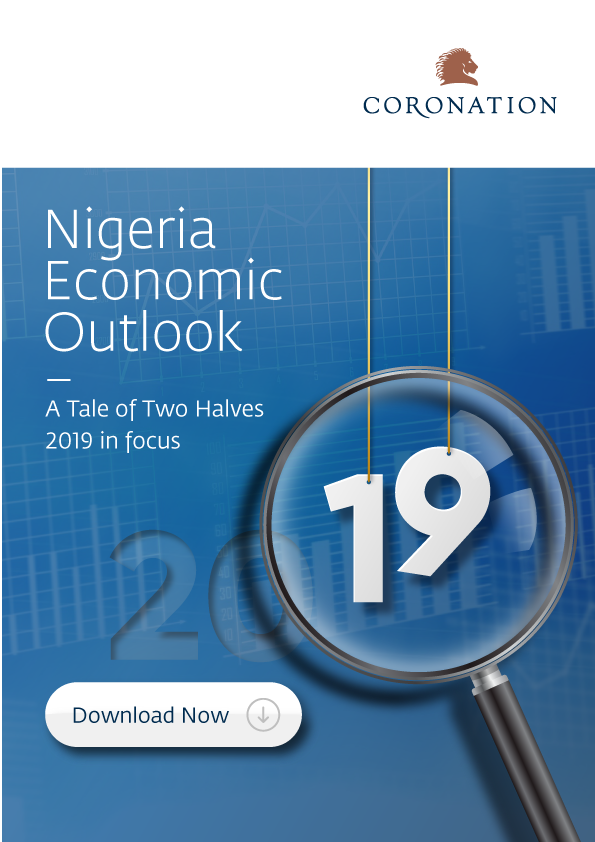
In its 2019 economic outlook report titled A Tale of Two Halves, Coronation Research, a leading financial services company licensed and regulated by the Securities and Exchange Commission (SEC), further said the deposit money banks will also not experience much loan growth, given the weak economy and the fact that they can benefit from high treasury bill yields.

Speaking on the report, the Head of Coronation Research, Mr Guy Czatoryski, said if interest rates come down later in the year and the market conditions improve, then there could be a sharp rally in bank stocks later in the year.

He further said the narrative for the Nigerian economy in 2019 is largely hinged around the performance of the oil.

“We forecast an average $58.00/bbl for 2019. An average much below this means the Central Bank of Nigeria (CBN) will have to keep rates very high and could even challenge the Naira/Dollar exchange argument.

“An average much about $60.00/bbl means the CBN will have confidence its reserve position and will be able to cut rates later in the year, in Q4, less likely Q3.”

In addition, he said, “The current rate of N365.29/$, or close to it, is likely to prevail this year. The CBN’s policy is to defend the rate and with reserves at $43.0 billion, it is in a strong position to do so.  We think the CBN will supply US dollars to the FX markets at an average rate of $500 million per month during 2019. This is compatible with maintaining a strong reserve level

“If, as we think, the oil prices will average $58.00/bbl this year, then we think the CBN will want to keep interest rates high. It will do this through its open market operations (OMO).

“We think OMOs will be issued in a range of 17.00 percent to 19.00 percent and that T-bill rates will be very close to this level during 2019.

“We look at Nigeria in the international context of interest rates. Nigerian T-bill rates look competitive in the context of other emerging market rates – which is why the CBN is having success in attracting inflows of Foreign Portfolio Investment

“However, if oil trades at substantially above $60.00/bbl during 2019 then foreign investors in T-bills will be encouraged and the CBN might well be in a position to cut rates in Q4 2019, or even in Q3 2019.

“This could be helped by a downtrend in inflation. Inflation has proved stubborn and has trended at around 11.00 percent over the past few months. But if inflation trends, in 2019, towards the CBN’s target band of 6.00 percent to 9.00 percent, then it will help the CBN cut rates in order to stimulate the economy.

“We are agnostic on politics. However, there is some evidence that in the period after general elections (2011 and 2015) yields in the T-bill market tend to fall. This might help persuade the CBN to cut OMO rates later in the year.” According to the report, GDP growth is expected to be 2.25 percent in 2019, as a result of very weak consumer demand, and a lack of growth in government expenditure relative to the 2018 budget.


Dipo Olowookere is a journalist based in Nigeria that has passion for reporting business news stories. At his leisure time, he watches football and supports 3SC of Ibadan. Mr Olowookere can be reached via [email protected]

Click to comment

Leave a Reply

Your email address will not be published. Required fields are marked *

Banking

Entries Open for Second CBN Regulatory Sandbox

Published

on

CBN regulatory sandbox

By Aduragbemi Omiyale

Eligible innovators, financial institutions, Virtual Asset Service Providers (VASPs), financial technology (fintech) companies, and technology firms have been invited to apply for the second cohort of the Central Bank of Nigeria (CBN) Regulatory Sandbox Programme.

A statement signed by the acting Director of Corporate Communications and Investor Relations Department of the apex bank, Mrs Hakama Sidi-Ali, disclosed that entries opened on Wednesday, August 12, 2026, and will close on Monday, August 31, 2026.

Cohort 2 of the initiative introduces two dedicated testing tracks to support emerging technologies with the potential to strengthen Nigeria’s financial system while upholding high standards of consumer protection, financial stability, and market integrity.

According to the central bank, the two tracks are VASP and Data-Enabled Financial Services (Non-VASP).

VASP track is to support innovative virtual asset, stablecoin, payment, settlement, custody, wallet, and related financial infrastructure solutions that require supervised live testing, while the non-VASP track supports innovations that leverage secure digital infrastructure and permission-based data sharing to improve financial inclusion, payments, credit, risk management, operational efficiency, and consumer outcomes.

The CBN Regulatory Sandbox provides a controlled environment in which eligible participants may test innovative financial products, services, business models, and enabling technologies under the supervision of the CBN.

The programme enables the CBN and innovators to engage constructively throughout the testing process, supporting regulatory learning while encouraging responsible innovation that benefits consumers and the wider financial system.

Eligible organisations whose proposed innovations fall within the programme’s scope are encouraged to apply.

Applications will be assessed based on the level of innovation, readiness for controlled live testing, potential consumer or market benefit, governance arrangements, risk management capability, and the suitability of the proposed testing plan.

Successful participants will undertake supervised testing within clearly defined parameters agreed with the CBN, including appropriate safeguards for consumer protection, operational resilience, cybersecurity, and regulatory reporting.

The central bank emphasised that participation in the scheme does not constitute a licence, authorisation, or approval to operate outside the approved testing parameters.

It noted that the Sandbox is intended to facilitate responsible experimentation, strengthen regulatory engagement, and support evidence-based policy development in line with the CBN’s statutory mandate.

Continue Reading

Banking

Offshore Spending Limit on GTBank Naira Card Now $40,000 As FX Liquidity Improves

Published

on

GTBank Naira Card Dollar limit

By Aduragbemi Omiyale

The international spending limit on the GTBank Naira card has been increased by the financial institution to $40,000.

This information was revealed by the lender in an email to customers on Tuesday, August 11, 2026.

The banking subsidiary of GTCO Plc disclosed that the new offshore spending limit is for a quarter.

This development comes as the Nigerian foreign exchange (FX) market is witnessing stability against the United States Dollar.

The forex volatility experienced a few years ago has eased, allowing companies and others to plan within a reasonable exchange rate band.

“The Dollar limit on your GTBank Naira Card is now $40,000 quarterly,” the tier-1 commercial bank said in the message sighted by Business Post.

Improvement in forex liquidity in the domestic FX ecosystem has allowed Nigerians to use their local cards to complete financial transactions on foreign platforms, which was not possible a few years ago because of Dollar scarcity and arbitrage.

At the official market on Tuesday, the exchange rate closed at N1,364/$1. It was exchanged at N1,367/$1 at the GTBank FX desk and N1,395/$1 at the parallel market.

Continue Reading

Banking

NDPC Probes Lotus Bank, UNILAG, Hackerbella for Students’ Data Breach

Published

on

Lotus Bank

By Adedapo Adesanya

The Nigeria Data Protection Commission (NDPC) is investigating the University of Lagos, Lotus Bank, and Hackerbella Limited over alleged violations of data protection laws.

The probe followed public complaints alleging that students’ personal data was used to open bank accounts without a lawful basis.

The NDPC disclosed this in a statement signed by its Head of Legal, Enforcement and Regulations, Mr Babatunde Bamigboye, on behalf of the commission.

According to the commission, its chief executive, Mr Vincent Olatunji, directed the investigation team to conduct a comprehensive assessment of the circumstances surrounding the collection, use and disclosure of the affected students’ personal data.

The investigation will also determine the roles and responsibilities of the university, the bank, and the information technology solutions firm in the alleged data processing activities.

The NDPC said the probe would assess the compliance obligations of the three organisations under the Nigeria Data Protection Act, 2023, as well as the potential risks posed to the rights and freedoms of the affected students.

The commission said the investigation would cover several areas, including Data Protection Impact Assessments, the lawfulness and transparency of credit scoring or profiling activities, automated decision-making systems, privacy notices and data-sharing arrangements.

It will also examine the lawful bases for processing the students’ information, data minimisation, purpose limitation, retention policies and the adequacy of technical and organisational safeguards for protecting data subjects’ rights.

The commission stressed that institutions handling the personal information of students, staff and other members of their communities have a greater responsibility to ensure such data is properly protected.

“Institutions entrusted with the personal data of students, staff and other members of their communities have a heightened responsibility to ensure that such data is processed lawfully, fairly, transparently and securely,” the NDPC said.

The commission also warned educational institutions that have yet to comply with its existing data protection directives to take immediate steps to meet the required standards.

“Accordingly, the NDPC warns educational institutions that are yet to comply with its existing data protection compliance directives to do so immediately,” the statement added.

Continue Reading