Banking
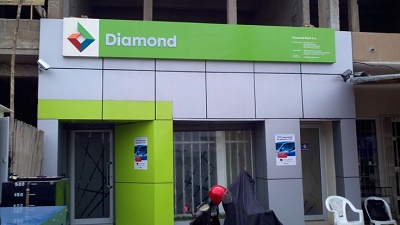
Diamond Bank Suffers 38% Profit Loss in 2016

By Modupe Gbadeyanka
One of the major financial institutions in Nigeria, Diamond Bank, has released its audited financial statements for the year ended December 31, 2016.
In the results released to the Nigerian Stock Exchange (NSE) today and sighted by Business Post, it was observed that the profit of the lender dropped by 38 percent in the year under review.
This resulted from the harsh business environment the company operated in last year when Nigeria slumped into a deep recession, which affected many businesses in the country.
Diamond Bank, in the financial statements, declared a profit after tax of N3.5 billion in contrast to 5.7 billion it declared in the corresponding period of 2015.
Also, the financial institution suffered a drop in its gross revenue in 2016. While it recorded a turnover of N217.1 billion in 2015, a total of N212.4 billion was netted 12 months later.
In the same vein, the bank’s net operating income depreciated to N102.1 billion in 2016 from N104.6 billion in 2015.
The firm declared a pre-tax profit of N5.03 billion in the period under review compared with N7.09 billion it posted a year earlier.
The bank stated in the report that assets pledged as collateral included N145.65 billion for borrowings from financial institutions against N140.9 billion in December 2015, while as at December 31, 2016, it held no collateral which it was permitted to sell or repledge in the absence of default by the owner.
It further stated that there were no capitalised borrowing costs related to the acquisition of property and equipment during the year and that the amount of contractual commitments for the acquisition of property and equipment as at December 31, 2016 stood at N5.11 billion versus N8.33 billion a year earlier.
Banking
CBN Unveils New Revised Manual to Modernise FX Market
By Adedapo Adesanya
The Central Bank of Nigeria (CBN) has unveiled the fourth edition of its Foreign Exchange Manual as part of efforts to deepen liquidity, improve transparency and strengthen confidence in the country’s foreign exchange market.
Speaking at the launch of the revised manual in Abuja on Friday, the Governor of the apex bank, Mr Yemi Cardoso, said the document will take effect from June 1, 2026.
He said it was developed after extensive consultations with banks, exporters, importers, corporates, regulators and development partners.
He said the new framework reflects the apex bank’s commitment to modernising the country’s foreign exchange administration in line with international best practices.
Mr Cardoso described the foreign exchange market as a critical pillar of any open economy, noting that effective governance of the sector is essential for sustaining macroeconomic stability and investor confidence.
“Foreign exchange is more than a financial instrument. It anchors price stability, facilitates the flow of goods and capital, and shapes investor sentiment,” he said.
The CBN governor stressed that the revised manual became necessary due to changing global economic realities, domestic reforms and the need for a more coherent and forward-looking regulatory framework.
According to him, the last edition of the FX manual was issued in 2018, making the latest review both timely and necessary.
Mr Cardoso disclosed that Nigeria’s foreign exchange market has witnessed significant improvement in liquidity since the current administration began reforms in the sector.
He added that daily turnover in the FX market increased from an average of about $100 million in the early days of the administration to between $400 million and $600 million daily.
The CBN Governor added that the market had also recorded transactions of up to $1 billion per day on several occasions in recent months.
“We have gone from a situation where it was more or less a one-way market, where the central bank came in, intervened and went away, to a much more dynamic market,” he stated.
The apex bank boss noted that the reforms were gradually restoring confidence among investors and market participants, encouraging freer entry and exit in the market without unnecessary restrictions.
He also maintained that the nation’s foreign reserves should not be used as the primary tool for funding the foreign exchange market.
“Reserves are reserves. They are not what you look to fund a market,” he said.
The CBN Governor assured stakeholders that the revised manual would be distributed free of charge to authorised dealers while the bank strengthens monitoring mechanisms to ensure compliance, fairness and accountability across the foreign exchange market.
On his part, the Deputy Governor for Economic Policy, Mr Muhammad Abdullahi, said the review formed part of broader reforms initiated by Mr Cardoso to restore confidence, improve transparency and deepen liquidity in the foreign exchange market.
Mr Abdullahi explained that the revised manual introduces several changes aimed at improving ease of doing business and reducing transaction bottlenecks.
Among the notable changes, he noted, are provisions allowing unfettered access to export proceeds, the introduction of non-resident investment accounts and operational guidelines for Pan-African Payment and Settlement System (PAPSS) transactions to support regional trade.
Mr Abdullahi added that the manual also contains new provisions on service exports, revised documentation requirements and updated operational procedures designed to align Nigeria’s FX market with global standards.
He said the apex bank deliberately adopted an ease of doing business approach during the review process to eliminate inefficiencies and ambiguities identified by stakeholders.
“The revised manual is not a stand-alone exercise but part of a broader institutional reform effort designed to strengthen the integrity, credibility and effectiveness of Nigeria’s foreign exchange system,” he said.
Banking
CBN Authorises Omodayo-Owotuga’s Inclusion into First Bank Board
By Aduragbemi Omiyale
The Central Bank of Nigeria (CBN) has approved the appointment of Mr Julius Omodayo-Owotuga to the board of First Bank of Nigeria Limited as an executive director.
A statement from the company said the appointment of Mr Omodayo-Owotuga became effective on Wednesday, May 13, 2026.
He was appointed to the board of the subsidiary of First Holdco Plc to further strengthen its leadership capacity across strategic finance, governance, risk management, and institutional transformation.
Before now, he served on the board of First Holdco as a non-executive director between 2021 and 2026.
The appointee brings to the board 24 years of experience spanning banking and financial services, infrastructure finance, power, oil & gas, and audit and consulting.
His appointment, according to the notice to the Nigerian Exchange (NGX) Limited, reflects the Bank’s continued commitment to strong governance, disciplined execution, financial resilience, and sustainable long-term growth.
He most recently served as deputy chief executive of Geregu Power Plc, Nigeria’s first listed power generation company, where he played a pivotal role in institutional transformation, governance strengthening, capital market positioning, operational optimisation, and major financing initiatives, including the company’s landmark listing on NGX.
Mr Omodayo-Owotuga previously served as group executive director, Finance & Risk Management at Forte Oil Plc (now Ardova Plc), where he was instrumental in the company’s financial and operational transformation, leading strategic restructuring, capital raising, treasury optimisation, enterprise risk management, and governance improvement initiatives that strengthened long-term shareholder value.
His professional career also includes roles at Africa Finance Corporation, Standard Chartered Bank, KPMG Professional Services and MBC International Bank (Now First Bank Nigeria Limited), providing him with deep experience in institutional finance, treasury management, financial controls, regulatory engagement, and corporate advisory.
Mr Omodayo-Owotuga is a CFA Charter Holder, KPMG-trained Accountant, and a Fellow of the Institute of Chartered Accountants of Nigeria (ICAN), the Chartered Institute of Taxation of Nigeria (CITN), and the Institute of Credit Administration. He is also a member of the Institute of Directors (IoD) Nigeria and a Certified Management Accountant.
He holds a Doctorate in Business Administration, a Master’s in Business Administration and a Bachelor’s degree in Accounting. He is an alumnus of Saïd Business School, University of Oxford, IE Business School, Geneva Business School, and the University of Lagos.
Banking
ASBON Honours Union Bank for Advancing Growth of Nigerian SMEs
By Modupe Gbadeyanka
In recognition of its strategic leadership in advancing the growth and resilience of small and medium-sized enterprises (SMEs), Union Bank of Nigeria Plc has been honoured by the Association of Small Business Owners of Nigeria (ASBON).
The lender was rewarded by the group for its suite of solutions designed to enable business expansion and long-term value creation.
At the Nigeria National SME Business Awards, held recently in Lagos, Union Bank was given the Best SME Growth Banking Initiatives Award for 2025.
The ceremony was organised by ASBON in partnership with the Lagos State government through the Ministry of Commerce, Cooperatives, Trade and Investment.
The event convened stakeholders from the public and private sectors to recognise individuals and organisations driving meaningful impact across Nigeria’s SME ecosystem.
Receiving the award on behalf of the bank, its Head of SME Segment, Mr Ayokunnumi Abraham, described the recognition as a strong endorsement of the organisation’s commitment to supporting small and medium-sized businesses.
“We are honoured to receive this recognition, which reflects Union Bank’s continued commitment to helping SMEs grow by making banking simpler, faster, and more accessible.
“Through enhancements to our specialised platforms such as Union360, we have meaningfully reduced the time it takes for businesses to come on board and begin transacting.
“These improvements have shortened onboarding, increased digital adoption among our SME customers, and supported the acquisition of new business clients. Our focus remains on delivering practical solutions that help Nigerian businesses thrive,” he stated.
-
Feature/OPED6 years agoDavos was Different this year
-
Travel/Tourism10 years ago
Lagos Seals Western Lodge Hotel In Ikorodu
-
Showbiz3 years agoEstranged Lover Releases Videos of Empress Njamah Bathing
-
Banking8 years agoSort Codes of GTBank Branches in Nigeria
-
Economy3 years agoSubsidy Removal: CNG at N130 Per Litre Cheaper Than Petrol—IPMAN
-
Banking3 years agoSort Codes of UBA Branches in Nigeria
-
Banking3 years agoFirst Bank Announces Planned Downtime
-
Sports3 years agoHighest Paid Nigerian Footballer – How Much Do Nigerian Footballers Earn