Connect with us

Banking

Our N2.10 Dividend to Shareholders Shows Capacity to Deliver Superior Returns—Fidelity Bank

Published

on

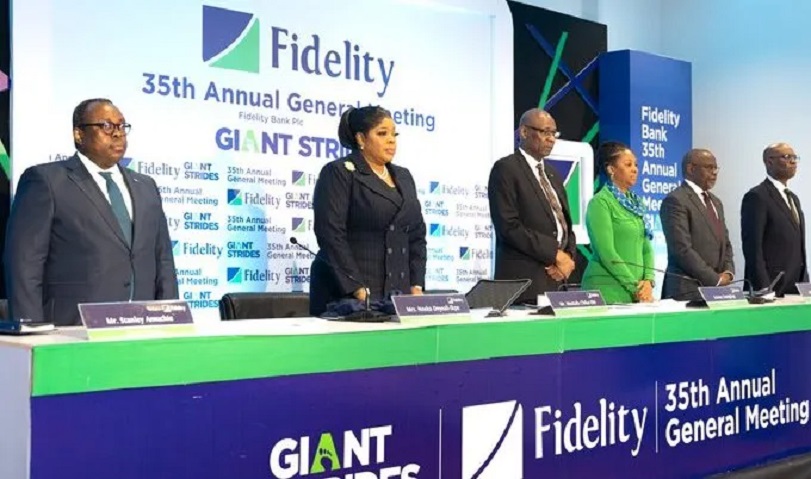
Fidelity Bank shareholders AGM

By Aduragbemi Omiyale

The chief executive of Fidelity Bank Plc, Mrs Nneka Onyeali-Ikpe, has said the total dividend of N2.10 per share to shareholders for the 2024 financial year is a demonstration of the company’s capacity to deliver superior returns to investors.

Having consistently paid dividends since 2006, Fidelity Bank will pay investors a total dividend of N2.10 per share for the 2024 financial year, subject to shareholders’ approval at its Annual General Meeting (AGM) on April 29, 2025.

The dividend will be paid on April 29, 2025, to shareholders whose names appear on the register of members as of April 15, 2025.

Last week, the bank released its 2024 full-year audited financial statements, reporting a 210 per cent growth in profit before tax to N385.2 billion versus the N124.3 billion achieved in 2023, and a 179.6 per cent improvement in the post-tax profit to N278.1 billion.

As for the top-line, the lender grew its gross earnings by 87.7 per cent to N1.043 trillion, driven by 106.9 per cent rise in interest and similar income to N950.6 billion.

The increase in interest income was led by a combination of improved yield on earnings assets and 51.6 per cent expansion in earnings base to N6.3 trillion.

In the period under consideration, the bank’s net interest income increased by 127.1 per cent to N629.8 billion, driven by a high-yield environment in 2024.

To optimize its margin, the company sustained its asset yields above funding cost by maintaining a high low-cost deposit profile at 92.6 per cent, leading to a jump in its net interest margin to 12.0 per cent from 8.1 per cent in the preceding year.

Similarly, the bank continued to deepen its market share in both the corporate and retail segments, with customer deposits increasing by 47.9 per cent to N5.9 trillion from N4.0 trillion in 2023FY due to strong double-digit growth across all deposit types.

The retail banking business gained significant traction with savings deposits increasing by 28.8 per cent to N1.1 trillion, marking the 10th consecutive year of double-digit annual growth in savings deposits.

Despite the difficult economic terrain in 2024, the bank has continued to support the real sector of the economy by increasing its net loans and advances to N4.4 trillion in 2024 from N3.1 trillion in 2023.

“We are delighted with our 2024 full-year (FY) performance, which showed strong growth across key revenue lines, improved asset quality, and significant traction in our strategic business segments.

“Our impressive results led to a triple-digit increase (210.0 per cent) in Profit Before Tax (PBT), rising from N124.3 billion in 2023 to N385.2 billion in 2024.

“This remarkable performance demonstrates our capacity to deliver superior returns to our shareholders.

“In line with our commitment to them, we have declared a final dividend of N1.25 per share, bringing our total dividend for the 2024 financial year to N2.10 per share,” Mrs Onyeali-Ikpe stated.

It will be recalled that the bank successfully completed the first phase of its capital raising exercise through a public offer and rights issue in 2024, which were oversubscribed by 237.92 per cent and 137.73 per cent, respectively.

The positive result is a testament to the strength of the bank’s franchise in the capital market. A total of N175.9 billion was recognized as fresh capital in 2024 financial year from the exercise, which had a positive impact on its Capital Adequacy Ratio (CAR) at 23.5 per cent.

The bank plans to conclude the second phase by Q3 2025, ahead of the Central Bank of Nigeria’s deadline, which will further strengthen its capital base and reaffirm its attainment of Tier 1 Bank status in the Nigerian Banking Industry.


Banking

CBN Unveils New Revised Manual to Modernise FX Market

Published

on

FX Market Segments

By Adedapo Adesanya

The Central Bank of Nigeria (CBN) has unveiled the fourth edition of its Foreign Exchange Manual as part of efforts to deepen liquidity, improve transparency and strengthen confidence in the country’s foreign exchange market.

Speaking at the launch of the revised manual in Abuja on Friday, the Governor of the apex bank, Mr Yemi Cardoso, said the document will take effect from June 1, 2026.

He said it was developed after extensive consultations with banks, exporters, importers, corporates, regulators and development partners.

He said the new framework reflects the apex bank’s commitment to modernising the country’s foreign exchange administration in line with international best practices.

Mr Cardoso described the foreign exchange market as a critical pillar of any open economy, noting that effective governance of the sector is essential for sustaining macroeconomic stability and investor confidence.

“Foreign exchange is more than a financial instrument. It anchors price stability, facilitates the flow of goods and capital, and shapes investor sentiment,” he said.

The CBN governor stressed that the revised manual became necessary due to changing global economic realities, domestic reforms and the need for a more coherent and forward-looking regulatory framework.

According to him, the last edition of the FX manual was issued in 2018, making the latest review both timely and necessary.

Mr Cardoso disclosed that Nigeria’s foreign exchange market has witnessed significant improvement in liquidity since the current administration began reforms in the sector.

He added that daily turnover in the FX market increased from an average of about $100 million in the early days of the administration to between $400 million and $600 million daily.

The CBN Governor added that the market had also recorded transactions of up to $1 billion per day on several occasions in recent months.

“We have gone from a situation where it was more or less a one-way market, where the central bank came in, intervened and went away, to a much more dynamic market,” he stated.

The apex bank boss noted that the reforms were gradually restoring confidence among investors and market participants, encouraging freer entry and exit in the market without unnecessary restrictions.

He also maintained that the nation’s foreign reserves should not be used as the primary tool for funding the foreign exchange market.

“Reserves are reserves. They are not what you look to fund a market,” he said.

The CBN Governor assured stakeholders that the revised manual would be distributed free of charge to authorised dealers while the bank strengthens monitoring mechanisms to ensure compliance, fairness and accountability across the foreign exchange market.

On his part, the Deputy Governor for Economic Policy, Mr Muhammad Abdullahi, said the review formed part of broader reforms initiated by Mr Cardoso to restore confidence, improve transparency and deepen liquidity in the foreign exchange market.

Mr Abdullahi explained that the revised manual introduces several changes aimed at improving ease of doing business and reducing transaction bottlenecks.

Among the notable changes, he noted, are provisions allowing unfettered access to export proceeds, the introduction of non-resident investment accounts and operational guidelines for Pan-African Payment and Settlement System (PAPSS) transactions to support regional trade.

Mr Abdullahi added that the manual also contains new provisions on service exports, revised documentation requirements and updated operational procedures designed to align Nigeria’s FX market with global standards.

He said the apex bank deliberately adopted an ease of doing business approach during the review process to eliminate inefficiencies and ambiguities identified by stakeholders.

“The revised manual is not a stand-alone exercise but part of a broader institutional reform effort designed to strengthen the integrity, credibility and effectiveness of Nigeria’s foreign exchange system,” he said.

Continue Reading

Banking

CBN Authorises Omodayo-Owotuga’s Inclusion into First Bank Board

Published

on

Julius Omodayo-Owotuga

By Aduragbemi Omiyale

The Central Bank of Nigeria (CBN) has approved the appointment of Mr Julius Omodayo-Owotuga to the board of First Bank of Nigeria Limited as an executive director.

A statement from the company said the appointment of Mr Omodayo-Owotuga became effective on Wednesday, May 13, 2026.

He was appointed to the board of the subsidiary of First Holdco Plc to further strengthen its leadership capacity across strategic finance, governance, risk management, and institutional transformation.

Before now, he served on the board of First Holdco as a non-executive director between 2021 and 2026.

The appointee brings to the board 24 years of experience spanning banking and financial services, infrastructure finance, power, oil & gas, and audit and consulting.

His appointment, according to the notice to the Nigerian Exchange (NGX) Limited, reflects the Bank’s continued commitment to strong governance, disciplined execution, financial resilience, and sustainable long-term growth.

He most recently served as deputy chief executive of Geregu Power Plc, Nigeria’s first listed power generation company, where he played a pivotal role in institutional transformation, governance strengthening, capital market positioning, operational optimisation, and major financing initiatives, including the company’s landmark listing on NGX.

Mr Omodayo-Owotuga previously served as group executive director, Finance & Risk Management at Forte Oil Plc (now Ardova Plc), where he was instrumental in the company’s financial and operational transformation, leading strategic restructuring, capital raising, treasury optimisation, enterprise risk management, and governance improvement initiatives that strengthened long-term shareholder value.

His professional career also includes roles at Africa Finance Corporation, Standard Chartered Bank, KPMG Professional Services and MBC International Bank (Now First Bank Nigeria Limited), providing him with deep experience in institutional finance, treasury management, financial controls, regulatory engagement, and corporate advisory.

Mr Omodayo-Owotuga is a CFA Charter Holder, KPMG-trained Accountant, and a Fellow of the Institute of Chartered Accountants of Nigeria (ICAN), the Chartered Institute of Taxation of Nigeria (CITN), and the Institute of Credit Administration. He is also a member of the Institute of Directors (IoD) Nigeria and a Certified Management Accountant.

He holds a Doctorate in Business Administration, a Master’s in Business Administration and a Bachelor’s degree in Accounting. He is an alumnus of Saïd Business School, University of Oxford, IE Business School, Geneva Business School, and the University of Lagos.

Continue Reading

Banking

ASBON Honours Union Bank for Advancing Growth of Nigerian SMEs

Published

on

union bank nigeria

By Modupe Gbadeyanka

In recognition of its strategic leadership in advancing the growth and resilience of small and medium-sized enterprises (SMEs), Union Bank of Nigeria Plc has been honoured by the Association of Small Business Owners of Nigeria (ASBON).

The lender was rewarded by the group for its suite of solutions designed to enable business expansion and long-term value creation.

At the Nigeria National SME Business Awards, held recently in Lagos, Union Bank was given the Best SME Growth Banking Initiatives Award for 2025.

The ceremony was organised by ASBON in partnership with the Lagos State government through the Ministry of Commerce, Cooperatives, Trade and Investment.

The event convened stakeholders from the public and private sectors to recognise individuals and organisations driving meaningful impact across Nigeria’s SME ecosystem.

Receiving the award on behalf of the bank, its Head of SME Segment, Mr Ayokunnumi Abraham, described the recognition as a strong endorsement of the organisation’s commitment to supporting small and medium-sized businesses.

“We are honoured to receive this recognition, which reflects Union Bank’s continued commitment to helping SMEs grow by making banking simpler, faster, and more accessible.

“Through enhancements to our specialised platforms such as Union360, we have meaningfully reduced the time it takes for businesses to come on board and begin transacting.

“These improvements have shortened onboarding, increased digital adoption among our SME customers, and supported the acquisition of new business clients. Our focus remains on delivering practical solutions that help Nigerian businesses thrive,” he stated.

Continue Reading

Trending