Banking
Standard Chartered Bank Offers Zero Charge on SMS Alert, Transfers, ATM
By Dipo Olowookere
Nigerians can now perform financial transactions without having to bother about charges that normally come with such from banks.
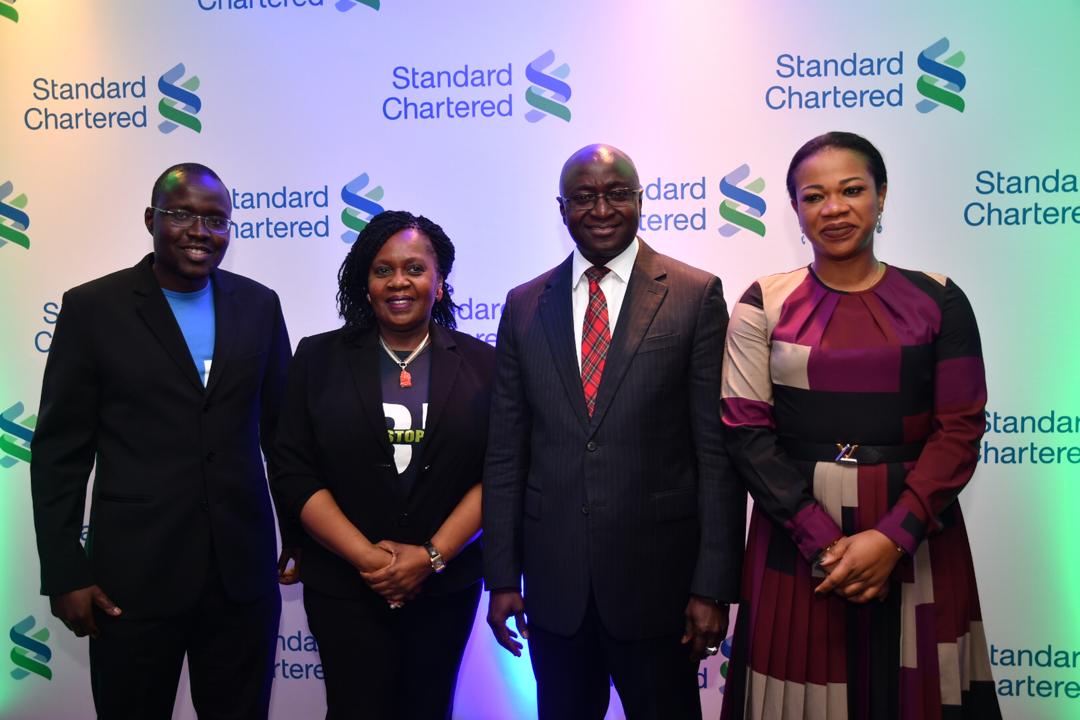
This is because Standard Chartered Bank, which officially launched its Digital Bank in Nigeria on Monday, is offering zero charge on all interbank transfers, SMS notification and ATM withdrawals.
In addition, account holders with the lender would be able to perform funds transfer without adding beneficiaries, generate a soft token for all transactions, enjoy free bank card delivered to their doorsteps nationwide as well as enjoy account management and service request.
At the launch held at the Civic Centre in Lagos yesterday, it was announced that the Digital Bank will initially offer savings accounts, current accounts, fixed deposits (with the option of joint accounts) along with Lending and Wealth Management solutions.
It was further stated that the bank’s digital services are available by downloading the Standard Chartered mobile application on the app stores. New clients can execute all their banking activities from their mobile devices, starting by opening their bank account in less than 10 minutes. They can also provide all verification documents by uploading to the application and fully complete their onboarding process within minutes.
Commenting on the launch, Lamin Manjang, CEO, Nigeria said, “We are pleased to launch our digital bank in Africa with the support of the Central Bank of Nigeria (CBN). This is a key milestone on our digital journey as a Bank and underlines our commitment to investing and growing in the market.
“We have been steadily investing in expanding our footprint in Africa over the years, launching earlier in CDI, Ghana, Kenya and Tanzania, and this will continue to be a priority moving forward. Digitising Africa remains at the heart of our business strategy for the region and we look to continue to grow our business in Nigeria being the best financial partner to our clients.
“For us, our commitment to our clients is not only being Here for good for them but also empowering them to be unstoppable in their financial aspirations.”
Also commenting, David Idoru, Head of Retail Banking, Nigeria, said, “Our digital bank was developed with our clients in mind. We have taken into consideration the feedback received by our clients at each stage of the design process and have incorporated innovative technology to allow them to execute all banking activities from a mobile device.
“This includes 70 banking services through the appIn addition, the client onboarding journey has been digitised and in just the amount of time it takes you to make a cup of coffee, you can open a new account through the app. What has also been introduced is that our clients enjoy zero charge on all interbank transactions, zero charge on SMS notifications and free delivery of cards to them wherever they are.
“Clients can also open term deposit accounts, Joint accounts, Lending and WM products. This is something we are very proud of and we look forward to continuously providing the best in class financial services to our clients.”
Business Post gathered that the unveiling on Monday was attended by over 300 dignitaries, business leaders, clients and senior management, as well as the African Giant and Nigerian music icon, Burna Boy, who doubles as the bank’s Digital Ambassador. He used the occasion to share his experience on the ease of opening an account using his mobile phone.
Banking
Flutterwave Pauses IPO Plans Amid African Banking Expansion Push
By Adedapo Adesanya
Africa’s most valuable fintech, Flutterwave, has signalled that its long-anticipated initial public offering (IPO) remains firmly on the back burner as the company intensifies efforts to transform itself into a licensed financial institution across the continent.
The firm’s chief executive, Mr Olugbenga Agboola, said the firm is focused on building sustainable profitability, diversifying its revenue streams and expanding its banking footprint before considering a stock market listing.
Speaking to The Africa Report, Mr Agboola described an IPO as a future financing milestone rather than an immediate strategic objective.
“An IPO is a financing event, not a strategy,” he said. “We are not holding any pressure to go public. This gives us the flexibility to be patient and ensure when we do list, we’re doing so from a position of strength.”
The comments come as Flutterwave embarks on an acquisition-led expansion strategy aimed at securing banking licences and deeper regulatory access across Africa.
Mr Agboola revealed that the company is currently in the process of acquiring a bank in East Africa, though he declined to disclose the institution or country involved.
The planned acquisition is expected to provide Flutterwave with an established customer base, existing banking infrastructure and regulatory approvals, significantly shortening the time required to enter new financial services markets.
According to Mr Agboola, the company’s expansion priorities include Kenya, Ghana, Rwanda, Tanzania, South Africa and Egypt, while the Democratic Republic of Congo and Ethiopia remain under consideration for future growth.
Rather than building banks from scratch in every market, Flutterwave intends to adopt a mix of acquisitions, licences and strategic partnerships depending on local regulatory conditions.
“The vision is not to form a bank in every country but to ensure that every African business has access to more than financial services,” Mr Agboola said in the interview.
The banking push follows recent regulatory and corporate developments, including the Central Bank of Nigeria’s approval of Flutterwave’s banking licence and the acquisition of open banking startup Mono.
Together, the moves underscore a broader strategy to expand beyond payments and establish new revenue streams in lending, liquidity management and business banking services.
Flutterwave plans to focus on institutional deposits from businesses already using its platform rather than competing aggressively for retail deposits.
The company intends to leverage transaction data from its payments network to provide short-term working capital, merchant financing, invoice discounting and trade finance products for small and medium-sized enterprises.
Mr Agboola disclosed that the bulk of the capital earmarked for banking operations will be directed toward credit support and liquidity buffers, with additional allocations for lending and banking infrastructure.
The strategy reflects a growing trend among African fintech firms seeking banking licences to reduce dependence on traditional financial institutions and gain greater control over settlement, liquidity management and product development.
Despite speculation about a near-term public listing, Mr Agboola maintained that Flutterwave’s immediate focus remains execution and growth.
He noted that the company will only consider an IPO after achieving stronger profitability and establishing scale across its payments, banking and remittance businesses.
In February 2025, he told Bloomberg that Flutterwave would only pursue a public offering after becoming profitable. He also stated in late 2024 that the company was “not in the IPO race.”
Founded in 2016, Flutterwave has processed more than one billion transactions valued at over $40 billion across 35 African countries. The company recently secured fresh funding that lifted its valuation to $3.3 billion, with American blockchain firm Ripple leading the investment round.
For now, however, Flutterwave appears more interested in building the foundations of a pan-African financial institution than rushing to the public markets, positioning banking expansion as the next phase of its growth story while keeping an eventual IPO firmly on the long-term horizon.
Banking
Is Femi Otedola Set for Full Control of First Holdco?
By Adedapo Adesanya
Nigerian businessman Femi Otedola has strengthened his position as the largest shareholder in First Holdco Plc, increasing his stake to 26 per cent through the acquisition of additional shares worth N222.21 billion on the Nigerian Exchange (NGX) Limited.
According to a disclosure on the NGX on Thursday, the chairman of First Holdco acquired further 1,779,094,976 shares of the group at N124.90 per share.
The transaction on the Nigerian main bourse takes Mr Otedola’s position to 11,763,018,192 shares from 9,277,792,037 as of June 30 2026, as per the company’s unaudited results, making him the largest shareholder of the oldest financial institution in Nigeria.
The acquisition also has implications under Nigeria’s takeover rules, which require any shareholder that acquires 30 per cent or more of a listed company to make a mandatory offer to the remaining shareholders.
With an estimated 26 per cent stake in First Holdco, which is equivalent to nearly 12 billion shares out of the company’s 45.48 billion outstanding shares, Mr Otedola is now nearing the regulatory threshold.
The gap to the mandatory takeover threshold is about 2.49 billion shares, fewer than the block Otedola acquired in July 2026 alone. A further purchase of a similar scale would trigger Nigeria’s mandatory takeover rules, requiring him to make an offer for all the remaining shares of First Holdco Plc, the parent company of First Bank of Nigeria Limited.
As of now, the billionaire has given no indication that he intends to trigger a mandatory takeover, consistently describing his share purchases as a long-term investment rather than a path to outright control of the group.
Mr Otedola’s stake-building has been years in the making but gathered significant pace in 2026. He held 6.68 billion shares, representing 15.95 per cent of First Holdco, at the end of June 2025, when the company had 41.88 billion shares outstanding.
By March 31, 2026, his holding had risen to 8.06 billion shares against an expanded share capital of 44.45 billion. Three months later, his stake increased to 9.28 billion shares after he acquired about 1.22 billion shares in a single quarter, largely through indirect holdings. A further acquisition through his investment vehicle, Calvados Global Services, this month pushed his holdings above the 10 billion-share mark for the first time.
He has also reiterated that the money committed is his own rather than borrowed.
In recent months, Mr Otedola has also made other high-profile investment moves beyond the banking sector, including acquiring a luxury residence in London’s exclusive Mayfair district, underscoring his growing international real estate portfolio.
He is believed to have participated in a financing arrangement involving the Dangote Refinery, placing funds with the facility as it secured working capital to support the scale-up of operations.
With the 30 per cent threshold now within reach, is a First Holdco takeover Mr Otedola’s next move?
Banking
Sterling’s Customer Deposits Hit N3.62trn, Generates N279bn in Six Months
By Aduragbemi Omiyale
In the first six months of this year, Sterling Financial Holdings Company Plc, the parent company of Sterling Bank Limited, grew its gross earnings by 31.5 per cent to N279.6 billion.
This was buoyed by a 33.7 per cent jump in interest income to N223.6 billion as the loan book expanded and asset yields improved, with non-interest income rising by 23.3 per cent to N56.0 billion, supported by notable increases in fee income and other operating income lines. As of June 30, 2026, the organisation’s net interest income climbed by 41.0 per cent to N137.4 billion.
The unaudited results for the half-year ended June 30 showed that the firm recorded a 21.9 per cent surge in profit before tax (PBT) to N55.5 billion, and a 20.4 per cent leap in profit after tax (PAT) to N50.3 billion.
The broad-based growth across key performance indices extended to the balance sheet, with total assets expanding by 19.3 per cent to N4.67 trillion, supported by a 21.1 per cent growth in customer deposits to N3.62 trillion and disciplined expansion in the loan portfolio.
Shareholders’ funds increased in the period under review by 27.8 per cent to N547.7 billion, primarily reflecting the N96.6 billion raised through a public offer of 13.8 billion ordinary shares.
Also, return on average equity stood at 20.6 per cent and return on average assets improved to 2.35 per cent from 2.05 per cent.
The performance by Sterling Holdings was anchored by the ongoing modernisation of its technology stack and operating model across its commercial (Sterling Bank), non-interest (AltBank), and wealth management (SterlingFI) arms.
That work is showing up in faster service turnaround, tighter unit economics, and greater headroom to absorb rising customer activity without loosening its risk posture.
The combination of a reinforced capital base, expanding deposit franchise, and broader earnings mix leaves Sterling Holdings positioned to compound growth in the second half of the year, channelling capital where it earns most and continuing to lend into the real economy.