Brands/Products
Zoho Upgrades Bigin to Redefine Small Business CRM Market
By Modupe Gbadeyanka
A leading global technology company, Zoho Corporation, has upgraded its customer relationship management (CRM) solution for small businesses, Bigin, with new features for better performance.
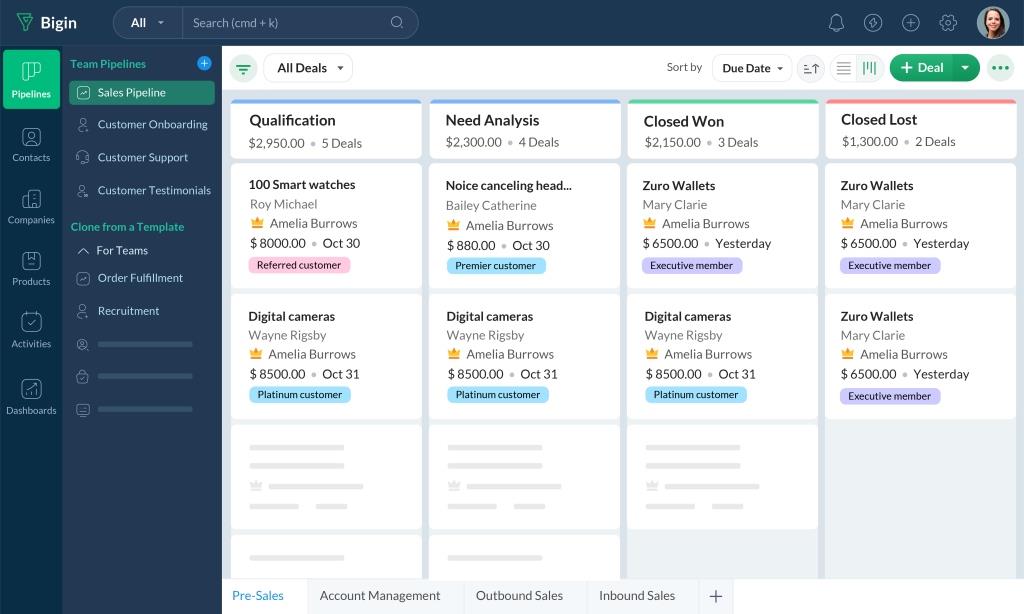
According to the firm, the platform has been fortified with new capabilities like team pipelines, toppings, and developer centres, which will allow users to manage all types of customer operations.
It is believed that the upgrade will redefine the small business CRM market as it would provide small and micro businesses with the tools and insights they need to maintain and grow meaningful and high-value relationships with customers in a challenging economic environment.
“Small businesses face challenges in choosing the right technology for managing their customer-facing operations because of constraints related to time, cost, and software implementation,” the Country Manager for Zoho Nigeria, Kehinde Ogundare, stated.
“Bigin is the only solution that brings together all customer operations like sales, onboarding, delivery, training, advocacy, and more into an intuitive interface that takes only 30 minutes to deploy.
“By bringing together all the facets of customer operations into a single view, Bigin allows small businesses to have a more accurate understanding of the customer’s journey.
“These insights help them attract and retain customers, ultimately growing the business. The fast-growing adoption of Bigin shows the expanding appetite of small businesses who want and need CRM technology suited to their particular needs, helping them move beyond old-school spreadsheets,” Ogundare added.
Since its launch in 2020, Bigin has stood out as a robust, easy-to-use, and welcoming CRM solution thanks to its 30-minute set-up promise. Bigin saw a revenue growth of 161 per cent in 2022 in Nigeria, indicating the revenue has doubled compared to 2021.
Zoho has observed that around 65 per cent of Bigin’s global customers have never used a CRM previously, making it the ideal choice for business owners who are looking to move away from spreadsheets.
When they outgrow Bigin, Zoho also offers them an easy migration to its full-fledged CRM solution. Bigin now boasts 20,000 customers and continues to help small and micro businesses manage all of their customer-facing operations within a unified platform.
The introduction of Team Pipelines allows customer-facing teams to manage their distinctive operations using a set of pipelines and sub-pipelines within a single Bigin account.
Competitive offerings often cater only to a single function — like sales — whereas Bigin is an efficient solution for all customer-facing teams. New features compile customer operations into one place and enable tighter alignment and collaboration between individuals and teams without compromising the simplicity that makes Bigin stand out.
The Connected Pipelines feature automates the flow of customer data across processes, improving the customer experience and saving time on manual data entry, while the Toppings feature allows the addition of additional functionality and third-party integrations to address specific business needs. Examples include the ‘Email-In’ topping, which maps emails to customer records and the ‘File Cabinet’ topping, which automates file collection and management.
The Dynamic Display allows users to customize the appearance of records in their pipelines, while the Developer Centre gives room for global app developers and partners to create custom solutions for unique business needs.
With various tools and components like custom fields, buttons, links, widgets, related lists, and REST APIs, developers can create new Toppings and monetise them in the Bigin Marketplace.
Bigin by Zoho CRM starts at N2,100/user/monthly (billed annually) for the Express edition and goes up to N3,600 user/monthly (billed annually) for the Premier edition, though a free edition is also available.
Brands/Products
Chicken Republic Introduces Improved Smokey Jollof Recipe
By Aduragbemi Omiyale
To further reinforce its commitment to continuous enhancement of customer experience through menu innovation and quality improvements, Chicken Republic, Nigeria’s leading quick-service restaurant brand and a flagship brand of Food Concepts Plc, has improved its Smokey Jollof recipe across restaurants nationwide.
As a customer-centric brand, Chicken Republic regularly evaluates consumer feedback, dining trends, and product performance to ensure its menu continues to deliver the quality and value to which customers have become accustomed.
The updated Smokey Jollof is part of this ongoing commitment to continuous improvement.
The refreshed recipe represents the latest evolution of one of the brand’s most popular offerings.
Developed with a focus on richer flavour, greater consistency and an even more satisfying eating experience, the improved Smokey Jollof reflects Chicken Republic’s dedication to meeting the evolving tastes and expectations of its customers.
“At Chicken Republic, our customers are at the heart of every decision we make. We are constantly listening, learning and looking for ways to improve the experience we deliver.
“The improved Smokey Jollof is a reflection of that commitment. We’ve refined the recipe to deliver an even richer, more enjoyable taste experience while maintaining the flavour profile our customers know and love,” the Managing Director of Food Concept, Mr Olumide Aniyikaiye, stated.
“Great brands evolve with their consumers. This update is not about changing what people love, but about making it even better.
“We are confident that customers will enjoy the improved recipe and appreciate the attention we continue to invest in delivering quality meals every day,” Mr Aniyokaiye added.
The improved Smokey Jollof is now available at Chicken Republic outlets nationwide, allowing customers to experience a more flavourful and consistent version of a fan-favourite menu item.
This latest enhancement underscores Chicken Republic’s broader commitment to innovation, quality and creating memorable meal experiences for customers across Nigeria.
Brands/Products
NAFDAC Busts N42m Expired Baby Wipes Warehouse
By Adedapo Adesanya
The National Agency for Food and Drug Administration and Control (NAFDAC) said it has uncovered a warehouse stocked with expired baby wipes intended for illegal revalidation and sale to unsuspecting consumers.
In a statement shared on X (formerly known as Twitter) on Monday, the agency said the value of the products is estimated at N42 million.
The agency said during the operation, its officers discovered over 240 cartons of expired baby wipes that had already been revalidated and repackaged, alongside approximately 20,000 additional expired wipes, equivalent to 625 cartons, awaiting revalidation.
NAFDAC said one suspect was apprehended at the scene, while the warehouse was sealed and the products evacuated for further investigation.
“The distribution and use of expired baby wipes pose significant health risks, particularly to infants and young children, including skin irritation, skin infections, allergic reactions, worsening of eczema or dermatitis, and an increased risk of diaper rash due to the reduced effectiveness of preservatives that inhibit microbial growth.
“The seized products are valued at approximately N42 million.
“We reaffirm our commitment to protecting public health by preventing substandard and expired regulated products from re-entering the market.
“Members of the public are urged to remain vigilant and report suspicious activities involving regulated products to the nearest NAFDAC office or call 0800 1 623322,” it stated.
Brands/Products
ALTON Supports NCC Call for Made-in-Nigeria Smartphones
By Adedapo Adesanya
The Association of Licensed Telecommunications Operators of Nigeria (ALTON) has backed the call by the Nigerian Communications Commission (NCC) for local smartphone manufacturing to accelerate digital inclusion.
The ALTON Chairman, Mr Gbenga Adebayo, described the proposal as a practical measure capable of accelerating broadband adoption and expanding digital inclusion across the country.
He said Nigeria must deliberately transition from being predominantly a technology consumer to becoming an innovator, designer and manufacturer of digital technologies.
According to him, Nigeria’s large telecommunications market and youthful population provide the scale and human capital needed for world-class technology manufacturing.
The ALTON chairman said the country’s ambition should extend beyond assembling smartphones to developing complete technology capabilities across the value chain.
“Our ambition should extend beyond assembling devices. We must pursue genuine knowledge transfer, research and development, product engineering, software development, semiconductor capabilities and large-scale manufacturing,” he stressed.
He said the objective should be producing devices and digital technologies for Nigeria, Africa and the global market.
Mr Adebayo said the emergence of Artificial Intelligence had further strengthened Nigeria’s opportunity to become a competitive technology manufacturing hub.
He said Artificial Intelligence was transforming product design, manufacturing, quality assurance, supply chain management, customer experience and software innovation.
According to him, investing in AI-enabled manufacturing will improve productivity, create high-value jobs and strengthen Nigeria’s competitiveness across Africa.
NCC’s Board Chairman, Mr Idris Olorunnimben, at a Digital Africa Summit Roundtable in Shanghai, called for local smartphone production and innovative financing to tackle the proliferation of counterfeit and non-type-approved devices through stronger market integrity.
The ALTON boos described the grey market as a major challenge affecting consumers, Original Equipment Manufacturers (OEMs) and the wider telecommunications ecosystem.
According to him, robust local manufacturing supported by strong quality standards will provide credible alternatives to grey-market imports.
He said effective type approval, competitive pricing and consumer confidence would encourage wider acceptance of locally manufactured smartphones.
“This will strengthen consumer protection, improve network performance, retain greater value within our economy, and stimulate industrial growth,” he said.
Mr Adebayo also endorsed innovative smartphone financing, stronger device management systems and identity-enabled credit frameworks.
He added that the initiatives would enable more Nigerians to acquire quality smartphones through affordable payment models.
According to him, telecom operators remain ready to partner with the government, manufacturers, financiers, academia, investors and development partners to build sustainable local manufacturing.
The ALTON boss described the initiative as a national economic transformation agenda capable of creating jobs and strengthening Nigeria’s position in the global digital economy.
-
Feature/OPED6 years agoDavos was Different this year
-
Travel/Tourism10 years ago
Lagos Seals Western Lodge Hotel In Ikorodu
-
Showbiz4 years agoEstranged Lover Releases Videos of Empress Njamah Bathing
-
Banking8 years agoSort Codes of GTBank Branches in Nigeria
-
Economy3 years agoSubsidy Removal: CNG at N130 Per Litre Cheaper Than Petrol—IPMAN
-
Banking3 years agoSort Codes of UBA Branches in Nigeria
-
Banking3 years agoFirst Bank Announces Planned Downtime
-
Sports3 years agoHighest Paid Nigerian Footballer – How Much Do Nigerian Footballers Earn