Economy
$13bn Trans-Saharan Gas Pipeline to Boost Nigeria’s Gas Exports
By Adedapo Adesanya
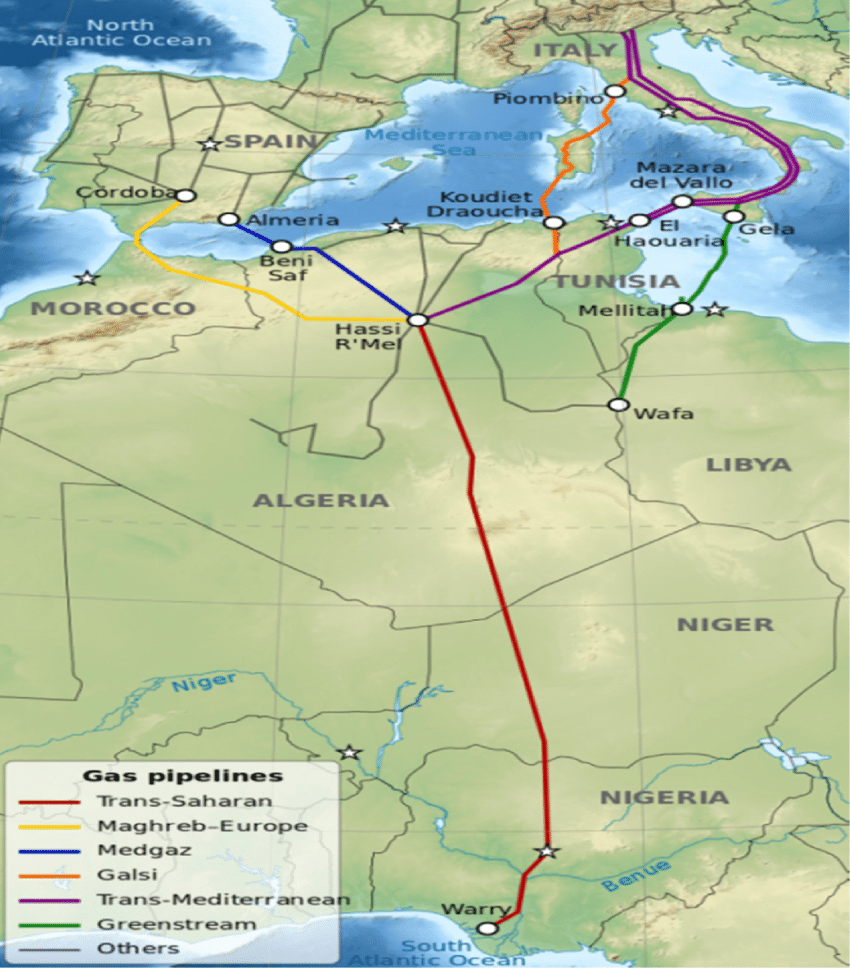
Nigeria is set to boost its gas development initiative through exports to Europe after reaching a new milestone in further opening the domestic and regional gas market via the construction of the multi-billion Trans-Saharan Gas Pipeline (TSGP) alongside Algeria and Niger.
The oil ministers of the three countries — Mr Mahamane Sani Mahamadou, Minister of Petroleum for the Republic of Niger, Mr Mohamed Arkab, Minister of Energy and Mines, Algeria, and Mr Timipre Sylva, Minister of State for Petroleum Resources of Nigeria as well as the Director Generals of national oil companies (NOCs) of the three African countries met to discuss the implementation of the TSGP on June 20, 2022, in Abuja.
During the meeting, which follows the signing of the Niamey Declaration during the 3rd Forum of the Economic Community of West African States in February 2022, parties established a task force and roadmap for the development of the TSGP.
It was disclosed that the TSGP project will mark a new era of improved regional cooperation in Africa, enhancing gas monetization and exports while scaling up exports to Europe via Algeria.
Not only will the $13 billion project drive socioeconomic growth by unlocking massive investments across the energy sector, but it will also help create jobs in various industries including energy, petrochemicals and manufacturing whilst optimizing energy production and positioning Africa as a global energy hub.
A steering committee made up of the three Ministers and Director Generals of the NOCs, established during the two-day meeting, will be responsible for updating the feasibility study for TSGP and will meet at the end of July 2022 in Algiers to discuss how to progress with the TSGP project.
With energy poverty increasing across the African continent due to limited investments in energy projects, delays in exploration, production and infrastructure rollout, the COVID-19 pandemic, and global energy transition-related policies, the TSGP project will bring in a new era of energy reliability for Africa.
With the 4,128 km pipeline running from Warri in Nigeria to Hassi R’Mel in Algeria via Niger, the pipeline will not only create a direct connection between Nigeria and Algeria’s gas fields to European markets but will bring significant benefits to Nigeria.
The pipeline will enable up to 30 billion cubic meters of natural gas to be traded yearly enhancing regional and international energy trade.
With gas emerging as the energy of the future, the TSGP project will play a critical role in positioning Nigeria, alongside Algeria and Niger, at the forefront of the energy transition.
Economy
Otedola Denies Funding, Owning Stake in Dangote Refinery
By Adedap0 Adesanya
Nigerian businessman, Mr Femi Otedola, has dismissed reports suggesting he has a stake and financed the Dangote Petroleum Refinery, describing the allegation as completely false.
The billionaire, who is a close ally of Mr Aliko Dangote, the owner of the $20 billion oil facility, clarified in a statement on Monday that those behind such claims were spreading misinformation and attempting to create division among leading Nigerian business figures.
His clarification came a day after the Dangote Group addressed viral claims suggesting a financing rift between its president, Mr Dangote, and fellow businessman, Mr Tony Elumelu.
He wrote, “Let’s set the record straight. Reports claiming that Femi Otedola funded the Dangote Petroleum Refinery are completely and utterly false. He has not invested a single kobo, not one dollar, not one naira.”
He added that, “The real story, which those peddling these lies conveniently ignore, is that Mr Otedola has actually been requesting a special allocation to participate in the refinery’s forthcoming public offer.”
Mr Otedola further explained that Mr Dangote did not request financial support from Mr Elumelu, Mr Mike Adenuga, or himself, a statement that aligns with a clarification issued by the Dangote Group’s Chief Branding and Communications Officer, Mr Anthony Chiejina.
The company also warned individuals, organisations, and platforms involved in creating, publishing, or disseminating such false content to desist immediately.
Mr Otedola said, “I can categorically state that at no point did Alhaji Dangote request financing from Mr Elumelu, Mr Adenuga and me. The Dangote Group is a well-structured organisation that is well-versed in raising structured capital for its operations.
“This is calculated mischief and a deliberate attempt to create rifts and sow discord within Nigeria’s closely knit and respected private sector leadership. These are men who have built businesses, created jobs, and invested in this nation for decades. They deserve better than to be used as props in a social media fabrication.”
“To those behind this: desist immediately.. And to everyone else, social media is not a tool for manufactured drama. Nigeria deserves truth, not lies dressed up as insider information,” Mr Otedola warned.
Economy
FTMining Launches Free Mining Service for BTC, ETH, XRP and DOGE Holders, with Daily Earnings of up to $9,900?
FTMining’s new free mining service allows BTC, ETH, XRP and DOGE holders to easily earn passive income without expensive equipment or specialized technical skills.
As cryptocurrencies gain popularity worldwide, more and more investors are beginning to focus on how to earn stable passive income without the need for expensive equipment or specialized skills.
Recently, UK-based cloud computing platform FTMining officially launched a new “free cloud mining service,” specifically designed for holders of major cryptocurrencies such as BTC, ETH, XRP and DOGE, offering users a new zero-barrier opportunity to participate in cryptocurrency mining.
At the same time, FTMining has also launched a brand-new mobile application, enabling users to manage their mining activities anytime and anywhere, truly ushering in the “era of mobile mining.
Mine Cryptocurrency Anytime, Anywhere with FTMining Cloud Mining Service
This brand-new mobile application offers a user-friendly interface, allowing users to easily monitor mining contracts, track daily earnings, and manage their investments.
Enhanced Security
The application uses top-tier security technologies from McAfee® and Cloudflare® to ensure that your digital assets remain protected no matter where you are.
Instant Rewards
New users who register through the application will immediately receive a sign-up bonus of $15–$100, along with a $0.75 daily login reward.
Multiple Contract Options
From daily contracts starting at just $15 to long-term investments, users can choose from a variety of mining plans to suit different budgets and goals.
24/7 Reliability
With 100% uptime and round-the-clock technical support, this mobile application ensures uninterrupted mining.
This brand-new free mining mechanism is a hash power reward program specifically designed for Bitcoin, Ethereum, and Dogecoin holders. Users do not need mining machines or complex setup—simply registering is enough to receive free hash power.
How to Start Your Cloud Mining Journey with FTMining
Step 1: Choose FTMining as Your Service Provider
FTMining’s mining process is simple and transparent, requiring only a small deposit to get started. The platform offers daily returns from mining contracts and flexible payment options, making it easy for everyone to participate.
Step 2: Register an Account:
Visit the official FTMining website: ftmining.com
Enter your email address to create an account, log in, and access your dashboard to start mining immediately.
Step 3: Purchase a Mining Contract:
FTMining offers a variety of contract options to suit different budgets and goals. Users can choose from the following plans:
Starter Contract: $100 – 2 days – Total return: $108
Stable Contract: $1,080 – 10 days – Total return: $1,236
Professional Contract: $10,000 – 25 days – Total return: $14,250
Advanced Contract: $50,000 – 30 days – Total return: $77,000
(For more contract details, please visit the official website.)
Once your order is completed, your earnings will be automatically credited to your account within 24 hours. When your account balance reaches $100, you can withdraw funds to your personal wallet or reinvest them to earn more returns.
About FTMining
FTMining is a UK-licensed cloud cryptocurrency mining platform. Founded in 2021 and headquartered in the United Kingdom, the company is committed to providing efficient and cost-effective cryptocurrency mining solutions through advanced hardware, intelligent algorithms, and cloud infrastructure.
FTMining has more than 6 million users across over 180 countries and regions worldwide, providing convenient and scalable cryptocurrency mining services to users around the globe.
You can now visit the FTMining website to view or download the FTMining app. This brand-new mobile application makes it easier and safer than ever to manage your cryptocurrency investments.
🌐 Official Website: https://ftmining.com
📱 App Download: https://ftmining.com/xml/index.html
Economy
Windfall: Why Nigeria Isn’t Pocketing Full N5.13trn Oil Gains
By Adedapo Adesanya
Nigeria’s oil revenue reportedly surged above its 2026 benchmark by an estimated N5.13 trillion in March and April as global crude prices spiked amid Middle East tensions, but only a fraction of the windfall is reaching government coffers.
Since the war started, oil prices have continued to soar, selling for above $120 at some point. The 2026 budget is anchored on daily oil production of 1.8 million barrels per day, a benchmark oil price of $64.85 per barrel and an exchange rate of N1,400 to the Dollar.
The revenue surge followed a sharp rally in the global oil market after tensions between the United States and Iran disrupted supply expectations and drove crude prices far above Nigeria’s budget benchmark of $64.85 per barrel.
The calculation puts Nigeria’s expected daily oil revenue at about N163.42 billion.
However, actual earnings in March and April came in far above that level as global prices climbed, offsetting weaker production and delivering a strong fiscal boost to the federal government.
This does not translate to the entirety entering the country’s purse, because a large share of Nigeria’s crude is produced under Production Sharing Contracts (PSCs) and Joint Ventures (JVs) with international oil companies. Cost recovery and profit-sharing formulas mean only a fraction of incremental price gains accrues to the state after operators deduct capital and operating expenditures.
Beyond these, structural inefficiencies further limit actual inflows. Oil theft, pipeline vandalism, and persistent underproduction reduce the volume of crude available for sale, weakening revenue performance despite favourable prices. Additionally, before funds are distributed, multiple deductions, including operational costs, debt servicing obligations tied to oil-backed loans, and other statutory charges, are applied, shrinking what eventually reaches the Federation Account.
Nigeria also has to contend with exchange rate dynamics as Dollar-denominated earnings are subject to conversion challenges, further diluting the real fiscal impact in Naira terms.
Data from the Nigerian Upstream Petroleum Regulatory Commission (NUPRC) showed that March crude production averaged 1.55 million barrels per day, below budget, but stronger oil prices lifted average daily revenue to about N201.8 billion, creating an estimated surplus of N1.19 trillion for the month.
In April, production improved to about 1.7 million barrels per day, while average crude prices climbed further, pushing daily revenue to about N294.84 billion and generating an additional N3.94 trillion above budget expectations.
Combined, both months delivered a revenue upside of N5.13 trillion, with the bulk of the gain driven by higher crude prices rather than stronger production performance.
The sharp rise in earnings has given the government short-term fiscal relief, but it has also exposed the economy’s continued dependence on external oil market shocks, where gains in public revenue often come with direct pressure on domestic energy costs.
That pressure is already showing in the downstream market, with refined fuel prices rising sharply as crude costs climbed. Gantry prices at Dangote Refinery rose to about N1,275 per litre, while petrol retail prices increased to between N1,310 and N1,400 per litre in several parts of the country.
The development has renewed concerns over inflation, transport costs and household spending, as higher crude prices continue to boost government earnings while increasing the cost of living for consumers.
-
Feature/OPED6 years agoDavos was Different this year
-
Travel/Tourism10 years ago
Lagos Seals Western Lodge Hotel In Ikorodu
-
Showbiz3 years agoEstranged Lover Releases Videos of Empress Njamah Bathing
-
Banking8 years agoSort Codes of GTBank Branches in Nigeria
-
Economy3 years agoSubsidy Removal: CNG at N130 Per Litre Cheaper Than Petrol—IPMAN
-
Banking3 years agoSort Codes of UBA Branches in Nigeria
-
Banking3 years agoFirst Bank Announces Planned Downtime
-
Sports3 years agoHighest Paid Nigerian Footballer – How Much Do Nigerian Footballers Earn