Connect with us

Economy

Asian Stocks Recover from Weak Start to Close Broadly Higher

Published

on

By Investors Hub

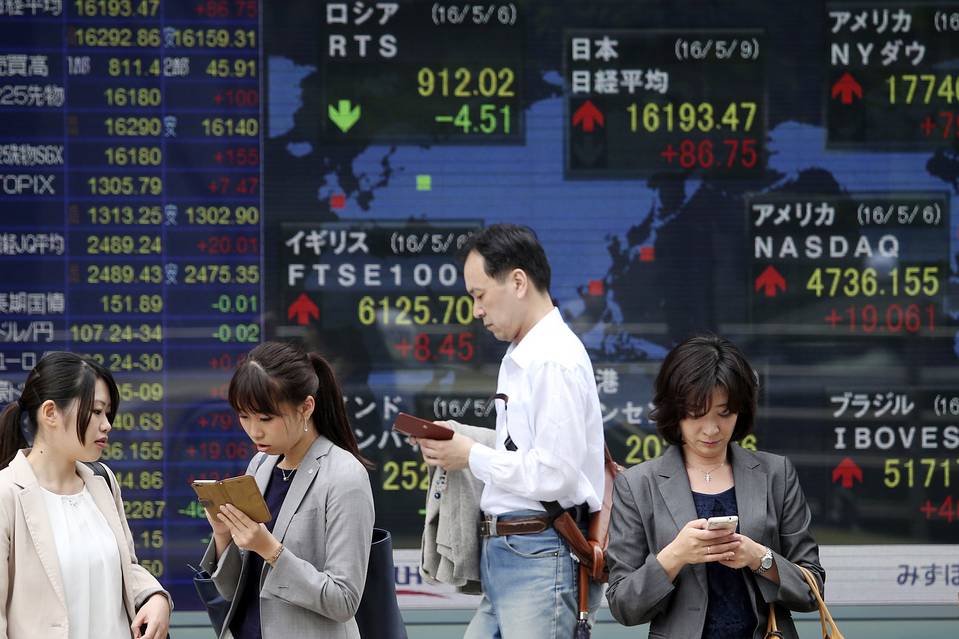
Asian stocks recovered from a weak start to close broadly higher on Tuesday as hopes for Chinese stimulus helped offset fresh worries over the trade war between the U.S. and China.

U.S. President Donald Trump said he thinks there will be ?a great deal? with China on trade but warned of more tariffs if talks next month fail to ease the trade war.

China?s Shanghai Composite Index jumped 25.94 points or 1 percent to 2,568.05 after the securities regulator said it would enhance market liquidity and encourage share buybacks and mergers and acquisitions by listed firms. However, Hong Kong’s Hang Seng Index dropped 226.51 points or 0.9 percent to 24,585.53.

Japanese shares rose by the most in 2-1/2 months as the yen extended its drop against the dollar and Chinese equities rebounded on fresh attempts by Beijing to stabilize the markets.

The Nikkei 225 Index spiked 307.49 points or 1.5 percent to 21,457.29, marking its biggest single-day gain since mid-August. The broader Topix Index closed 1.4 percent higher at 1,611.46.

Auto companies and banks led the surge, with Honda Motor and Mitsubishi UFJ Financial rising around 2 percent. Machinery maker Yaskawa Electric soared 6.1 percent as Beijing pledged more support for the economy.

Komatsu rallied 6.2 percent after raising its full-year operating profit forecast. Fanuc Corp also advanced 3.4 percent after announcing a special dividend. In the tech sector, Tokyo Electron jumped 6.5 percent and Advantest added 2.2 percent.

In economic news, Japan?s jobless rate fell to 2.3 percent in September from 2.4 percent in August, a government report showed. This was the lowest rate since the early 1990s.

Australian shares rallied to extend gains from the previous session. The benchmark S&P/ASX 200 Index surged up 76.90 points or 1.3 percent to 5,805.10 after jumped 1.1 percent the previous day. The broader All Ordinaries Index advanced 74.10 points or 1.3 percent to 5,887.90.

Firmer copper prices helped lift mining stocks, with heavyweights BHP Billiton and Rio Tinto gaining around 2 percent.

Energy stocks also closed mostly higher even as oil prices dipped for a second day amid signs that Russian oil output will remain high. Beach Energy shares jumped 10.4 percent. In the healthcare sector, infant formula maker Bellamy’s Australia climbed 2.5 percent.

Lender Australia and New Zealand Banking Corp rallied 1.8 percent ahead of its full-year results due Wednesday. Commonwealth and Westpac surged up over 2 percent.

On the other hand, gold miner Evolution Mining lost 2.9 percent and Newcrest dropped 1.5 percent as the precious metal edged lower on dollar strength.

Wealth manager AMP fell 2.1 percent on news that its banking arm will reduce or remove 20 fees to simplify its product offering to customers.

On the data front, Australia’s building approvals rose by seasonally adjusted 3.3 percent in September, slower than the 3.8 percent rise economists had expected, figures from the Australian Bureau of Statistics showed. The increase largely reflects a 9.2 percent rise in private dwellings excluding houses.


Dipo Olowookere is a journalist based in Nigeria that has passion for reporting business news stories. At his leisure time, he watches football and supports 3SC of Ibadan. Mr Olowookere can be reached via [email protected]

Economy

NGX Group Advances Investor Education Drive with Digital Retail Engagement Initiative

Published

on

NGX Group Shares

Nigerian Exchange Group has intensified its investor education drive through a digital engagement initiative aimed at improving financial literacy and deepening retail participation in the Nigerian capital market.

The Group recently hosted an X Space session themed Follow the Fundamentals: A Beginner’s Guide to the Stock Market, reaching over 5,000 users, largely young Nigerians, first-time investors, and retail market participants seeking to better understand investment opportunities in the capital market.

Featuring social media investment influencer Omiete Inko-Tariah, alongside representatives from Nigerian Exchange Limited and NGX Regulation Limited, the session demystified key concepts around market operations, investor protection, and safe participation. Beyond education, it served as an open forum where retail investors engaged directly with market stakeholders on issues of confidence, transparency, and accessibility.

Speaking on the initiative, Clifford Akpolo, Head, Group Communications and Partnerships at NGX Group, said: “Deepening retail participation is critical to building a more resilient, inclusive, and sustainable capital market. At NGX Group, we believe financial literacy is not just an educational responsibility; it is a strategic imperative for strengthening investor confidence, improving market accessibility, and expanding long-term wealth creation opportunities for Nigerians. Through digital platforms like this, we are leveraging innovation to connect with the next generation of investors and democratize access to market knowledge.”

The initiative forms part of NGX Group’s broader sustainability agenda under its Community pillar, which focuses on advancing financial literacy, inclusion, and economic empowerment through education-driven and stakeholder-focused programmes.

Following the success of this edition, NGX Group plans to sustain similar engagements as part of its ongoing commitment to strengthening investor confidence, deepening retail participation, and building a more resilient and inclusive investment ecosystem.

Continue Reading

Economy

NGX Posts Turnover of 7.772 billion Equities Worth N374bn in Five Days

Published

on

VFD Group Lists NGX

By Dipo Olowookere

A total turnover of 7.772 billion equities worth N374.040 billion in 402,945 deals was recorded by the Nigerian Exchange (NGX) Limited last week compared with the 7.075 billion equities worth N324.351 billion traded in 474,436 deals a week earlier.

Data from the stock exchange showed that the financial services industry led the activity chart with 4.774 billion shares valued at N196.352 billion in 153,515 deals, contributing 61.43 per cent and 52.49 per cent to the total trading volume and value, respectively.

The ICT segment followed with 1.118 billion stocks worth N57.825 billion in 44,622 deals, and the services sector transacted 601.745 million equities for N6.984 billion in 27,653 deals.

First Holdco, UBA, and Chams accounted for 2.195 billion shares worth N99.820 billion in 30,056 deals, contributing 28.24 per cent and 26.69 per cent to the total trading volume and value, respectively.

Berger Pains led the gainers’ chart after gaining 55.57 per cent to trade at N168.95, SCOA Nigeria improved by 45.92 per cent to N33.05, DAAR Communications expanded by 42.41 per cent to N2.25, Fidson rose by 32.52 per cent to N136.50, and Learn Africa grew by 32.32 per cent to N10.85.

On the flip side, Zichis led the losers’ table after it gave up 11.78 per cent to settle at N29.43, The Initiates declined by 10.03 per cent to N32.30, NPF Microfinance Bank depreciated by 10.00 per cent to N5.76, NCR Nigeria shed 10.00 per cent to quote at N179.10, and Custodian Investment crashed by 9.52 per cent to N81.25.

At the close of transactions in the five-day trading week, 74 equities appreciated versus 69 equities in the previous week, 24 stocks depreciated versus 36 stocks a week earlier, and 48 shares closed flat versus 41 shares of the preceding week.

Last week, the All-Share Index (ASI) gained 2.27 per cent to finish at 250,330.92 points, and the market capitalisation chalked up 2.13 per cent to end at N160.444 trillion.

Similarly, all other indices finished higher apart from the energy, sovereign bond, and commodity indices, which fell by 1.19 per cent, 0.08 per cent and 0.80 per cent, respectively.

Continue Reading

Economy

CPPE Warns CBN Against Further Rate Hikes as MPC Meeting Kicks Off

Published

on

muda yusuf

By Adedapo Adesanya

The Centre for the Promotion of Private Enterprise (CPPE) has urged policymakers to adopt a cautious approach to further interest rate hikes, warning that rising political spending ahead of the 2027 elections and growing geopolitical tensions could complicate monetary policy decisions.

The Monetary Policy Committee (MPC) of the central bank will hold its 305th meeting starting Monday, May 19 (today) to Tuesday, May 20, after which the monetary policy decisions will be announced.

The centre said while inflation control remains critical, excessive monetary tightening could weaken credit growth, discourage private investment and slow Nigeria’s fragile economic recovery.

Last week, the National Bureau of Statistics (NBS) said the country’s inflation increased to 15.69 per cent in April amid the impact of the continued tension in the Middle East.

According to the chief executive of CPPE, Mr Muda Yusuf, the MPC will need to carefully weigh domestic economic realities alongside global developments before taking any decision on rates.

He stated that geopolitical tensions involving the United States, Israel and Iran were already fueling uncertainty in the global energy market, with rising crude oil prices expected to increase domestic energy, logistics and production costs, noting that the global developments could further intensify inflationary pressures within the Nigerian economy.

On the domestic front, Mr Yusuf said signs of rising liquidity linked to preparations for the 2027 general elections are becoming more evident, explaining that political spending by candidates and parties, combined with increasing allocations from the Federation Account Allocation Committee (FAAC) to state governments, could create fresh liquidity management and inflation challenges for monetary authorities.

“Indications of increased liquidity related to the upcoming 2027 elections are becoming more prominent. Political spending from candidates and parties, coupled with enhanced disbursements from FAAC to state governments, presents important considerations for liquidity management and inflation control,” he said.

Mr Yusuf stated that, given the current environment, there is a strong possibility that the MPC may either retain the current policy stance or opt for only moderate tightening.

The CPPE warned that sustained high interest rates could hurt economic growth, weaken industrial productivity and undermine job creation and acknowledged the need to manage inflation expectations

The centre argued that Nigeria’s inflation challenges are largely supply-driven, particularly due to high energy costs, logistics bottlenecks and structural inefficiencies, limiting the effectiveness of aggressive monetary tightening.

According to Mr Yusuf, monetary tightening is generally more effective in tackling demand-pull inflation than supply-side inflation.

He stressed that higher interest rates could increase borrowing costs for businesses, reduce manufacturing competitiveness, constrain small and medium-scale enterprises and discourage investment at a time when the economy requires stronger productivity growth.

The CPPE also warned that elevated rates could heighten the risk of loan defaults and place additional pressure on businesses already struggling with high operating costs.

Mr Yusuf advocated a more balanced and development-focused monetary policy framework suited to the realities of emerging economies like Nigeria, where infrastructure gaps, weak productive capacity, unemployment and financing constraints remain major challenges.

He maintained that sustainable disinflation in Nigeria would depend more on supply-side reforms, energy security, improved logistics, stable exchange rates and increased domestic refining capacity than solely on aggressive monetary tightening.

“The primary focus should be on fostering investor confidence, encouraging productive investments, enhancing output growth and improving the economy’s supply-side capacity while remaining attentive to inflation management,” he said.

Continue Reading

Trending