Economy
BUA Foods 9-Month Profit Grows Amid Cut in Staff Welfare, Others
By Dipo Olowookere
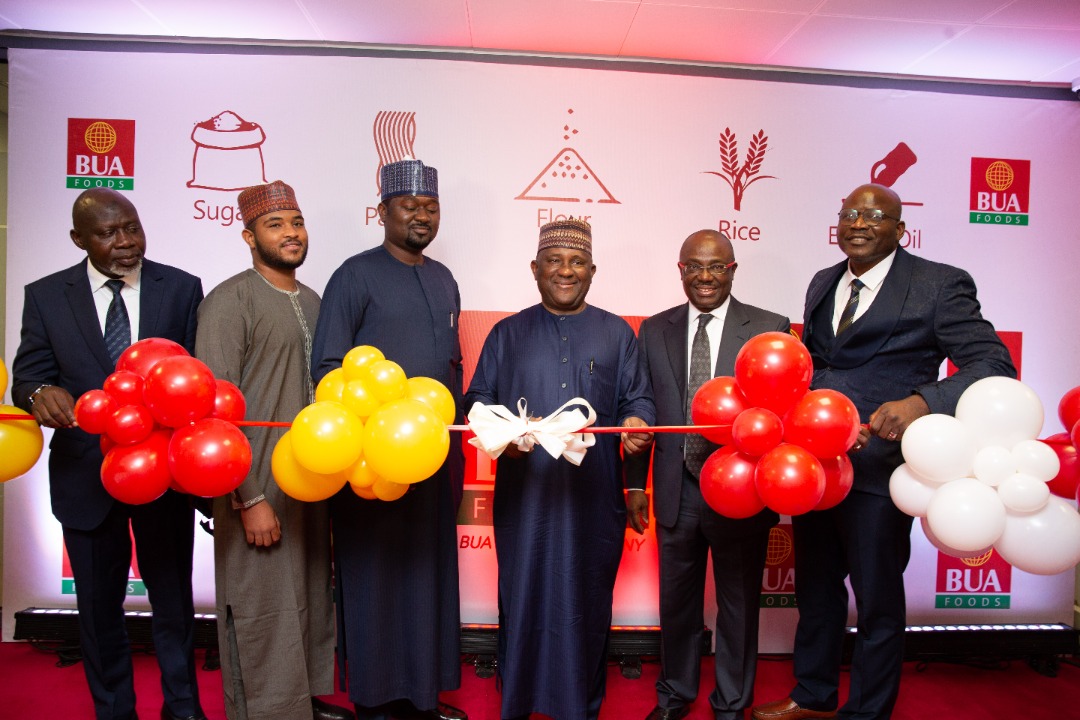
The recently-listed BUA Foods Plc on Monday released its financial statements for the first nine months of its 2021 fiscal year ended September 30.
Details of the result filed to the Nigerian Exchange (NGX) Limited showed that the BUA Foods 9-month profit increased to N16.6 billion from N15.5 billion in the corresponding period of 2020, though the profit netted in the quarter, between July and September, went down to N4.6 billion from N6.1 billion in the same quarter of the preceding year.
Business Post observed that in the nine-month period under review, the company cut down its administrative expenses to N1.4 billion from N2.4 billion and this was mainly due to a slice in the staff welfare & training, electricity, newspaper & periodicals, donations, legal & professional, ITF expenses, diesel & fuel, depreciation and others.
The lower operating costs supported the increase in the operating profit of BUA Foods in the first nine months of last year, which stood at N21.3 billion compared with the N19.0 billion reported in the same period of 2020.
However, the other income line of the financial statements went down to N1.2 billion from N7.9 billion while the finance charges rose to N5.8 billion from N3.4 billion.
As for the top line of the results, the company generated total revenue of N79.7 billion compared with N74.6 billion achieved in the first nine months of the preceding year.
The increase was largely due to the improvement in the earnings from the sales of non-fortified sugar, which raked N57.5 billion versus N22.8 billion in the corresponding period of 2020.
This made up for the decline in the revenue generated from the sales of its fortified sugar (N22.0 billion in Q3 of 2021 versus N51.7 billion in Q3 of 2020), though revenue from the sales of Molasses grew to N221.7 million from N94.1 million.
The results also showed that the cost of sales gulped N57.1 billion as against the N53.2 billion recorded in 2020, while the gross profit rose to N22.6 billion from N21.4 billion.
Economy
Naira Slips 0.1% to N1,358/$1 at Official FX Market
By Adedapo Adesanya
A 0.1 per cent or N1,49 loss was recorded by the Nigerian Naira against the United States Dollar in the Nigerian Autonomous Foreign Exchange Market (NAFEX) on Thursday, June 4, closing at N1,358.75/$1 compared with the previous day’s N1,347.26/$1.
In the same vein, the Naira depreciated against the Pound Sterling in the official FX market during the session by N5.39 to trade at N1,828.06/£1 versus Wednesday’s closing rate of N1,822.67/£1, but gained N6.75 against the Euro to sell at N1,574.83/€1 versus the preceding session’s N1,584.39/€1.
At the black market and GTBank FX desk, the local currency traded flat against the Dollar during the session at N1,375/$1 and N1,372/$1, respectively.
Data from the Central Bank of Nigeria (CBN) showed that NFEM interbank FX turnover contracted to $128.117 million in 121 deals on Thursday from $133.731 million the previous day.
On the positive side, Nigeria’s external reserves moved closer to a 2009 high of $50 billion, enhancing analysts’ confidence about the local currency outlook in the second half of 2026.
This improvement has been helped by heightened global uncertainty, which has reduced the incentive for importers and corporates to demand FX, as cautious trade weighs on import needs. Analysts estimate a $40 billion net FX position for the year, a projection anchored in oil windfall gains.
As for the cryptocurrency market, prices extended steep weekly losses as the broader artificial-intelligence trade that has driven global risk assets since 2026 faltered.
The sell-off was led by equity and currency markets, with semiconductor stocks, Asian indexes and several regional currencies sliding in a broad risk-off shift.
Persistent outflows from US spot Bitcoin ETFs and a rare BTC sale by Strategy have removed a key source of support, leaving markets focused on Friday’s US jobs report for clues on Federal Reserve policy and the fate of the AI trade. The most valued coin slipped 3.6 per cent to $61,914.58.
Cardano (ADA) plunged by 17.6 per cent to $0.1630, Solana (SOL) declined by 7.0 per cent to $65.69, Ethereum (ETH) slipped by 6.9 per cent to $1,666.13, Dogecoin (DOGE) went down by 6.5 per cent to $0.8445, and Ripple (XRP) crashed by 6.5 per cent to $1.11.
Further, Binance Coin (BNB) slumped by 4.3 per cent to $581.45, and TRON (TRX) dropped 1.9 per cent to sell at $0.3261, while the US Dollar Tether (USDT) and the US Dollar Coin (USDC) gained 0.01 per cent each to sell at $0.9990 and $0.9998, respectively.
Economy
Brent Settles at $95, WTI at $93 as Middle East Tensions Ease
By Adedapo Adesanya
The price of the crude oil benchmarks moderated by about 3 per cent on Thursday on investor hopes for an end to the United States-Israeli war with Iran that could reopen the Strait of Hormuz, following a ceasefire deal between Israel and Lebanon.
Brent futures lost $2.78 or 2.84 per cent to trade at $95.03 per barrel, while the US West Texas Intermediate (WTI) crude declined by $2.98 or 3.1 per cent to close at $93.04 per barrel.
Israel and Lebanon said they have agreed to implement a ceasefire on Wednesday, raising hopes for a deal between the US and Iran. Iran has made any agreement conditional in part on an end to fighting between Israel and Hezbollah, an Iran-aligned group in Lebanon. However, Israeli strikes in southern Lebanon continued on Thursday.
Iran signalled that there has been “no tangible progress” in the talks with the Americans on a potential deal, while the Israel-Lebanon ceasefire announced by the United States overnight appears shaky.
“No tangible progress has been achieved in the negotiation process,” Iran’s Foreign Minister Abbas Araghchi was quoted as saying by the semi-official Iranian news agency Tasnim.
The US and Iran have been exchanging messages on a framework proposal for a potential agreement for weeks. The oil market has reacted to each signal or hint of a breakthrough with sell-offs that sent Brent Crude prices to below $100 per barrel last week.
Despite the market hopes, the positions of the two sides appear to remain very distant, and a re-opening of the Strait of Hormuz is not imminent.
Earlier this week, Iran targeted civilian infrastructure in Kuwait and Bahrain, and alarms were raised at US military bases in Saudi Arabia, as Iran responded to the Israeli offensive in Lebanon.
The Republican-led US House of Representatives approved a resolution to block President Donald Trump from continuing the war against Iran. To take effect, the resolution would need Senate approval and a two-thirds majority in both chambers to override an almost certain Trump veto.
The Organisation of the Petroleum Exporting Countries (OPEC) expects robust oil demand growth and is not changing its estimate, according to its Secretary General, Haitham Al Ghais, on Thursday.
Economy
Dangote Refinery Raises Crude Oil Processing Capacity to 700,000bpd
By Adedapo Adesanya
Dangote Petroleum Refinery & Petrochemicals has increased its crude oil processing capacity to 700,000 barrels per day, exceeding its nameplate capacity of 650,000 barrels per day, reinforcing its position as the world’s largest single-train petroleum refinery.
The milestone was achieved during a performance test conducted by the refinery’s process licensors, highlighting the facility’s operational efficiency and ability to process additional feedstock while optimising output across its production units.
Vice President, Oil and Gas, Dangote Industries Limited, Mr Devakumar Edwin, said the increase forms part of a broader expansion strategy aimed at raising the refinery’s capacity to 1.4 million barrels per day within the next 30 months.
According to him, the planned expansion is expected to strengthen Nigeria’s energy security, eliminate dependence on imported refined petroleum products and position the country as a major regional export hub.
Mr Edwin noted that the refinery’s growth trajectory reflects ambitions that extend beyond meeting domestic demand, with a focus on establishing continental and global refining leadership.
The refinery, owned by billionaire Aliko Dangote, began fuel production in 2024 and has since scaled up output of petrol, diesel and jet fuel.
It supplies domestic markets and exports to African countries and Europe, including the United Kingdom, France and the Netherlands, while also shipping products to the United States and Saudi Arabia.
The refinery has also supplied petrol (called gasoline) to the United States and jet fuel to Saudi Arabia, further expanding its global footprint.
Dangote Refinery’s growing output has strengthened its role in stabilising fuel supply across Africa, particularly amid disruptions linked to geopolitical tensions in the Middle East. Industry observers say the facility has increasingly become a key source of energy security for several African nations.
Recall that Dangote Petroleum Refinery emerged as the world’s largest exporter of jet fuel in April, according to S&P Global Commodities.
The refinery has also contributed to reducing Nigeria’s dependence on imported fuel, easing pressure on foreign exchange reserves and supporting broader efforts to maximise value from the country’s crude oil resources.
Growing production levels have attracted interest from global crude suppliers and commodity trading firms, with the refinery sourcing feedstock from both domestic and international producers to sustain rising output.
Looking ahead, Dangote has outlined plans to transform the facility into the world’s largest refinery by 2028, with a targeted processing capacity of 1.4 million barrels per day.
The expansion is expected to generate significant economic benefits through increased industrial activity, job creation, export earnings and improved trade balances.
Beyond fuels, the refinery is also expected to strengthen downstream manufacturing through the supply of liquefied petroleum gas (LPG), polypropylene and other industrial feedstocks used in the production of packaging materials, consumer goods and detergents. Future plans also include the production of Linear Alkylbenzene (LAB), a key raw material in detergent manufacturing.
-
Feature/OPED6 years agoDavos was Different this year
-
Travel/Tourism10 years ago
Lagos Seals Western Lodge Hotel In Ikorodu
-
Showbiz3 years agoEstranged Lover Releases Videos of Empress Njamah Bathing
-
Banking8 years agoSort Codes of GTBank Branches in Nigeria
-
Economy3 years agoSubsidy Removal: CNG at N130 Per Litre Cheaper Than Petrol—IPMAN
-
Banking3 years agoSort Codes of UBA Branches in Nigeria
-
Banking3 years agoFirst Bank Announces Planned Downtime
-
Sports3 years agoHighest Paid Nigerian Footballer – How Much Do Nigerian Footballers Earn