Economy
CBN Postpones MPC Meeting to November 21
By Dipo Olowookere
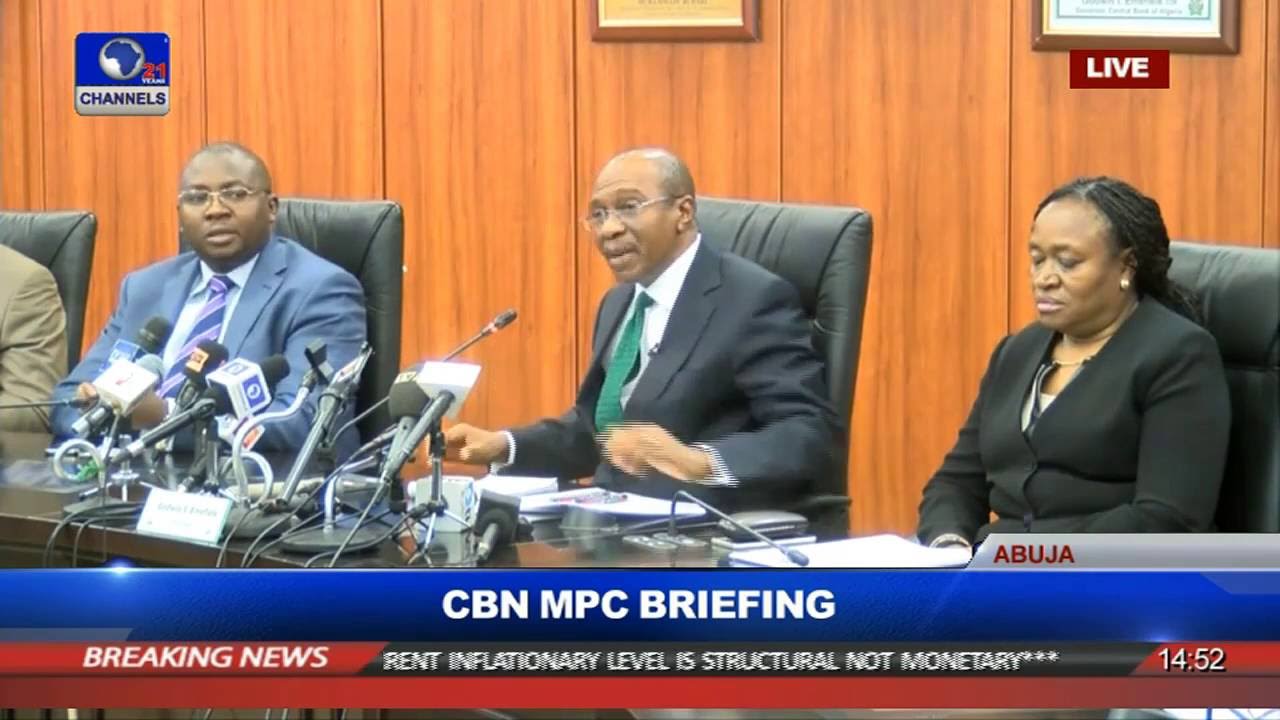
The Central Bank of Nigeria (CBN) has shifted the dates for its last Monetary Policy Committee (MPC) meeting for 2018 to another period.
The crucial meeting was supposed to commence on Monday, November 19, and end on Tuesday, November 20, 2018.
However, as a result of the public holiday declared by the federal government for Tuesday, November 20, the apex bank has now postponed the gathering.
According to a statement issued on Saturday by its spokesman, Mr Isaac Okorafor, the central bank said the MPC meeting will now take place on Wednesday, November 21 and end on Thursday, November 22, 2018.
“The November 2018 meeting of the Monetary Policy Committee (MPC) of the Central Bank of Nigeria (CBN) has been rescheduled from Monday and Tuesday, 19th & 20th November to Wednesday and Thursday, 21st and 22nd November, 2018, as a result of the declaration of Tuesday, 20th November, 2018, as a public holiday by the Federal Government.
“The CBN regrets any inconvenience this change may have caused its stakeholders and the general public,” Mr Okorafor said in the statement.
During the MPC meeting, observers will be watching if the central bank will want to adjust the benchmark interest rate this time from 14 percent, especially with the rising inflation rate in the country.
Economy
LCCI Opposes Pension Contribution Hike, Cites Inflation, High Costs
By Adedapo Adesanya
The Lagos Chamber of Commerce and Industry (LCCI) has urged the federal government to suspend plans to increase Nigeria’s mandatory pension contribution rate.
The chamber’s Director General, Dr Chinyere Almona, warned that the move could worsen the challenges facing businesses, threaten jobs and discourage investment.
She noted that while improving retirement security is important, raising pension contributions at a time when businesses are grappling with soaring inflation, extremely high borrowing costs, exchange rate volatility, rising energy prices and multiple taxes would place an unbearable burden on employers.
According to the DG, Nigeria’s existing contribution rate is already comparable with global standards, noting that the country’s 18 per cent mandatory contribution is close to the OECD’s 18.8 per cent average and significantly higher than rates in countries such as the United Kingdom (8 per cent), the United States (12.4 per cent) and Kenya (12 per cent).
She warned that increasing payroll costs at this time would discourage recruitment, suppress wage growth, place disproportionate pressure on micro, small and medium-sized enterprises (MSMEs), reduce Nigeria’s attractiveness to investors and push more businesses into the informal sector.
The advocacy group called on the government to defer the proposal until a comprehensive Nigeria-specific actuarial and economic impact assessment is conducted and extensive consultations are held with the organised private sector and labour unions.
The group recommended that instead of increasing mandatory contributions, the National Pension Commission (PenCom) should focus on developing innovative investment instruments capable of delivering higher returns on existing pension assets, saying this would improve contributors’ retirement savings without imposing additional financial pressure on businesses.
PenCom had recently proposed an increase in mandatory pension contributions as well as a 3 per cent mandatory annual contribution equivalent to 3 per cent of the total wage bill.
According to the insurance regulator, the proposal forms part of broader pension sector reforms designed to strengthen the financial security of Nigerian workers in retirement.
LCCI’s opposition to this proposed policy comes after the Organised Private Sector of Nigeria expressed its disdain over the issue, also citing rising inflation and economic hardship for its rejection.
Economy
Nigeria to Import 154m Litres of Petrol Despite Rising Local Refining Capacity
By Adedapo Adesanya
Nigeria will receive about 154.2 million litres of imported Premium Motor Spirit (PMS) this week despite increased domestic refining capacity driven by the Dangote Petroleum Refinery.
The latest Nigerian Ports Authority (NPA) shipping schedule shows that five petrol-laden vessels carrying a combined 115,000 metric tonnes of PMS are expected to berth at Tin Can Island Port in Lagos and Calabar Port between Monday and Wednesday.
The continued inflow of imported petrol highlights how marketers are balancing local supplies with overseas purchases based on pricing, availability and commercial considerations, even as domestic refining capacity expands.
According to the NPA’s Daily Shipping Schedule – Vessels Expected, four vessels will discharge their cargoes at the KLT Phase 3A terminal in Tin Can Island, while one vessel is scheduled to berth at the North West Petroleum & Gas terminal in Calabar.
The vessel LESTE is expected to arrive on Monday with 30,000 metric tonnes of PMS, equivalent to about 40.23 million litres, while BORA will deliver 10,000 metric tonnes, or approximately 13.41 million litres, to the same terminal.
On Tuesday, ST ILHAAM is scheduled to discharge another 30,000 metric tonnes (about 40.23 million litres), followed by STELLAR, which is expected on Wednesday with an additional 30,000 metric tonnes, also translating to roughly 40.23 million litres.
At Calabar Port, SL AREMU is expected to berth on Tuesday with 15,000 metric tonnes of PMS, equivalent to approximately 20.12 million litres, at the North West Petroleum & Gas terminal.
The shipping schedule also lists STELLAR at the Dangote terminal in Lekki Deep Sea Port with an arrival date of July 24.
However, its cargo status is marked “INB”, indicating the vessel is in ballast and not carrying cargo, suggesting it may be positioning to load refined products rather than discharge them.
The latest imports come as Nigeria continues to operate a liberalised downstream petroleum market that allows marketers to source products from either domestic refineries or international suppliers.
Industry operators have consistently argued that imports remain necessary to guarantee supply, encourage competition and take advantage of favourable pricing opportunities.
The Nigerian Midstream and Downstream Petroleum Regulatory Authority (NMDPRA) has also maintained that the market remains open to all qualified operators, with fuel prices expected to reflect prevailing market conditions.
Although local refining output has risen significantly following the ramp-up of the 700,000 barrels per day Dangote refinery and ongoing rehabilitation of government-owned refineries, imported petrol continues to account for a portion of Nigeria’s fuel supply, reflecting the competitive dynamics of the deregulated market.
Economy
FrieslandCampina, Afriland Properties Drive NASD Exchange 1.11% Higher
By Adedapo Adesanya
The duo of FrieslandCampina Wamco Nigeria Plc and Afriland Properties Plc lifted the NASD Over-the-Counter (OTC) Securities Exchange by 1.11 per cent on Monday, July 27.
FrieslandCampina Wamco Nigeria, the milk producer famed for Peak Milk and Three Crowns, added N13.61 to its share price to sell for N149.80 per unit compared with the previous session’s N136.19 per unit, and Afriland Properties Plc grew by N1.60 to N19.01 per share from N17.41 per share.
The two securities offset the 30 Kobo loss posted by Nitrox Industrial Gases Plc. This stock closed at N20.00 per unit compared with last Friday’s closing value of N20.30 per unit.
As a result, the market capitalisation of the trading platform went up by N28.72 billion to N2.606 trillion from N2.577 trillion, and the NASD Security Index (NSI) increased by 47.85 points to 4,342.60 points from 4,294.75 points.
The first trading session of the week witnessed a drop in activity level, as the volume of securities crashed by 79.8 per cent to 604,565 units from 2.99 million units, the value of securities declined by 71.7 per cent to N19.6 million from the preceding session’s N69.4 million, and the number of deals dipped by 40 per cent to 33 deals from 55 deals.
At the close of trades, Great Nigeria Insurance (GNI) Plc remained the most traded stock by value on a year-to-date basis, with a turnover of 3.4 billion units valued at N8.4 billion, followed by Infrastructure Credit Guarantee (Infracredit) Plc with 2.3 billion units sold for N6.5 billion, and Central Securities Clearing Systems (CSCS) Plc with 75.6 million units exchanged for N5.4 billion.
GNI Plc was also the traded stock by volume on a year-to-date basis, with the sale of 3.4 billion units worth N8.4 billion, followed by Infracredit Plc with 2.3 billion units transacted for N6.5 billion, and Resourcery Plc with 1.1 billion units traded for N415.7 million.