Connect with us

Economy

Dangote to List Refinery on NGX, Says NNPC Won’t Take Beyond 20% Stake

Published

on

Dangote Refinery

By Dipo Olowookere

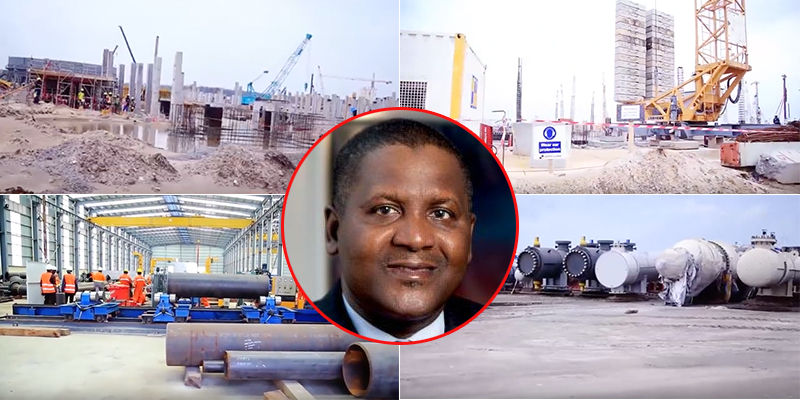
Dangote Refinery and Petrochemical Limited will be listed on the floor of the Nigerian Exchange (NGX) Limited in the future, the Chairman of the company, Mr Aliko Dangote, has revealed.

Mr Dangote, who is the richest man in Africa, confirmed this in an interview with the Financial Times published on Saturday.

The refinery will join other businesses of Mr Dangote currently trading their equities on the NGX, Dangote Cement, Dangote Sugar, and NASCON.

The oil facility, believed to be worth about $20 billion, was launched in May 2023 by the immediate past president of Nigeria, Mr Muhammadu Buhari, though it is yet to commence operations.

A few weeks ago, it was reported that the refinery was starved of crude oil supply by the Nigerian National Petroleum Company (NNPC) Limited, one of its major shareholders, frustrating its commencement of the production of premium motor spirit (PMS), otherwise known as petrol, which the country desperately needs as it currently relies on the importation of the commodity from Europe, especially from the Netherlands and Belgium.

But in the interview, Mr Dangote confirmed that this issue has been resolved, announcing that the refinery may begin to supply the nation diesel, kerosene and jet fuel from December 2023, which is just a few days away.

“We’re starting with 350,000 barrels a day. [We have sealed a deal for the first cargo of about 6mn barrels [for delivery in December],” he was quoted as saying.

According to him, “We have resolved all the issues of supply [with the NNPC,]” he said, refusing to blame the state-owned oil-firm for the difficulties in supplying crude oil to the refinery.

“Let’s not have the blame game here,” he declared in the interview.

However, he expressed optimism that the oil facility would be a game-changer for Nigeria, especially when it is listed on the domestic stock exchange, stressing that the NNPC was not attempting to increase its stake in the organisation with the supply-restriction tactics.

Recall that in 2021, the NNPC acquired a 20 per cent equity stake in Dangote Refinery for about $2.76 billion, and there have been speculations that the firm was planning to increase its shares in the company, which has the capacity to produce 650,000 barrels of crude oil per day and could generate $25 billion a year.

But Mr Dangote, who is 66, played down these rumours, saying, “I don’t think NNPC needs to buy more shares. I think they’re OK with what we’ve given them.”

Business Post reports that the commencement of production date of Dangote Refinery has been shifted more than three times in 2023.

In August 2022, the NNPC said the oil facility would begin operations by mid-2023, but this did not happen and at the commissioning of the refinery on May 22, 2023, in Lagos, Mr Dangote said the first product from the mega-complex structure “will be in the market before the end of July, beginning of August this year”.

In September 2023, the Dangote Group Executive Director, Mr Devakumar Edwin, told S&P Global Commodity Insights that the refinery will kick off production with 350,000 – 370,000 barrels per day of diesel and jet fuel by October, when the crude distillation unit, sulfur block and hydrogen plant should be online.


Dipo Olowookere is a journalist based in Nigeria that has passion for reporting business news stories. At his leisure time, he watches football and supports 3SC of Ibadan. Mr Olowookere can be reached via [email protected]

Economy

NASD Unlisted Security Index Crosses 4,000-point Benchmark Again

Published

on

NASD Unlisted Security Index

By Adedapo Adesanya

The NASD Over-the-Counter (OTC) Securities Exchange achieved a milestone on Friday, April 24, 2026, after five securities on the platform helped with a 1.85 per cent growth.

Data showed that the NASD Unlisted Security Index (NSI) again crossed the 4,000-point benchmark yesterday.

The index chalked up 73.64 points during the trading day to close at 4,052.59 points compared with the preceding session’s 3,978.95 points, while the market capitalisation added N5.38 billion to finish at N2.424 trillion versus Thursday’s closing value of N2.380 trillion.

The price gainers were led by Okitipupa Plc, which grew by N25.00 to sell at N305.00 per share compared with the previous price of N280.00 per share. Central Securities Clearing System (CSCS) Plc gained N6.92 to close at N76.26 per unit versus N69.34 per unit, Afriland Properties Plc appreciated by N1.00 to N17.00 per share from N18.00 per share, FrieslandCampina Wamco Nigeria Plc improved by 55 Kobo to N99.55 per unit from N99.00 per unit, and Food Concepts Plc increased by 5 Kobo to N2.70 per share from N2.65 per share.

However, there was a price loser, MRS Oil, which dipped by N21.75 to N195.75 per unit from N217.50 per unit.

During the final session of the week, the value of securities jumped 75.2 per cent to N41.3 million from N23.6 million units, and the number of deals expanded by 62.9 per cent to 44 deals from 27 deals, while the volume of securities declined marginally by 0.9 per cent to 447,403 units from 451,522 units.

At the close of trades, Great Nigeria Insurance (GNI) Plc was the most traded stock by volume (year-to-date) with 3.4 billion units worth N8.4 billion, trailed by Resourcery Plc with 1.1 billion units valued at N415.7 million, and Infrastructure Guarantee Credit Plc with 400 million units traded for N1.2 billion.

GNI was also the most active stock by value (year-to-date) with 3.4 billion units sold for N8.4 billion, followed by CSCS Plc with 59.6 million units transacted for N4.0 billion, and Okitipupa Plc with 27.8 million units exchanged for N1.9 billion.

Continue Reading

Economy

Naira Slips to N1,358/$1 as FX Reserves, Policy Uncertainty Concerns

Published

on

Naira-Yuan Currency Swap Deal

By Adedapo Adesanya

It was not a good day for the Nigerian Naira in the currency market on Friday, April 24, as its value depreciated against the major foreign currencies at the close of transactions.

In the Nigerian Autonomous Foreign Exchange Market (NAFEX), it lost N4.53 or 0.33 per cent against the United States Dollar yesterday to trade at N1,358.44/$1, in contrast to the N1,353.91/$1 it was exchanged on Thursday.

Equally, the domestic currency slipped against the Pound Sterling in the official market during the session by N8.14 to close at N1,834.02/£1, compared with the previous rate of N1,825.88/£1 and dropped N8.01 against the Euro to sell at N1,590.73/€1 versus N1,582.72/€1.

Also, the Naira depreciated against the US Dollar at the GTBank FX desk on Friday by N4 to quote at N1,370/$1 compared with the previous session’s N1,366/$1, and at the parallel market, it depleted by N5 to settle at N1,380/$1 versus the preceding day’s N1,375/$1.

Data published by the Central Bank of Nigeria (CBN) indicated that NFEM interbank turnover surged to N43.562 million across 68 deals, up from N28.117 million the previous day.

Despite the CBN’s reassurance that the recent drop in external reserves is not worrisome, the market remains unsettled by persistent concerns over liquidity constraints, policy transparency, and weakening confidence in Nigeria’s FX market as gross reserves continue to decline to $48.4 billion.

The outlook for the Dollar appears supported by broader macro risks, including elevated oil prices tied to the tanker traffic disruptions in the Strait of Hormuz and a continued US-Iran standoff over ceasefire negotiations.

A look at the digital currency market showed that investors are sitting on the edge as the US Dollar rebounded amid geopolitical and inflation risks despite continued inflows into US spot bitcoin Exchange Traded Funds (ETFs).

Solana (SOL) rose by 1.2 per cent to sell $86.45, Cardano (ADA) appreciated by 1.1 per cent to $0.2517, Dogecoin (DOGE) grew by 0.9 per cent to $0.0989, Ripple (XRP) improved by 0.3 per cent to $1.43, Ethereum (ETH) soared by 0.2 per cent to $2,316.83, and Binance Coin (BNB) chalked up 0.1 per cent to sell for $637.44.

However, TRON (TRX) depreciated by 1.3 per cent to $0.3235, and Bitcoin (BTC) lost 0.2 per cent to close at $77,562.27, while the US Dollar Tether (USDT) and the US Dollar Coin (USDC) closed flat at $1.00 each.

Continue Reading

Economy

Oil Market Mixed Amid Supply Disruptions, US–Iran Peace Talk Prospects

Published

on

crude oil market

By Adedapo Adesanya

The oil market was mixed on Friday as traders weighed supply disruptions against the potential restart of peace talks between the US and Iran that could help limit those shortfalls.

Brent crude futures settled at $105.33 a barrel after rising by 26 cents or 0.3 per cent, while the US West Texas Intermediate (WTI) crude futures traded at $94.40 ​a barrel after falling by $1.45 or 1.5 per cent. For the week, Brent gained about 16 per cent and WTI rose nearly 13 per cent.

Reuters reported that Iranian Foreign Minister Abbas Araqchi was expected to arrive ⁠in Islamabad late on Friday to discuss proposals for resuming peace talks with the U.S. after talks collapsed earlier this ​week.

Also, CNN reported that US President Donald Trump was sending special envoy Steve Witkoff and Jared Kushner to ​Pakistan for talks with Iran’s foreign minister.

The American President also told Reuters on Friday that Iran plans to make an offer aimed at satisfying US demands. On Thursday, he said Iran may have loaded up its weaponry “a little bit” during a two-week ceasefire, but added that the US military could eliminate it in a single day. ​On Wednesday, he said he would indefinitely extend the ceasefire to allow for further peace ​talks.

Meanwhile, navigation through the Strait of Hormuz, which before the war carried about a fifth of global oil output, remains effectively blocked.

Iran’s Islamic Revolutionary Guard Corps seized two container ships – MSC Francesca and Epaminondas – following the US’ seizure of the Iranian cargo ship Touska, putting a drastic halt to attempts to pass through the Strait of Hormuz by non-oil tankers.

The head of the International Energy Agency (IEA), Mr Fatih Birol, said that the Iran war has permanently changed the fossil fuel industry, adding that the damage to confidence in fossil fuel security is permanent, and that countries exposed to the Strait of Hormuz disruption will rethink how much geopolitical risk they are willing to embed in their energy systems.

Analysts from JPMorgan argued that prices may need to rise further to force additional demand destruction. Goldman Sachs estimates Gulf oil production is down 57 per cent from pre-war levels, which are shortage signals, not evidence of a fossil fuel system in retreat.

Continue Reading

Trending