Connect with us

Economy

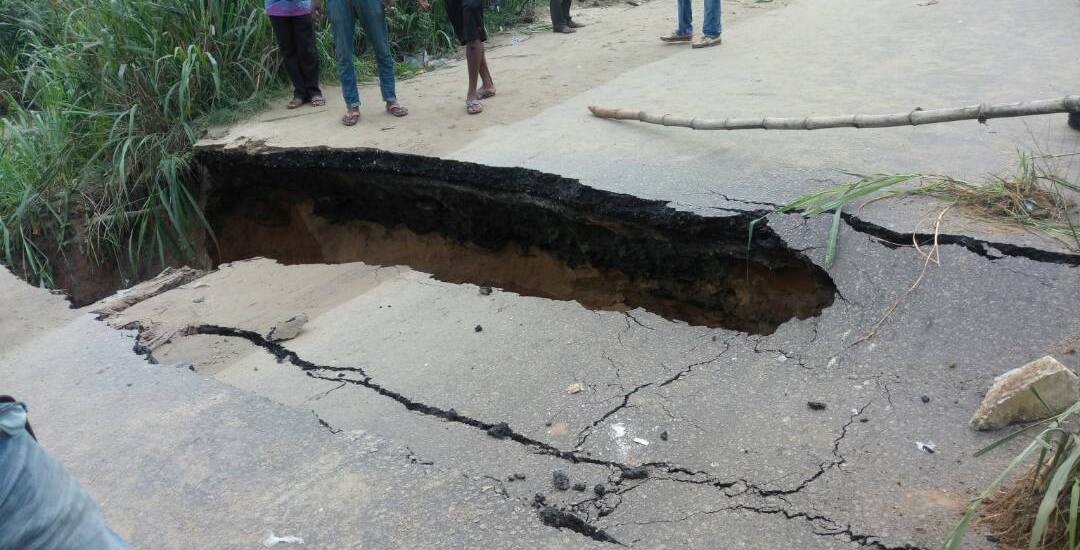
Nigeria Loses $50b Investments to Collapsed East-West Road

Published

on

East-West Road

By Modupe Gbadeyanka

Head of Operations and Technical Services at the Oil and Gas Free Zones (OGFZA), which is the regulator of the Onne Free Zone, Mr Adekunle Ajayi, has revealed that the collapse of a section of the East-West Road in Eleme, Rivers State, has paralysed investments estimated to be over $50 billion in the Eleme-Onne axis of the industrial hub of the state.

That section of the road had been virtually impassable for about two years but it became a real logistic nightmare two weeks ago following the collapse of the bridge that allows access to the two petroleum refineries in Eleme, the Onne Port complex, including Onne Free Zone; the Indorama/Eleme Petro-chemical Plant, Notore Petro-Chemical Industries and many businesses within the corridor.

Mr Ajayi said businesses cut off by the collapse of the East-West Road in Eleme were collectively worth more than $50 billion.

Those businesses, according to him, include Intels, which is the Onne Free Zone developer, the West African Container Terminal (WACT), Brawal Shipping Company, all the IOCs represented in the free zone.

Among government establishments that are equally cut off by the collapsed road are OGFZA, the NPA, Nigeria Customs Service, the Nigerian Naval College, and the Nigeria Immigration Service.

Besides the investments already mentioned, there are lots of sundry businesses and government establishments along the corridor up to Ogoni that are also no longer accessible from Port Harcourt because of the failure of the road.

Commenting on the condition of the road, Managing Director of OGFZA, Mr Umana Okon Umana, said apart from its adverse impact on existing businesses in the axis, the logistic crisis caused by the failed section of the road constitutes a serious deterrence to foreign direct investment which the Federal Government has been campaigning for.

“No foreign investor wants to stake his money where he cannot have access to,” Mr Umana disclosed.

The OGFZA boss said that he has drawn the attention of the Minister of the Niger Delta and the managing director of the Niger Delta Development Commission (NDDC) to the condition of the road, commending the NDDC for its intervention.

However, Mr Umana added that what is needed is a holistic and permanent solution to the bad state of the road.

The terrible condition of the road attracted the attention of the Rivers State Governor, Mr Nyesom Wike, in 2016, who met with investors and government establishments within the axis.

On the prompting of the state governor, the investors and the Rivers State Government contributed N3 billion to assist in the repair of the failed section of the road, which measures about seven kilometres.

A member of the committee that was set up to implement the intervention on the road from the N3 billion collections said the money was disbursed to RCC to carry out repairs of the road.

However, less than two years after, the road has become impassable again. The East-West Road is a Federal Government trunk ‘A’ road, intended to link the South-South, Southeast and Western parts of the country together.


Modupe Gbadeyanka is a fast-rising journalist with Business Post Nigeria. Her passion for journalism is amazing. She is willing to learn more with a view to becoming one of the best pen-pushers in Nigeria. Her role models are the duo of CNN's Richard Quest and Christiane Amanpour.

Advertisement
Click to comment

Leave a Reply

Your email address will not be published. Required fields are marked *

Economy

NNPC E&P Hits 36-year High Record Oil Output of 355,000b/d

Published

on

bayo ojulari nnpc

By Adedapo Adesanya

The flagship upstream subsidiary of the Nigerian National Petroleum Company (NNPC) Limited, NNPC E&P Limited (NEPL), has achieved a record production level of 355,000 barrels of oil per day, its highest daily output since 1989.

The 36-year high milestone, which was achieved on December 1, marks a significant step forward for Nigeria’s upstream sector and reflects the company’s ongoing transformation anchored on efficiency and discipline.

According to a statement signed by Mr Andy Odeh, NNPC’s chief spokesperson, the figures show genuine transformation with average daily production surging by 52 per cent, rising from 203,000 barrels per day in 2023 to 312,000 in 2025.

“This record growth is no coincidence; it stems from a clear strategy anchored on operational excellence, strong asset management, and structured field development. NEPL’s performance demonstrates that with the right leadership, strengthened systems, and a committed workforce, Nigeria’s upstream sector can overcome years of instability,” the statement reads in part.

This comes as the country targets an ambitious production level of 2 million barrels per day by 2027 and 3 million by 2030, with the statement claiming that, “NEPL’s delivery brings them closer to reality.”

Speaking on the development, Mr Bashir Bayo Ojulari, the Group CEO of NNPC Limited pointed out that the milestone is proof that Nigeria’s energy revival is not a dream; it is already happening.

“By showing its ability to exceed its own production benchmarks, NEPL confirms that the essential building blocks for scaling national output are being firmly established. The achievement signals that the machinery of production—equipment, processes, capabilities, and partnerships—can be driven with commercial discipline to produce real and positive outcomes,” Mr Ojulari stated.

The NNPC helmsman noted that the achievement reinforces confidence nationally and across the global energy landscape, assuring partners and investors that Nigeria is committed to reaffirming its role as a dependable energy supplier.

Also speaking, Mr Udy Ntia, the Executive Vice President of upstream operations at the state oil company, observed that the milestone goes beyond the 355,000 barrels per day figure.

“In a sector where shortcuts can yield short-term wins but long-term damage, NEPL is making a different point: sustainable progress must rest on responsible operations. This ensures that scaling production does not compromise worker safety, community wellbeing, or environmental protection. It reinforces a shift away from extraction at any cost towards sustainable value creation—a core requirement for any modern energy company seeking global relevance,” he added.

Adding his input, Mr Nicolas Foucart, MD, NEPL also noted that NEPL’s record-setting performance mirrors the broader transformation unfolding across NNPC Limited.

“This is a story shaped by leadership that charts a clear course; by partnerships built on alignment and accountability; and by a workforce whose hard work is turning goals into measurable progress. Our people, our processes, and principles are the real engines behind this success. We are building for tomorrow, not just celebrating today.”

“For Nigerians, this accomplishment means far more than increased barrels; it translates into greater national revenue, stronger energy security, and a more resilient economic foundation. NEPL has not only produced more hydrocarbons; it has reignited belief in what Nigeria’s energy sector can achieve with the right systems, culture, and dedication,” he added.

Continue Reading

Economy

Helios to Acquire Frigoglass’ Stake in Beta Glass for Up to €100m

Published

on

beta glass

By Adedapo Adesanya

Beta Glass Plc, a leading manufacturer of glass packaging solutions in West and Central Africa, will soon have a new major shareholder as Frigoglass Group has agreed to sell its entire stake in the company to Helios Investment Partners for up to €100 million.

The agreement covers the sale of Frigoglass’ shareholding in Frigoinvest Nigeria Holdings B.V., the parent company of Beta Glass Plc and Frigoglass Industries Nigeria Limited. The business units include glass container manufacturing, plastic crates, and metal crown production.

The deal is subject to regulatory approval and is expected to conclude in the first quarter of 2026.

According to a statement, during the transition period, Beta Glass will continue to work closely with its current owners and partners to ensure smooth operations.

Speaking on this, Mr Gagik Apkarian, founder and Managing Director of Tetrad Capital Partners and Chairman of the Frigoglass Group, described the transaction as the culmination of a three-year transformation programme for the company.

According to him, Beta Glass’ strong financial performance and growth potential attracted “significant interest from domestic and international buyers,” with Helios ultimately emerging as the preferred investor.

Mr Apkarian noted that Helios’ investment is expected to accelerate the company’s future growth, adding that Beta Glass’ 50-year legacy makes it an attractive platform for further value creation.

Also, speaking on the development, Mr Alex Gendis, the chief executive of Beta Glass, welcomed Helios Investment Partners, saying the move aligns with the long-term strategic vision for the business.

He said the transaction “is testament to the underlying growth potential” of Beta Glass and credited Frigoglass for its guidance and support during the company’s transformative years.

Mr Gendis also assured customers, suppliers, and stakeholders that business operations will continue uninterrupted throughout the transition.

The transaction marks a significant shift for Frigoglass, which is divesting from its Nigerian glass operations after a period of intensive restructuring and growth optimisation. It comes a few months after Beta Glass completed the revamp of its DF1 Furnace at Ughelli Plant in 48 days.

Continue Reading

Economy

FG Prohibits Cash Transactions at MDAs, Adopts Electronic Payments

Published

on

cashless transactions

By Adedapo Adesanya

The federal government has banned the use of physical cash for revenue payments and directed all Ministries, Departments, and Agencies (MDAs) to deploy Point of Sale (PoS) terminals within 45 days, as part of a sweeping shift toward full electronic revenue collection.

The directive was contained in four separate treasury circulars issued by the Office of the Accountant-General of the Federation (OAGF) late last month.

In the documents, the Accountant-General, Mr Shamseldeen Ogunjimi, ordered that all payments to the federal government must now be made electronically and routed through platforms approved by the treasury.

According to the first circular, dated November 24, 2025, the government expressed concern over the persistent acceptance of physical cash at MDA revenue points, noting that it contradicts existing policies on e-payment and the Treasury Single Account (TSA). It warned that continued cash collection undermines the integrity of federal electronic payment systems.

The OAGF therefore prohibited the receipt of cash “in Naira or any other currency” for government revenues and mandated MDAs to immediately sensitise staff and the public. Revenue points are to display notices such as “NO PHYSICAL CASH RECEIPT” and “NO CASH PAYMENT.”

It added that MDAs still collecting cash must install functional POS machines or other approved electronic tools within 45 days, with accounting officers held accountable for breaches.

A second circular, dated November 25, 2025, addressed the Treasury’s concern over widespread unauthorised deductions carried out through customised MDA payment platforms. It noted that some MDAs were using front-end applications linked to Payment Solution Service Providers (PSSPs) that deducted charges before remitting balances to the TSA. The OAGF said this has resulted in significant revenue leakages.

The circular ordered MDAs to stop all direct deductions at source and remit revenues in full to designated TSA or Sub-TSA accounts. Any service-related fees must be paid directly by the Treasury rather than through automated deductions.

It also directed that all MDA portals and PSSPs be regularised with the OAGF by December 31, 2025, warning that non-compliance could lead to suspension from GIFMIS and TSA access.

A third circular, issued on November 26, 2025, announced the introduction of a unified Federal Treasury e-Receipt (FTe-R), which will serve as the only valid proof of payment for federal transactions from January 1, 2026. The receipt will be issued via the Revenue Optimisation platform and delivered electronically through channels selected by each MDA.

The fourth circular, dated November 27, 2025, outlined guidelines for the rollout of the new Revenue Optimisation (RevOP) platform, which the government has adopted as the central system for automating billing, reconciliation, and monitoring of MDA accounts.

The platform will integrate with TSA, GIFMIS, the Central Bank of Nigeria, NIBSS, FIRS, and collecting banks, ensuring real-time visibility over government revenues.

MDAs are required to nominate three officers as RevOP focal persons within seven working days, integrate their existing financial systems, and ensure that only CBN-licensed and NITDA-recommended PSSPs approved by the OAGF are used. All PSSPs currently engaged by MDAs must connect to RevOP for immediate harmonisation of federal collections. The Treasury also directed MDAs to submit details of all local and foreign currency accounts within 60 days.

These reforms represent some of the most significant changes to federal revenue administration since the introduction of the TSA. Earlier in March 2025, The PUNCH reported the launch of the Treasury Management & Revenue Assurance System, aimed at streamlining federal revenue and payment processes. The system’s first phase covers naira-denominated transactions, while the second phase—scheduled for June 1, 2025—will expand to foreign currency transactions and integration with MDA enterprise resource platforms.

The Treasury maintained that the new measures are designed to strengthen transparency, curb leakages, and modernise Nigeria’s public financial management framework.

Continue Reading

Trending