Economy
Nigeria to Demand Higher OPEC+ Output Quota at November Meeting
By Adedapo Adesanya
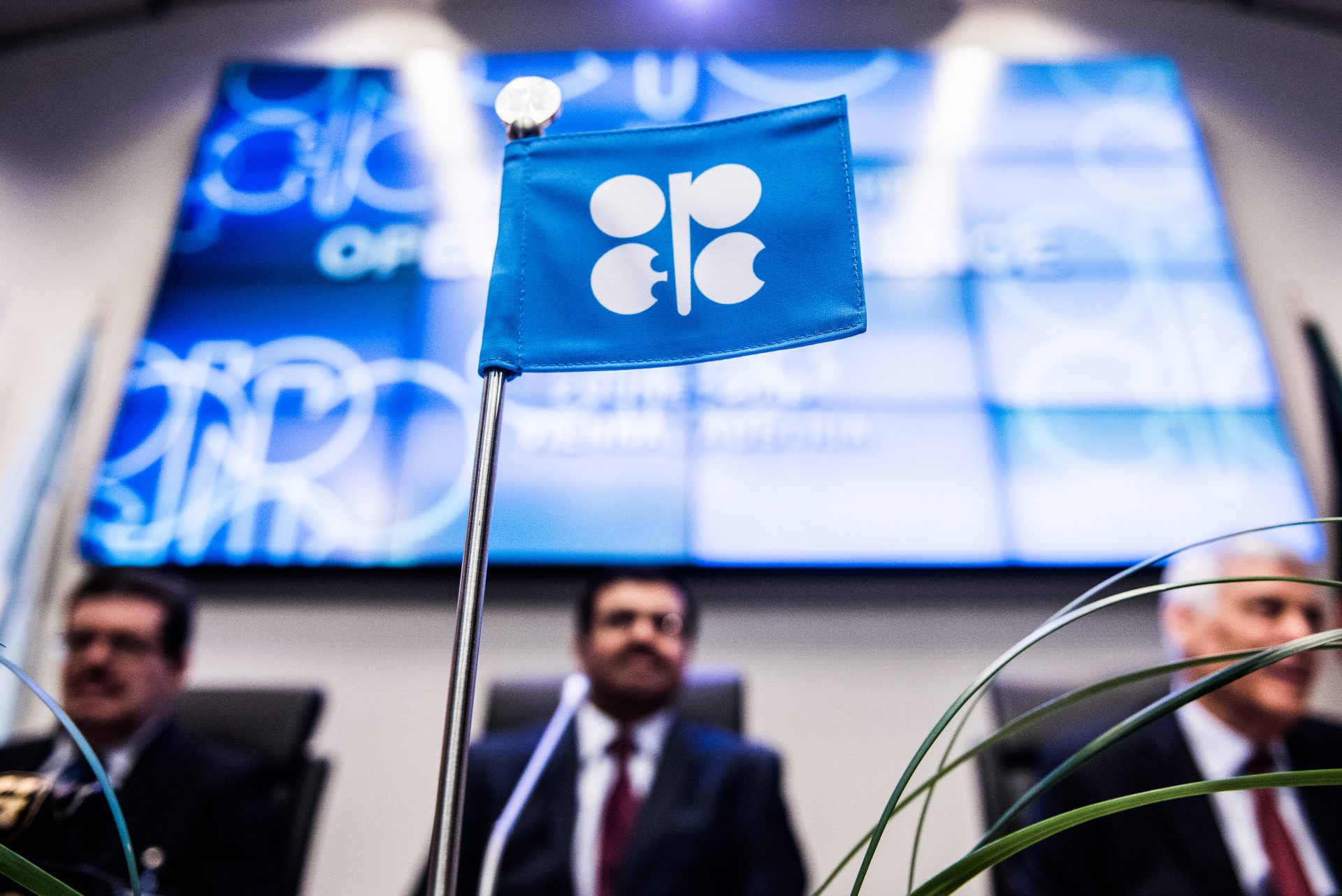
Nigeria will put forward its demand for a higher oil production quota at the next meeting of the Organisation of Petroleum Exporting Countries and allies (OPEC+) scheduled for November.
This was disclosed by the Minister of State for Petroleum Resources (Oil), Mr Heineken Lokpobiri, during an interview with the media team of the Nigerian Upstream Petroleum Regulatory Commission (NUPRC), where he reviewed the country’s upstream oil performance four years after the enactment of the Petroleum Industry Act and the establishment of the commission.
He said the country’s current quota, pegged at about 1.5 million barrels per day, no longer reflects its true production capacity, noting that the upcoming OPEC meeting provides an opportunity for Nigeria to make a strong case for an upward review to at least two million barrels per day.
“The OPEC quota is subject to periodic review, and by November, when we attend the annual meeting, we will certainly be making a case for a higher quota for Nigeria. And I believe that there’s no better time than now for us to make a strong case for Nigeria’s quota to be reviewed to two million and above,” the minister said.
He expressed confidence that Nigeria’s improved output levels, strengthened infrastructure, and renewed investments in the upstream sector would support the country’s case for an increase.
Mr Lokpobiri said the sustained recovery in production, improved regulatory environment, and fresh inflow of investment into the oil and gas sector have positioned Nigeria to make a strong case for a higher OPEC quota.
“When I became minister, the OPEC quota for Nigeria was 1.5 million barrels per day because our production then was below that.
“Today, we are producing around 1.7 million barrels daily, including condensates, and we have the capacity to produce above two million barrels per day. It is time to review the quota upward,” he noted.
He explained that Nigeria’s actual output includes condensates, a lighter, higher-value form of crude not covered by OPEC’s production limits, adding that this gives the country flexibility without violating its quota.
“Condensate is not counted in OPEC production, yet it sells at a higher price,” he said. “If we do 1.5 million barrels of crude and one million barrels of condensate, we are still within the rules. And because we have capacity, we are also going to show that we have capacity. Right now, there is something going on to assess our capacity, and that assessment is currently going on. And we believe that we will show the world that we have the capacity to produce more than two million barrels.”
The minister added that verifiable production data, domestic crude supply obligations under the PIA, and evidence of renewed capacity would form part of Nigeria’s case at the OPEC meeting.
Mr Lokpobiri attributed the production rebound to improved security and better pipeline integrity across the Niger Delta.
He said years of pipeline vandalism and oil theft had crippled Nigeria’s production capacity, but recent interventions by security agencies and community partnerships had reversed the trend.
According to him, Nigeria’s rig count, a key indicator of upstream activity, has jumped from about 14 to nearly 50 and is expected to rise further by year-end.
The minister also expressed optimism that the country’s goal of achieving 2.06 million barrels per day by 2025 was within reach, citing improved infrastructure, new investments, and policy stability.
“When I took office, production was around one million barrels a day. Today, it’s between 1.7 and 1.8 million barrels. That’s progress, but we’re not stopping there.
“Our cost of production is higher than the global average, but we’re also bringing it down. The cost of production is bound to be high depending on the circumstances. But today, we have taken steps to ensure that the cost of production is made competitive, and the executive orders have been very helpful in ensuring that we take certain steps that will reduce the cost of per-barrel production.
“Saudi Arabia is getting about eight dollars per barrel. I mean, some of the things that they do there are not available here. Circumstances here are different. But we definitely will get there. The global average is perhaps $12, but ours is way above that. But that doesn’t mean that we are not taking steps. So, having identified the problem, we are taking steps to ensure that we address that problem,” he affirmed.
Economy
Customs Street Chalks up 1.08% on Renewed Buying Pressure
By Dipo Olowookere
A 1.08 per cent growth was further printed by the Nigerian Exchange (NGX) Limited on Friday on improved appetite for Nigerian stocks.
Data showed that the insurance sector lost 0.61 per cent yesterday due to profit-taking as the energy space gave up 0.08 per cent, while the commodity counter closed flat.
However, the industrial goods landscape appreciated by 2.06 per cent, the banking index improved by 1.31 per cent, and the consumer goods sector expanded by 0.83 per cent.
At the close of business on Customs Street, the All-Share Index (ASI) increased by 1,563.92 points to 147,040.07 points from 145,476.15 points and the market capitalisation went up by N996 billion to N93.722 trillion from N92.726 trillion.
UAC Nigeria led the advancers’ log yesterday after it grew by 10.00 per cent to N96.80, Transcorp Hotels jumped by 9.71 per cent to N172.80, Royal Exchange appreciated by 8.89 per cent to N1.96, Ikeja Hotel soared by 8.74 per cent to N31.10, and Veritas Kapital leapt by 8.07 per cent to N1.74.
On the flip side, Union Dicon declined by 10.00 per cent to N6.30, ABC Transport slipped by 9.88 per cent to N3.10, AXA Mansard depreciated by 7.19 per cent to N12.90, FTN Cocoa lost 4.62 per cent to trade at N4.75, and Guinea Insurance dropped 3.36 per cent to finish at N1.15.
A total of 38 stocks ended on the gainers’ table and 17 stocks finished on the losers’ table, representing a positive market breadth index and strong investor sentiment.
Traders transacted 361.6 million equities for N14.8 billion in 21,051 deals yesterday versus the 1.9 billion equities worth N19.2 billion traded in 23,369 deals a day earlier, showing a decline in the trading volume, value, and number of deals by 80.97 per cent, 22.92 per cent, and 14.20 per cent, respectively.
The busiest stock for the session was Zenith Bank with 59.5 million units worth N3.6 billion, Access Holdings traded 46.1 million units valued at N973.0 million, Fidelity Bank exchanged 29.4 million units for N560.4 million, FCMB transacted 27.9 million units worth N293.9 million, and Tantalizers sold 13.0 million units valued at N29.8 million.
Economy
Nipco, 11 Plc Crash OTC Securities Exchange by 4.76%
By Adedapo Adesanya
Energy stocks influenced the 4.76 per cent loss recorded by the NASD Over-the-Counter (OTC) Securities Exchange on Friday, December 5.
The culprits were the duo of 11 Plc and Nipco Plc,with the former shedding N32.17 to end at N291.83 per share compared with the previous day’s N324.00 per share, and the latter down by N21.00 to sell at N195.00 per unit versus the previous session’s N216.00 per unit.
Consequently, the NASD Unlisted Security Index (NSI) slumped by 170.16 points to 3,401.37 points from 3,571.53 points and the market capitalisation lost N101.81 billion to close at N2.035 billion from the N2.136 trillion quoted in the preceding session.
The OTC securities exchange suffered the decline yesterday despite the share prices of three companies closing green.
Central Securities Clearing System (CSCS) Plc was up by N1.80 to close at N39.80 per share compared with Thursday’s price of N38.00 per share, Air Liquide Plc appreciated by N1.09 to N11.99 per unit from N10.90 per unit, and FrieslandCampina Wamco Nigeria Plc grew by 78 Kobo to N56.57 per share from N55.79 per share.
During the session, the volume of transactions rose by 6,885.3 per cent to 18.2 million units from 4.3 million units, the value of transactions ballooned by 10,301.7 per cent to N389.7 million from N347.2 million, but the number of deals declined by 29.7 per cent to 26 deals from 37 deals.
Infrastructure Credit Guarantee Company (InfraCredit) Plc ended the day as the most traded stock by value on a year-to-date basis with 5.8 billion units worth N16.4 billion, followed by Okitipupa Plc with 170.4 million units valued at N8.0 billion, and Air Liquide Plc with 507.5 million units worth N4.2 billion.
InfraCredit Plc also finished the day as the most traded stock by volume on a year-to-date basis with 5.8 billion units transacted for N16.4 billion, followed by Industrial and General Insurance (IGI) Plc with 1.2 billion units sold for N420.2 million, and Impresit Bakolori Plc with 536.9 million units worth N524.9 million.
Economy
Naira Depreciates to N1,450/$1 at Official Forex Market
By Adedapo Adesanya
The Naira depreciated further against the US Dollar in the Nigerian Autonomous Foreign Exchange Market (NAFEX) on Friday, December 5, as FX demand pressure mounts.
The Nigerian currency lost N2.60 or 0.18 per cent against the greenback to close at N1,450.43/$1 compared with the previous day’s N1,447.83/$1.
Equally, the domestic currency declined against the Pound Sterling in the official forex market during the session by N4.48 to trade at N1,935.45/£1, in contrast to Thursday’s closing price of N1,930.97/£1 and shrank against the Euro by 43 Kobo to end at N1,689.17/€1 versus the preceding session’s rate of N1,688.74/€1.
Similarly, the local currency performed badly against the US Dollar at the GTBank FX counter by N2 to close at N1,455/$1 versus Thursday’s N1,453/$1 but traded flat at the parallel market at N14.65/$1.
As the country gets into the festive period, pressure mounted on the local currency reflecting higher foreign payments and lower FX inflows.
However, there are expectations that the Nigerian currency will be stable, supported by interventions by to the Central Bank of Nigeria (CBN) in the face of steady dollar Demand and inflows from Detty December festivities that will give the Naira a boost after it depreciated mildly last month.
Traders cited by Reuters expect that the Naira will trade within a band of N1,443-N1,450/$1 next week, buoyed by improved FX interventions by the apex bank.
As for the crypto market, it was down yesterday due to profit-taking associated with year-end trading. However, the December 1-Year Consumer Inflation Expectation by the University of Michigan fell to 4.1 per cent from 4.5 per cent previously and 4.5 per cent expected. The 5-Year Consumer Inflation Expectation fell to 3.2 per cent from 3.4 per cent previously and 3.4 per cent expected.
With the dearth of official economic data of late, these private surveys have taken on a new level of significance and the market banks of them to make decisions.
Cardano (ADA) depreciated by 5.7 per cent to $0.4142, Dogecoin (DOGE) slid by 5.1 per cent to $0.1394, Ethereum (ETH) dropped by 3.9 per cent to $3,039.75, Solana (SOL) declined by 3.8 per cent to $133.24, and Litecoin (LTC) fell by 3.7 per cent to $80.59.
Further, Bitcoin (BTC) went down by 2.6 per cent to sell at $89,683.72, Binance Coin (BNB) slumped by 2.2 per cent to $883.59, and Ripple (XRP) shrank by 2.1 per cent to $2.04, while the US Dollar Tether (USDT) and the US Dollar Coin (USDC) remained unchanged at $1.00 each.
-
Feature/OPED6 years agoDavos was Different this year
-
Travel/Tourism9 years ago
Lagos Seals Western Lodge Hotel In Ikorodu
-
Showbiz3 years agoEstranged Lover Releases Videos of Empress Njamah Bathing
-
Banking7 years agoSort Codes of GTBank Branches in Nigeria
-
Economy3 years agoSubsidy Removal: CNG at N130 Per Litre Cheaper Than Petrol—IPMAN
-
Banking3 years agoFirst Bank Announces Planned Downtime
-
Banking3 years agoSort Codes of UBA Branches in Nigeria
-
Sports3 years agoHighest Paid Nigerian Footballer – How Much Do Nigerian Footballers Earn