Connect with us

Economy

NNPC Gas Subsidiary Takes 15% Equity Stake in Starz CNG Facility

Published

on

Starz CNG

By Adedapo Adesanya

The Nigerian National Petroleum Company (NNPC) Limited, through its subsidiary, NNPC Gas Marketing Limited (NGML), has agreed to take a 15 per cent equity shareholding in Starzs Gas Limited’s 2 million standard cubic feet per day (2mmscf/d) Compressed Natural Gas (CNG) facility.

The station is located at Iwhrekan in Ugheli South Local Government Area of Delta State and largely owned by Nigeria’s foremost maritime investor, Mr Greg Ogbeifun.

As part of the equity partnership, the national oil company has also agreed to guarantee gas supply to the multi-million-dollar facility on a competitive pricing basis and allow its logo to stand side by side with that of Starzs Gas in further demonstration of the partnership.

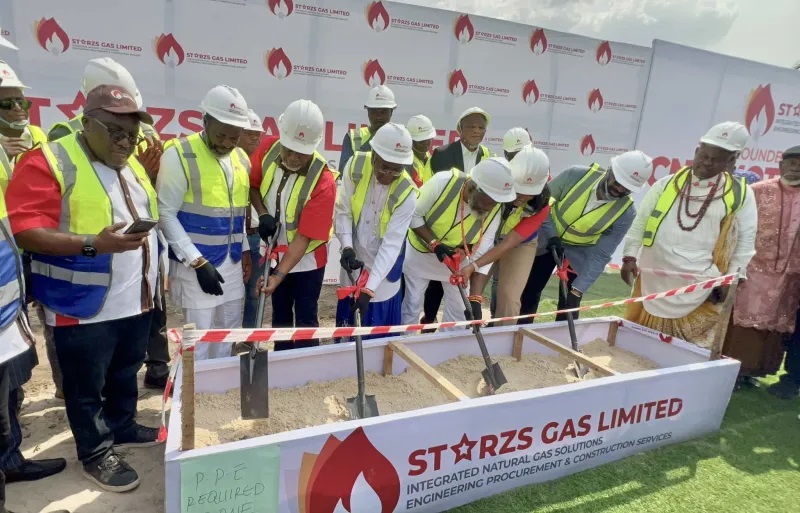
The partnership was announced at the groundbreaking ceremony of the project led by the Managing Director of NGML, Mr Justin Ezeala, who represented the Minister of State for Petroleum Resources (Gas), Mr Ekperikpe Ekpo.

The facility sited close to NAZ 3 gas plant in Utorogu, on a land size of 21,002.226sm², is planned for inauguration in the first quarter of 2026 while its scale up to 5mmscf/d will happen within 18 months.

The project aligns with the federal government’s commitment to ensure penetration and utilisation of domestic gas to drive industrialization, increase access to affordable power, and reduce the country’s carbon footprint through the adoption of CNG as autofuel.

Upon completion, the one-stop-shop facility is expected to undertake industrial CNG supplies, power generation-based load supplies, natural gas vehicle fueling, vehicle conversion, and general natural gas distribution to off-grid and satellite locations lacking pipeline infrastructure, all supported by a virtual pipeline system.

The first phase of the project is estimated to cost over $7 million.

Speaking at the event, Vice Chairman of Starzs Gas Limited, Miss Iroghama Ogbeifun, said through the facility, the company and its partners were setting the stage for a future powered by clean, efficient, and sustainable energy and also setting the stage for further development and empowerment in their host community.

Miss Ogbeifun noted that the facility was in tandem with the federal government’s declaration of the current decade as the Decade of Gas, adding that it also supports the Presidential CNG initiative whose mandate was to deepen the use of CNG as auto fuel thereby reducing carbon emissions into the environment.

She noted that the south-south region has long been a pillar of Nigeria’s energy landscape, she said with this project, the company was reinforcing that legacy by harnessing natural gas as a cleaner alternative to conventional fuels.

“This plant represents our unwavering commitment to reducing carbon emissions, enhancing energy accessibility, and fostering economic growth—not only in Delta State or the South South region but across Nigeria”, Miss Ogbeifun stated.

She announced the strategic partnership with NNPCL, saying NGML was offered and has agreed to accept a 15 per cent equity stake in the project

“Our journey has been fueled by vision, collaboration, and unwavering determination. However, to achieve this project, we require strategic partners who can guarantee it’s success and it is on that note that I am happy to announce that NNPC through its subsidiary, the NNPC Gas Marketing Ltd (NGML) was offered and has agreed to accept a 15 per cent equity in this project.

“This will not only help to guarantee gas supply at competitive pricing but will avail the project all the expertise NNPC has developed over the years in the Gas value chains. This partnership is a testament to the viability and importance of this project and we look forward to an impactful relationship.”

She recognised the invaluable contributions and the steadfast support of the company’s investors, government, regulatory agencies, and the local community while deeply appreciating their collaboration, trust, and shared vision for a greener and more prosperous future.

“As we break ground today, we embark on a journey that will drive industrial growth, create jobs, and provide affordable energy solutions for generations to come,” Miss Ogbeifun added.

On his part, Mr Ezeala, said the state oil company was showing the way in the private sector’s response to the federal government’s call for private investment in the nation’s gas space.

He reiterated that the NNPC will supply gas to the facility through the NNPC Gas Company (NGCs) pipeline.


Adedapo Adesanya is a journalist, polymath, and connoisseur of everything art. When he is not writing, he has his nose buried in one of the many books or articles he has bookmarked or simply listening to good music with a bottle of beer or wine. He supports the greatest club in the world, Manchester United F.C.

Click to comment

Leave a Reply

Your email address will not be published. Required fields are marked *

Economy

Oyedele Says IMF Latest Assessment Positive

Published

on

Taiwo Oyedele

By Adedapo Adesanya

The Minister of Finance, Mr Taiwo Oyedele, has endorsed the 2026 Article IV Mission Concluding Statement on Nigeria by the International Monetary Fund (IMF), saying the report provides further independent validation that the bold and necessary reforms undertaken under the leadership of President Bola Tinubu are strengthening macroeconomic stability.

He noted the IMF’s overall positive assessment of the country’s economic reform programme, which projected economic growth of 4.1 per cent in 2026 despite persistent poverty, food insecurity, and renewed inflationary pressures arising from rising global fuel and food prices.

The Fund said that although the reforms have delivered improved macroeconomic outcomes, conditions remain difficult for many Nigerians. According to the IMF, poverty reached 63 per cent based on the national poverty line, while an estimated 27 million Nigerians faced food insecurity in late 2025.

According to Mr Oyedele, the IMF observed that reforms implemented over the past three years have yielded improved macroeconomic outcomes and enhanced Nigeria’s resilience to external shocks.

He said the Fund specifically highlighted improvements in foreign exchange market functioning, stronger external buffers, ongoing fiscal and revenue reforms, banking sector resilience, and growing macroeconomic stability.

“These developments affirm that Nigeria is moving in the right direction and is better positioned to withstand global economic uncertainties than at any time in recent years.

“The government is particularly encouraged by the IMF’s recognition that the difficult but necessary decisions to end fuel subsidies, eliminate deficit monetisation, liberalise the foreign exchange market, and strengthen fiscal discipline have contributed significantly to reducing vulnerabilities and rebuilding confidence in the economy. The report notes that Nigeria now faces global shocks with stronger policy frameworks and buffers than before.”

Mr Oyedele said the recent conflict in the Middle East has created new challenges for economies around the world through higher energy prices, rising food costs, tighter financial conditions, and disruptions to global supply chains. While these developments present inflationary pressures, the IMF acknowledged that Nigeria has demonstrated notable resilience.

He added that despite significant increases in global energy prices, the foreign exchange parallel market premium has remained below five per cent, sovereign spreads have remained broadly stable, and investor confidence has been preserved.

“The IMF further noted that Nigeria is well-positioned to benefit from higher energy prices through stronger export earnings, improved fiscal revenues, and increased foreign exchange inflows.”

The minister explained that the federal government remains focused on translating these opportunities into long-term gains by increasing crude oil production, expanding domestic refining capacity, growing gas production and exports, and attracting new investments across the energy value chain.

“While challenges remain, the direction is clear, and the foundations are stronger. The ultimate objective of these reforms is not merely improved economic indicators, but better outcomes for all Nigerians: lower inflation, decent jobs, higher incomes, greater economic opportunity, and a better quality of life,” he said.

Continue Reading

Economy

Extensive Distribution Network, Promotional Activities Buoy Indomie 60% Noodles Market Share

Published

on

dufil indomie

By Aduragbemi Omiyale

Dufil Prima Foods Limited, makers of the popular Indomie Noodles, has been able to control over 60 per cent of the noodles market share in Nigeria because of its strong customer base, extensive distribution network and promotional activities, GCR Ratings has said.

These strategies deployed by the organisation have improved its financial profile, prompting the rating agency to upgrade the national scale long-term and short-term issuer ratings of Dufil to A(NG)/A1(NG) from A-(NG)/A2 (NG), previously, with a stable outlook.

It was disclosed that the company has witnessed strong cash generation and modest debt levels, which have enhanced its credit profile.

GCR said Dufil’s supply chain stability and ongoing product development have helped it to sustain the brand’s appeal to the young demographics in Nigeria and deepen market penetration.

These strengths are partly offset by high revenue concentration, with noodles accounting for more than 74 per cent, while other business lines, including flour, pasta, snacks, packaging, and palm oil, contribute a combined 26 per cent in 2025, it stated.

“We expect noodles to remain a dominant contributor to topline, supported by plans to expand noodle production capacity in 2026. Nevertheless, the completion of the flour plant expansion in Q3 2026 is expected to modestly increase the contribution of the flour business and support margins in the snacks segment,” a part of the statement obtained by Business Post read.

In the 2025 fiscal year, Dufil grew its earnings by 30 per cent to N1.1 trillion as a result of inflation-induced price review and gradual volume recovery. Its absolute EBITDA contracted to N84.5 billion from N92.7 billion in 2024, while its EBITDA margin eased to 8 per cent from 11.4 per cent in 2024.

Also, gross debt reduced to N96.2 billion from N163.6 billion in 2024, and to N79.6 billion in the first quarter of 2026, driven by management efforts to deleverage its balance sheet from expensive borrowings.

In addition, the liquidity position has slightly improved on robust cash holding of N44.6 billion, including restricted cash of N20.8 billion as of March 2026, adequate to cover the anticipated short-term debt obligations of N47.9 billion over the next nine-month period to December 31, 2026.

Although refinancing risk remains high with short-term debt accounting for above 40 per cent of the total debt, liquidity is further supported by sizable, unutilised committed facilities of N106.5 billion, indicating the company’s wide access to funding sources.

GCR said it expects the anticipated higher capital spending of N32.5 billion over the next 21 months to December 2027, as well as projected higher dividend payments in view of robust prior year profits to be sufficiently covered by the projected robust operating cash flow.

Continue Reading

Economy

FG Encourages Businesses to Tap $1bn AfCFTA Financing Scheme

Published

on

AfCFTA

By Adedapo Adesanya

The federal government says Nigerian businesses now have access to a $1 billion financing facility under the African Continental Free Trade Area (AfCFTA), designed to strengthen production and improve export competitiveness across African markets.

Speaking at the 2nd Quarter 2026 meeting of the AfCFTA Central Coordination Committee in Abuja, the Minister of Industry, Trade and Investment, Mrs Jumoke Oduwole, described the financing window as a major opportunity for businesses looking to scale operations and deepen regional trade.

“This financing facility presents a significant opportunity for Nigerian companies seeking to expand operations, modernise production, and increase exports across African markets,” she said.

Mrs Oduwole noted that despite progress in AfCFTA implementation, Nigerian exporters still face challenges such as documentation bottlenecks, certification requirements, and standards compliance issues.

She said the government is addressing these gaps through trade facilitation reforms and stronger collaboration with agencies, including the Nigeria Customs Service (NCS) and the Nigerian Export Promotion Council (NEPC).

The trade minister also stressed the importance of strengthening Nigeria’s legal and regulatory framework, particularly through the domestication of the AfCFTA Digital Trade Protocol.

At the meeting, the National Coordinator and CEO of the Nigeria AfCFTA Coordination Office, Mrs Patience Okala, said the $1 billion AfCFTA Adjustment Fund Credit Facility is targeted at large-scale businesses with a minimum financing threshold of US$10 million.

“The facility will support business expansion, modernisation, working capital requirements, project development, industrialisation efforts, and regional value chain integration,” she explained.

Mrs Okala added that the coordination office is working with fund managers to ensure qualified Nigerian firms can access the facility, while also assembling a pilot group of businesses to maximise participation.

She further highlighted growing private sector engagement, noting that recent sensitisation events in Kano attracted more than 470 businesses, including women-led enterprises.

On his part, a representative of the Federal Ministry of Industry, Trade and Investment, Mr Simon Om-Ezomo, commended stakeholders for their collaboration and urged sustained commitment to policy implementation.

Continue Reading

Trending