Connect with us

Economy

OPL 245: FG Fumes as Milan Court Acquits Eni, Shell

Published

on

Shell Eni OPL 245

By Adedapo Adesanya

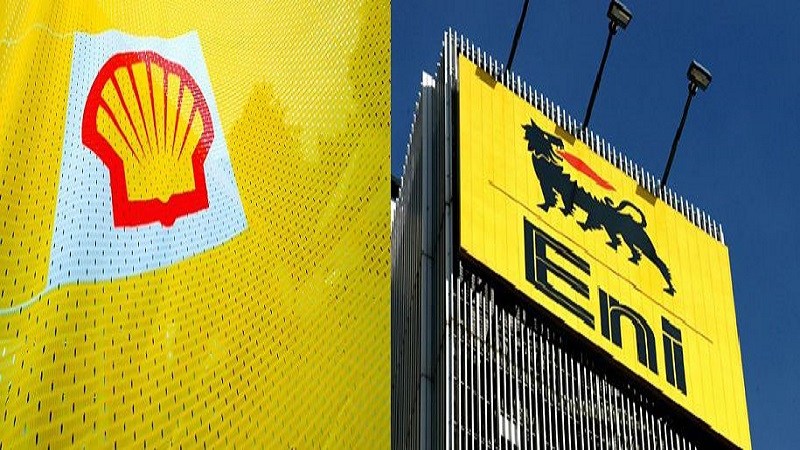
The federal government has expressed its displeasure at Wednesday’s ruling by an Italian court that acquitted the Royal Dutch Shell and Eni for alleged fraud as regards the Oil Production License (OPL) 245 in Nigeria.

A representative of the Nigerian government told Bloomberg that the nation will wait to review the Italian court’s written judgment before considering its position.

“The Federal Republic of Nigeria is disappointed in today’s (Wednesday) ruling in Milan, but thanks the Italian prosecuting authorities for their tireless efforts.

“The Federal Republic of Nigeria will continue to hold those responsible for the OPL 245 fraud accountable,” the unnamed official told the reputable news platform.

A Milan court on Wednesday acquitted energy companies; Eni and Royal Dutch Shell along with a series of past and present managers including Eni Chief Executive, Mr Claudio Descalzi in what has been regarded as the oil industry’s biggest corruption scandal.

The sentence, read out in court by Judge Marco Tremolada, comes more than three years after the trial first began and after a total of 74 hearings. He said the companies and defendants had been acquitted as there was no case to answer.

However, there is a glimmer of hope for Nigeria as rulings in Italy can be appealed and only become enforceable once they are final.

According to an analyst, Matthew Page, an associate fellow at the Chatham House Africa programme. “This is a huge blow for natural resource governance and transparency in Nigeria.

“The OPL 245 deal has been a multi-layered tale of corruption and malfeasance and international complicity that’s been going on for two decades.”

“This judgment will continue to sting, as it is a real and visible defeat for global and Nigerian anti-corruption efforts,” he said.

The exploration licence for the field, some 150 km (95 miles) off the Niger Delta, has not been revoked but it has not been converted into a mining licence and no oil has been produced.

A Brief History of the Case

The case revolved around the $1.3 billion purchase by Eni and Shell of the OPL 245 offshore oilfield in Nigeria in 2011 from Malabu Oil and Gas, a company owned by a former Nigerian oil minister, Mr Dan Etete.

Prosecutors alleged that just under $1.1 billion of the purchase price was shared with politicians and middlemen, including the former oil minister.

On Eni and Shell’s part, there were clamours that there were to be fined alongside the call for prosecution of a number of past and present managers from both companies, including Mr Descalzi.

The defendants all denied any wrongdoing and said the purchase price for OPL 245 was paid into a Nigerian government account and subsequent transfers were beyond their control.


Adedapo Adesanya is a journalist, polymath, and connoisseur of everything art. When he is not writing, he has his nose buried in one of the many books or articles he has bookmarked or simply listening to good music with a bottle of beer or wine. He supports the greatest club in the world, Manchester United F.C.

1 Comment

Leave a Reply

Your email address will not be published. Required fields are marked *

Economy

Investors Eye Investment Opportunities in Dangote Refinery

Published

on

South African investors dangote refinery

By Aduragbemi Omiyale

The planned listing of the Dangote Petroleum Refinery & Petrochemicals on the Nigerian Exchange (NGX) Limited is already attracting interest from South African investors and others.

The leadership of South Africa’s Government Employees Pension Fund (GEPF), alongside the Public Investment Corporation and Alterra Capital Partners, were recently at the Lagos-based facility.

The chairperson of GEPF, Mr Frans Baleni, said that the refinery stands as evidence that Africa can execute transformational infrastructure projects when backed by visionary leadership, long-term investment and strong technical expertise.

According to him, the significance of the project extends well beyond Nigeria’s borders, noting that it should reshape how Africa thinks about itself.

“The Dangote Refinery and Petrochemicals Complex is a powerful demonstration that, with visionary leadership and long-term capital, that perception no longer holds. This is the kind of African-led industrial scale that institutional investors on this continent should be backing,” he said.

Also speaking, the chief executive of PIC, Mr Patrick Dlamini, described the refinery as one of the most transformative industrial projects undertaken on the continent, saying it is reshaping global perceptions about Africa’s industrial capabilities and economic potential.

He said PIC, which manages about $230 billion in assets largely on behalf of South Africa’s Government Employees Pension Fund, is actively seeking long-term partnerships aligned with infrastructure development, industrialisation and economic transformation across Africa.

“There is real strategic alignment between Dangote’s industrial agenda and how we are positioning our portfolio, and we look forward to exploring meaningful avenues for collaboration,” he stated.

While receiving his visitors, the chief executive of Dangote Group, Mr Aliko Dangote, said the proposed listing is designed to democratise wealth creation and give Africans direct access to participate in the continent’s industrial transformation.

“We are opening the doors for investors to participate directly in Africa’s industrial future and the prosperity it will create,” Mr Dangote said, adding that the refinery project reflects the scale of untapped opportunities within Africa’s energy market, particularly as most countries on the continent remain dependent on imported refined petroleum products despite growing industrial demand and rising consumption.

The billionaire industrialist noted that demand for products such as polypropylene, aviation fuel and refined petroleum products has exceeded earlier projections, reinforcing the commercial viability of the refinery and shaping future expansion plans.

Continue Reading

Economy

Nigeria’s Oil Exploration Declines 41.7% as Rig Counts Falls to 12 in April

Published

on

rig count

By Adedapo Adesanya

Nigeria’s oil exploration and drilling activities declined by 41.7 per cent in April 2026, following reduced upstream operations and investment activities.

According to the May 2026 Monthly Oil Market Report (MOMR) of the Organisation of the Petroleum Exporting Countries (OPEC), Nigeria’s rig count, a major indicator of upstream oil and gas activities, dropped to 12 in April 2026 from 17 recorded in March 2026.

The decline came amid persistent upstream investment and operational challenges, according to the latest monthly report released by OPEC.

Earlier data contained in the May 2026 edition of the MOMR also showed that Nigeria’s average rig count declined to 13 in 2025 from 15 recorded in 2024, indicating reduced exploration and drilling activities in the upstream petroleum sector.

The report showed that Nigeria’s rig count fell by five rigs month-on-month, from 17 rigs in March 2026 to 12 rigs in April 2026.

Rig count is widely regarded in the petroleum industry as a key indicator of exploration, field development and investment activities.

The decline comes despite ongoing efforts by the Nigerian government and industry operators to raise crude oil production, boost reserves and attract fresh upstream investments under the Petroleum Industry Act (PIA)

Nigeria’s performance contrasted with the broader African trend, where total rig count increased marginally from 42 in March 2026 to 48 in April 2026.

However, Nigeria accounted for a significant share of the continent’s decline in operational rigs during the period.

Within OPEC, Nigeria remained behind major producers such as Saudi Arabia, which recorded 265 rigs in April 2026, the United Arab Emirates with 66 rigs, and Iraq with 19 rigs.

The development also comes at a time when Nigeria is struggling to meet its crude oil production quota allocated by OPEC consistently.

Continue Reading

Economy

Nigeria’s Central Bank Holds Rate at 26.50% Despite Heightened Disruptions

Published

on

CBN MPC meeting May 20

By Adedapo Adesanya

The Monetary Policy Committee (MPC) of the Central Bank of Nigeria (CBN) has retained the headline interest rate, the Monetary Policy Rate (MPR), at 26.50 per cent.

This was disclosed by the Governor of Nigeria’s central bank, Mr Yemi Cardoso, on Wednesday, after the conclusion of the MPC meeting. He noted that the decision was hinged on Nigeria being largely insulated from external shocks relating to developments in the Middle East.

He also acknowledged that inflation and exchange rate stability were put into consideration during the two-day meeting.

The committee reduced the benchmark interest rate by 50 basis points from 27.0 per cent to 26.5 per cent at its 304th MPC gathering in February.

Nigeria’s inflation rose to 15.69 per cent in April 2026, affected by the fallout from the Iran war, which continued to impact the global economy. Noting that year-on-year, the figures show a moderation rather than worry.

The headline inflation rate for April on a month-on-month basis was 2.13 per cent, while the food inflation rate in the review month was 16.06 per cent on a year-on-year basis.

Mr Cardoso noted that the Cash Reserve Ratio (CRR) was also retained at 45 per cent for commercial Banks, 16 per cent for Merchant Banks, and 75 per cent for non-TSA public sector deposits.

He added that the Standing Facilities Corridor was also held flat at +50 / -450 basis points around the MPR.

Continue Reading

Trending