Connect with us

Economy

Selloffs Bring Down Nigerian Stock Market by 0.01%

Published

on

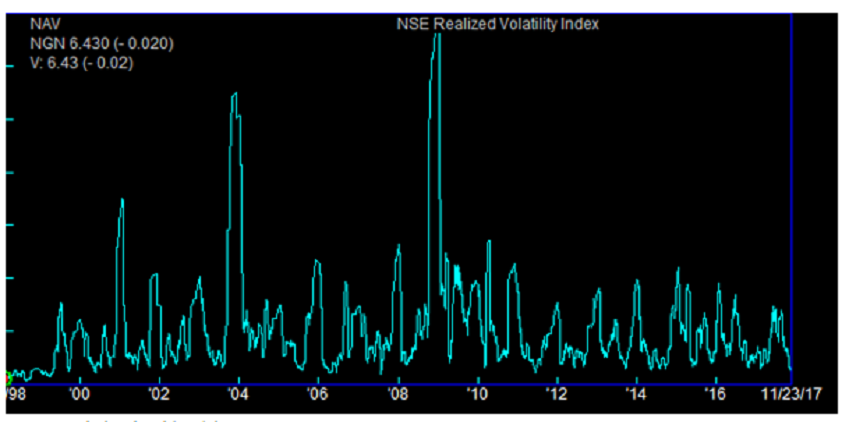
Volatility Index for Nigerian Stock Market

By Dipo Olowookere

The Nigerian stock market succumbed to profit-taking on Wednesday, losing 0.01 per cent as a result of selloffs in GTCO, FBN Holdings, Access Bank, Ecobank and 13 others.

The delay in the release of the half-year results of tier-one banks at the Nigerian Exchange (NGX) Limited is still making some investors trade cautiously. They want to see what the numbers are saying before taking an action.

At the close of business at the midweek session, the All-Share Index (ASI) slumped by 4.69 points to 39,545.67 points from 39,550.36 points, while the market capitalisation shrank by N2 billion to N20.604 trillion from N20.606 trillion.

Business Post reports that the insurance sector depreciated yesterday by 0.87 per cent, while the other four key sectors closed bullish.

The consumer goods counter grew by 0.12 per cent, the banking sector rose by 0.08 per cent, while the energy and industrial goods counters appreciated by 0.04 per cent each.

Yesterday, SCOA Nigeria was the heaviest price loser, declining by 9.66 per cent to N1.59, followed by Prestige Assurance, which lost 8.33 per cent to trade at 44 kobo.

Regency Alliance depreciated by 6.98 per cent to 40 kobo, Mutual Benefits Assurance lost 5.71 per cent to sell for 33 kobo, while Caverton dropped 5.49 per cent to N1.72.

During the trading day, the gainers’ chart recorded 19 members led by Pharma Deko, which appreciated by 10.00 per cent to trade at N1.43.

BOC Gases grew by 9.78 per cent to N10.10, Honeywell Flour Mills improved by 9.72 per cent to N2.71, Courtville went up by 8.00 per cent to 27 kobo, while ABC Transport closed 6.06 per cent higher to 35 kobo.

A total of 132.1 million stocks worth N2.7 billion were traded in 3,307 deals on Wednesday as against the 110.8 million stocks worth N3.1 billion transacted in 3,305 deals on Tuesday, indicating a decline in the trading value by 13.29 per cent and an increase in the trading volume and the number of deals by 19.23 per cent and 0.06 per cent respectively.

Transcorp was the most traded stock yesterday with 14.2 million shares valued at N13.5 million, trailed by Chams with 14.1 million equities valued at N2.9 million.

Also, Zenith Bank traded 8.5 million stocks worth N206.2 million, GTCO sold 6.2 million shares valued at N175.0 million, while Oando exchanged 5.4 million stocks worth N26.8 million.


Dipo Olowookere is a journalist based in Nigeria that has passion for reporting business news stories. At his leisure time, he watches football and supports 3SC of Ibadan. Mr Olowookere can be reached via [email protected]

Click to comment

Leave a Reply

Your email address will not be published. Required fields are marked *

Economy

Rising Food Prices Not Good for Nigeria’s Inflation Gains—CPPE

Published

on

Prices of Food

By Adedapo Adesanya

Despite signs that Nigeria’s headline inflation is easing, rising food prices continue to threaten the country’s inflation outlook, the chief executive of the Centre for the Promotion of Private Enterprise (CPPE), Mr Muda Yusuf, has warned.

He noted that structural inflationary pressures in the real economy remain pronounced despite improving macroeconomic stability.

In a policy brief released following the inflation report, he noted that headline inflation eased marginally, while month-on-month change moderated from 1.75 per cent to 1.66 per cent, indicating that headline inflation has largely plateaued.

According to him, the dominant concern in the latest inflation report is the renewed acceleration in food inflation.

This growth, he said, suggested that food prices have resumed an upward trajectory after a brief period of moderation.

Warning that a renewed increase in food inflation has significant economic and social implications, he stressed that food inflation remained the biggest driver of Nigeria’s cost-of-living crisis, stressing that rising food prices continue to erode household purchasing power, worsen poverty and food insecurity while weakening the inclusiveness of the current reform programme.

He maintained that sustained moderation in food prices is critical to improving citizens’ welfare and strengthening public confidence in the ongoing economic reforms.

Acknowledging the easing of core inflation as encouraging, he drew attention to the persistence of urban inflation.

At 16.08 per cent, urban inflation exceeded the national headline inflation rate of 15.91 per cent, while month-on-month urban inflation increased from 1.99 per cent to 2.13 per cent.

According to Mr Yusuf, the figures indicated that inflationary pressures remained particularly intense across urban centres.

He attributed the rising urban inflation partly to increasing population displacement from rural communities affected by insecurity, expressing worry that as more households migrate to urban areas, demand for housing, transportation, utilities and other essential services would increase, adding to inflationary pressures and creating additional urbanisation challenges.

Addressing insecurity in farming communities, he said, was important not only for protecting lives and property and boosting agricultural output but also for easing cost pressures in urban centres, adding that the June CPI data reinforced the view that Nigeria’s inflation challenge is predominantly structural rather than monetary.

On the monetary policy outlook, he said the data do not justify further monetary tightening, arguing that headline inflation has largely stabilised.

The CPPE chief expected the Monetary Policy Committee (MPC) to retain the current monetary policy rate at its next meeting, adding that the priority is for monetary and fiscal authorities to work together to accelerate structural reforms to expand food supply, improve logistics, reduce energy and production costs, lower debt service costs, as well as strengthen domestic value chains.

Continue Reading

Economy

Sterling Holdings Lists New Shares Worth N96.7bn on Stock Exchange

Published

on

Sterling Holdings

By Aduragbemi Omiyale

Additional shares of Sterling Financial Holdings Company Plc have been listed on the Nigerian Exchange (NGX) Limited.

The new equities were added to the company’s existing stocks on Customs Street on Thursday, July 16, 2026, a notice from the bourse confirmed.

Business Post reports the total new ordinary shares of Sterling Holdings listed yesterday were 13,812,239,000 units.

They were from the offer for subscription of 12,581,000,000 ordinary shares of 50 Kobo each sold for N7.00 per share, which was oversubscribed by investors.

The financial institution brought the new shares to the stock exchange to increase its total issued and fully paid-up shares to 65,929,251,414 ordinary shares of 50 Kobo each from 52,117,012,414 ordinary shares of 50 Kobo each.

“Trading licence holders are hereby notified that an additional 13,812,239,000 ordinary shares of 50 Kobo each of Sterling Financial Holdings Company Plc were on Thursday, July 16, 2026, listed on the daily official list of Nigerian Exchange Limited.

“The additional shares listed on NGX arose from the company’s offer for subscription of 12,581,000,000 ordinary shares of 50 Kobo each at N7.00 per share.

“With the listing of the additional shares, the total issued and fully paid-up shares of Sterling Financial Holdings Company Plc have now increased from 52,117,012,414 to 65,929,251,414 ordinary shares of 50 Kobo each,” the notice read.

Continue Reading

Economy

Nigeria Launches Unified Virtual Asset Regulatory Framework

Published

on

Tinubu 2026 budget

By Adedapo Adesanya

President Bola Tinubu has signed a Presidential Executive Order on Virtual Assets Coordination, establishing a new framework to coordinate the regulation of virtual assets across government agencies as Nigeria seeks to curb fraud while supporting innovation in the digital economy.

The Executive Order, which takes immediate effect, creates a Virtual Asset Council chaired by the Central Bank of Nigeria (CBN) to harmonise oversight of cryptocurrencies, tokenised assets, stablecoins, and other digital assets without creating a new regulator.

As part of the new framework, the CBN will establish a regulatory sandbox that will allow eligible firms to test virtual asset products, blockchain solutions, and related services under regulatory supervision before they are introduced to the wider market.

The development was disclosed in a statement issued on Friday by the President’s Special Adviser on Information and Strategy, Mr Bayo Onanuga.

According to the presidency, the Executive Order responds to the growing complexity of virtual assets, which increasingly cut across the traditional boundaries of currencies, securities, commodities, and payment systems.

The fragmented regulatory environment has left gaps that have exposed Nigeria to money laundering, terrorism financing, cybersecurity and data privacy risks, fraud, and revenue losses.

The government said some unregistered operators have exploited these regulatory gaps to defraud unsuspecting Nigerians, resulting in significant financial losses.

“The Order is designed to close these gaps through supervisory coordination, without introducing new layers of regulation or displacing the mandates of existing agencies,” the statement read.

Under the new framework, the Virtual Asset Council will be chaired by the CBN, with the Nigeria Revenue Service (NRS) and the Securities and Exchange Commission (SEC) serving as vice chairs. Other members include the Nigerian Financial Intelligence Unit (NFIU) and the Office of the National Security Adviser (ONSA).

The Council will provide policy direction, improve cooperation among participating agencies, and work with the Attorney General of the Federation to develop a harmonised legal and institutional framework for the sector.

The Executive Order also establishes a Virtual Asset Office, which will serve as the Council’s operational arm. The office will be domiciled at the CBN and will coordinate information sharing, applications, and reporting among the participating agencies through a shared supervisory technology platform.

The presidency stressed that the Executive Order does not create a new regulator or transfer statutory powers from existing agencies, clarifying that instead, each institution will continue to exercise its existing mandate while working within a coordinated framework.

Under the arrangement, registration of virtual asset businesses will depend on the nature of the service being offered.

Activities classified as securities will continue to be regulated by the SEC, while payment, settlement, custody, and other services involving non-security virtual assets will fall under the CBN.

Where there is uncertainty over regulatory jurisdiction, the Virtual Asset Council will determine the appropriate supervising agency.

“The sandbox will provide a controlled environment in which eligible operators can test and operate virtual asset products, services, and blockchain-based solutions under close supervision, enabling the participating agencies to assess the implications for monetary sovereignty, financial stability, market integrity, consumer protection, financial inclusion, and revenue administration before products reach the wider market,” the statement added.

According to the presidency, the sandbox will enable regulators to evaluate the implications of emerging products for financial stability, monetary sovereignty, consumer protection, financial inclusion, market integrity, and revenue administration.

The central bank is expected to announce further details of the sandbox.

Continue Reading