
Economy
Stanbic IBTC Asset Management Debunks Money Myths With Money’s Mind Campaign


In an effort to enhance financial literacy and empower Nigerians to make informed financial decisions, Stanbic IBTC Asset Management is addressing prevalent money myths that often hinder wealth creation and financial security.
Money myths, ranging from the belief that only the wealthy can invest, to the misconception that one cannot invest with small amounts, often shape financial behaviour in ways that limit long-term growth. These misconceptions prevent individuals, particularly young people, and aspiring investors, from seizing wealth-building opportunities available within the formal economy. Instead, they are drawn to quick and misleading Ponzi schemes that exploit their lack of knowledge.
Recognising these challenges, Stanbic IBTC Asset Management launched a campaign to inspire individuals to rethink their financial habits by exploring how money “thinks” about investing. The campaign, designed to demystify investment fears and misconceptions, encourages people to reassess their attitudes towards money and make strategic decisions to grow it. With inflation eroding the value of uninvested cash and financial markets offering long-term growth opportunities, experts suggest that now is the time to put money to work.
Busola Jejelowo, Chief Executive of Stanbic IBTC Asset Management, recently shared insights on the company’s mission to provide clarity by addressing misleading financial narratives and replacing them with practical advice.
In her statement, she emphasised, “In an era of financial uncertainty, it is crucial to make informed, confident investment choices. We believe that financial growth is a journey of partnership, and many people make financial decisions based on myths rather than facts, which can limit their ability to build sustainable wealth. With the Money’s Mind campaign, we aim to correct these misconceptions and provide individuals with the right tools and knowledge to take control of their financial future.”
Busola further mentioned that these tools have been housed in BluNest, Stanbic IBTC Asset Management’s intuitive digital investment platform. BluNest offers new and existing investors access to a variety of investment portfolios, including Money Market Portfolios, Commercial Papers, Treasury Bills, and Bonds.
Some notable features of BluNest include The Wallet, a feature that allows customers to fund and purchase any investment instrument seamlessly; Auto-Invest, which helps automate investments periodically to keep users on track to meet their financial goals; and Target Savings, which assists customers in saving and making goal-oriented investments for specific milestones.
In today’s digital era, accessibility to financial information is more crucial than ever. BluNest by Stanbic IBTC Asset Management leverages technology to enhance financial education, ensuring that Nigerians can access valuable resources anytime, anywhere. Users can monitor investments, gain real-time market insights, and receive expert guidance tailored to their financial objectives.
Stanbic IBTC Asset Management remains committed to building a financially literate society where individuals can take charge of their financial futures. The organisation has shown a particular interest in nurturing young investors through Beyond Dreams, a youth-centric community focused on sharing relatable investment insights with a younger demographic, equipping them with the right tools to make more informed investment decisions.
The Money’s Mind campaign reflects this commitment, fostering a shift from financial myths to financial empowerment. By prioritising education, accessibility, and expert-backed solutions, the company reinforces its role as a trusted partner in financial planning, helping Nigerians navigate their journey toward long-term financial security.














By Adedapo Adesanya
Seven price gainers flipped recent declines at the NASD Over-the-Counter (OTC) Securities Exchange, raising the alternative stock market by 2.19 per cent on Friday.
According to data, the market capitalisation added N51.24 billion to end N2.389 trillion compared with the previous day’s N2.338 trillion, while the NASD Unlisted Security Index (NSI) climbed 85.65 points to close at 3,994.32 points, in contrast to the 3,908.67 points it ended a day earlier.
Business Post reports that the advancers were led by MRS Oil Plc, which improved its value by N13.00 to N200.00 per share from N187.00 per share, FrieslandCampina Wamco Nigeria Plc gained N7.40 to settle at N91.55 per unit versus the previous day’s N84.15 per unit, Central Securities Clearing System (CSCS) Plc appreciated by N6.08 to N71.00 per share from N64.92 per share, Afriland Properties Plc added 66 Kobo to finish at N17.17 per unit versus N16.51 per unit, IPWA Plc rose 37 Kobo to N4.15 per share from N3.78 per share, First Trust Mortgage Bank Plc grew by 11 Kobo to N1.20 per unit from N1.09 per unit, and Food Concepts Plc went up by 10obo to N3.70 per share from N3.60 per share.
On the flip side, there were two price losers led by Geo-Fluids Plc, which depreciated by 28 Kobo to N3.32 per unit from N3.60 per unit, and Industrial and General Insurance (IGI) Plc dropped 5 Kobo to sell at 45 Kobo per share from 50 Kobo per share.
Yesterday, the volume of trades went down by 92.0 per cent to 3.7 million units from 45.8 million units, the value of transactions fell by 59.4 per cent to N84.5 million from N208.2 million, while the number of deals went up by 7.7 per cent to 42 deals from 39 deals.
CSCS Plc remained the most traded stock by value (year-to-date) with 32.6 million units exchanged for N1.9 billion, trailed by Geo-Fluids Plc with 119.6 million units valued at N470.3 million, and Resourcery Plc with 1.05 billion units traded at N408.6 million.
Resourcery Plc closed the day as the most traded stock by volume (year-to-date) with 1.05 billion units sold for N408.7 million, followed by Geo-Fluids Plc with 119.6 million units worth N470.3 million, and CSCS Plc with 32.6 million units worth N1.9 billion.
By Adedapo Adesanya
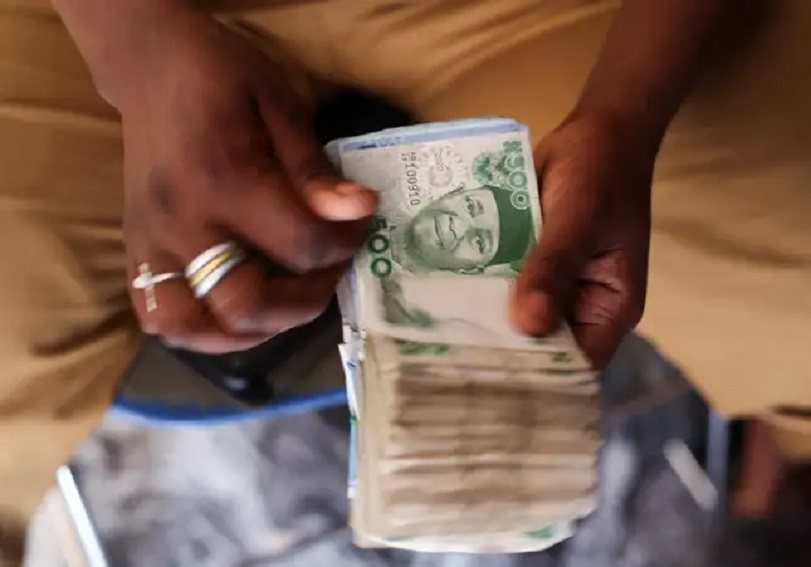
The Naira weakened further against the United States Dollar in the Nigerian Autonomous Foreign Exchange Market (NAFEX) on Friday, February 20, by N4.97 or 0.37 per cent to N1,346.32/$1 from the N1,341.35/$1 it was transacted on Thursday.
Heightened FX demand tilted the market toward the downside yesterday, exerting upward pressure on rates despite efforts by the Central Bank of Nigeria (CBN) to stabilise the foreign exchange market.
Also in the official market, the domestic currency depreciated against the Pound Sterling during the session by N9.39 to sell for N1,815.25/£1 versus the previous day’s N1,805.86/£1, and lost N7.33 against the Euro to close at N1,584.62/€1 compared with the preceding session’s N1,577.29/€1.
The story was not different for the Nigerian Naira at the GTBank FX desk, where it depleted against the Dollar by N7 on Friday to quote at N1,356/$1 versus the N1,349/$1 it was sold a day earlier, but remained unchanged in the black market at N1,370/$1.
It was observed that risky sentiment among Foreign Portfolio Investors (FPIs) contributed to the FX market, amid fears of hot money flight due to capital gains tax and other factors.
As for the cryptocurrency market, it was mostly green yesterday in reaction to a Supreme Court verdict dismissing a fresh 10 per cent global levy by President Donald Trump.
The apex court on Friday described Mr Trump’s global tariff rollout as illegal. The decision did not clarify what should happen to tariff revenue already collected, and it doesn’t necessarily spell the end of the trade agenda, with multiple legal and executive avenues still available.
Litecoin (LTC) grew 2.7 per cent to $55.00, Cardano (ADA) appreciated 2.6 per cent to trade at $0.2815, Binance Coin (BNB) expanded by 2.6 per cent to $627.19, Dogecoin (DOGE) recouped 1.3 per cent to quote at $0.1, Ripple (XRP) jumped 0.7 per cent to $1.43, Solana (SOL) improved by 0.5 per cent to $84.15, and Ethereum (ETH) soared 0.1 per cent to $1,962.78.
However, Bitcoin (BTC) lost 0.2 per cent to sell for $67,850.49, while the US Dollar Tether (USDT) and the US Dollar Coin (USDC) traded flat at $1.00 each.

By Dipo Olowookere
A further 0.99 per cent was gained by the Nigerian Exchange (NGX) Limited on Friday after a positive market breadth index supported by 53 price gainers, which outweighed 23 price losers, representing bullish investor sentiment.
During the trading day, the trio of Jaiz Bank, Fidson, and NPF Microfinance Bank chalked up 10.00 per cent each to sell for N11.00, N86.90, and N6.27, respectively, while Deap Capital appreciated by 9.96 per cent to N7.62, and Mutual Benefits increased by 9.94 per cent to N5.42.
Conversely, Secure Electronic Technology shed 10.00 per cent to trade at N1.62, Sovereign Trust Insurance slipped by 9.73 per cent to N2.32, Ellah Lakes declined by 7.91 per cent to N12.80, International Energy Insurance retreated by 5.56 per cent to N3.40, and ABC Transport moderated by 5.26 per cent to N9.00.
Data from Customs Street revealed that the insurance counter was up by 2.52 per cent, the industrial goods sector grew by 2.28 per cent, the banking space expanded by 1.43 per cent, the consumer goods index gained 1.23 per cent, and the energy industry rose by 0.05 per cent.
As a result, the All-Share Index (ASI) went up by 1,916.20 points to 194,989.77 points from 193,073.57 points, and the market capitalisation moved up by N1.230 trillion to N125.164 trillion from Thursday’s N123.934 trillion.
Yesterday, investors traded 820.5 million stocks valued at N28.3 billion in 63,507 deals compared with the 898.5 million stocks worth N38.5 billion executed in 61,953 deals, showing a jump in the number of deals by 2.51 per cent, and a shortfall in the trading volume and value by 8.68 per cent and 26.49 per cent apiece.
Closing the session as the most active equity was Mutual Benefits with 79.0 million units worth N427.1 million, Zenith Bank traded 44.0 million units valued at N3.8 billion, Chams exchanged 43.9 million units for N182.0 million, AIICO Insurance transacted 42.4 million units valued at N179.8 million, and Veritas Kapital sold 36.0 million units worth N90.6 million.









-
 Feature/OPED6 years ago
Davos was Different this year
-
Travel/Tourism10 years ago
Lagos Seals Western Lodge Hotel In Ikorodu
-

 Showbiz3 years ago
Estranged Lover Releases Videos of Empress Njamah Bathing
-
 Banking8 years ago
Sort Codes of GTBank Branches in Nigeria
-

 Economy3 years ago
Subsidy Removal: CNG at N130 Per Litre Cheaper Than Petrol—IPMAN
-

 Banking3 years ago
Sort Codes of UBA Branches in Nigeria
-

 Banking3 years ago
First Bank Announces Planned Downtime
-

 Sports3 years ago
Highest Paid Nigerian Footballer – How Much Do Nigerian Footballers Earn
Pingback: 14 myths about business wealth management, debunked - Top Stories Around The Globe