Connect with us

Economy

Trump’s Speech: Wall Street Risks Choppy Trading

Published

on

By Modupe Gbadeyanka

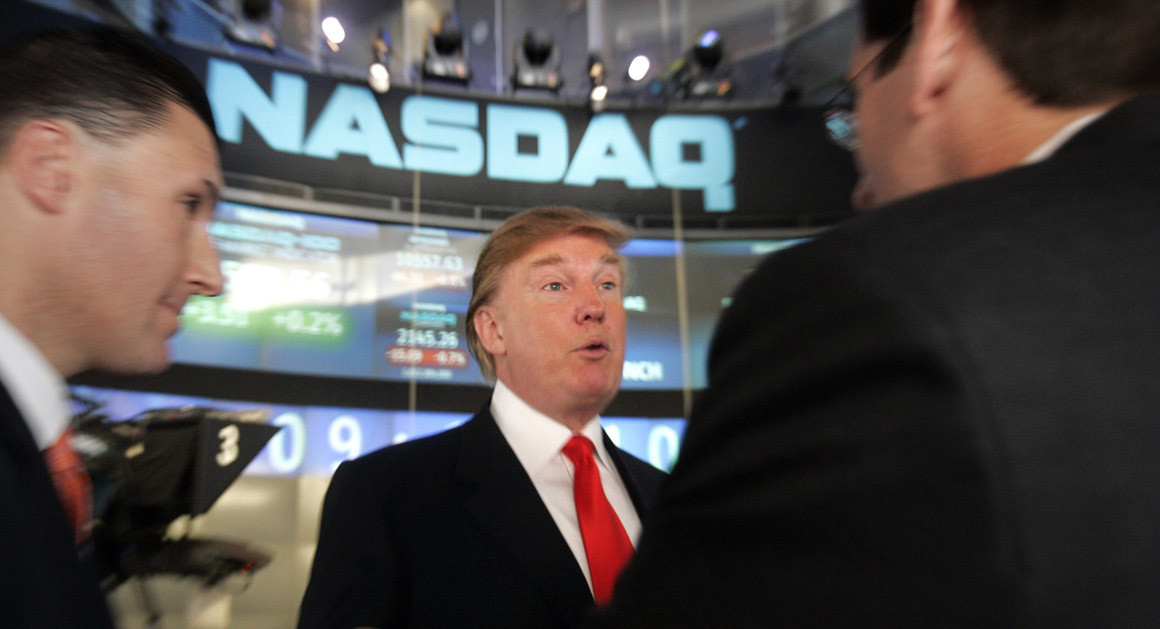
The major U.S. index futures are pointing to a roughly flat opening on Tuesday as traders await President Donald Trump’s highly anticipated speech to a joint session of Congress.

The markets have recently benefited from optimism about pro-business policies under Trump, and traders will be looking additional details on his policies on tax reform, deregulation, and infrastructure spending. Early trading may also be impacted by reaction to a slew of U.S. economic data.

After initially moving to the downside, stocks turned higher over the course of the trading session on Monday. With the turnaround on the day, the Dow and the S&P 500 once again climbed to new record closing highs.

The major averages ended the session modestly higher. The Dow crept up 15.68 points or 0.1 percent to 20,837.44, the Nasdaq rose 16.59 points or 0.3 percent to 5,861.90 and the S&P 500 edged up 2.39 points or 0.1 percent to 2,369.73.

Profit taking contributed to the early weakness on Wall Street following recent strength, although selling pressure remained relatively subdued.

The subsequent rebound reflected recent upward momentum amid optimism about pro-business policies under President Donald Trump.

Trump is due to speak to a joint session of Congress on Tuesday, and traders will be looking for details on his promises of tax reform, deregulation and infrastructure spending.

In economic news, the Commerce Department released a report showing a rebound in durable goods orders in the month of January.

The report said durable goods orders jumped by 1.8 percent in January after falling by a revised 0.8 percent in December. Economists had expected orders to climb by 1.7 percent.

Excluding a sharp increase in orders for transportation equipment, durable goods orders edged down by 0.2 percent in January following a revised 0.9 percent advance in December. Ex-transportation orders had been expected to rise by 0.5 percent.

A separate report from the National Association of Realtors unexpectedly showed a steep drop in pending home sales in the month of January.

NAR said its pending home sales index tumbled by 2.8 percent to 106.4 in January after climbing by 0.8 percent to a revised 109.5 in December.

A pending home sale is one in which a contract was signed but not yet closed. Normally, it takes four to six weeks to close a contracted sale.

The steep drop by the index came as a surprise to economists, who had expected pending home sales to increase by 0.8 percent.

With the unexpected decrease, the pending home sales index fell to its lowest level since hitting 106.0 in January of last year.

Biotechnology stocks moved sharply higher over the course of the trading session, driving the NYSE Arca Biotechnology Index up by 3.8 percent. With the jump, the index reached its best closing level in over a year.

Significant strength was also visible among oil service stocks, as reflected by the 1.7 percent gain posted by the Philadelphia Oil Service Index.

Steel and housing stocks also saw considerable strength, with the NYSE Arca Steel Index and the Philadelphia Housing Sector Index climbing by 1.7 percent and 1.6 percent, respectively.

On the other hand, gold stocks moved sharply lower on the day, dragging the NYSE Arca Gold Bugs Index down by 5.1 percent. With the drop, the index fell to its lowest closing level in well over a month.

Investors Hub

Modupe Gbadeyanka is a fast-rising journalist with Business Post Nigeria. Her passion for journalism is amazing. She is willing to learn more with a view to becoming one of the best pen-pushers in Nigeria. Her role models are the duo of CNN's Richard Quest and Christiane Amanpour.

Click to comment

Leave a Reply

Your email address will not be published. Required fields are marked *

Economy

FrieslandCampina, Nitrox, Others Further Weaken NASD Index by 0.48%

Published

on

NASD Unlisted Securities Index

By Adedapo Adesanya

Six securities led by FrieslandCampina Wamco Nigeria Plc further weakened the NASD Over-the-Counter (OTC) Securities Exchange by 0.48 per cent on Tuesday, June 9.

The notable dairy firm lost N7.87 during the trading day to close at N173.81 per unit compared with the previous session’s N181.68 per unit, Nitrox Industrial Gases Plc depreciated by N2.42 to N21.88 per share from N24.30 per share, Afriland Properties Plc dipped by N1.25 to N15.55 per unit from N16.80 per unit, Food Concepts Plc stumbled by 27 Kobo to N2.48 per share from N2.75 per share, UBN Property Plc dropped 9 Kobo to settle at N2.11 per unit versus N2.20 per unit, and Industrial and General Insurance (IGI) Plc crashed by 4 Kobo to 50 Kobo per share from 54 Kobo per share.

As a result of these losses, the market capitalisation went down by N12.50 billion to N2.593 trillion from N2.606 trillion, and the NASD Unlisted Security Index (NSI) declined by 20.89 points to 4,335.31 points from 4,356.20 points.

Business Post reports that there was a price gainer yesterday, and this was Central Securities Clearing System (CSCS) Plc, which improved its value by N2.65 to N81.13 per unit from N78.48 per unit.

The volume of transactions soared on Tuesday by 644.3 per cent to 1.6 million units from 213,188 units, the value of trades increased by 208.6 per cent to N62.3 million from N20.2 million, and the number of deals surged by 64 per cent to 41 deals from 25 deals.

The most active stock by value on a year-to-date basis remained Great Nigeria Insurance (GNI) Plc, with 3.4 billion units worth N8.4 billion, trailed by Infrastructure Credit Guarantee (Infracredit) Plc with 2.3 billion units transacted for N6.5 billion, and CSCS Plc with 65.1 million units sold for N4.4 billion.

GNI Plc was also the most traded stock by volume on a year-to-date basis, with 3.4 billion units valued at N8.4 billion, followed by Infracredit Plc with 2.3 billion units exchanged for N6.5 billion, and Resourcery Plc with 1.1 billion units traded for N415.7 million.

Continue Reading

Economy

Naira Appreciates to N1,360.55/$1 at Official Market

Published

on

funds in Naira accounts

By Adedapo Adesanya

The Naira was exchanged at N1,360.55/$1 in the Nigerian Autonomous Foreign Exchange Market (NAFEX) on Tuesday, June 9, compared with the N1,362.84/$1 it was exchanged a day earlier, indicating an appreciation of N2.29 or 0.17 per cent against the United States Dollar.

It also gained 74 Kobo against the Euro in the same market segment to quote at N1,573.61/€1, in contrast to Monday’s closing price of N1,574.35/€1, but lost N1.71 against the Pound Sterling to trade at N1,823.00/£1 versus the preceding day’s N1,821.29/£1.

At the black market window, the Nigerian currency maintained stability against the greenback during the session at N1,380/$1, and also traded flat at the GTBank FX counter at N1,373/$1.

Market analysts say the ongoing implementation of the fourth edition of the Foreign Exchange Manual by the Central Bank of Nigeria (CBN) since June 1 has strengthened the Naira and the country’s foreign reserves, bolstering confidence in the market.

The new manual is expected to deepen FX transparency, improve liquidity and strengthen market confidence and liquidity, as it aligns with the apex bank’s broader vision of ensuring that businesses and individuals have equal access to FX in a transparent and liquid market.

The gross external reserves have climbed to a record $50.04 billion, reinforcing investor confidence and boosting the CBN’s capacity to support the local currency.

As for the cryptocurrency market, expectations for higher interest rates sapped demand for non-yielding assets. The latest crypto pullback appears driven by a short squeeze rather than fresh buying, as more than $500 million in bearish bets were liquidated and spot demand.

Cardano (ADA) depreciated by 5.5 per cent to $0.1603, Ripple (XRP) declined by 5.2 per cent to $1.11,  Solana (SOL) fell by 4.6 per cent to $64.05, Ethereum (ETH) tumbled by 3.5 per cent to $1,626.51, Dogecoin (DOGE) crashed by 3.6 per cent to $0.0835, Bitcoin (BTC) dropped 3.2 per cent to trade at $61,292.98, Binance Coin (BNB) slumped by 2.9 per cent to $585.26, and TRON (TRX) slipped by 0.9 per cent to $0.3220, while the US Dollar Tether (USDT) and the US Dollar Coin (USDC) remained unchanged at $0.9997 and $0.9998, respectively.

Continue Reading

Economy

Bill to Regulate Crypto Market in Nigeria Scales Second Reading

Published

on

Global Crypto Market

By Aduragbemi Omiyale

A bill to regulate the cryptocurrency ecosystem in Nigeria passed second reading at the Senate during a plenary on Tuesday presided over by the Deputy Senate President, Mr Jibrin Barau.

Mr Barau, who sponsored the bill titled Virtual Asset Service Providers Regulation Bill, 2026, said that when passed into law, the piece of legislation would protect stakeholders from exploitation and promote confidence.

According to him, it will also place Nigeria among African countries such as Kenya, South Africa and Ghana that have adopted formal regulatory frameworks for cryptocurrency and digital asset transactions, while empowering regulators to license operators and combat fraud, money laundering and terrorism financing.

The Kano lawmaker noted that he pushed for this because of the absence of a comprehensive regulatory and supervisory framework for virtual assets, digital assets and Virtual Asset Service Providers (VASPs) in the country.

But he said that with this, the nation’s digital economy would become robust, with investors having the confidence to explore opportunities in the market.

One of the Senators who spoke on the bill, Mrs Natasha Akpoti-Uduaghan, threw her weight behind it, noting that her son, who operates a gaming platform with a large global user base, is having a tough time getting partners to set up operations in Nigeria due to the lack of a robust regulatory environment.

She stated that billions of dollars in potential investments and job opportunities could be lost if the country fails to create the necessary legal framework for emerging digital industries.

According to her, many young innovators are being forced to take their businesses abroad, lauding the sponsor of the bill.

Others who commented on the bill emphasised that virtual assets remain an inevitable feature of the modern global economy, warning that continued regulatory gaps could drive investments and business activities into unregulated channels.

They argued that effective regulation would protect millions of Nigerians, particularly young entrepreneurs and traders, who depend on cryptocurrency and related technologies for employment and income.

After deliberations, the lawmakers passed the bill for second reading and referred it to the Senate Committee on Capital Market for further legislative scrutiny. The team is expected to submit its report within four weeks.

Continue Reading

Trending