
Feature/OPED
Equities Market Outlook: Tilting Towards Value


By Steve Brice
We maintain a bullish outlook for global equities in general for 2021. However, we are switching our bias from a preference for the so-called quality and growth stocks to an increasingly optimistic outlook for value equities.
At a high level, growth stocks are companies with a high expected earnings growth rate. Value stocks are companies that are cheap relatively to the rest of the market.
While valuations for all areas of the market look expensive relative to their own history, growth equities appear to have discounted a lot more good news and, therefore, there is scope for their value counterparts to play catch up.
It might sound strange, but growth stocks did extraordinarily well in 2020, despite the unprecedented recession. There are two main reasons for this. First, the sector composition of the growth universe of equities could hardly have been better suited for the pandemic year, with almost three-quarters of the index coming from 4 sectors – Technology, Consumer Discretionary, Healthcare and Communication Services – which were the main beneficiaries of the COVID-19 outbreak.
Second, the collapse in interest rates and bond yields reduced the discount rate feeding into equity valuation models. This had a much larger impact when it came to valuing growth companies where the future earnings are expected to rise sharply and sustainably. Therefore, much lower yields meant sharply higher valuations could be justified.
On the other side of the equation, the value style was hurt by its sector composition – with the two largest sectors being Financials and Industrials, while the weight of the Energy sector is 16 times that of its weight in the rival Growth index.
These sectors were amongst the worst hit by the sharpest recession on record (remember there was a bizarre day in 2020 when owners of crude oil were paying people to take it off their hands).
So, why do we think that value may outperform in 2021? We believe there are three key factors to watch when it comes to a potential pivot towards value – economic growth, inflation expectations and bond yields.
Stronger economic growth (above 3 per cent in the US and globally) and rising inflation expectations and bond yields would be seen as supportive to Value equities and detrimental to the growth style.
This may sound counter-intuitive, but in an environment of stronger global economic activity, the so-called growth equities lose their “growth” advantage.
We believe economic growth will rebound strongly in 2021 as coronavirus cases peak and vaccine distribution allows for significant economic reopening. The exact timeline for this is clearly uncertain, as shown by early disappointment in vaccination deployment and further spikes in COVID cases in Europe and the US, and to some extent in Asia.
However, we believe a tipping point will be reached over the coming months, resulting in much stronger growth. Potential further upside surprises on the economic growth front could come from fiscal policy in Europe and the US.
We are a bit more sceptical about sharp rises in either inflation expectations (given large excess capacity in the global economy) and bond yields (as central banks appear keen to intervene in bond markets to cap any increase in funding costs).
Subdued inflation and bond yields should not preclude the potential outperformance of value stocks in 2021 for three main reasons.
First, the sharp underperformance of value equities in 2020 means that even if they were just to return to the trend seen since the Global Financial Crisis of 2007/8, this would lead to a sharp outperformance in the coming months.
Second, while value stocks look expensive on traditional metrics relative to their own history, this could easily change if the fortunes of companies were to improve from the depressed earnings outlook that most analysts and investors hold. Meanwhile, relative to their Growth counterparts, they are extremely cheap.
Finally, value stocks, after underperforming Growth for the past two decades, are unloved and under-owned. Therefore, there are likely more potential buyers out there than sellers, should the situation improve. This situation reminds me of George Soros’ adage that the worse a situation becomes, the less it takes to turn it around and the bigger the upside.
Of course, it is possible that we could be wrong and that value continues to underperform, especially if COVID is not eradicated, economic growth disappoints and bond yields go to fresh lows. This could continue to lead investors to favour Growth stocks. Therefore, it would be prudent to maintain some exposure to growth style, even as we tilt towards value.
Since the March 2020 lows, value stocks have underperformed, but they still rose 50 per cent to close the year largely unchanged.
Therefore, adding more exposure to this still-unloved area of the market and diversifying away slightly from the area that has risen over 80 per cent in the same period (and over 30 per cent in 2020) probably makes a lot of sense.
Steve Brice is Standard Chartered Bank’s Chief Investment Officer for Wealth Management









By Prince Charles Dickson, PhD
Every generation of Nigerian politics likes to imagine that its quarrel is unprecedented, that its betrayals are original, that its intrigue is wearing a crown no earlier intrigue ever touched. But Nigerian politics is an old drummer. It changes songs, not rhythm. The names change. The costumes improve. The microphones get better. Yet the same questions keep returning like harmattan dust: What is opposition for? Is it a moral force, a strategic waiting room, or merely a branch office of the ruling instinct?
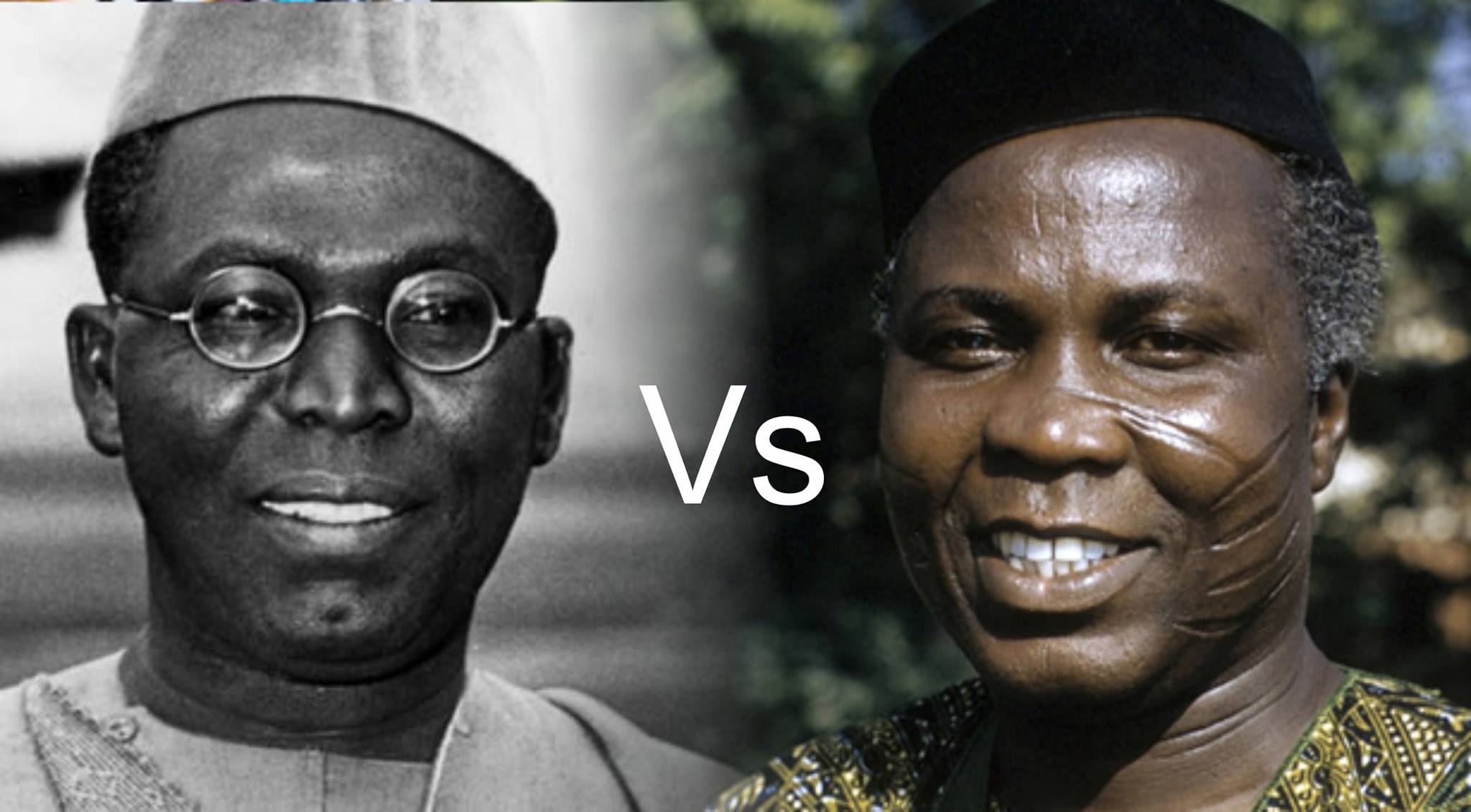
To ask that question seriously is to walk back into the haunted chamber of Awolowo and Akintola. What began as a struggle inside the Action Group was not just a disagreement between two brilliant men. It was a collision of political temperaments, ideological direction, ambition, and the larger architecture of power in Nigeria. Awolowo, who moved to the federal centre as opposition leader after 1959, was increasingly identified with a broader ideological project. Akintola, by contrast, came to embody a more conservative, region-focused and business-oriented current, and his openness to working with the Northern-dominated federal establishment deepened the rupture. By mid-1962, Awolowo’s camp had repudiated Akintola; the federal government declared a state of emergency in the Western Region and restored him in 1963. The bitterness of that split, and the wreckage that followed, helped poison the First Republic.
That is why the Awolowo-Akintola feud still matters. It was not gossip in an agbada. It was an early Nigerian lesson that opposition can die in two ways. It can be strangled from outside by a hostile ruling order. Or, more dangerously, it can decay from within, when conviction gives way to access, when strategy becomes personal survival, when party machinery becomes a theatre of ego. The Western crisis was, in that sense, not only about who should lead. It was about whether opposition should remain an instrument of principle or become a bargaining chip in the market of power.
Kano and Kaduna then enter the story like twin furnaces of northern political memory. Kano carries the old radical grammar of Aminu Kano, NEPU, Sawaba, talakawa politics, the language of emancipation rather than patronage. Oxford’s entry on Aminu Kano notes his struggle against corruption and oppression in the emirate order and his commitment to democratizing Northern Nigeria. The PRP’s own profile, lodged with INEC, explicitly roots itself in NEPU’s legacy and recalls that the PRP had two state governments in the Second Republic: Kaduna and Kano. In other words, both states are not accidental footnotes in the story of Nigerian opposition. They are ancestral terrain.
Then came 1999 and the Fourth Republic, with the PDP arriving not merely as a party but as a vast political weather system. Founded in 1998 and quickly becoming dominant, winning the presidency and legislative majorities in 1999 and retained national control for years. Opposition existed, yes, but it was fragmented, regional, underpowered, and often more symbolic than threatening. That era did not abolish opposition. It domesticated it.
The great interruption came in 2013, when the APC was formed through the merger of major opposition forces. That merger worked because it answered a Nigerian truth older than any campaign slogan: power rarely yields to scattered complaint. It yields to a disciplined coalition. The APC emerged from the merger of ACN, CPC, ANPP, and part of APGA, and in 2015, Buhari’s victory marked the first time an incumbent was defeated and the first inter-party transfer of power in Nigeria’s post-independence history. Reuters described it plainly as a historic democratic transfer. For a brief moment, opposition in Nigeria looked like more than lamentation. It looked like a ladder.
But even that victory carried a warning label. The problem with Nigerian opposition is that once it wins, it often stops being opposition in spirit and becomes merely the next landlord in the same building. An academic review of Nigeria’s democratic journey notes that the APC and PDP share many structural defects, and even cites the broader judgment that little distinguishes the two main parties because both are fluid elite networks with weak ideology. That diagnosis is painful because it explains so much. In Nigeria, opposition too often opposes only until the gates open. After that, the vocabulary changes, but the appetite stays the same.
This is where Kano and Kaduna become especially revealing from 1999 till now. Kano has repeatedly shown a willingness to defy neat national binaries, and in the 2023 election, it backed Rabiu Kwankwaso of the NNPP in the presidential race while also electing Abba Kabir Yusuf of the NNPP as governor. Kaduna told a different but equally interesting story: it voted Atiku Abubakar of the PDP in the presidential contest, yet elected APC’s Uba Sani as governor. CDD West Africa described the 2023 election as unusually fragmented, noting that all four major presidential contenders won at least one state and that states like Kano, Lagos, and Rivers split among three different parties. So, Kano and Kaduna have not been passive spectators in the Nigerian democratic drama. They have been laboratories of resistance, fragmentation, coalition, and contradiction.
And now we arrive at the present crossroads, where the phrase “one-party state” is no longer a tavern exaggeration but a live political argument. Reuters reported in May 2025 that the APC endorsed President Tinubu for a second term while the opposition was widely seen as too divided and weak to mount a serious challenge, with high-profile defections strengthening the ruling party. AP later reported Tinubu’s denial that Nigeria was being turned into a one-party state, even as several governors and federal lawmakers had left opposition parties for the APC. By February 2026, major opposition leaders, including Atiku, Peter Obi, and Amaechi, were jointly rejecting the new Electoral Act, calling it anti-democratic and warning that it could help install a one-party order. Tinubu, for his part, has continued to insist that democracy requires room for the minority to speak.
So, is Nigeria now a one-party state? Not formally. Not yet. There are still multiple parties, multiple ambitions, multiple resentments, and multiple routes to elite reassembly. But that is not the only question that matters. A country can avoid the legal shell of one-party rule and still drift into the political culture of one-party dominance. That drift happens when the ruling party becomes the default shelter for frightened politicians, when defections replace debate, when opposition parties become war zones of internal ego, and when citizens begin to see parties not as platforms of principle but as bus stops for the next powerful convoy. The danger is less a constitutional decree than a democratic evaporation.
This is why the ghosts of Awolowo and Akintola are still standing by the roadside, watching us. Their quarrel warned that opposition without internal discipline can collapse into treachery, and that power at the centre always knows how to exploit a divided house. Kano reminds us that opposition can spring from social memory, from the stubborn dignity of people who do not always vote as ordered. Kaduna reminds us that politics is rarely simple, that a state can host both establishment power and insurgent sentiment in the same electoral season. And the Fourth Republic reminds us that opposition in Nigeria only works when it is more than noise, more than wounded ambition, more than a coalition of temporarily unemployed strongmen.
The real Nigerian danger, then, is not that one party will conquer the entire country by brilliance alone. It is that the opposition will continue to fail by habit. If opposition is only a queue for access, then the ruling party will keep eating its rivals one defection at a time. If, however, opposition rediscovers ideology, internal democracy, regional credibility, and the courage to look different from what it condemns, then the old republic may still whisper a useful lesson into the new one.
Awolowo and Akintola were not just fighting over a party. They were fighting over the soul of the political alternative in Nigeria. That battle never ended—May Nigeria win!
By Edwin Uhara
There is no doubt that the national convention of our great party, the ruling All Progressives Congress (APC), has come and gone, with the former Minister of Humanitarian Affairs and Poverty Alleviation, Professor Nentawe Yilwatda, retained as the National Chairman of the party.
I congratulate him and the new members of the National Working Committee (NWC) of the party, even as I encourage them to brace up for the challenging tasks ahead.
However, I must point out that the new NWC members are not going to enjoy any honeymoon because the time frame for the conduct of party primaries is too short, and as a result, the leadership must roll up its sleeves and hit the ground running because there is no time for a walk in the park at the moment.
In this regard, the party must adopt both proactive and reactive strategies in handling the post-primary election crisis, which will most likely erupt.
I’m not a pessimist, but the new party leadership must anticipate a crisis emanating from some states over conflicts of interest and make arrangements on how to strike a balance between the interests of longstanding members and the interests of new members who now enjoy the attention of the party.
This is where the proactive strategy will work perfectly for the overall interest of the party.
The second strategy is that the leadership must embark on genuine reconciliation immediately after the primary elections are over in order to establish a modus vivendi within the party structure across states.
If this second aspect is not properly handled, anything can happen because politicians always go to where their nest would be feathered.
The Presidential Primary would not be an issue because the President would be given the automatic ticket of the party.
Next time, when our party delegates will be coming back to Abuja, it will be to ratify the automatic ticket that would be given to Mr President.
So, at the presidential level, the leadership will have a field day because there would not be much trouble in this regard, but it will most definitely not be like that at the state level.
This is where the challenge lies, and it requires high-level negotiation abilities and conflict resolution skills to overcome it.
Such a challenge did not arise in Anambra, Ondo and other states that recently witnessed gubernatorial primaries because it’s a staggered primary with minimal interest.
This area is one of the most neglected aspects that led to the downfall of the former ruling party — the People’s Democratic Party (PDP) in the 2015 Presidential Election.
A lot of analysts focused on the immediate cause of PDP failure, but refused to look at the remote cause, which I want to highlight in this piece because I was part of the process.
Towards the end of 2014, the PDP conducted the worst party primary, which it carried over to the 2015 general election year.
Initially, the party encouraged interested members to buy the nomination and expression of interest forms at very high prices and promised that it would give every member a level playing ground.
But during the primaries, the party went against its own rules, and the leadership carried on as if nothing had happened.
Because these aggrieved party members commanded huge followership among the electorates, they decided to protest under the auspices of the PDP Aspirants Forum (PAF), of which I was one of its national spokespersons.
PAF wanted to engage the party leadership to amicably find a lasting solution to the crisis, but some hardliners within the party hierarchy, who thought that the election would be business as usual, frustrated every one of our moves until we decided to go public.
Because our members refused to participate in partisan activities, their non-participation started showing bad and dangerous signals for all the candidates, including President Goodluck Jonathan.
First, public opinion began to go against the candidates. Second, the electorates began to pelt the President with pebbles and sachet waters.
Third, blame and counterblame started creeping into the campaign train.
While all these were happening, General Buhari, who was the candidate of the APC, soared high as he became the main beneficiary of the internal party wrangling.
The Presidency and the PDP refused to recognise the political reality in the country and also underestimated their main challenger, General Muhammadu Buhari and his party, without knowing that the APC had covertly engaged the services of AKPD, which was the political consultancy firm owned by David Axelrod, President Obama’s Chief Campaign Strategist for the 2008 and 2012 United States Presidential Elections.
Because Mr Axelrod had the ear of President Obama, he was able to turn the heart of Mr Obama against President Jonathan.
Accordingly, Obama mobilised David Cameron, who was then the UK Prime Minister and other allies to work against Jonathan’s re-election.
When the Presidency saw the danger ahead, they decided to reach out to PAF by sending the Deputy Director-General of the Jonathan/Sambo Presidential Campaign Organisation, Professor Tunde Adeniran and the traditional ruler of Jonathan’s community in Ogbia, King Asara A. Asara, to the group.
Professor Adeniran urged PAF members not to allow what some persons had done to cause them to leave the party or work against it during polls, noting that there were some party members on the campaign train who did not want President Jonathan reelected.
While speaking on behalf of the President, the Traditional Ruler of Akipelai Community in Ogbia Local Government Area of Bayelsa State, Chief Asara A. Asara, appealed to PAF members not to leave the party saying, “President Jonathan was deeply worried over the way and manner the last primaries were conducted, but, because the automatic ticket granted him by the party was yet to be ratified as at the time the various primaries were conducted, he was very helpless in intervening in the matter. He assured them that the President would soon meet with them.
On March 2, 2015, President Jonathan finally invited PAF members to the Presidential Villa, but most of our members refused to attend.
Some members who honoured the invitation observed that everyone was already in panic mode.
This was when the Director -General of the PDP Presidential Campaign Council, Senator Amodu Ali, told us that the battle was not against Buhari but against the American Government.
Trying to justify his claim, Senator Ali said that Mr Obama was angry with President Jonathan because he refused to allow same sex marriage to be made official in Nigeria, but this narrative fell on deaf ears because the PDP had already lost the sympathy of many Nigerians.
For example, instead of running their campaigns on issues, the party decided to focus on Buhari, making him the campaign issue.
So, after the popular Abuja peace accord, President Obama started sending his then Secretary of State, Senator John Kerry, to Nigeria often and often signalling danger over any plot to rig the election.
After much filibustering, PAF dissected everything within the context of truth and observed that even if we decided to support the PDP, public opinion had already gone against the party.
For example, Hon. Ndudi Elumelu, who was one of the governorship aspirants for Delta State, said that elections had not yet been conducted, but some of the beneficiaries of the kangaroo primaries had started carrying themselves as if they had won the election already.
Other members like the Governorship Aspirant for Lagos State, Chief Babatunde Badamasi, Rivers State, Hon. Gabriel Pidomson, Benue State, Mrs Rosaline Ada Chenge, Imo State, late Chief Bethel Amadi, the Senatorial Aspirant for Edo North, Chief Richard Lamai, Adamawa, Mallam Isa Tambaran, Anambra, Barrister Chike Madueke, House of Representatives Aspirants like Hon. Pat Asadu, Lady Irene Ottih, Chief Mrs Olivia Agbajo and over 150 Aspirants for various State House of Assemblies spoke in a similar direction.
It was at this point that Buhari saw the opportunity and sent a high-powered delegation to the PAF members. Though he has been sending Senator Dino Melaye, who was one of his campaign spokespersons to the group.
So, while some defected to APC, including myself to support Buhari, others remained in PDP but to work against it during polls, which in the end, Buhari gave PDP a very hard blow with a crushing defeat.
Ever since then, the PDP has never recovered from the Buhari blow and from the look of things, they will have no option but to adopt our President as their presidential candidate for next year’s election.
So, with the benefits of hindsight, insight and foresight, I write this piece to arrest things before they go out of hand.
Once again, congratulations to our Chairman and members of the National Working Committee of the party.
Comrade Edwin Uhara is a Political Operative, Public Policy Analyst and former Member of the APC Presidential Campaign Council. He can be reached via email: [email protected]
By Vivian Imoh-Ita
Across African banking, the conversation is shifting from “inclusion as intent” to “inclusion as performance.” Margin pressure, recapitalisation conversations, digitisation, and tighter risk expectations are forcing a hard question: where will sustainable, low-volatility growth come from in the next cycle? One answer is hiding in plain sight: women-led enterprises, underfunded, underserved, and consistently productive.
In Nigeria’s informal economy, where cash flow is real but documentation is uneven, the institutions that win will be the ones that price risk with better signals, distribute at scale, and convert trust into long-term financial relationships. Too often, women’s economic participation is framed as a social commitment rather than a commercial imperative.
That framing is expensive: when we fail to design capital, products, and distribution around the realities of women in business, we don’t just exclude customers, we misprice opportunity and leave growth on the table. Women in Nigeria are not waiting to be “empowered” before they build.
They are already trading, employing, and sustaining households at scale. The real constraint is not capability; it is the fit between how finance is structured and how women-owned businesses actually operate: cash-flow patterns, collateral realities, and the need for speed, trust, and advisory alongside capital.
Three practical frictions show up repeatedly: Collateral versus cash-flow: many viable women-run businesses are cash-generative but asset-light, so collateral-heavy underwriting excludes the very segment banks say they want. Information gaps: when transactions happen outside formal rails, banks see “thin files.”
But thin files are not the same as high risk; they are a data problem that better design and alternative signals can solve. Time-to-cash matters: entrepreneurs often need small, fast working-capital decisions, not slow processes built for corporate cycles.
Speed is a risk tool when it is paired with the right controls. Nigeria has roughly 23 million women entrepreneurs in the micro-business segment, one of the highest rates of female entrepreneurship globally.
Women account for 41% of SME ownership, and SMEs contribute nearly half of the national GDP. Yet access to formal finance remains disproportionately low: women receive only about 10% of loans from financial service providers, and an estimated 98% of women entrepreneurs still lack access to formal credit.
An internal strategy analysis drawing on EFInA/Global Findex/SMEDAN data shows a structural gap: 41% of Nigerian women are financially excluded (vs 33% for men), and while 39% of women borrowed from multiple sources, only 4% accessed a bank loan.
Across Africa, the financing gap for women-led businesses is estimated at $42 billion. This is not a “nice-to-have” agenda. McKinsey Global Institute’s The Power of Parity estimates that advancing women’s equality could add up to $12 trillion to global GDP.
The IMF has estimated that equal participation by women could lift GDP by as much as 40% in some countries. For Nigeria, an analysis cited by the Council on Foreign Relations, drawing on McKinsey’s data, projects that closing the gender gap in economic participation could increase GDP by 23%.
For banks, the implication is straight-forward: women-led enterprises are not a niche; they are a mass-market growth opportunity. Unlocking it requires moving from “product availability” to “product usability”: cash-flow-based lending, simpler onboarding, distribution through digital and agent rails, and trust-by-design (clear pricing, consumer protection, and strong data privacy). Usage is what creates the data to lend responsibly at scale.
There is also a practical reason the returns are outsized: women tend to reinvest more of what they earn into their families and communities, often cited as up to 90%, driving a multiplier effect that shows up in education, health outcomes, and local employment.
For financial institutions, that multiplier is not just a story; it is a durable pathway to deposit growth, transaction volume, credit performance, and long-term customer value. I have seen this play out across Nigeria, in every state and market. The woman selling clothes in Balogun Market employs three other women and sends five children to school.
The general merchandise trader in Onitsha Market is the economic anchor of her extended family. Each of these women is a multiplier, and each of them started with someone, somewhere, giving her a loan, a skill, an opportunity, a chance. That is the “Give to Gain” principle made real. Giving is not a subtraction. It is, as this year’s IWD campaign puts it, intentional multiplication.
At Union Bank, we treat women’s financial inclusion as a core product strategy, not CSR, because the commercial logic is clear. When a woman builds financial capability, she doesn’t just open an account. She saves, transacts, borrows responsibly, expands her business footprint, and brings others with her.
We also understand that distribution is a strategy. Union Bank’s UnionDirect agency banking network operates over 58,000 agents across rural and underserved communities, extending access to deposits, withdrawals, and micro-lending where branches cannot cover the economics.
We have also disbursed over N50 billion in micro-lending to smallholder farmers, market women, and informal entrepreneurs, because inclusion only becomes real when it is usable, frequent, and local.
In a market where a large share of working women operates in the informal sector, bringing women into the formal financial system through savings, digital banking, micro-lending, and insurance is a material growth frontier. Multiple studies across emerging markets also show women often have lower default rates than men, reinforcing what many banks observe in practice: disciplined cash management and strong repayment culture when products are designed around real operating conditions.
That is why we created alpher, Union Bank’s women’s banking proposition launched in 2020 and aligned with SDG5 on Gender Equality. Alpher is designed for the Nigerian woman, whether she is an entrepreneur, a working professional, or managing household finances. For women in business, alpher combines tailored loans and savings plans with capacity-building, mentorship, and practical masterclasses, because capital without capability yields fragile outcomes. alpher is built around a simple promise: practical financial solutions, support systems, savings and investment options, discounted loans, personal and professional development, mentorship/coaching/networking, discounted healthcare plans, and lifestyle/business discounts.
Operationally, we segment customers into individuals (professionals and entrepreneurs), women-led organisations, and organisations that support women in their workforce and supply chains. Hence, the service is relevant, not generic.
Practically, that has meant designing access to credit with reduced collateral requirements, recognising that traditional collateral models were not built around women’s asset ownership patterns.
It has also meant investing deliberately in skills, entrepreneurship, bookkeeping, pricing, digital commerce, and personal finance, so that funding translates into resilience, not just activity.
One initiative I am particularly proud of is the alpher Fair. In this marketplace concept, we open our premises (and those of partners) to women entrepreneurs to sell directly to customers, employees, and partner networks.
It creates immediate market access, strengthens visibility, and proves a simple point: scaling women-owned businesses is often about building pipelines of customers, information, and trust, not just issuing loans. Beyond our own programmes, we partner to scale outcomes.
In May 2025, through alpher, Union Bank sponsored the Nigerian British Chamber of Commerce (NBCC) Women and Youth Entrepreneurship Development Centre (WYEDC) Cohort 2 Programme, which graduated 125 entrepreneurs who benefited from entrepreneurship training and business grants. At the graduation, we hosted a pitch segment that awarded funding to standout entrepreneurs. This is the point: capability building is not “soft.”
It is pipeline development for stronger businesses and better credit outcomes. Importantly, alpher sits within Union Bank’s broader retail and SME ecosystem, loan products, business advisory, digital payment infrastructure, and growth workshops, so customers can access funding, learn how to deploy it, connect to mentors and peers, and gain visibility for their businesses.
The objective is straightforward: build businesses that last. The next phase of banking growth in Nigeria will favour institutions that translate insight into design products that reflect customer reality, distribution that meets customers where they are, and risk models that recognise performance beyond legacy collateral. Backing women-led enterprise is not a campaign; it is a competitive advantage.
The forward-looking question is whether we will build the rails, capital, capability, digital trust, and market access fast enough to earn the growth already waiting in plain sight. If we are serious about inclusive growth, we should be equally serious about inclusive balance sheets and about building the underwriting, data, and distribution models that make inclusion commercially sustainable.
Vivian Imoh-Ita is Head, Retail & SME Business at Union Bank of Nigeria, with a focus on building retail and SME propositions that drive inclusion, growth, and long-term customer value
-
 Feature/OPED6 years ago
Davos was Different this year
-
Travel/Tourism10 years ago
Lagos Seals Western Lodge Hotel In Ikorodu
-

 Showbiz3 years ago
Estranged Lover Releases Videos of Empress Njamah Bathing
-
 Banking8 years ago
Sort Codes of GTBank Branches in Nigeria
-

 Economy3 years ago
Subsidy Removal: CNG at N130 Per Litre Cheaper Than Petrol—IPMAN
-

 Banking3 years ago
Sort Codes of UBA Branches in Nigeria
-

 Banking3 years ago
First Bank Announces Planned Downtime
-

 Sports3 years ago
Highest Paid Nigerian Footballer – How Much Do Nigerian Footballers Earn