Connect with us

General

Ambode Inaugurates N500m Disability Trust Fund

Published

on

disability-trust-fund

By Dipo Olowookere

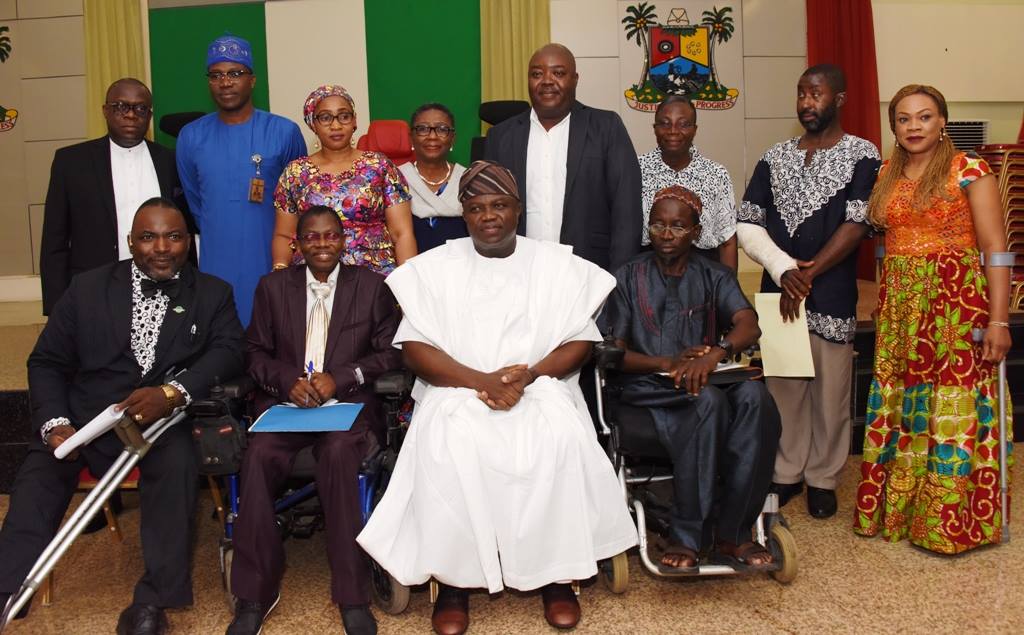
Mr Akinwunmi Ambode, the Governor of Lagos State, inaugurated the Governing Board of the Office for Disability Affairs on Tuesday to manage the N500 million Disability Trust Fund.

The Governor expressed optimism that it would aid people living with disabilities in the state realize their dreams and live a more comfortable life.

Mr Ambode, who spoke at the Lagos House, Alausa, while inaugurating the Board, said it was in fulfilment of his administration’s promise to ensure that the affairs of people living with disabilities is managed by people passionate enough to show that there is ability in disability.

Describing the development as another milestone in his commitment to run an all-inclusive government, the Governor said the Board will, on behalf of the State Government, manage the affairs of people living with disabilities by issuing guidelines for their education, social development and welfare.

“The Board will also manage the Disability Trust Fund. In fulfilment of the promise I made on May 29th, 2016, this Fund has in its kitty today, N500m with a marching order to solicit from the public and other charitable organisations, additional support for its objectives.

“We could not have done otherwise, given the array of people with disabilities who possess requisite qualification, experience and character.

“In addition, we believe in their ability to manage the Disability Trust Fund more judiciously because they have a more personal understanding of the needs and situation of our less privileged people. This fund will give our brothers and sisters a needed boost to make a livelihood for themselves and a chance to fulfil their potentials,” the Governor said.

The Governor, however, assured that notwithstanding the N500million Trust Fund, people living with disabilities are still eligible to access the N25billion Employment Trust Fund (ETF).

Governor Ambode, while congratulating the members of the Board, tasked them to ensure that the principles of transparency, accountability, inclusiveness and fairness are observed in administering the Fund and coordinating all affairs concerning people living with disabilities.

“It is my belief that the fund should provide infrastructure and facilities required by needed parties to also complement the efforts of our administration,” he said.

Earlier, Commissioner for Youth and Social Development, Mrs Uzamat Akinbile-Yusuf, said that people living with disabilities have the same right as everyone else, noting that with proper planning, a person with special needs can have a more fulfilling, healthier and enjoyable life, hence the fulfilment of the Governor’s promise of the N500million fund to take care of people living with disabilities.

“This is an important step towards scaling up efforts to address disability inclusion and further strengthen the fact that social exclusion of persons living with disabilities is unacceptable in the face of economic and social progress in the state”, Akinbile-Yusuf said.

In his vote of assurance, Chairman of the Board of Trustee, Office For Disability Affairs, Dr. Oki Olabodunrin Waheed, thanked the Governor for reposing confidence in him and his team, just as he assured that they would discharge their duties conscientiously.

Other members of the Board are Leila Omawumi Atake, Rose Ekaete Mordi, Abdulwahab Matepo, Deaconess Adedoyin Beyioku-Alase, Dr Adebayo Adebukola Shehu, Biola Liadi, Bada Emmanuel Oladipupo, Hakeem Muri-Okunola, representing the Ministry of Youth and Social Development; and Dr Babatunde Awelenje.


Dipo Olowookere is a journalist based in Nigeria that has passion for reporting business news stories. At his leisure time, he watches football and supports 3SC of Ibadan. Mr Olowookere can be reached via [email protected]

Click to comment

Leave a Reply

Your email address will not be published. Required fields are marked *

General

FG Seeks Public Input on National Policing Bill

Published

on

state police bill

By Modupe Gbadeyanka

Members of the public have been invited to submit memoranda and policy proposals on the proposed National Policing Bill.

The Chairman of the Working Group, Mr Femi Gbajabiamila, announced this on Monday after the team’s meeting at the State House in Abuja.

The group, headed by the Chief of Staff to President Bola Tinubu, is calling for input from Nigerians as part of efforts to establish a comprehensive legal and operational framework for state policing.

It is reviewing the Police Act 2020, the Police Service Commission framework, police regulations, and other relevant laws to support the development of an effective, modern policing system.

The proposed framework will set national minimum standards, define state readiness and grant certification, clarify jurisdictional responsibilities, ensure independent oversight, uphold human rights, and guarantee sustainable funding. It would also spell out an orderly transition to a dual-policing structure.

The call for memoranda will run for two weeks, allowing citizens, professionals, civil society, security agencies, state and local governments, academics, and other stakeholders to contribute. Submissions will be reviewed and integrated into the draft bill, which will then be subject to further national consultation before being finalised and sent to the National Assembly.

The Working Group has adopted a seven-week work programme running from July 27 to September 14, 2026. The draft Executive Bill is scheduled for presentation to President Bola Ahmed Tinubu on September 3, 2026, with national consultations to follow before the final approval.

The new National Policing Bill will set out requirements for recruitment, training, oversight, funding, and transition arrangements to ensure credible, effective, and accountable policing nationwide.

“A proposed State Police Service must demonstrate that it has credible arrangements for recruitment, vetting, training, pay, pensions, equipment, custody, complaints, discipline, data, firearms control, independent oversight and financial sustainability before it begins policing,” Mr Gbajabiamila said.

The representative of the Nigeria Governors’ Forum and Governor of Ogun State, Dapo Abiodun, who described State Police as a landmark reform, described the initiative as one of the defining reforms of President Tinubu’s administration.

Responding to concerns about federal overreach, he clarified that there is no Federal attempt to control State Police. He added that the proposed legislation is intended to provide an operational framework rather than centralise control.

Prince Lateef Fagbemi, the Attorney-General of the Federation and Minister of Justice, said the proposed National Policing Bill is designed to guarantee the security of lives and property while ensuring that the establishment of state police does not become a tool for political persecution.

The Attorney-General added that states not immediately ready to establish their own police services would continue to benefit from the presence of the Federal Police until they meet the required standards.

Other participants at the meeting included the Inspector General of Police, Tunji Disu; President of the Nigerian Bar Association, Afam Osigwe; Chairman, Policy Advisory Committee, Justice Abdullahi Liman (rtd); Professor Olu Ogunsakin, Head, Nigeria Police Reform Secretariat; Senior Special Assistant to the President on Planning and Research, Nnadubem Moghalu; and Brigadier General Olutayo Muyiwa Adesuyi, representing the National Security Adviser.

Continue Reading

General

NMDPRA Records 30% Drop in Gas Imbalance on Western Network

Published

on

NMDPRA fee regulations

By Adedapo Adesanya

The Nigerian Midstream and Downstream Petroleum Regulatory Authority (NMDPRA) says it recorded a 30 per cent reduction in gas imbalance on the country’s Western Network following the conclusion of its first-half 2026 Nigerian Gas Network Reconciliation (NGNR) Workshop.

The workshop brought together gas transporters, suppliers, shippers and off-takers to reconcile gas volumes traded between January and June 2026, while introducing a Network Entry/Exit Point Measurement Infrastructure Audit Template aimed at improving metering accuracy and accountability across the gas transmission network.

In a communiqué issued after the workshop, the authority said participants also reviewed the performance of the Nigerian Gas Transmission Network, assessed progress on major pipeline infrastructure projects, and received updates on the ELPS Gas Shrinkage Factor and Hydraulic Modelling Project.

Discussions focused on addressing metering gaps, improving network visibility through Supervisory Control and Data Acquisition (SCADA) integration, and enhancing system reliability ahead of the commissioning of the Ajaokuta-Kaduna-Kano (AKK) Pipeline System.

The workshop adopted key resolutions, including the execution of outstanding Network Exit Agreements, mandatory submission of measurement audit templates and closer collaboration among industry stakeholders to improve network pressure management.

Speaking at the closing session on behalf of the authority’s chief executive, Mr Rabiu A. Umar, the Director of Transportation Systems and Networks, Mr Joseph G. Musa, said the biannual reconciliation exercise had become critical to promoting equitable gas transactions, transparency, investor confidence and efficient network operations.

Mr Musa noted that since the NGNR process was introduced in 2023, it had significantly improved gas measurement, strengthened regulatory compliance through consequence management, reduced operational imbalances and contributed to a more reliable domestic gas supply.

The workshop concluded with participants adopting the reconciled H1 2026 gas volumes, reaffirming the authority’s commitment to a transparent, efficient and reliable domestic gas market.

Continue Reading

General

Swedfund Supports Climate Resilience in African Food Systems With $12m

Published

on

Agriculture in nigeria

By Modupe Gbadeyanka

An investment that supports growing food and agriculture companies across Africa that strengthen agricultural value chains has been made by Swedfund.

The organisation is putting down about $12 million to strengthen climate resilience in African food systems through the Acumen Resilient Agriculture Fund II (ARAF II).

By improving access to markets, finance and essential services, these companies help smallholder farmers become more resilient to climate and economic shocks.

Over 30 million smallholder farmers operate across Sub-Saharan Africa, accounting for 80 per cent of all farms and producing 70 per cent of the region’s food (IFAD). Yet many face limited access to finance, quality inputs, reliable buyers and market information. At the same time, they are among those most exposed to climate change and weather-related shocks, which threaten harvests, incomes and food security.

The investment has an ambition to reach around four million smallholder farmers through ARAF II’s portfolio companies. It also aims to meet the criteria of the 2X Challenge, which promotes investments that support women’s economic empowerment.

ARAF II invests in businesses that address key gaps in agricultural value chains, from improving market access and reducing post-harvest losses to expanding financial and digital services for farmers. By helping these businesses grow, the investment aims to improve productivity, strengthen local value chains and increase the resilience of food systems.

Swedfund invests alongside other development finance institutions and investors to help mobilise long-term capital for businesses that often struggle to access financing despite their potential to strengthen food security, climate resilience and economic development across Africa.

“Climate change is already affecting the livelihoods of millions of smallholder farmers across Africa. Investing in businesses that improve access to markets, finance and agricultural services helps farmers strengthen their resilience, increase productivity and build more stable incomes. That is essential for more resilient food systems,” the Investment Director of Food Systems and Strategic Investments at Swedfund, Ms Helen Hagos, said.

Continue Reading