General
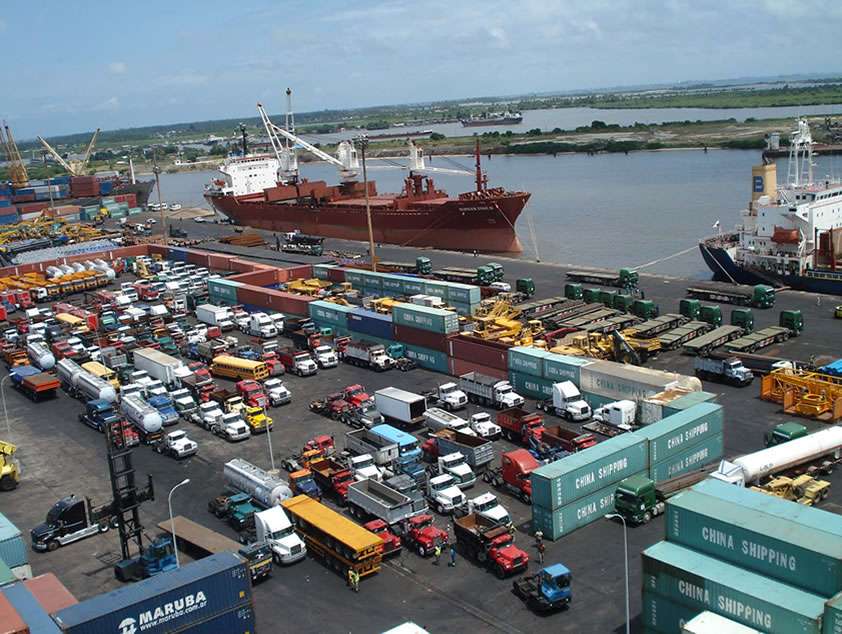
FG Blames Poor Management for Apapa Port Congestion
By Adedapo Adesanya
The federal government has said terminal operators responsible for the inefficiency of the Apapa Port must work towards its total reconstruction and reorganisation.
This was made by the Minister of Transportation, Mr Chibuike Amaechi, citing the drastic change in the Port on the day the President visited to commission the Deep Blue Project.
“I was in the train with the president on that day and noticed that everything had disappeared, even inside the port that looked like a marketplace was very well organized, no persons were found loitering about, no trucks. What it shows is that the problem of the seaport is the problem of efficiency.
“If they had the capacity in just one night, because I was there the previous evening, and when I came back in the morning, everything had disappeared; If that can happen in one night, it means that the problem is management, nothing else.
“Do we need to wait for the President to come before we can be efficient?” Mr Amaechi queried.
“What I’ve done was to have a meeting with the terminal operators, and I told them that they have to contribute to the reconstruction of the Apapa Seaport.
“We must rebuild the Apapa Seaport, taking into cognizance all the issues that we are seeing now that is frustrating the seaport, like where do you park the trucks, how many trucks are coming into the seaport at what point in time?
“How can a person come into the seaport who has no business being there, what is he doing at the seaport? The seaport is a security area and it is not for everybody, even me, after my tenure as Minister, I’m not entitled to go into the seaport unless I have business in the seaport,” he added.
The Minister noted that the Ministry of Transportation will partner with the Nigeria Customs Service (NCS) and the Nigerian Ports Authority (NPA) to solve the problem, adding that freighting of cargoes from the seaport through the rail, when it begins, will also help in arresting the situation at the port.
“We are going to partner with customs because they are largely involved. Between them and the NPA, they are the operators (or regulators) of the Seaport and see how to arrest this situation. I believe that when we begin to freight cargoes from the seaport through the rail, we’ll reduce some of the challenges that we have at the seaport,’ he said.
Mr Amaechi also said the recently launched Deep Blue Project is overseen by the Nigerian Maritime Administration and Safety Agency (NIMASA) in partnership with the Ministry of Defence, would not only boost security in the country’s waters but will also improve trade in the Gulf of Guinea and reduce the cost of production for the oil industry while improving revenue for Nigeria’s economy.
“Before we came, various contractors were contracted to provide security for oil companies in the water. There was a case between the government and OMSL in which the company provides about three or four boats to the Navy and they collect $2,500 per vessel for the first day and $1,500 for about 30 days.
In a year, like in 2020, they made about $67 million, and when you hand over the security of a country to individuals, it becomes very challenging and irresponsible. So, the president kindly approved that the police, army, air force, and other security agencies should be involved in providing security with the equipment that we have provided.
“We have about three helicopters, two fixed-wing planes, 17 interceptor boats, two vessels, drones, and more; what it does is that it gives you information about where the criminals are, those who go and destroy pipes just because they are looking for oil to bunker. It provides you that information, then you deter them or arrest them.
“So, we are able to provide security in the coastal region, both on land and on the sea. Now, those who provide the coastal security on land will be the Nigerian Army and the Police, and we’ve provided them with all the necessary tools they need.
“We have ammunitions, we have vehicles, like Armoured Personnel Carriers (APCs) and all that for patrol by the coast. All that, we believe will begin to yield fruits between now and next year.”
He added that by the time the government provide the necessary maritime security, the economy will improve as a result of more money coming into the economy through oil.
“That’s the impact it will have when it comes to the Deep Blue project. In fact, the Israelis who did the training said in 6 months to 1 year, if there is no improvement in the economy in terms of how much comes in, both to NIMASA, NPA, and the oil industry, come back to us and we’ll be willing to refund.
“But you know it is simple mathematics; It is true that the moment you can take away the criminals from the water, and the contractors from the water, then the cost of security which is borne either by NNPC or the oil companies will be part of what will come back to us as income. Then on land, in all our rail and train coaches, you have enough armed policemen in any trip we are making to withstand any criminal attack.”
General
NERC Seeks Reallocation of Rural Electrification Fund to Industries, Others
By Adedapo Adesanya
The Nigerian Electricity Regulatory Commission (NERC) is seeking the reallocation of the $2 billion currently domiciled with the Rural Electrification Agency (REA) beyond rural use to include industries and other large-scale needs.
The Vice Chairman of NERC, Mr Musiliu Oseni, called for a policy rethink in the management and utilisation of the REA fund, saying Nigeria must go beyond powering homes to powering industries and national prosperity.
Mr Oseni, speaking during the Technical Sessions to mark NERC’s 20th Anniversary in Abuja, said the commission’s focus has now shifted toward unlocking private capital, particularly in the transmission sub-sector, through the newly established Transmission Infrastructure Fund (TIF).
“Through effective regulation, we have saved the Federal Government several trillions of naira in subsidies, strengthened market reliability, and enhanced consumer protection,” he said.
The REA fund is part of efforts address Nigeria’s electricity access gaps. It was established for the purpose of supporting rural and underserved electrification. The fund provides capital subsidies or grants to schemes that can help achieve the electrification goal.
According to Mr Oseni, transmission remains a challenge beyond generation and distribution.
“But now we must move from subsidy savings to investment stimulation. That is why our attention is on transmission, the weakest link in the electricity value chain.“
The NERC Vice Chairman explained that the TIF will provide a financing platform to attract both local and international investors into Nigeria’s transmission grid, thereby enhancing stability and capacity for industrial growth.
On the management of the Rural Electrification Fund, Mr Oseni urged the federal government to deploy part of the $2 billion fund toward large-scale industrial and commercial power supply.
“You can power access through mini-grids, but you can’t power your economy to prosperity,” he said pointedly.
“We must ensure that access translates to productivity, and productivity translates to jobs and growth,” he added.
General
NCSP Urges Stronger Alignment to Unlock Private Capital for Nigeria’s Blue Economy
By Adedapo Adesanya
The Nigeria–China Strategic Partnership (NCSP) has urged stronger alignment among federal, state, and global climate strategies to unlock billions of dollars in private capital for Nigeria’s growing Blue Economy.
This call was made by the Director-General of NCSP, Mr Joseph Tegbe, at the 11th Lagos International Climate Change Summit (LICCS), held from November 6–7, 2025 in Lagos.
The DG, represented by the Head of Investment Management, Mr Taiwo Ajetunmobi, commended the Lagos State government for leading subnational climate action and setting a continental benchmark for sustainable growth.
Organized by the Lagos State Ministry of the Environment and Water Resources, the summit, themed Blue Economy, Green Money; Financing Africa’s Coastal Resilience and Ocean Innovation, convened policymakers, investors, climate experts, and development partners to explore innovative financing for ocean-based and climate-resilient projects.
Highlighting Lagos’s 180-kilometre coastline and dynamic private sector, the Director-General identified the state as a natural leader in Nigeria’s Blue Economy transformation.
He cited the Lekki Deep Sea Port as a prime example of effective federal–state collaboration that attracted over $1 billion in private equity investment, reinforcing Nigeria’s position as a regional maritime hub.
“Investors look for three things policy coherence, regulatory predictability, and project bankability. When these align, private capital follows,” he stated.
“By synchronizing federal vision with subnational execution, Lagos can unlock billions in blended finance for coastal resilience and sustainable infrastructure,” he added.
He further outlined Public–Private Partnership (PPP) models such as Build–Operate–Transfer (BOT), Design–Build–Finance–Operate (DBFO), and Lease–Develop–Operate (LDO), urging reforms to standardize processes, improve transparency, and strengthen institutional capacity.
The NCSP DG also highlighted China’s growing role as a strategic partner in Nigeria’s Blue Economy, noting investor interest in waste-to-energy, solar-powered cold-chain, and water transport projects.
“China leads globally in clean energy and marine infrastructure. With transparent, commercially viable frameworks, Lagos can attract long-term equity partnerships that deliver real value to its people,” he added.
Mr Tegbe called for unified action among stakeholders: “The tide of opportunity is rising and Lagos must rise with it. By aligning state, federal, and global strategies, we can turn Nigeria’s maritime potential into real wealth and shared prosperity.”
NCSP also reaffirmed its commitment to supporting projects that strengthen Nigeria’s climate resilience and solidify Lagos’s position as Africa’s hub for sustainable Blue Economy innovation.
General
We Will Defeat Every Form of Terrorism, Secure Nigerians—Tinubu
By Modupe Gbadeyanka
President Bola Tinubu has promised to protect the country and work very hard to ensure every form of terrorism in Nigeria is defeated.
Mr Tinubu gave this assurance during the Federal Executive Council (FEC) meeting in Abuja on Thursday.
He disclosed that Nigeria remains on a steady growth trajectory, with more promise of stability and prosperity as economic reforms continue to yield results and gain national and international acceptance.
Speaking in reaction to the threats by President Donald Trump of United States to raid terrorists’ camps in Nigeria, Mr Tinubu asked, “Do we have problems? Yes. Are we challenged by terrorism? Yes. But we will defeat terrorism. We will overcome the CPC designation.
“Nigeria is one happy family, and we shall spare no effort until we eliminate all criminals from our society. We want our friends to help us as we step up our fight against terrorism, and we will eliminate it.”
The President also disclosed that the federal government was engaging with the world diplomatically, noting, “The most important thing is the fact that despite the political headwinds and the fear of our people, we will continue to engage with partners.”
Commenting on the economy, he said, “The success of the $2.3 billion Eurobond that was oversubscribed by 400 per cent is the most assuring. So, the task ahead is immense; we are engaging the world diplomatically, and we assure all of you that we will defeat terrorism in this country.
“The task ahead is immense, but it is our resolve to move forward with unity and purpose, guided by the Renewed Hope Agenda to build a prosperous, inclusive and resilient Nigeria.”
Mr Tinubu directed the Minister of Finance and Coordinating Minister of the Economy, Mr Wale Edun, to brief the council on the nation’s economic performance, stated that the government will continue to sustain and consolidate the gains.
-
Feature/OPED6 years agoDavos was Different this year
-
Travel/Tourism9 years ago
Lagos Seals Western Lodge Hotel In Ikorodu
-
Showbiz3 years agoEstranged Lover Releases Videos of Empress Njamah Bathing
-
Banking7 years agoSort Codes of GTBank Branches in Nigeria
-
Economy2 years agoSubsidy Removal: CNG at N130 Per Litre Cheaper Than Petrol—IPMAN
-
Banking3 years agoFirst Bank Announces Planned Downtime
-
Sports3 years agoHighest Paid Nigerian Footballer – How Much Do Nigerian Footballers Earn
-
Banking3 years agoSort Codes of UBA Branches in Nigeria