Connect with us

General

Hunger Eases First Time Since Boko Haram Crisis

Published

on

By Modupe Gbadeyanka

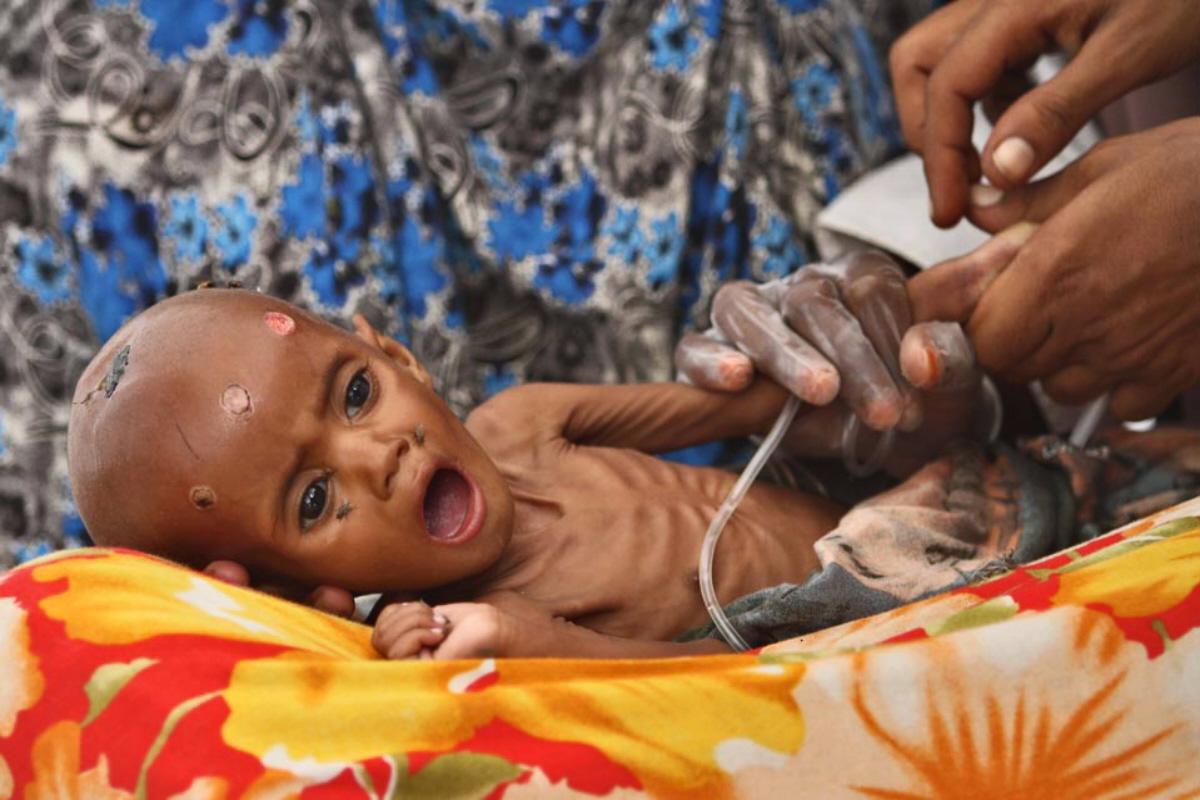
For the first time since the onset of the Boko Haram crisis, hunger has considerably declined in north eastern Nigeria. In the three states ravaged by the violence, the number of people facing acute hunger has halved since June-August – from 5.2 million to 2.6 million people – according to the latest Cadre Harmonisé food security analysis.

This is a major step forward thanks to an overall improved security situation, and the scaling-up of humanitarian and longer-term livelihoods assistance by the government and its partners.

The report warns, however, that without sustained and timely assistance, all good work could quickly be undone; more than 3.5 million people could battle again with acute hunger, including a risk of famine, by next August.

FAO provided cowpea, maize, millet, sorghum, vegetable seeds and fertilisers to 1 million people  – internally displaced populations (IDPs), returned refugees and host communities – to help them get through the last rainy season (June-September) when food stocks are low.

Now, as the harvest season is winding down and communities transition into the dry season and a new planting phase, FAO is aiming to further boost local production through distributions of vegetable seeds, farming kits, fertilisers and irrigation equipment to some 780,000 people across the three states.

In Yobe, one of the three states affected by violence, the villages are still a bustling field of yellow as farmers cut the last millet and sorghum and pile them in neat bundles. The smell of freshly cut crops lingers in the air.

Everyone takes part in the harvest – the children cut the head of the millet, the women thresh it, the men bundled it and carry it home. For many, this is the first time they have enough food to eat.

“This will be enough food for the family, and with the money from my knitting business, I will plan for my children’s education,” said 37-year-old Aisha Ibrahim who was forced to flee her village three years ago and has been displaced ever since.

“Families in my village help about five to six displaced people each. They depend on our assistance. Good harvest brings joy to all of us. It reduces the pressure and makes us stronger,” said Malam Mohammed, a local farmer from Ngalda village who supports IDPs.

By supporting host communities to plant during the rainy season, FAO has also brought relief to displaced, landless populations who could work in the fields and earn an income.

“The local communities have helped me; I could work on their farms and got paid,” said 40-year-old Hajanuwe Sulieman, a widowed mother of eight children who has been displaced by violence three years ago and is now taking refuge in an informal settlement of Mainok. This is a considerable support for Hajanuwe who, at times, has had to resort to begging to make ends meet.

Across north eastern Nigeria, violence aside, farmers have been through a lot these past few months; some have had to deal with a dry spell, others with flooding. Others still with pest infections that ate their crops.

But now the fields are dry and farmers like Malam and Hajanuwe are getting ready to plant again.

Sustained support – from rainy to dry season – builds vulnerable communities’ resilience, strengthens their capacity to grow both staple and cash crops, and reduces the need for food assistance.


Modupe Gbadeyanka is a fast-rising journalist with Business Post Nigeria. Her passion for journalism is amazing. She is willing to learn more with a view to becoming one of the best pen-pushers in Nigeria. Her role models are the duo of CNN's Richard Quest and Christiane Amanpour.

Click to comment

Leave a Reply

Your email address will not be published. Required fields are marked *

General

NIMC Launches WhatsApp, Live Chat Support for NIN Enquiries

Published

on

NIMC

By Adedapo Adesanya

The National Identity Management Commission (NIMC) has launched a WhatsApp and live chat support platforms to provide faster and more accessible assistance to Nigerians and legal residents seeking help with National Identification Number (NIN) related enquiries.

According to NIMC, the new digital customer support channels were introduced as part of ongoing reforms and digital transformation initiatives under the leadership of the Director-General and Chief Executive Officer, Mrs Abisoye Coker-Odusote.

The commission said members of the public can now access support services through the live chat feature on its official website and the official NIMC WhatsApp support line.

It explained that the initiative was designed to improve accessibility, responsiveness and overall service delivery for Nigerians seeking information and support on identity management services.

NIMC stated that the platforms would provide prompt responses to enquiries, real-time guidance and improved customer interaction from any location, thereby reducing the need for physical visits to its offices.

The agency added that the move aligns with the Renewed Hope Agenda of President Bola Ahmed Tinubu, which seeks to improve public sector efficiency and expand access to government services through technology-driven solutions.

“The initiative reflects the Commission’s commitment to service innovation, citizen-centred engagement, and efficient identity management service delivery in line with the Renewed Hope Agenda of President Bola Ahmed Tinubu(GCFR), aimed at improving public sector efficiency and enhancing access to government services through technology-driven solutions.

“The newly introduced platforms are designed to provide prompt responses to enquiries, real-time guidance, and improved customer interaction from anywhere and at any time, reducing the need for physical visits while enhancing user experience and operational efficiency.

“Under the visionary leadership of Engr. Abisoye Coker-Odusote, NIMC continues to implement strategic reforms and innovative digital solutions focused on expanding access, strengthening public trust, and improving service delivery for all Nigerians and legal residents,” the commission stated.

Continue Reading

General

Yakubu Gowon to Unveil Book on Nigerian Civil War May 19

Published

on

Yakubu Gowon

By Adedapo Adesanya

Nigeria’s former Military Head of State, Mr Yakubu Gowon, will offer a personal account of the Nigerian civil war, one of the country’s darkest events, in his long-awaited autobiography due for launch on May 19.

Mr Gowon, who served as Nigeria’s leader from 1966 to 1975, said the book intends to clarify several written perspectives and policies surrounding the birth of the Nigerian Civil War.

In a statement released ahead of the book’s public presentation, Mr Gowon said the memoir provides his personal perspectives on events often narrated by others, saying it is not intended to reopen old wounds.

The Nigerian Civil War, often regarded as one of the darkest periods in Nigeria’s history, began in 1967 and ended in 1970.

“The autobiography became necessary because many accounts of the civil war era had been written from different perspectives over the years without fully reflecting [my] own reasoning as Nigeria’s leader at the time,” the statement said.

He added, “By choosing to write, I took a conscious decision not to reopen old wounds but to clarify my thinking on policies and plans at a period often narrated by others.

“My story is one of conviction evaluated by circumstances at the crossroads of expectations and reality.”

The 881-page book, published by Havilah Group, gives a personal account of General Gowon’s life, leadership journey, and reflections on defining moments in Nigeria’s history.

The book is scheduled for unveiling on May 19 at the Bola Ahmed Tinubu International Conference Centre, Abuja.

President Bola Tinubu is expected to attend the event as a special guest of honour, while Mr Theophilus Danjuma, former minister of defence and ex-chief of army staff, will perform the formal unveiling.

The event is expected to draw prominent political leaders, military veterans, diplomats, and senior government officials.

The autobiography also chronicles Mr Gowon’s early years and his emergence as Nigeria’s leader at a critical point in the country’s history. Born in 1934, Mr Gowon became head of state and commander-in-chief on August 1, 1966, and served for nine years.

After leaving office in 1975 after being ousted by General Murtala Muhammad, he went on to earn a PhD in political science from the University of Warwick in 1984 and has since focused on peacebuilding, national development, and spiritual leadership.

His post-service initiatives include the “Nigeria prays” movement and advocacy against guinea worm, HIV/AIDS, tuberculosis, and malaria through the Yakubu Gowon centre.

He also serves as Nigeria’s national goodwill ambassador for the control of viral hepatitis.

Continue Reading

General

N33.8bn Fraud: Former Power Minister Mamman Gets 75 Years Imprisonment

Published

on

Saleh Mamman 75 years

By Adedapo Adesanya

A Federal High Court has sentenced former Minister of Power, Mr Saleh Mamman, to 75 years in prison over the diversion of N33.8 billion meant for the Zungeru and Mambilla hydroelectric power projects.

Mr Mamman, who served as Minister of Power from August 2019 to July 2021, was accused of overseeing the alleged diversion of funds during his tenure.

The Economic and Financial Crimes Commission (EFCC) said he diverted the funds using some ministry officials, private companies, and Bureau de Change (BDC) operators.

He was also reported to have purchased the Taraba State governorship forms under the All Progressives Congress (APC), while separately facing another case at the FCT High Court in Maitama, where he is accused of diverting N31 billion meant for the Mambilla Power Project.

Delivering the judgment today, Justice Omotosho sentenced Mr Mamman, who is on the run and was absent at the last court sitting, on each count and ordered that the sentences run consecutively, bringing the total to 75 years.

The court also ruled that the sentence will begin to run from the day the convict is arrested, and ordered all security agencies, including Interpol, to apprehend him wherever he is found.

Monies recovered, along with forfeited properties, are to be remitted to the Federal Government, while the convict is also ordered to pay the outstanding balance of ₦22 billion tied to the affected hydroelectric power projects.

He was removed from office by the late president in 2021 and arrested by the anti-money laundering organisation four months after. He was said to have used embezzled funds of up to N33.8 billion to acquire properties.

Last week, the judge confirmed that Mr Mamman made a cash payment of $655,700 (equivalent to N200 million) for landed property in Abuja, without recourse to a financial institution.

He was also found guilty of criminal breach of trust in relation to funds released by the federal government for the Mambilla and Zungeru Hydroelectric Power Plant projects.

Continue Reading

Trending