General
I Wept ‘Cause of Buhari’s Health, He Needs Prayers—Bisi Akande

By Dipo Olowookere
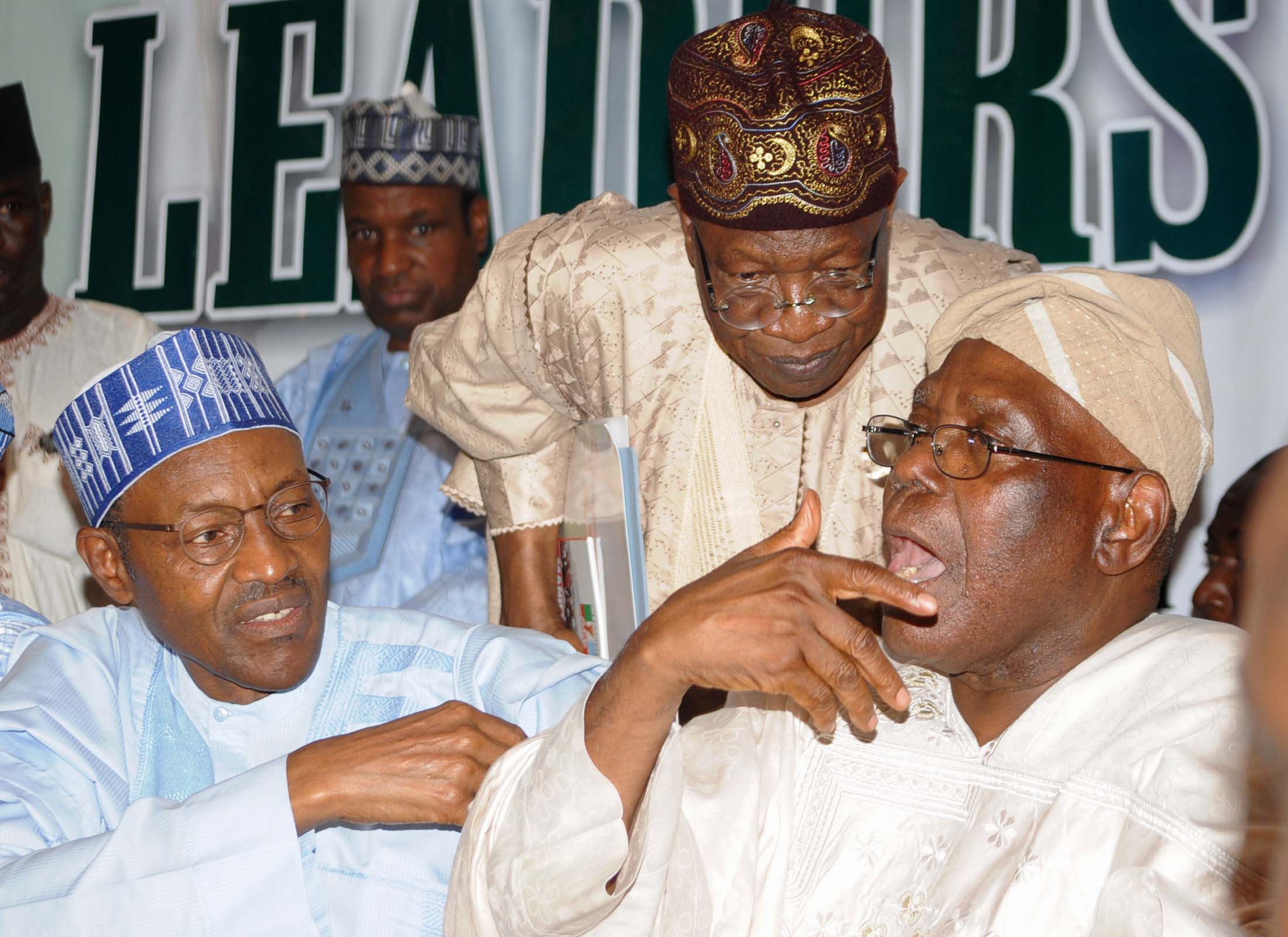
Former Chairman of the All Progressives Congress (APC), Mr Bisi Akande, has appealed to Nigerians to pray fervently for the health of President Muhammadu Buhari.
Mr Akande said the poor health of the President was already taking a toll on the health of Nigeria as a polity.
“I did not see President Buhari at the wedding of his grandson in Kaduna last Saturday. I was sad and I wept,” the founding National Chairman of the ruling party said.
He pointed out that Nigerians must pray for Mr Buhari because “health of the leader is intricately intertwined with the health of the nation,” stressing that it is more so in a “delicately fragile union of nations called Nigeria.”
“When last we met at the wedding of his daughter in Abuja last December, I complained to him that I was not happy about his stressful looks. His reply connoted some allusions to circumstances where an honest man fighting corruption is surrounded mostly by unpatriotic greedy ruling class. He felt painfully frustrated. He assured me he would soon be going on vacation. I then knew that corruption has effectively been fighting back. And I prayed for Nigeria. That was why Ashiwaju Bola Tinubu and I rushed to meet him in London in February this year when he was sick and could not return as scheduled from his vacation. The rest is history but we must appreciate that his poor health is already taking a toll on the health of Nigeria as a polity.
“There are two challenges facing the country today. The first and most critical is the health of the President which, unfortunately, is a development beyond his control and for which we did not prepare.
“The second is the disorder and lack of cohesion between the National Assembly and the Presidency. These are two great red flag dangers that have the potential of plunging the country into unprecedented chaos and of destabilising the gains of democracy since 1999.”
He said the greatest danger however was for political interests at the corridor of power attempting to feast on the health of Mr President in a dangerous manner that may aggravate the problems between the Executive and the National Assembly without realizing if, in the end, it could drag the entire country into avoidable doom.
As delicately fragile the Union of Nations making up Nigeria, so delicately fragile the democracy and the rule of laws governing the polity of the Union called Nigerian Federation, he said.
According to him, certain Nigerian leaders, having been blindfolded by corruption, assume the possibility of using money in manipulating the national security agencies to intimidate, suppress and hold down certain ethnic nationalities or playing one ethnic nationality against the other with a view to undermining the constitution and perversely upturning the rule of law.
He warned that to avoid the ugly consequences of letting President Buhari’s ailments throw Nigeria into confusion, “I am urging all Nigerians to begin to pray for his divine healing and perfect recovery.”
“Let me warn today that those who wish to harvest political gains out of the health of the President are mistaken. This is not Nigeria of 1993. We are in a new national and global era of constitutionalism and order. We hope Nigerians have enough patience to learn from history.
“My greatest fear, however, is that the country should not be allowed to slide into anarchy and disorder of a monumental proportion.”
General
Tinubu Confirms Killing of Abu-Bilal Al-Manuki by Nigerian, US Forces
By Modupe Gbadeyanka
President Bola Tinubu on Saturday confirmed the killing of a senior ISIS leader, Mr Abu-Bilal Al-Manuki, in an overnight operation carried out by the United States and Nigeria.
President Donald Trump had earlier announced the elimination of the notorious terrorist via a post on his Truth Social.
Later, in a statement today, Mr Tinubu praised the action, describing it as “a significant example of effective collaboration in the fight against terrorism.”
“Our determined Nigerian Armed Forces, working closely with the Armed Forces of the United States, conducted a daring joint operation that dealt a heavy blow to the ranks of the Islamic State,” he said in the statement.
According to him, early assessments confirm the elimination of the wanted IS senior leader, Abu-Bilal Al-Manuki, also known as Abu-Mainok, along with several of his lieutenants, during a strike on his compound in the Lake Chad Basin.
He commended the partnership between Nigeria and America in waging war against terrorists, thanking his US counterpart “for his leadership and unwavering support in this effort.”
“I commend the personnel involved on both sides for their professionalism and courage, and I look forward to more decisive strikes against all terrorist enclaves across the nation,” the Nigerian leader added.
General
Nigeria Steps up AI Surveillance, Anti-Drone Systems for National Security
By Adedapo Adesanya
Nigeria is set to strengthen its defence architecture by deploying artificial intelligence-powered surveillance systems and advanced anti-drone technology as part of efforts to modernise the country’s military capabilities, according to the Minister of Defence, Mr Christopher Musa.
He disclosed this during a high-level visit to Monaco, where he led a Nigerian delegation to conclude discussions on the multi-domain Hybrid Intelligence Shield (HIS) project.
According to Mr Musa, the initiative is designed to enhance border security, protect urban centres and improve the country’s response to emerging security threats.
The project is expected to introduce AI-driven surveillance systems capable of identifying threats rapidly through smart algorithms, while anti-drone technology will be deployed to intercept and neutralise unmanned aerial threats.
The government also plans to establish national and regional command-and-control centres to improve real-time coordination and response to security incidents across the country.
Mr Musa said the initiative would place strong emphasis on technology transfer and local capacity development through the establishment of a military Centre of Excellence in Nigeria.
He added that the federal government would leverage partnerships with international firms, including Marss UK Ltd, while simultaneously building indigenous capabilities to address insurgency, illegal mining, piracy and other security threats.
Nigeria has continued to battle multiple security challenges in recent years, including insurgency in the North-East, banditry and kidnappings in the North-West, farmer-herder clashes in the North-Central region, crude oil theft in the Niger Delta and piracy in the Gulf of Guinea.
Nigeria is stepping up its defence as the border region of Nigeria, Benin and Niger on the southern edge of the Sahel region is becoming a new stronghold for jihadists, as militants turn forests and pastoral networks in West Africa into bases for recruitment and international attacks.
Attacks in Nigeria have also risen, with data from the website of the Armed Conflict Location & Event Data (ACLED), a conflict-monitoring group, affirming that the number of suicide bombings in Nigeria by March already matched the annual average over the past six years.
The Nigerian military has also been dealt a blow to its military bases and senior figures targeted. In April, Brigadier-General Oseni Omoh Braimah was killed when Islamist fighters attacked a base in Borno State.
To also meet the defence goal, Nigeria is stepping up efforts to build domestic arms-manufacturing capacity.
General
Nigeria, Morocco to Seal Atlantic Gas Pipeline Deal by Q4 2026
By Adedapo Adesanya
Nigeria and Morocco are set to sign a major intergovernmental agreement later this year to push forward the long-delayed Nigeria-Morocco Gas Pipeline project, a multi-billion-dollar energy corridor expected to reshape gas trade across West Africa and Europe.
The agreement, expected to be signed in the fourth quarter of 2026 by President Bola Tinubu and King Mohammed VI of Morocco, follows the completion of preliminary technical studies for the ambitious project, according to officials from both countries.
The pipeline, also known as the African Atlantic Gas Pipeline, is projected to stretch about 6,900 kilometres along offshore and onshore routes across West Africa, making it one of the largest gas infrastructure projects on the continent.
With an estimated cost of $25 billion, the pipeline is designed to transport up to 30 billion cubic metres of gas annually once completed.
Discussions on the project gained fresh momentum during a telephone conversation between Nigeria’s Minister of Foreign Affairs, Mr Bianca Odumegwu-Ojukwu, and her Moroccan counterpart, Mr Nasser Bourita.
The project would not only strengthen energy cooperation between the two countries but also improve regional economic integration and expand Africa’s access to European energy markets.
According to Morocco’s hydrocarbons and mining agency, ONHYM, part of the gas supply will support Morocco’s domestic energy demand, while large export volumes will be directed to Europe.
The project, first proposed about a decade ago, is seen as a strategic alternative gas supply route amid rising global energy security concerns and Europe’s search for more diversified energy sources.
Beyond the pipeline, Nigeria and Morocco are also exploring broader economic partnerships, particularly in fertiliser production and distribution to support food security across Africa.
Both countries also agreed on the need to revive the Nigeria-Morocco Business Council to strengthen trade and investment relations under the African Continental Free Trade Area framework.
Analysts noted that the project could significantly boost gas monetisation opportunities for Nigeria, expand regional infrastructure development, and deepen economic ties between West African nations and Europe if successfully executed.
-
Feature/OPED6 years agoDavos was Different this year
-
Travel/Tourism10 years ago
Lagos Seals Western Lodge Hotel In Ikorodu
-
Showbiz3 years agoEstranged Lover Releases Videos of Empress Njamah Bathing
-
Banking8 years agoSort Codes of GTBank Branches in Nigeria
-
Economy3 years agoSubsidy Removal: CNG at N130 Per Litre Cheaper Than Petrol—IPMAN
-
Banking3 years agoSort Codes of UBA Branches in Nigeria
-
Banking3 years agoFirst Bank Announces Planned Downtime
-
Sports3 years agoHighest Paid Nigerian Footballer – How Much Do Nigerian Footballers Earn