General
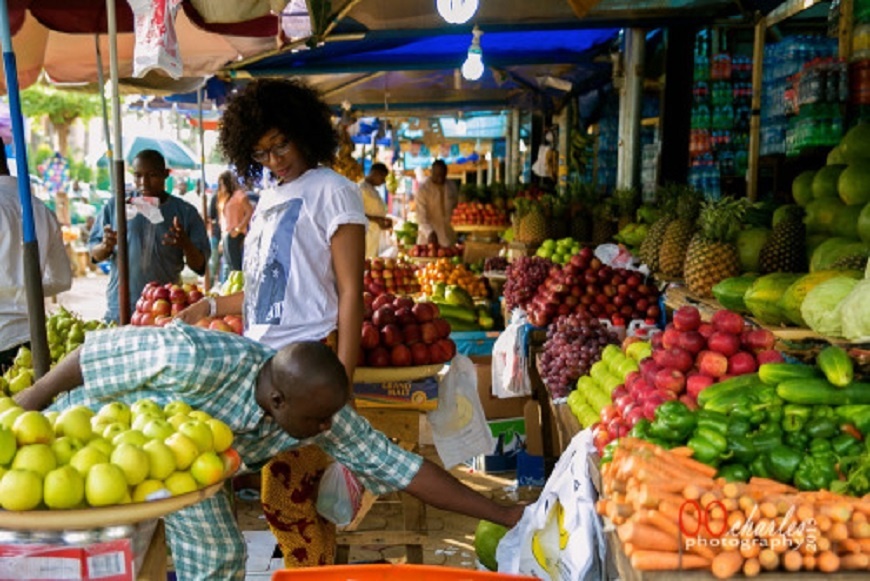
Lagos Creates 50 Neighbourhood Markets for Cheap Food Items
By Dipo Olowookere
Fifty neighbourhood food markets aimed to enable residents of Lagos State have access to affordable eatable items during this period of restriction of movement have been established by Governor Babajide Sanwo-Olu.
The markets were launched on Friday at large public-school premises across the state and will serve as makeshift groceries for residents to buy food items, as confirmed cases of Coronavirus (COVID-19) increases the chance of possible stringent measures.
The establishment of the food markets followed the creation of 10 food banks strategically positioned across the city, which is targeted at feeding over 200,000 vulnerable households that earn daily wage to feed.
Since Thursday, movements in the metropolis have been restricted as part of efforts to curb the spread of COVID-19 in the state. The disease has infected over 40 people in Lagos and 70 persons in the country.
Addressing the media on Friday, Mr Sanwo-Olu said, “These neighbourhood markets will operate every two days, and will help achieve a number of goals that are all in line with the guidelines of the health authorities.”
“The markets will reduce journey times for the residents. By extension, it reduces the time people will spend in public and will also help to maintain social distancing requirements,” he added.
He also hinted that the state government may take “tougher decisions” if the confirmed cases of coronavirus surpass the threshold set by the state.
According to him, there had been a “strange trend” recorded by the state in its response to the viral epidemic, hinting further that some of the new infections showed Lagos may be entering a phase of community transmission of the disease.
“We have started to see a trend that suggests we may be entering the phase of community transmission of the disease,” he told newsmen during his regular briefing.
The Governor also signed the Lagos State Infectious Diseases Regulation 2020 into law to give legal backing to the ongoing enforcement of restrictive measures being taken by the State Government to contain the spread of the virus.
The regulation, Mr Sanwo-Olu said, prescribes stringent penalties to defaulters of directives and guidelines issued by the government to stop community transmission of COVID-19.
As cases of COVID-19 surges, Governor Sanwo-Olu said he would not rule out possible lockdown of the state in the coming days, urging the residents to brace for tougher measures.
He, however, said the treatment and management of the confirmed cases at Infectious Disease Hospital (IDH) had not overwhelmed the State.
Going by the nature of spread of the virus in other countries, the Governor said every human was at risk of contracting the disease, stressing that the response strategy to defeat the pandemic required collective effort and cooperation of residents.
“I have said again and again that this fight is a collective one; we are all in it together,” he said.
Mr Sanwo-Olu praised President Muhammadu Buhari for his leadership and support of the effort by Lagos government to stop the epidemic. He said the release of N10 billion grant to the state was a recognition of Lagos as epicentre of COVID-19 pandemic in the country.
He also appreciated the contributions of members of the organised private sector that supported the State’s effort by donation of cash, medical equipment and building of isolation centres.
The Governor said efforts were ongoing to halt community transmission, revealing that agents of the government had already started state-wide fumigation. This, he said, would be followed up by mass sensitisation and advocacy to disseminate information to residents at the grassroots.
General
Oyebanji Retains Ekiti Governorship with 90% Votes
By Adedapo Adesanya
The Independent National Electoral Commission (INEC) has announced the candidate of the All Progressives Congress (APC), Mr Biodun Oyebanji, as the winner of the 2026 Ekiti State governorship election.
The Returning Officer for the Ekiti State governorship election, Mrs Adenike Oladiji, who declared the results at about 3:13 a.m. on Sunday, said that the incumbent Oyebanji polled 319,224 votes.
Mrs Oladiji, a professor and Vice-Chancellor of the Federal University of Technology, said that the candidate of the Peoples Democratic Party (PDP), Mr Oluwole Oluyede, scored 40,543 votes, while Mr Dare Bejide of the African Democratic Party (ADP) polled 12,872 votes.
According to her, a total of 384,940 voters were accredited for the election, with 375,777 valid votes, 6,332 rejected votes, and a total of votes cast.
Voting, which began at about 8:31 a.m, ended officially at 2:30 p.m. on Saturday, with more than 380,000 voters casting their ballots.
Mr Oyebanji, who won all 16 local government areas with the victory at the polls, becomes the first Ekiti State governor to be re-elected to office since 1999.
The Chairman of the Progressive Governors Forum (PGF), Mr Hope Uzodimma of Imo State, and his colleague in Ogun State, Mr Dapo Abiodun, have expressed delight in the victory of the Ekiti State governor.
Speaking at the Ekiti State Government House, Mr Uzodimma said Mr Oyebanji’s victory signalled the success of the All Progressives Congress (APC) and, by extension, that of President Bola Ahmed Tinubu in the 2027 general elections.
He said the electorate voted massively for the APC and its candidate despite ongoing reforms that have brought hardship to citizens.
According to him, democracy in the country is growing, with significant achievements being recorded across various sectors. He noted that the economy is becoming stronger and the political system is evolving into a more sustainable one.
Governor Abiodun described Mr Oyebanji’s victory, with about 90 per cent of the votes, as a testament to his performance during his first term in office and the love the people have for the ruling APC.
“The percentage of victory is almost 90 per cent. I rejoice with him. I rejoice with the good people of Ekiti State. I rejoice with the All Progressives Congress, particularly our National Chairman, Professor Nentawe Yilwatda, the Chairman of the Progressive Governors Forum, our President, and all the good people of Nigeria,” he said.
“This is an indication of what the 2027 elections would look like going forward, and we are excited about the future of our polity and Nigeria. Again, I congratulate Governor Oyebanji, his wife, the entire cabinet, the APC family in Ekiti State, the APC family in Nigeria, and all of you. Thank you very much,” he added.
General
Waste Management: GRV Urges Lagos Commissioner Wahab to Resign
By Aduragbemi Omiyale
The candidate of the Labour Party in the 2023 governorship election in Lagos State, Mr Gbadebo Rhodes-Vivour (GRV), has advised the Lagos State Commissioner for Environment and Water Resources, Mr Tokunbo Wahab, to resign over the state of the waste management system in the metropolis.
The opposition politician berated the state government for the handling of waste in the state, saying excuses have always been given for making the environment dirty.
“Impact is felt, not explained in 1,578 words. Your plastic policy has failed. Your environmental policy, if one truly exists, has been ineffective.
“Your waste management policy has been an unmitigated disaster. The only area where you have consistently delivered is the demolition of the hard-earned properties and livelihoods of ordinary citizens.
“Not to mention your Bigotry and Gaslighting. You have lost the moral authority to remain in office. You should resign,” the chieftain of the African Democratic Congress (ADC) posted on his X handle on Saturday.
He was reacting to comments made by Mr Wahab as to why the state has remained flooded after the rains despite the different policies put in place, including the ban on single-use plastic and the return of the monthly environmental sanitation.
“A lot of people are genuinely concerned about the waste situation in parts of Lagos, and that concern is understandable. Waste is not something you can talk around. If refuse is sitting on your street, beside your market, close to your bus stop, or inside the drainage near your house, the only thing that matters to you is that it should be removed. And that is fair.
“But it may also help to explain the scale of what is being managed, and what is actually being done.
“Lagos generates about 13,000 tonnes of waste every day. Not weekly. Every day. In May alone, LAWMA and PSP operators evacuated about 418,500 tonnes of waste across the state, which comes to an average of about 13,200 tonnes daily. That is not a small operation. It involves hundreds of PSP operators, public waste teams, transfer and disposal operations, street sweepers, enforcement teams, customer service staff, drivers, loaders, supervisors and monitoring officers working across a very large and difficult city.
“Just to mention, during the 2026 Hajj, Saudi Sanitation Authorities announced that a total of over 472 tons of waste were generated from Mina and Muzdalifah. This is the total waste generated by pilgrims all over the world in 5 days.
“Still, nobody is pretending that everything is fine everywhere. Some communities have had delays. Some PSP operators have not performed well. Some routes have grown beyond the capacity that was originally assigned to them. In some areas, road access is poor. During the rains, movement into disposal sites can become slower. Trucks break down. Diesel and spare parts are expensive. Payment compliance is also weak in many places, and when people do not pay for waste service, the operators struggle to maintain trucks, pay crews and keep to schedule. These are not excuses but the harsh realities that have to be fixed.
“That is why LAWMA has been reviewing weak routes, replacing and sanctioning underperforming operators, increasing monitoring, and deploying evacuation teams to pressure points. As of last month (May), 442 PSP operators were active across Lagos while 27 routes were under review for service improvement. LAWMA also received 474 complaints and service requests that month, which are now part of how the agency is identifying weak spots and following up on operator performance.
“There is also a daily blackspot operation that many people do not see unless it is happening near them. LAWMA clears 3,000 black spots every day across 57 routes. These are the road medians, market edges, illegal dumping points, bus stops, setbacks and open spaces where people keep dropping waste outside the normal collection system. Some are cleared in the morning and abused again by night. That is one of the hardest parts of the job.
“This is why enforcement has become more serious. In 2025, LAWMA recorded 1,023 incidents of illegal dumping and other waste violations across the state. Out of these, 447 cases were referred for prosecution. The surveillance teams also identified 431 scavengers and reconciled 145 properties with their assigned PSP operators. The data showed that much of the illegal dumping happens between midnight and early morning, and the waste is not only household refuse. It includes construction debris and even hazardous waste in some cases.
“So, when people say “just clear it,” we agree. It must be cleared. But we also have to stop the same locations from being turned back into dumpsites again and again.
“Street sweeping is another big part of the work. Lagos has thousands of sweepers working across hundreds of routes, including highways, medians and major public corridors. This work starts very early, and it is not easy work. Some areas are swept daily, but once people keep littering from vehicles, markets, shops and buses, the same routes look dirty again within hours. That is why the long-term answer cannot be sweeping alone. We need better behaviour, stronger enforcement, more mechanised sweeping on strategic roads, and safer working conditions for the sweepers.
“The bigger reform is infrastructure. Lagos cannot continue with the old collect-and-dump model. That is why construction is ongoing for Transfer Loading Stations to replace the old landfill operations at Olusosun in Ojota and Solous III in Igando. These will be supported by Material Recovery Facilities in Ikorodu and Badagry, so waste can be moved out of the centre of the city to modern facilities where it can be sorted, recovered, recycled and repurposed.
“The Olusosun system is expected to move about 2,500 tonnes of waste daily to the Ikorodu MRF, while the Solous III side is expected to move about 1,500 tonnes daily to the Badagry recovery facility. The target for this transition is 6 months. Once completed, it should reduce pressure on the old dumpsites, improve the flow of waste evacuation, reduce congestion around disposal points and give Lagos a more serious recovery and recycling platform.
“There is also the organic waste side, which is very important because a large part of Lagos waste is food and market waste. The Ikosi Fruit Market Biodigester has now been launched to treat organic waste closer to source and convert it into useful outputs like biogas, electricity and fertiliser. The plan is to replicate that model in other markets that generate high volumes of organic waste, instead of moving everything across the city to a landfill.
“So yes, the complaints are valid. Some backlogs should not have happened. Some residents have not received the service they deserve. Some operators have disappointed. There is no need to deny any of that.
“But the fuller picture is that waste is being evacuated daily, black spots are being cleared daily, operators are being monitored, weak routes are being reviewed, illegal dumping is being prosecuted, street sweeping is ongoing, and new infrastructure is being built to change the system from the ground up.
“The government has a duty to keep improving the system. Residents, markets, estates and businesses also have a duty to use the system properly and stop illegal dumping. Both things are true.
“Lagos is not where it should be yet. But it is not standing still either. The work now is to clear what has built up, fix the routes that are failing, hold operators accountable, and complete the infrastructure that will move Lagos from dumping to sorting, recovery, recycling, energy and circular economy.
“So, for your nomadic self to jump on the Governor’s release for your political agenda without talking solutions speaks to who you really are,” the Commissioner wrote.
General
Apapa Customs Foils Intercepts Expired Pharmaceuticals, Canadian Loud
By Modupe Gbadeyanka
Some expired pharmaceutical products and 1.8 tonnes of Cannabis Sativa have been intercepted by officials of the Nigeria Customs Service (NCS), Apapa Area Command.
The command’s Public Relations Officer, Mr Isah Sulaiman, a Chief Superintendent of Customs (CSC), disclosed that the pharmaceutical products are suspected to be pushed into the Nigerian market by relabelling them.
It was disclosed that the items were intercepted based on credible intelligence and enhanced risk profiling systems, in collaboration with the National Drug Law Enforcement Agency (NDLEA) and other relevant regulatory bodies.
In one of the major interceptions, officers of the command seized a 40-foot container numbered CAAU7569127, which was found to contain a large consignment of Cannabis Sativa, popularly referred to as Canadian Loud.
The command revealed that a total of 3,639 sachets of the illicit substance were recovered, each weighing 500 grams, for a total estimated weight of about 1,819 kilograms (1.81 tonnes). Preliminary field tests confirmed the substance as Cannabis Sativa. The drugs were concealed inside a vehicle and within bags and drums packed inside the container.
Speaking on the seizures, Comptroller Emmanuel Oshoba warned perpetrators to desist from criminal activities, stating that “unpatriotic importers and their collaborators who deliberately engage in smuggling, drug trafficking and the importation of expired pharmaceuticals are enemies of Nigeria’s progress.”
“We have the intelligence, the technology and the resolve to identify and apprehend them. Anyone still contemplating these criminal acts should desist immediately, because the consequences will be swift, decisive and uncompromising,” he added.
He further reiterated that Apapa Port and all Customs-controlled areas remain under constant surveillance, adding that enforcement operations will continue to be intelligence-driven while ensuring legitimate trade is not hindered.
-
Feature/OPED6 years agoDavos was Different this year
-
Travel/Tourism10 years ago
Lagos Seals Western Lodge Hotel In Ikorodu
-
Showbiz3 years agoEstranged Lover Releases Videos of Empress Njamah Bathing
-
Banking8 years agoSort Codes of GTBank Branches in Nigeria
-
Economy3 years agoSubsidy Removal: CNG at N130 Per Litre Cheaper Than Petrol—IPMAN
-
Banking3 years agoSort Codes of UBA Branches in Nigeria
-
Banking3 years agoFirst Bank Announces Planned Downtime
-
Sports3 years agoHighest Paid Nigerian Footballer – How Much Do Nigerian Footballers Earn