

General
Lekki Massacre: FG Calls Lagos Panel Report Waste of Taxpayers’ Funds

By Modupe Gbadeyanka
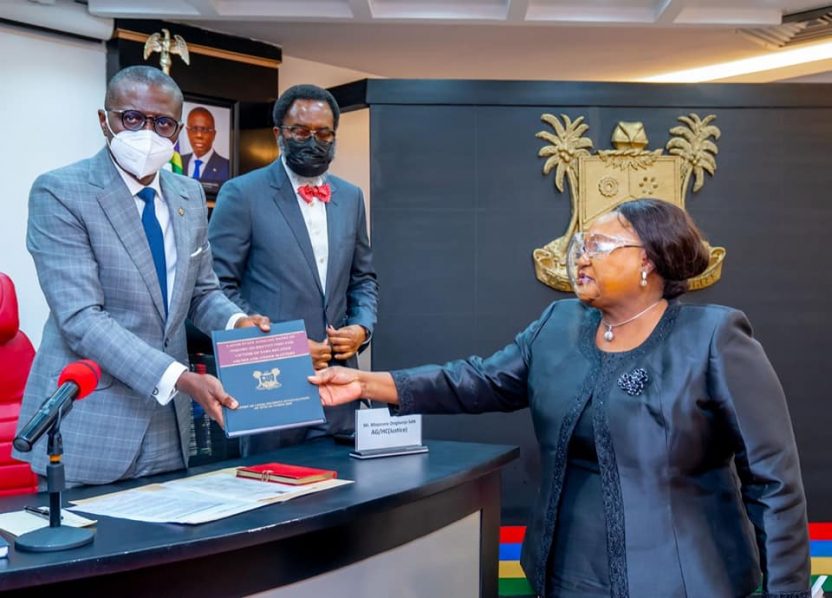
The federal government has picked holes in the leaked report submitted to the Lagos State Governor, Mr Babajide Sanwo-Olu, by the Lagos State Judicial Panel of Inquiry that investigated cases of police brutality as well as the incident of October 20, 2020, at Lekki Toll Gate in Lagos.
The Minister of Information and Culture, Mr Lai Mohammed, in a media briefing on Tuesday, described the report as a waste of “taxpayers’ funds and everyone’s time” because it “is nothing but the triumph of fake news and the intimidation of a silent majority by a vociferous lynch mob.”
He slammed the panel headed by a retired justice, Mrs Dorcas Okuwobi, for submitting “a report laden with allegations, the same allegations it was set up to investigate in the first instance.”
According to him, “never in the history of any judicial panel in this country has its report been riddled with so many errors, inconsistencies, discrepancies, speculations, innuendoes, omissions and conclusions that are not supported by evidence.”
“What is circulating in public space is simply a rehash of the unverified fake news that has been playing on social media since the incident of October 20, 2020,” he added.
Mr Mohammed questioned the use of massacre in context in the Lagos panel report to describe the action of the federal government agencies like the military and the police last year, when peaceful protesters sitting on the ground waving the national flag and reciting the national anthem were allegedly shot and killed and beamed live on Instagram by DJ Switch, who is now on exile.
“Why did the judicial panel feel compelled to concoct a massacre in context as a euphemism for massacre? A massacre is a massacre. What is massacre in context?” the Minister queried.
“It is clear, from the ongoing, that the report of the panel in circulation cannot be relied upon because its authenticity is in doubt. Besides, the Lagos State Government, being the convening authority, has yet to release any official report to the public.
“Neither has the panel done so. The cowardly leakage of an unsigned report to the public is not enough.
“Assuming the report in circulation bears any iota of genuineness, it is basic knowledge that the report of such a panel is of no force until the convening authority issues a White Paper and Gazette on it. It is therefore too premature for any person or entity to seek to castigate the federal government and its agencies or officials based on such an unofficial and unvalidated report,” he further said.
Mr Mohammed stressed that, “There is absolutely nothing in the report that is circulating to make us change our stand that there was no massacre at Lekki on October 20, 2020.
“For us to change our stand, a well-investigated report of the incident that meets all required standards and will withstand every scrutiny must be produced and presented to the public.”
“We also appeal to the families of those allegedly killed in Lekki to speak out. It’s untenable to say that some families did not come out because they are afraid. Any parent who is afraid to testify about the death of his or her child is not worth to be called a parent,” he stated, saying the government rejects “the notion that our soldiers and policemen massacred innocent Nigerians at Lekki on October 20, 2020. That conclusion is not supported by the weight of available evidence.”
Read the full text of the press conference below;
TEXT OF THE PRESS CONFERENCE ADDRESSED BY THE HON. MINISTER OF INFORMATION AND CULTURE, ALHAJI LAI MOHAMMED, IN ABUJA ON TUESDAY NOV. 23RD 2021 ON THE REPORT OF THE LAGOS STATE JUDICIAL PANEL OF INQUIRY AND RESTITUTION TO INVESTIGATE CASES OF POLICE BRUTALITY AND THE INCIDENT OF OCT. 20TH 2020 AT LEKKI TOLL GATE
Good morning gentlemen
- It’s no longer news that the Lagos State Judicial Panel of Inquiry that investigated cases of police brutality as well as the incident of Oct. 20th, 2020, at Lekki Toll Gate in Lagos has submitted its report. The submission happened while I was out of the country on national assignment. Unlike many commentators and analysts, we took our time to read and digest the report, and we are now well placed to respond.
- Without mincing words, let me say that never in the history of any Judicial Panel in this country has its report been riddled with so many errors, inconsistencies, discrepancies, speculations, innuendoes, omissions and conclusions that are not supported by evidence. What is circulating in public space is simply a rehash of the unverified fake news that has been playing on social media since the incident of Oct.
20th 2020. It is simply incredible that a Judicial Panel set up to investigate an incident has submitted a report laden with allegations, the same allegations it was set up to investigate in the first instance. Instead of sitting for all of one year, the panel could have just compiled social media ‘tales by the moonlight’ on the incident and submitted, saving taxpayers’ funds and everyone’s time. That report is nothing but the triumph of fake news and the intimidation of a silent majority by a vociferous lynch mob.
- Gentlemen, we have read some critical analysis of the report by a courageous few. One commentator, a lawyer, said it raised more questions than answers. Another commentator, a journalist, called it a ‘disgraceful report by a disgraceful panel’, saying it reported allegations instead of investigating the allegations. Yet another wondered how a Judicial Panel could use the words ‘massacre in context’ and equate such to a massacre. All these and many more have raised valid questions on that report. We salute their courage and refusal to be cowed by the rampaging lynch mob that has been screaming blue murder since the report was released.
- We do not intend to bore you by rehashing details of the discrepancies, innuendoes, inconsistencies and errors in that report. They are already in the public space. Let us, however, point out some key highlights of such discrepancies, errors, omissions, etc.
- i) – The report threw away the testimony of ballistic experts who testified before it. The experts said, inter alia, in their testimony:
”The Team finds that from the medical data examined, including the timeline of arrival at medical facility and the nature of the injuries sustained by the Victims, who were taken to the 5 medical facilities, that no military grade live ammunition (high-velocity) was fired at the protesters at Lekki Tollgate on 20th October 2020, within the timeframe of reference (18.30- 20.34hrs). That the GSW (Gun Shot Wounds) injuries (4 in number between 19:05 and 19:45 hrs), which were examined by the Team, can be safely identified as being discharged by either low velocity caliber and/or artisanal/12-gauge firearms (artisanal firearms are locally-fabricated weapons). What is however certain is that had the military personnel deliberately fired military grade live ammunition directly at the protesters; there would have been significantly more fatalities and catastrophic injuries recorded. This was clearly not the case.’’
- ii) – The same panel that said it deemed as credible the evidence of the Forensic Pathologist, Prof. John Obafunwa, that only three of the bodies on which post mortem were conducted were from Lekki and only one had gunshot injury went on to contradict itself by saying nine persons died of gunshot wounds at Lekki!
iii) – The man whose evidence (that he counted 11 bodies in a military van where he was left for dead before he escaped) was found to be crucial by the panel never testified in person. Rather, the video of his ‘testimony’ was played by someone else. It did not occur to the panel to query the veracity of the testimony of a man who said he was shot and presumed dead but still had time to count dead bodies inside a supposedly dark van at night!
- iv) – The panel said trucks with brushes underneath were brought to the Lekki Toll Gate in the morning of Oct. 21 2020 to clean up bloodstains and other evidence, but still found bullet casings at the same site when it visited on Oct. 30th 2020. It said soldiers picked up bullet casings from Lekki Toll Gate on the night of Oct. 20th 2020, yet claimed that policemen came to the same spot to pick the same bullet casings on Oct. 21st 2020!
- v) – The panel was silent on the family members of those reportedly killed, merely insinuating they were afraid to testify. Even goats have owners who will look for them if they do not return home, not to talk of human beings. Where are the family members of those who were reportedly killed at Lekki Toll Gate? If the panel is recommending compensation for the families, what are their identities and addresses? Who will receive the compensations when no family members have shown up to date?
- vi) – How did a man who reported seeing the lifeless body of his brother himself ended up being on the list of the panel’s deceased persons?
vii) – How can a Judicial Panel convince anyone that the names of some casualties of the Lekki Toll Gate incident listed as numbers 3 (Jide), 42 (Tola) and 43 (Wisdom) are not fictitious names.
viii) – Why did the Judicial Panel feel compelled to concoct a ”massacre in context” as a euphemism for ”massacre”? A massacre is a massacre. What is ”massacre in context?”
- ix) – The report never mentioned cases of police personnel who were brutally murdered or the massive destruction of police stations, vehicles, e.t c during the Endsars protest. Does this mean that the panel didn’t consider policemen and women as human beings?
- x) – The report didn’t make any recommendation on the innocent people whose businesses were attacked and destroyed during the protest in Lagos. I think it was too busy looking for evidence to support its conclusion of ‘massacre in context’.
- It is clear, from the ongoing, that the report of the panel in circulation cannot be relied upon because its authenticity is in doubt. Besides, the Lagos State Government, being the convening authority, has yet to release any official report to the public.
Neither has the panel done so. The cowardly leakage of an unsigned report to the public is not enough. Assuming the report in circulation bears any iota of genuineness, it is basic knowledge that the report of such a panel is of no force until the convening authority issues a White Paper and Gazette on it. It is therefore too premature for any person or entity to seek to castigate the Federal Government and its agencies or officials based on such an unofficial and unvalidated report.
- CNN AND OTHERS
The CNN has been celebrating the leaked report of the Lagos State Judicial Panel of Inquiry. In its rush to claim vindication, CNN apparently didn’t even read the report before rolling out the drums in celebration. By that action, CNN has celebrated prematurely and has now committed a double faux pas: First, by relying on unverified social media stories and videos to carry out an investigation of the Oct. 20th 2020 incident at Lekki, where it did not have a correspondent on ground. CNN goofed in its report on the findings of the panel, which fell below the main standards of journalism. Secondly, CNN rushed to the air to celebrate an unsigned and unverified report that is riddled with inconsistencies, errors, discrepancies, innuendoes. That’s double faux pas by a news organization that is eager and willing to compromise standards just to claim vindication.
- Sadly, a section of the Nigerian media has also joined the lynch mob. Honestly, in an attempt to vilify government at all costs, they have done themselves a great disservice. How can any news organization worth its salt write an Editorial validating this kind of report? Are they not seeing what others, including journalists and lawyers, are seeing? In a shocking twist, a Nigerian newspaper chose to hail what it calls ‘’detailed investigative report’’ by CNN, even when the news channel did not even cover the incident of Oct. 20th 2020! It’s a classic case of cutting your nose to spite your face.
9 CONCLUSIONS
- i) – Gentlemen, there is absolutely nothing in the report that is circulating to make us change our stand that there was no massacre at Lekki on Oct. 20th 2020. For us to change our stand, a well-investigated report of the incident that meets all required standards and will withstand every scrutiny must be produced and presented to the public. The report in circulation does not meet those requirements. We also appeal to the families of those allegedly killed in Lekki to speak out. It’s untenable to say that some families did not come out because they are afraid. Any parent who is afraid to testify about the death of his or her child is not worth to be called a parent.
- ii) – We reject the notion that our soldiers and policemen massacred innocent Nigerians at Lekki on Oct. 20th 2020. That conclusion is not supported by the weight of available evidence. Indictment for murder is a very serious issue that cannot be done on the basis of allegations and corroborations, as the panel did. Such allegations must be proved beyond a reasonable doubt. The report in circulation is calculated to embarrass the Federal Government and its agencies without foolproof evidence. The Federal Government has never condoned the abuse of the rights of Nigerians by security agencies under any guise, hence it disbanded SARS and encouraged states to set up the panels to investigate reports of human rights abuses allegedly committed by the disbanded SARS personnel
iii) – The 37 policemen and six soldiers who died across the country during the Endsars protest are also Nigerians and should not be forgotten.
- iv) – Those who have engaged in premature celebration of the report in circulation should now go back and read it thoroughly and tell Nigerians whether it can pass any serious scrutiny.
- v) – We are saddened that anyone died at all during the Endsars protest as the life of every Nigerian and indeed every human is sacrosanct. As we have disclosed many times, 57 civilians, 37 policemen and six soldiers were killed across the country during the protest, and we commiserate with their families.
10) Gentlemen, I thank you for your kind attention. I will now take your questions.


