Technology
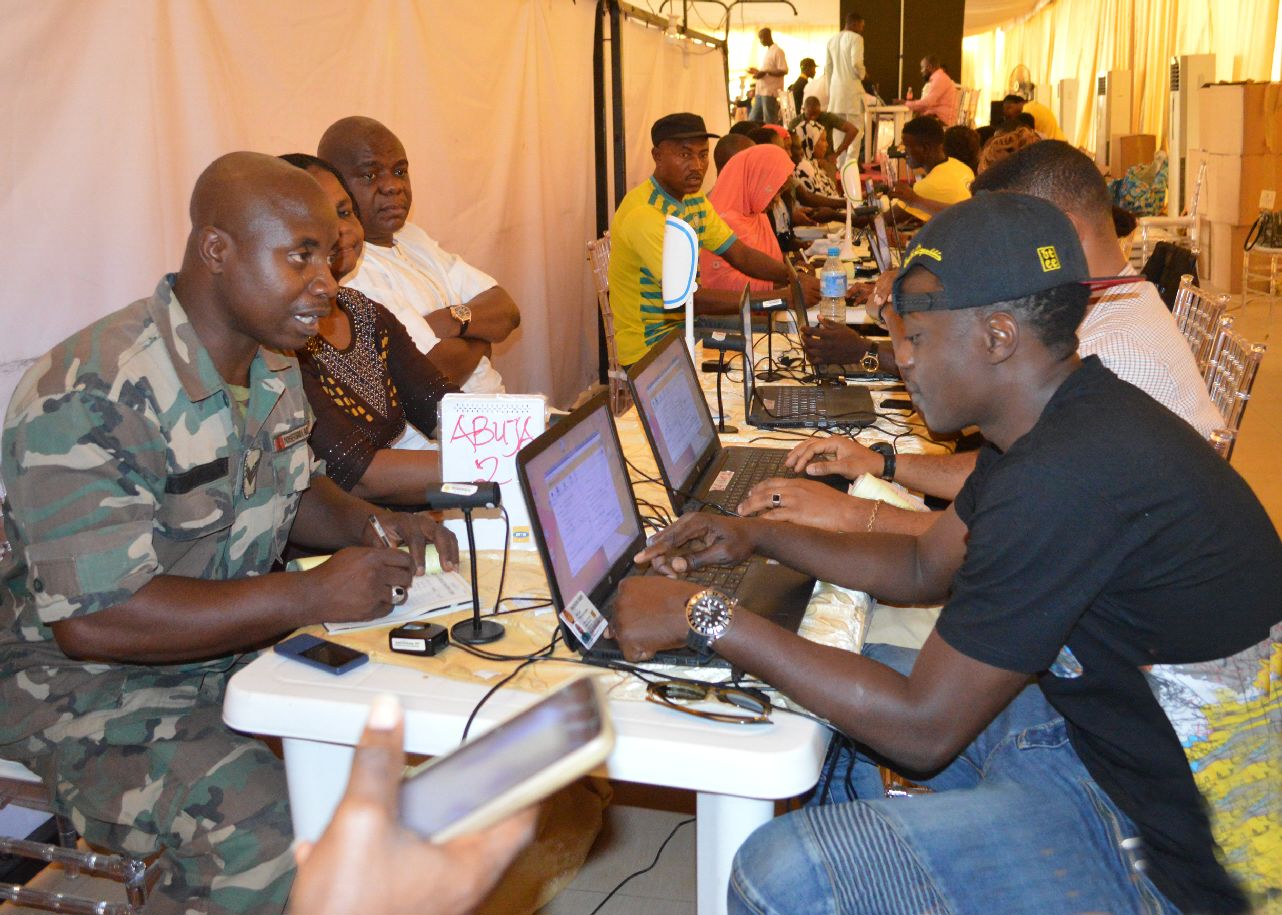
Nigeria Lifts Suspension on New SIM Card Registration
By Adedapo Adesanya
The suspension earlier place on the activation/registration of new SIM card in the country has been lifted by the Nigerian government.
The lifting of the suspension was announced by the federal government on Thursday. However, it stressed that the registration must be in compliance with guidelines from Monday, April 19, 2021.
The central government suspended the activation of new SIM cards by GSM network providers in December 2020 as it embarked on an audit of the Subscriber Registration Database.
On Thursday, the Ministry of Communications and Digital Economy, which announced the lifting of the embargo in a statement signed by Mr Femi Ademiluyi, a technical aide to the Minister, Mr Isa Pantami, said the latest development was in line with the Nigerian Communications Act (NCA) 2003, Section 23(a), which specifies the role of the Minister to include the formulation, determination and monitoring of the general policy for the communications sector.
On the Subscriber Registration Database, Mr Pantami, on behalf of President Muhammadu Buhari, coordinated and led the development of a Revised National Digital Identity Policy for SIM Card Registration in collaboration with all other stakeholders.
An earlier policy was approved on February 4, 2020, while the Revised Policy was developed in early March 2021.
In the statement, Mr Adeluyi noted that final amendments to the revised policy based on the directives of Mr President to make the use of NIN mandatory for all SIM registration were completed On Tuesday, April 14, 2021.
Prior to that, the key aspects of the draft Policy were presented to the stakeholders at the 4th Review Meeting of the Ministerial Task Force (MTF) on the NIN-SIM registration which held on Friday, February 26, 2021.
Key stakeholders and members of the MTF who joined the Honourable Minister at the meeting included the EVC/CEO of the Nigerian Communications Commission (NCC), DG/CEO of the National Identity Management Commission (NIMC), DG/CEO of the National Information Technology Development Agency (NITDA), Comptroller-General of the Nigeria Immigration Service (NIS) and the Chairman of the Association of Licensed Telecommunications Operators of Nigeria (ALTON). Others included the NCC Executive Commissioners for Technical Services and Stakeholder Management, MD/CEOs of MTN, Airtel, EMTS (9Mobile), NTEL, Spectranet and SMILE, as well as the COO of Glo.
The statement also noted that Mr Pantami also presented the revised policy to Mr Buhari on Friday, March 26 2021.
“Mr President made further improvements and endorsed it for implementation. Mr President also commended the Honourable Minister for his commitment in carrying out the responsibility of developing the digital economy sector, including championing the NIN-SIM registration process.
“The policy includes guidelines on new sIM acquisition and activation, SIM replacement, new SIM activation for corporates and Internet-of-Things/Machine-to-Machine (IoT/M2M), amongst others. The possession of a national identity number will be a prerequisite for each of these categories.
“For the corporate registration, institutions will be required to appoint a Telecoms Master (at the minimum of an executive management level) to provide the operational primary NIN representation. The telecoms master will also be responsible for ensuring that the users provide their NINs to serve as a secondary NIN”, the statement read.
“For IoT/M2M activations, SIM security protocols would be implemented on the SIM profile to ensure that SIMs can only be used for point to point data services specific to the URL they are working with. All other services will be barred.
“In the event that a data-only service is particular to individual use (eg home car tracking, WiFi, MiFi services, etc), the standard NIN registration process will be followed. A telecoms master will also be required for Corporates requiring IoT/M2M activations. The full details of the requirements for each class of service will be made available in due course.
“Significant progress has been made in the NIN registration process across the country. Nonetheless, the federal government is committed to supporting all Nigerians and legal residents to obtain a NIN.
“The biometric verification process has been slower than anticipated, owing largely to the non-adherence of many previous SIM biometric capture processes to the NIMC standards. The revised policy will ensure that operators conform to the required standards for biometric capture.
“The guidelines in the policy have been painstakingly developed and while they are thorough, it should be noted that they have been developed that way in National interest since the SIM is essentially a national resource. Citizens and legal residents are encouraged to bear with the government as the process has been developed in the best interest of the country”, he said.
“The Minister has also directed NCC and NIMC to ensure that the provisions of the policy are strictly followed by all operators and subscribers.
“Dr Pantami wishes to thank Nigerians for their patience and compliance with the federal government’s directive on the NIN-SIM registration exercise”.
“He reiterated government’s commitment to continue taking decisions aimed at easing the pains of the citizens with regard to issues related to NIN and SIM registration”, the statement concluded.
Technology
Our Goal is to Meet Soaring Demand for Connectivity—MTN
By Dipo Olowookere
The Chief Strategy and Innovation Officer for MTN Nigeria, Mr Babalola Oyeleye, has disclosed that the telecommunications company intends to expand its infrastructure to give its customers quality service.
The demand for connectivity in Nigeria is growing, and with a new forecast predicting the Internet of Things (IoT) market to reach $38.7 billion by 2030, stakeholders, especially operators, are already positioning themselves to dominate the space
Government and private sector investments in digital transformation have created an ecosystem that includes system integrators and security specialists. Industries such as utilities and agriculture are leading the charge, adopting IoT to solve localised problems like power theft and low crop yields.
Currently, 4G coverage has reached approximately 80 per cent of Nigeria’s population, with 5G services already in major cities like Lagos, Abuja, Port Harcourt, and Kano. This connectivity backbone is essential for the low-latency communication required by millions of connected devices.
“Reaching the $38.7 billion mark isn’t just about the numbers; it’s about the millions of data points helping Nigerian SMEs and large corporations make smarter decisions every day. Our goal is to ensure the connectivity is there to meet this soaring demand,” Mr Oyeleye noted.
As the ecosystem matures, the focus is shifting toward all-in-one solutions that simplify the user experience. With ongoing investments in NB-IoT (Narrowband IoT) and other low-power connectivity options, the next five years are set to see an explosion in smart city and smart home applications across the country.
Technology
Refiant AI Raises $5m to Cut AI Energy Use
By Adedapo Adesanya
South African-founded Refiant AI has raised $5 million to slash the energy footprint of artificial intelligence (AI) in a seed round led by VoLo Earth Ventures, a top climate technology fund.
The startup uses nature-inspired algorithms to radically compress AI models, slashing the hardware and energy required to run them. The new fund will be used to scale Refiant’s team – which already includes a former Google Cloud architect, a Cambridge PhD researcher, and an engineer with NASA experience – to build out a platform and to accelerate enterprise partnerships.
According to a statement shared with Business Post, the company is in active conversations with several multinational technology firms exploring how Refiant’s approach could reduce their AI compute costs while maintaining data and energy sovereignty.
“AI’s growing energy footprint is one of the most urgent and underappreciated challenges in the climate space,” said Mr Sid Gutta, the company’s co-founder. “The industry’s default answer is to build more data centres and consume more power. Ours is to make the AI itself dramatically more efficient.”
The company said it has already successfully demonstrated it can compress a 120 billion parameter AI model to run on a standard laptop, reducing energy requirements by over 80 per cent while preserving near-identical quality. It achieved this to run on a MacBook Pro with just 12GB of RAM. The same model would normally require hardware with at least 80GB of memory. The model retained 95-99 per cent of its fidelity, ran alongside a second AI model on the same machine, and the entire process took four hours with no cloud computing required.
For Refiant, its approach will help businesses reduce their carbon footprint and adopt AI to stay competitive. The energy required to process a single AI prompt on standard infrastructure could power roughly 100 equivalent prompts using Refiant’s approach.
The current breakthrough results were attained at the end of last year, and since then, the team have been gearing up to demonstrate successfully exceeding these results with further compression, longer context windows and model traceability.
“The AI industry is spending hundreds of billions scaling infrastructure when the real breakthrough is the ability to do more with radically less,” said Mr Viroshan Naicker, co-Founder and a mathematician with published research in networks and quantum systems. “Nature doesn’t build by brute force. Evolution optimises. We’ve applied that principle to AI – and the results speak for themselves.”
“AI’s biggest constraint isn’t demand – it’s energy,” added Mr Joseph Goodman, Managing Partner, VoLo Earth. “What’s been missing is a fundamentally more efficient way to compute. Refiant’s architecture replaces brute-force scaling with a far more efficient, nature-inspired approach that lowers energy use while increasing capability. That’s the kind of breakthrough needed to make AI sustainable on a global scale.”
Technology
Google, UpSkill Universe Revamp Hustle Academy to Bring Free AI Skills to Africans
By Adedapo Adesanya
Google and UpSkill Universe, Sub-Saharan Africa’s leading AI and business skills training partner, have announced a major redesign of the Google Hustle Academy programme. For the first time, the free training initiative is open to everyone, not just business owners.
The new curriculum is focused on equipping individuals and entrepreneurs with practical AI skills and comes at a time when small businesses have become the engine of Africa’s economy, creating over 80 per cent of jobs on the continent. To help them grow, the Hustle Academy was launched in 2022, providing bootcamp-style training on business strategy, digital skills, AI, and leadership. The program has since trained over 18,000 SMEs, with many reporting increased revenue and job creation.
Now, as AI reshapes the job market, the program is evolving. The 2026 edition is built for anyone in Sub-Saharan Africa, including employees, students, and job seekers, who want to use AI to advance their careers. To meet the needs of a diverse audience, the new format includes short, 60-minute webinars and more immersive, high-impact bootcamps. These sessions are laser-focused on putting AI to work immediately in areas like digital commerce, marketing, and growth strategy.
Speaking about the academy, Mr Gori Yahaya, Founder & CEO of UpSkill Universe, said, “The 2026 Hustle Academy is designed to close the AI Skills gap with hands-on training that is short, focused, and immediately useful. AI is reshaping how businesses win and how careers are built, right across this continent. We’re excited to renew our partnership, now in its fifth year with Google, combining their global AI leadership with our deep regional AI expertise. The next wave of AI leaders will come from this continent. We are making sure they are ready.”
The Hustle Academy initiative has strengthened digital competitiveness across emerging African economies by enabling SMEs to move beyond AI awareness to practical implementation, positioning them for sustained growth in an increasingly AI-driven business environment.
“We believe that the future of Africa’s digital economy lies in the hands of individuals and entrepreneurs alike. Our new strategy focuses on scaling reach by training individuals in the latest AI-centred tools and techniques,” said a Google representative.
Applications for the 2026 cohort are now open. Interested participants can apply at: https://rsvp.withgoogle.com/events/hustle-academy
-
Feature/OPED6 years agoDavos was Different this year
-
Travel/Tourism10 years ago
Lagos Seals Western Lodge Hotel In Ikorodu
-
Showbiz3 years agoEstranged Lover Releases Videos of Empress Njamah Bathing
-
Banking8 years agoSort Codes of GTBank Branches in Nigeria
-
Economy3 years agoSubsidy Removal: CNG at N130 Per Litre Cheaper Than Petrol—IPMAN
-
Banking3 years agoSort Codes of UBA Branches in Nigeria
-
Banking3 years agoFirst Bank Announces Planned Downtime
-
Sports3 years agoHighest Paid Nigerian Footballer – How Much Do Nigerian Footballers Earn