

World
Collective Sanctions Isolating Mali in the Sahel Sahara as Russia Rides the Wave of Anticolonialism

By Kester Kenn Klomegah
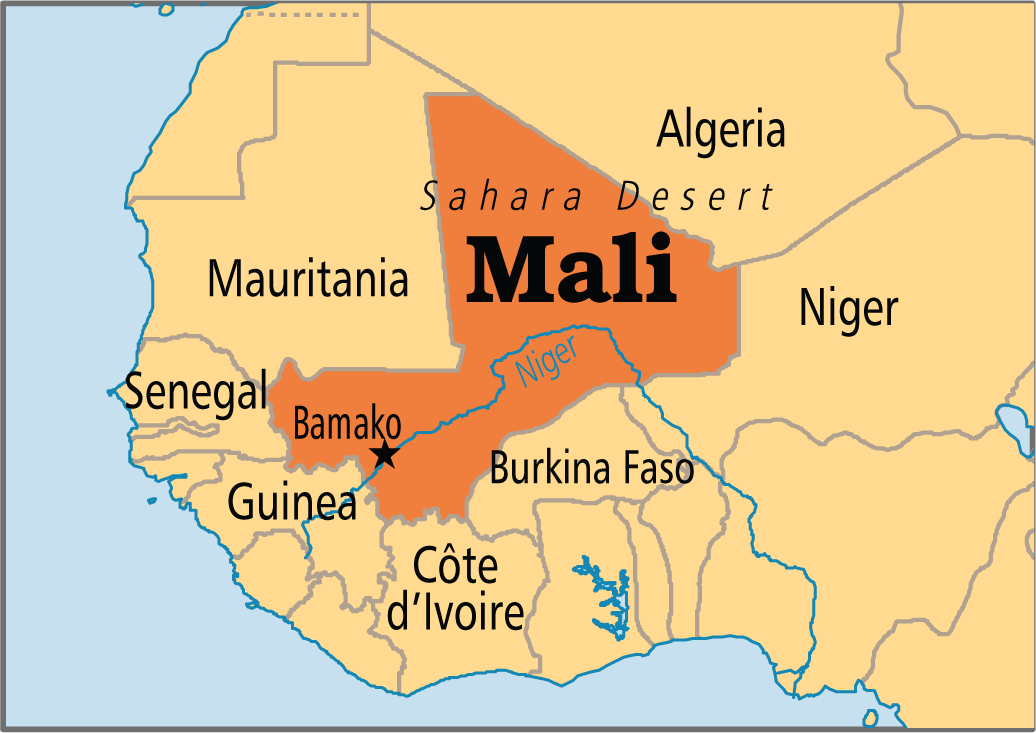
The Republic of Mali, a landlocked West African state with an impoverished population, faces increasing isolation from the international community over the political power grab.
Even as the African Union (AU), the continental organization, and the Economic Community of West African States (ECOWAS), the regional bloc, both suspended the membership of the Republic of Mali following military coups in August 2020 and May 2021, the ruling military officials are still holding onto political power by delaying the proposed elections earlier next year.
The African Union “decides to suspend the Republic of Mali from participation in all activities of the African Union, its organs and institutions, until normal constitutional order has been restored in the country”, the organization Peace and Security Council said in a statement earlier and further called on the military to return to barracks. It underlined the negative impact on the democratic gains made thus far throughout Africa.
Besides the African Union and ECOWAS, the international community has shown deep concern. Since October, the United Nations together with some European Union members have been urging the military officials to fix the polls on February 27, 2022.
Quite recently, West African leaders meeting at a summit in Nigeria demanded the military abide by plans for February polls, threatening further sanctions if Bamako fails to commit to returning to democracy and constitutional rule.
“The heads of state… decided to keep the (deadline) of February 27, 2022, for elections in Mali,” President of the West African ECOWAS bloc Jean-Claude Brou reiterated in Abuja, the capital of Nigeria, adding sanctions would be imposed in January if Mali did not move to stage polls.
Colonel Assimi Goita, the Head of Mali’s Transitional Government had, at first, promised to provide the regional bloc with an election timetable by the end of January 2022, but now offered multiple reasons to justify postponing the election, and said he would hold national consultations which he described as “indispensable” for peace and stability.
In a two-page letter to ECOWAS, Goita highlighted the need to “create the conditions for transparent and credible elections”, including stepped-up security operations, a new electoral law and the beginning of a series of national forums aimed at building a consensus for the return to civilian rule, without specifying concrete dates.
Several military leaders such as Defence Minister Sadio Camara and interim President Assimi Goita were trained by Russia. Despite various condemnations and calls for re-establishing a democratic government, undeterred Malians seem to enjoy all kinds of enormous support from Moscow.
While attending the conference at the United Nations, Foreign Affairs Minister Sergey Lavrov told reporters that the Malian government was turning towards private Russian companies. “This is an activity which has been carried out on a legitimate basis,” he said during a press conference at the UN headquarters in New York.
“We have nothing to do with that,” he added, saying the Malian government estimated that “its own capacities would be insufficient in the absence of external support” and initiated the discussions.
According to reports, Mali’s army-dominated government in Bamako is close to hiring 1,000 Wagner paramilitaries. France has warned Mali that hiring the fighters from the Russian private-security firm would isolate the country internationally.
Then during the joint media conference held with Mali’s Foreign Affairs Minister, Abdoulaye Diop, on November 11, Sergey Lavrov referred to the historical legacy, including the traditions of combating colonialism and overcoming colonial dependence and the subsequent recurrences of neo-colonialism in Africa. Regrettably, they have not yet become thing of the past.
“The fact that terrorist groups have been increasingly active, especially in the north of the country, does not offer a favourable environment for launching an election campaign. Mr Diop said the Malian government will determine the timeline for the election campaign before the end of the year,” Lavrov told the media conference.
“We do understand the need to reinforce Mali’s counter-terrorism potential. In this connection, the Russian state supplies the necessary equipment, weapons, and ammunition. We will do everything we can to prevent any threat to Mali’s statehood and territorial integrity,” he reassured his Malian counterpart.
Involvement of Russian ‘Mercenaries’
As for private military companies established by Russian nationals, Lavrov further explained: “We have nothing to do with this. If they sign agreements with the lawful governments of sovereign states, I don’t see anything negative in this.”
As for the nervous reaction of the French and some other Western representatives to Mali’s plans to work with a private military company from Russia (something the Prime Minister of Mali spoke openly about at the UN General Assembly session), this question is exclusively within the competence of the lawful Malian government.
Over the past few years, Russian authorities have in their speeches expressed anti-colonial sentiments and openly declared unflinching support for fighting against what they referred to as neocolonial tendencies in Africa. Russia is particularly against France in French-speaking African countries in West Africa including the entire Sahel and Central African Republic.
In an interview with Steven Gruzd, Head of the African Governance and Diplomacy Programme at the South African Institute of International Affairs (SAIIA), pointed out that Russia seeks to build on Soviet-era ties, and several African leaders of today studied in the USSR or in countries of the Soviet sphere of influence, and deploy the rhetoric of anti-colonialism in Africa.
He explained in his emailed discussion that Russia is fighting neo-colonialism from the West, especially in relations with the former colonies. It sees France as a threat to its interests especially in Francophone West Africa, the Maghreb and the Sahel. Russia has invested resources in developing French-language news media, and engages in anti-French media activity, including through social media.
In terms of political support like the UN Security Council, there is close interaction between Russia and the African States, but as recent research by SAIIA shows, not as much as assumed. (See this.) The relationship has to however deliver, and move from words to deeds, Gruzd, who also heads the Russia-Africa Research Programme initiated this year at SAIIA, South Africa’s premier research institute on international issues, concluding his discussion on Russia in Africa.
Joseph Siegle, Director of Research and Daniel Eizenga, Research Fellow at the Africa Center for Strategic Studies, co-authored an article headlined “Russia’s Wagner Play Undermines the Transition in Mali” in which they highlighted Wagner’s potential entry into Mali, and it reminds how the group started operating in the Central African Republic. The researchers offer an insight into possible reasons why Malians will delay smooth return to constitutional government.
With coup leader Colonel Assimi Goita still at the helm, Mali has been especially ripe for the picking as part of Russia’s asymmetric influence campaign in Africa. Borrowing from its Syria playbook, Moscow has followed a pattern of parachuting to prop up politically isolated leaders facing crises in regionally pivotal countries, often with abundant natural resources. These leaders are then indebted to Russia who assume the role of regional powerbroker.
By accepting Wagner troops in Mali, Goita will therefore gain a foreign security force that will help him consolidate his hold on power and break the prospects of returning to democratic rule. Allowing Wagner into Mali would have profound long-term implications for Mali’s sovereignty, security, governance, and foreign policy with repercussions for the broader region.
The two researchers reminded the African Union and ECOWAS to invoke the African Convention for the Elimination of Mercenarism, which went into effect in 1985, prohibiting states from allowing mercenaries into their territories. Declaring Wagner a mercenary force identifies them, appropriately, as an illegal entity, one that should be categorically prohibited from operating in Mali (and other parts of Africa).
Several reports have indicated that the Wagner operatives have dubious involvement in the Central African Republic (CAR), where some of the Russian military instructors backing the beleaguered government are believed to be mercenaries. They are also linked to war crimes in Libya’s civil war. Russia entered the fray in CAR in 2017 as part of efforts to expand its influence across the continent. It gave the African country weapons, ammunition and 175 military instructors, but reports indicated they are in thousands.
The U.S. State Department sanctioned Wagner Group, run by Russian oligarch Yevgeny Prigozhin, back in July 2020, as well as several front companies for the group’s operations in Sudan.
On December 13, the European Union (EU) imposed sanctions on the Wagner Group and several people allegedly associated with it, further accused of human rights violations, and in particular torture, extrajudicial executions and killings.
In a statement posted on its website, the Western nations warned that the deployment of Wagner mercenaries could “lead to an aggravation of the human rights situation in Mali [and] threaten the agreement for peace and reconciliation” in the conflict-torn country.
They also said they “deeply regret” the choice of the Malian authorities to use “already scarce public funds” to pay foreign mercenaries instead of supporting the country’s armed forces. The statement was jointly issued by Belgium, Canada, Czech Republic, Denmark, Estonia, France, Germany, Italy, Lithuania, Netherlands, Norway, Portugal, Romania and Sweden and the United Kingdom.
The Wagner Group and Operation Barkhane
According to the local Russian media Nezavisimaya Gazeta, the Wagner Group is facing sanctions for its work in Syria, Libya, the Central African Republic (CAR), Sudan, Mozambique and Ukraine.
The main architect of sanctions against Mali and the PMC Wagner is France. Both of its foreign and defence ministers have repeatedly criticized the possibility of deploying employees of the PMC Wagner to Mali, saying its activity was incompatible with France’s further military presence.
France has approximately 5,100 troops in the region under Operation Barkhane, which spans five countries in the Sahel—Burkina Faso, Chad, Mali, Mauritania and Niger.
Currently, Russia sees both Chad and Mali as conduits to penetrate into the Sahel by pushing the much-criticized Wagner Group that organizes private military for countries in conflict. It is aggressively targeting the Sahel region, an elongated landlocked territory located between north Africa (Maghreb) and West Africa region, and also stretches from the Atlantic Ocean to the Red Sea.
As developments explicitly show, Mali already stands in isolation here if the Goita military junta does not finally drop close deals with Russia’s Wagner and further ignores moving towards democratic elections next February.
The Economic Community of West African States (ECOWAS), the African Union, the United Nations, and the bilateral and multilateral partners endorse and support the implementation of sanctions and other strict measures to ensure a peaceful return to constitutional and democratic government in the Republic of Mali.
This article was first and originally published by IDN-InDepthNews.
Kester Kenn Klomegah writes frequently about Russia, Africa and the BRICS. As a versatile researcher, he believes that everyone deserves equal access to quality and trustworthy media reports. Most of his well-resourced articles are reprinted elsewhere in a number of reputable foreign media.


