Connect with us

Economy

Dangote to List Refinery on NGX, Says NNPC Won’t Take Beyond 20% Stake

Published

on

Dangote Refinery

By Dipo Olowookere

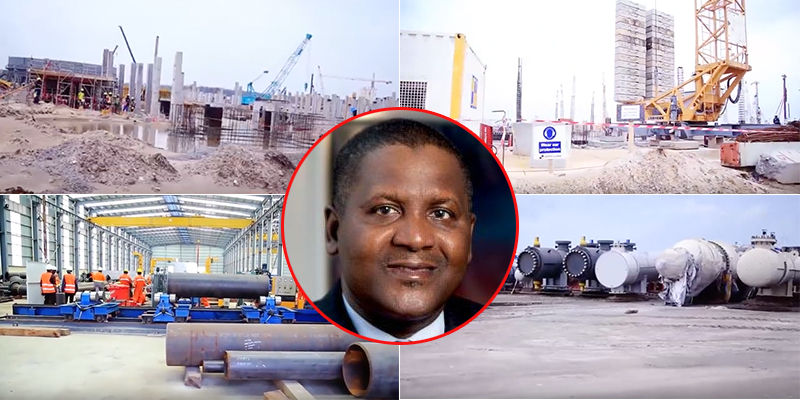
Dangote Refinery and Petrochemical Limited will be listed on the floor of the Nigerian Exchange (NGX) Limited in the future, the Chairman of the company, Mr Aliko Dangote, has revealed.

Mr Dangote, who is the richest man in Africa, confirmed this in an interview with the Financial Times published on Saturday.

The refinery will join other businesses of Mr Dangote currently trading their equities on the NGX, Dangote Cement, Dangote Sugar, and NASCON.

The oil facility, believed to be worth about $20 billion, was launched in May 2023 by the immediate past president of Nigeria, Mr Muhammadu Buhari, though it is yet to commence operations.

A few weeks ago, it was reported that the refinery was starved of crude oil supply by the Nigerian National Petroleum Company (NNPC) Limited, one of its major shareholders, frustrating its commencement of the production of premium motor spirit (PMS), otherwise known as petrol, which the country desperately needs as it currently relies on the importation of the commodity from Europe, especially from the Netherlands and Belgium.

But in the interview, Mr Dangote confirmed that this issue has been resolved, announcing that the refinery may begin to supply the nation diesel, kerosene and jet fuel from December 2023, which is just a few days away.

“We’re starting with 350,000 barrels a day. [We have sealed a deal for the first cargo of about 6mn barrels [for delivery in December],” he was quoted as saying.

According to him, “We have resolved all the issues of supply [with the NNPC,]” he said, refusing to blame the state-owned oil-firm for the difficulties in supplying crude oil to the refinery.

“Let’s not have the blame game here,” he declared in the interview.

However, he expressed optimism that the oil facility would be a game-changer for Nigeria, especially when it is listed on the domestic stock exchange, stressing that the NNPC was not attempting to increase its stake in the organisation with the supply-restriction tactics.

Recall that in 2021, the NNPC acquired a 20 per cent equity stake in Dangote Refinery for about $2.76 billion, and there have been speculations that the firm was planning to increase its shares in the company, which has the capacity to produce 650,000 barrels of crude oil per day and could generate $25 billion a year.

But Mr Dangote, who is 66, played down these rumours, saying, “I don’t think NNPC needs to buy more shares. I think they’re OK with what we’ve given them.”

Business Post reports that the commencement of production date of Dangote Refinery has been shifted more than three times in 2023.

In August 2022, the NNPC said the oil facility would begin operations by mid-2023, but this did not happen and at the commissioning of the refinery on May 22, 2023, in Lagos, Mr Dangote said the first product from the mega-complex structure “will be in the market before the end of July, beginning of August this year”.

In September 2023, the Dangote Group Executive Director, Mr Devakumar Edwin, told S&P Global Commodity Insights that the refinery will kick off production with 350,000 – 370,000 barrels per day of diesel and jet fuel by October, when the crude distillation unit, sulfur block and hydrogen plant should be online.


Dipo Olowookere is a journalist based in Nigeria that has passion for reporting business news stories. At his leisure time, he watches football and supports 3SC of Ibadan. Mr Olowookere can be reached via [email protected]

Economy

Persistent Grid Collapse Poses Direct Threat to Manufacturers, MSMEs—LCCI

Published

on

LCCI

By Adedapo Adesanya

The Lagos Chamber of Commerce and Industry (LCCI) has decried the frequent grid disturbances, saying they pose a grave threat to the economy, particularly to manufacturers and small businesses.

The LCCI concern came after the second national grid collapse within four days on Tuesday, which plunged the country into widespread outage and disrupted economic activity nationwide. It followed up from the 12 of such occurrences which were recorded in 2025.

Speaking about the issue, the director general of LCCI, Mrs Chinyere Almona, said, “This recurrence underscores deep structural and operational weaknesses in the power transmission system and poses a direct threat to manufacturers, MSMEs, and Nigeria’s overall business environment at a critical moment when the economy is expected to move from crisis management and stabilisation (2023–2025) into a consolidation phase in 2026.”

According to her, based on recent patterns and in the absence of urgent structural fixes, the LCCI estimates that Nigeria could experience tens of grid collapses in 2026 under a ‘business-as-usual’ scenario.

She noted that with immediate reforms, system upgrades, and strict operational discipline, this figure can be reduced to zero incidents, moving the country closer to grid reliability benchmarks required for economic consolidation.

Mrs Almona noted that repeated grid failures impose severe costs on businesses through lost production hours, damaged equipment, increased reliance on self-generation, higher operating expenses, and reduced competitiveness, saying that these disruptions weaken investor confidence, worsen inflationary pressures, and undermine the credibility of economic reforms.

She called on the federal government to take a decisive and transparent position by instituting an independent forensic audit of the national grid covering transmission infrastructure integrity, system protection schemes, operational protocols, and governance of grid management, adding that the findings should form a critical part of a grid performance system reform in the short term.

“Without urgent intervention, recurring grid collapses will continue to undermine the government’s objective of entering a consolidation phase in 2026, while constraining productivity, exports, and job creation. A reliable power supply is foundational to industrialisation, competitiveness, and macroeconomic stability.

“The Chamber reiterates that restoring grid stability must be treated as an economic emergency, not merely a technical issue. At this stage, the causes of these collapses should be well understood, better managed, and effectively prevented. What we are witnessing today is therefore unacceptable and calls for decisive, coordinated action to safeguard national economic performance,” the LCCI DG said.

Continue Reading

Economy

Court Convicts AAC Consulting Over N30.5m Theft from Chevron Contract Staff

Published

on

EFCC Abuja forex traders

By Adedapo Adesanya

A Lagos Special Offences Court has convicted AAC Consulting Limited for stealing over N30.5 million belonging to contract staff of Chevron Nigeria Limited.

The judge, Justice Rahman Oshodi, found the firm guilty of stealing N30,564,635.81, following its prosecution by the Lagos Zonal Directorate 1 of the Economic and Financial Crimes Commission (EFCC).

The conviction followed the company’s guilty plea to an amended one-count charge of stealing, contrary to Section 285(1) of the Criminal Code, Laws of Lagos State, 2011, sealing a long-running fraud case that exposed how outsourced workers’ salaries were diverted by their own payroll handlers.

The case dates back to June 5, 2023, when AAC Consulting Limited and its Managing Director, Anthony Adeoye, were arraigned on a 50-count charge bordering on stealing and issuance of dud cheques. Both defendants initially pleaded not guilty, forcing the EFCC to open full trial.

During proceedings, prosecuting counsel, Mr I.O. Daramola, called two witnesses, while several documents were tendered and admitted as exhibits by the court to establish how the funds meant for Chevron contract staff were allegedly misappropriated.

However, the trial took a dramatic turn after the full repayment of the stolen sum to the petitioner in December 2023.

Following the refund, the defendants changed their plea to “guilty”, prompting the EFCC to amend the charge, dropping the multiple counts and proceeding against the company alone on a single count of stealing.

The amended charge stated that AAC Consulting Limited, “on or about April 27, 2013, at Lagos, dishonestly converted to its own use the aggregate sum of N30,564,635.81, property of contract staff of Chevron Nigeria Limited.”

After reviewing the plea and evidence before the court, Justice Oshodi convicted the company and imposed a N5 million fine, with a stern warning.

The court ordered that the fine must be paid within 14 days, failing which AAC Consulting Limited will be wound up.

The conviction sends a strong message to outsourcing and payroll management firms, particularly those handling funds for multinational oil companies, that refund of stolen money does not erase criminal liability.

For the affected Chevron contract staff, the judgment closes a 13-year chapter of financial abuse, while reinforcing EFCC’s stance that corporate entities will be held accountable for payroll fraud and breach of trust in Nigeria’s corporate and labour ecosystem.

Continue Reading

Economy

Nigerian Startups Account for 8% of Africa’s $3.8bn Raise in 2025

Published

on

Nigerian startups

By Adedapo Adesanya

Nigeria recorded its lowest funding share since 2019 but the highest number of deals in 2025, according to Africa Investment Report 2025 published by Briter, a market intelligence platform focused on emerging markets.

According to the report, African companies disclosed a total of $3.8 billion in funding in 2025, representing a 32 per cent increase in deal volume and an 8 per cent rise in the number of announced transactions compared to the previous year ($2.8 billion in 2024).

However, Nigeria accounted for only 8 per cent of total funding, trailing behind South Africa (32 per cent), Kenya (29 per cent), and Egypt (15 per cent).

Despite the drop in funding share, Nigeria’s performance reflects a shift toward smaller, early- and growth-stage transactions, rather than mega-deals. The country recorded the highest number of deals on the continent, indicating strong entrepreneurial activity but limited access to large-ticket funding.

According to Briter, among the ‘Big Four’, Nigeria raised around $315 million alone last year from 205 estimated deals compared to South Africa which raised $1.2 billion from 130 deals, Kenya followed with $1.1 billion from around 16o deals, and Egypt came third with $595 million in 115 deals.

Nigeria which used to occupy the top two among this group has faced steep challenges including the 2023 currency devaluation which made it harder for startups to generate Dollar returns.

As a result, Briter explains that fewer mega-rounds happened in Nigeria, making the totals lower. However, it allowed for newer, upcoming startups to raise in 2025.

The report noted that fintech and digital financial services remained the most funded sector by both value and deal count, reinforcing Nigeria’s position as Africa’s fintech hub. However, climate-focused solutions recorded the fastest growth, raising more than three times their 2024 total, with solar energy emerging as the most funded category.

The surge in solar investment reflects growing investor appetite for infrastructure-like clean energy projects offering predictable returns, particularly in countries like Nigeria where power deficits remain a major economic constraint.

Briter noted that Artificial Intelligence (AI) attracted increased attention from investors in 2025, though funding remained largely concentrated in applied use cases such as financial services, logistics, and health tech rather than deep research and development.

In 2025, 63 acquisitions were announced, though only five disclosed transaction values. Notably, half of those involved startups acquiring other startups, pointing to early signs of consolidation within the ecosystem.

The report added that equity financing remained dominant, but debt funding surpassed $1 billion for the first time in a decade, signaling growing confidence in structured finance across African markets. It also noted a rise in capital from non-Western sources, particularly Japan and Gulf Cooperation Council (GCC) countries, as traditional Western investors scaled back.

Despite increased funding activity, Briter pointed out that the gender gap remains stark as less than 10 per cent of total funding went to companies with at least one female founder, highlighting ongoing challenges in inclusive capital access across Africa.

Continue Reading

Trending