World
French-Speaking African States Under Kremlin’s Politico-Military Influence
By Kestér Kenn Klomegâh
Russia has noticeably intensified its diplomatic relationship with French-speaking Africa after the second Russia-Africa summit in St. Petersburg. It has focused on dealing with growing French neo-colonialism which obstructs Russia’s desire to expand geopolitical and military influence, especially in the West African region. The republics of Burkina Faso, Chad, Niger and Mali have come under the stringent control of the Kremlin, as leaders frequently shuttle between their capitals and Moscow.
Analysis indicates that Moscow’s geopolitical and military inroads are steadily gaining unshakeable grounds. It has tightened its hold across the Sahel-Saharan part of Africa and strategically extended such militarized influence towards the Gulf coastal West Africa. As well-shown, the Francophones are exhausted with France’s exploitative approach and are desperately for an alternative to building fairer and more mutual economic relations.
Policy experts and researchers have widely written in their published papers about (i) Russia’s alleged involvement in the political changes in these French colonies with the fractured economy and (ii) the fact that the region constitutes a nutritious breeding field for armed Islamic jihadist groups, demonstrates Russia’s first drastic step towards combating terrorism and ultimately penetrating into the entire G5 Sahel in West Africa.
Despite this widely published allegation of determining political directions, Moscow officially said it was rather seriously concerned about the economic under-developments and the deepening instability as well as the impoverished population in the region. Moscow has showered humanitarian assistance, described as “delivery at no cost” and intended to ensure food security during the fourth quarter of 2023, on these countries.
While updating the implications of this ‘free food’ as its strategic part of the soft power, Burkina Faso, Chad, Niger and Mali have battered their natural resources, in exchange for creating military bases in the respective territories. Russian state-owned arms trader Rosoboronexport, as part of signed military-technical agreements, has delivered Russian-made combat and transport helicopters, armoured personnel carriers, small arms and ammunition to these Sahel-Saharan African countries, the Vedomosti newspaper reported.
Oleg Ozerov, Ambassador-at-Large at the Russian Foreign Ministry and head of the Secretariat of the Russia-Africa Partnership Forum spoke in an interview with RIA Novosti and explicitly pointed to the fact that Russia has no military bases nor military troops in Africa. “We don’t have a military presence there. There are appeals to the Russian side for help in ensuring security. This is not a military presence. Military presence is when troops are sent. We send instructors at the request of the African states themselves. But all this is not a military presence,” Ozerov said.
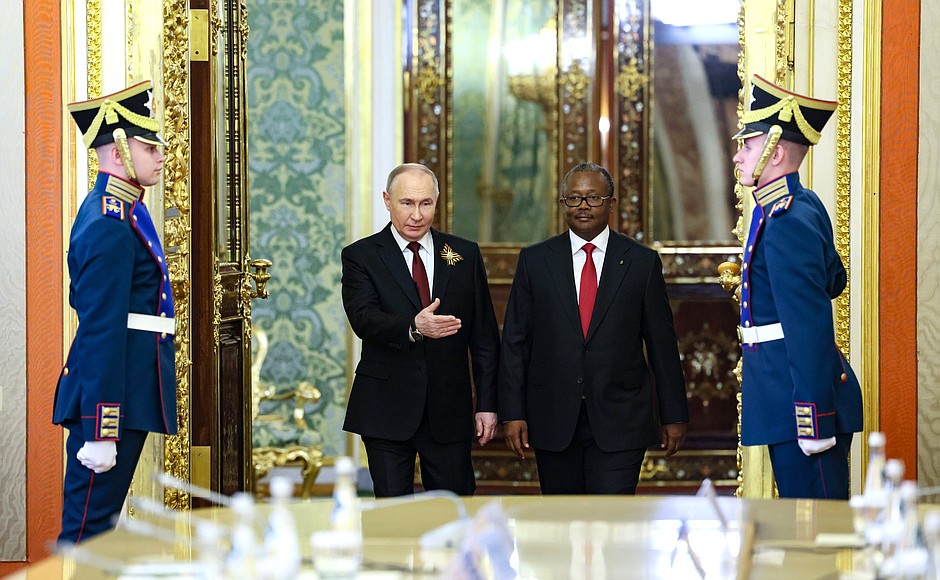
From late last year to almost half of 2024, the focus has been on West Africa. The Ministry of Foreign Affairs has received almost 10 foreign ministers (including Nigeria, Gambia, Gabon, Mali and Sierra Leone) and the Kremlin hosted Equatorial Guinean President Teodoro Obiang Nguema Mbasogo, then Chadian Transitional President Mahamat Idriss Deby in January, followed by Guinea-Bissau leader Umaro Sissoco Embalo. Moscow is moving further down from the Sahel-Saharan region, an elongated landlocked territory located between North Africa (Maghreb) and West Africa, to the Atlantic coast of West Africa.
On May 9, 2024, Russian President Vladimir Putin invited Guinea Bissau leader Umaro Sissoco Embalo as one of the special guests to the celebrations. It was simultaneously intended to strengthen the relationship. Umaro Sissoco Embalo was already here four times during the past couple of years since the ‘special military operation’ began, and as part of the team to discuss peace initiatives with the Kremlin. He was at the second Russia-Africa summit held in July 2023.
In a speech on that day, Putin first reminded, among other indelible facts, of the successful defeat of Nazism and asserted Russia’s independence, and the support it (then Soviet Union) provided others to their anti-colonial struggles and self-determination. Putin stressed, “Africa is now building up capacity and aspires to emerge as an effective powerhouse in a multipolar world with its unique identity by making confident strides in nurturing a genuine sense of political and economic sovereignty.”
During the exclusive talks with Guinea-Bissau’s delegation, including Guinea-Bissau’s Chief of the General Staff and army generals. Putin reiterated expanding bilateral partnership in economic, scientific and technological spheres, on grounds that ties between the two countries are rooted in long-standing traditions of friendship, as well as the principles of equality and mutual respect. “We have been maintaining effective inter-parliamentary and inter-agency ties too. Today, we have an opportunity to discuss our performance under bilateral agreements in various sectors and further steps to expand our cooperation. I must note that students from your country continue to study in Russia. We are ready to offer Guinea-Bissau an even bigger quota,” he told the delegation.
Russia has been paying special attention to its relations with African countries and seeking to ease its debt burden. But also for Putin, military-technical cooperation is at the prominent spot during closed-door negotiations. Russia has focused on dealing with France in most Francophone countries in West Africa.
Umaro Sissoco Embalo, on his part, expressed gratitude for the support which Russia has been giving to the Government and the people of Guinea-Bissau. Over 70 per cent of Guinea-Bissau’s servicemen and civilian officials were trained in the Soviet Union. This explains the necessity for the level of close interaction and cooperation with Russia.
Series of conferences and meetings proliferated these years, and Russia has a new dialogue format – the Ministerial Conference of the Russia-Africa Partnership Forum, at the level of foreign ministers. Without a doubt, Russia is looking to gain political support from African countries on some issues, including the ‘special military operation’ in Ukraine and the sanctions against Russia. Reports indicate Moscow is seriously working on arrangements for the first meeting of this kind, which is scheduled to take place in November 2024 in Sochi. Notwithstanding that, St Petersburg’s late July Russia-Africa summit resulted in the adoption of a solid package of joint documents, including a detailed declaration and a specific plan of action until 2026.
Nonetheless, many experts say Russia has its distinctive style and approach, set out to battle against the exploitation of resources, or better still what is often phrased as “the scramble for resources” in Africa.
Samir Bhattacharya, an Associate Fellow at Observer Research Foundation (ORF), where he works on geopolitics with particular reference to Africa in the changing global order, says Africa, especially the French-speaking West African countries continues to face multiple democratic challenges with a wider negative impact across the region. The narrative that depicts Russia as a proactive coup advocate is compelling and seems to hold water. Russian flags are being flown in the streets in West Africa. The entire region is experiencing sharp disintegration characterized by differences in political systems, economic structures and cultural norms in member countries. Unfortunately, military takeovers have become a distinctive feature (or accepted norm) of regime change in West Africa.
Bhattacharya said it would be overly generalizing to attribute the coup to neocolonialism alone. With eight coups in three years, the Sahel region in West Africa is most affected by coups. However, a close examination reveals that the Sahel Region has endured violent extremism, civil unrest, and poor governance for a very long period. It unmistakably shows how France and other Western powers are losing ground in this region. Frustration with France and other foreign powers increased fairly naturally as their military intervention failed to stem the Islamist insurgency that was spreading throughout the region.
Therefore, the West cannot address the issue merely by blaming Russia. And Russia can not blame only neocolonialism. There is fear that as many African nations continue to be beset by widespread complaints of poor governance, nepotism, and distress, many more within the region and beyond may eventually see military takeovers of a similar nature. Tracking all these bilateral developments implies that Russia’s engagement in Africa definitely requires an in-depth study, according to Bhattacharya.
In another insightful interview, Professor Sergiu Mișcoiu at the Faculty of European Studies, Babes-Bolyai University in Cluj-Napoca (Romania), where he serves as a Director of the Centre for International Cooperation and as Director of the Centre for African Studies, discusses the political situation in the French-speaking West African countries, the existing multiple challenges and Russia’s diplomacy within the context of current geopolitical changes and the scramble for influence in Africa.
Professor Sergiu Mișcoiu argued that neo-colonialism in Africa has been a growing reality after the end of the Cold War and reached a pinnacle by the early 2000s. More salient cases are the former French colonies, and Russia is focused on uprooting France from the continent. Vladimir Putin has intended to restore the mightiness of the Soviet Union, including its influence over the African continent. But unlike the USSR, Russia didn’t and doesn’t dispose of the financial and logistic resources needed to massively invest in the key sectors.
Compared, China has disposed of important financial resources and has been incomparably less violent than Russia between the 1990s and the end of the 2010s in spreading its influence all over the African continent. China succeeded in impressing via its investments in the road and railway infrastructures, in ports, in some major public buildings and in other sectors. As compared to China, Russia made almost no difference through its modest investments and bet its entire strategy on this mixture of, on one hand, the renewal of the former USSR networks and the Soviet past, and on the other, the direct intrusion in the domestic conflicts of the most vulnerable African states.
Ultimately, African countries are bound to wake up to a common understanding of the true meaning of their colonial past for the present and determine their future existence. In fact, the leaders and the elites have to engage in development decision-making processes, and at the same time have to play their roles as autonomous actors instead of being pawns in global politics.
World
Russian-Nigerian Economic Diplomacy: Ajeokuta Symbolises Russia’s Remarkable Achievement in Nigeria
By Kestér Kenn Klomegâh
Over the past two decades, Russia’s economic influence in Africa—and specifically in Nigeria—has been limited, largely due to a lack of structured financial support from Russian policy banks and state-backed investment mechanisms. While Russian companies have demonstrated readiness to invest and compete with global players, they consistently cite insufficient government financial guarantees as a key constraint.
Unlike China, India, Japan, and the United States—which have provided billions in concessionary loans and credit lines to support African infrastructure, agriculture, manufacturing, and SMEs—Russia has struggled to translate diplomatic goodwill into substantial economic projects. For example, Nigeria’s trade with Russia accounts for barely 1% of total trade volume, while China and the U.S. dominate at over 15% and 10% respectively in the last decade. This disparity highlights the challenges Russia faces in converting agreements into actionable investment.
Lessons from Nigeria’s Past
The limited impact of Russian economic diplomacy echoes Nigeria’s own history of unfulfilled agreements during former President Olusegun Obasanjo’s administration. Over the past 20 years, ambitious energy, transport, and industrial initiatives signed with foreign partners—including Russia—often stalled or produced minimal results. In many cases, projects were approved in principle, but funding shortfalls, bureaucratic hurdles, and weak follow-through left them unimplemented. Nothing monumental emerged from these agreements, underscoring the importance of financial backing and sustained commitment.
China as a Model
Policy experts point to China’s systematic approach to African investments as a blueprint for Russia. Chinese state policy banks underwrite projects, de-risk investments, and provide finance often secured by African sovereign guarantees. This approach has enabled Chinese companies to execute large-scale infrastructure efficiently, expanding their presence across sectors while simultaneously investing in human capital.
Egyptian Professor Mohamed Chtatou at the International University of Rabat and Mohammed V University in Rabat, Morocco, argues: “Russia could replicate such mechanisms to ensure companies operate with financial backing and risk mitigation, rather than relying solely on bilateral agreements or political connections.”
Russia’s Current Footprint in Africa
Russia’s economic engagement in Africa is heavily tied to natural resources and military equipment. In Zimbabwe, platinum rights and diamond projects were exchanged for fuel or fighter jets. Nearly half of Russian arms exports to Africa are concentrated in countries like Nigeria, Zimbabwe, and Mozambique. Large-scale initiatives, such as the planned $10 billion nuclear plant in Zambia, have stalled due to a lack of Russian financial commitment, despite completed feasibility studies. Similar delays have affected nuclear projects in South Africa, Rwanda, and Egypt.
Federation Council Chairperson Valentina Matviyenko and Senator Igor Morozov have emphasized parliamentary diplomacy and the creation of new financial instruments, such as investment funds under the Russian Export Center, to provide structured support for businesses and enhance trade cooperation. These measures are designed to address historical gaps in financing and ensure that agreements lead to tangible outcomes.
Opportunities and Challenges
Analysts highlight a fundamental challenge: Russia’s limited incentives in Africa. While China invests to secure resources and export markets, Russia lacks comparable commercial drivers. Russian companies possess technological and industrial capabilities, but without sufficient financial support, large-scale projects remain aspirational rather than executable.
The historic Russia-Africa Summits in Sochi and in St. Petersburg explicitly indicate a renewed push to deepen engagement, particularly in the economic sectors. President Vladimir Putin has set a goal to raise Russia-Africa trade from $20 billion to $40 billion over the next few years. However, compared to Asian, European, and American investors, Russia still lags significantly. UNCTAD data shows that the top investors in Africa are the Netherlands, France, the UK, the United States, and China—countries that combine capital support with strategic deployment.
In Nigeria, agreements with Russian firms over energy and industrial projects have yielded little measurable progress. Over 20 years, major deals signed during Obasanjo’s administration and renewed under subsequent governments often stalled at the financing stage. The lesson is clear: political agreements alone are insufficient without structured investment and follow-through.
Strategic Recommendations
For Russia to expand its economic influence in Africa, analysts recommend:
- Structured financial support: Establishing state-backed credit lines, policy bank guarantees, and investment funds to reduce project risks.
- Incentive realignment: Identifying sectors where Russian expertise aligns with African needs, including energy, industrial technology, and infrastructure.
- Sustained implementation: Turning signed agreements into tangible projects with clear timelines and milestones, avoiding the pitfalls of unfulfilled past agreements.
With proper financial backing, Russia can leverage its technological capabilities to diversify beyond arms sales and resource-linked deals, enhancing trade, industrial, and technological cooperation across Africa.
Conclusion
Russia’s Africa strategy remains a work in progress. Nigeria’s experience with decades of agreements that failed to materialize underscores the importance of structured financial commitments and persistent follow-through. Without these, Russia risks remaining a peripheral player (virtual investor) while Arab States such as UAE, China, the United States, and other global powers consolidate their presence.
The potential is evident: Africa is a fast-growing market with vast natural resources, infrastructure needs, and a young, ambitious population. Russia’s challenge—and opportunity—is to match diplomatic efforts with financial strategy, turning political ties into lasting economic influence.
World
Afreximbank Warns African Governments On Deep Split in Global Commodities
By Adedapo Adesanya
Africa Export-Import Bank (Afreximbank) has urged African governments to lean into structural tailwinds, warning that the global commodity landscape has entered a new phase of deepening split.
In its November 2025 commodity bulletin, the bank noted that markets are no longer moving in unison; instead, some are powered by structural demand while others are weakening under oversupply, shifting consumption patterns and weather-related dynamics.
As a result of this bifurcation, the Cairo-based lender tasked policymakers on the continent to manage supply-chain vulnerabilities and diversify beyond the commodity-export model.
The report highlights that commodities linked to energy transition, infrastructure development and geopolitical realignments are gaining momentum.
For instance, natural gas has risen sharply from 2024 levels, supported by colder-season heating needs, export disruptions around the Red Sea and tightening global supply. Lithium continues to surge on strong demand from electric-vehicle and battery-storage sectors, with growth projections of up to 45 per cent in 2026. Aluminium is approaching multi-year highs amid strong construction and automotive activity and smelter-level power constraints, while soybeans are benefiting from sustained Chinese purchases and adverse weather concerns in South America.
Even crude oil, which accounts for Nigeria’s highest foreign exchange earnings, though still lower year-on-year, is stabilising around $60 per barrel as geopolitical supply risks, including drone attacks on Russian facilities, offset muted global demand.
In contrast, several commodities that recently experienced strong rallies are now softening.
The bank noted that cocoa prices are retreating from record highs as West African crop prospects improve and inventories recover. Palm oil markets face oversupply in Southeast Asia and subdued demand from India and China, pushing stocks to multi-year highs. Sugar is weakening under expectations of a nearly two-million-tonne global surplus for the 2025/26 season, while platinum and silver are seeing headwinds from weaker industrial demand, investor profit-taking and hawkish monetary signals.
For Africa, the bank stresses that the implications are clear. Countries aligned with energy-transition metals and infrastructure-linked commodities stand to benefit from more resilient long-term demand.
It urged those heavily exposed to softening agricultural markets to accelerate a shift into processing, value addition and product diversification.
The bulletin also called for stronger market-intelligence systems, improved intra-African trade connectivity, and investment in logistics and regulatory capacity, noting that Africa’s competitiveness will depend on how quickly governments adapt to the new two-speed global environment.
World
Aduna, Comviva to Accelerate Network APIs Monetization
By Modupe Gbadeyanka
A strategic partnership designed to accelerate worldwide enterprise adoption and monetisation of Network APIs has been entered into between Comviva and the global aggregator of standardised network APIs, Aduna.
The adoption would be done through Comviva’s flagship SaaS-based platform for programmable communications and network intelligence, NGAGE.ai.
The partnership combines Comviva’s NGAGE.ai platform and enterprise onboarding expertise with Aduna’s global operator consortium.
This unified approach provides enterprises with secure, scalable access to network intelligence while enabling telcos to monetise network capabilities efficiently.
The collaboration is further strengthened by Comviva’s proven leadership in the global digital payments and digital lending ecosystem— sectors that will be among the biggest adopters of Network APIs.
The NGAGE.ai platform is already active across 40+ countries, integrated with 100+ operators, and processing over 250 billion transactions annually for more than 7,000 enterprise customers. With its extensive global deployment, NGAGE.ai is positioned as one of the most scalable and trusted platforms for API-led network intelligence adoption.
“As enterprises accelerate their shift toward real-time, intelligence-driven operations, Network APIs will become foundational to digital transformation. With NGAGE.ai and Aduna’s global ecosystem, we are creating a unified and scalable pathway for enterprises to adopt programmable communications at speed and at scale.
“This partnership strengthens our commitment to helping telcos monetise network intelligence while enabling enterprises to build differentiated, secure, and future-ready digital experiences,” the chief executive of Comviva, Mr Rajesh Chandiramani, stated.
Also, the chief executive of Aduna, Mr Anthony Bartolo, noted that, “The next wave of enterprise innovation will be powered by seamless access to network intelligence.
“By integrating Comviva’s NGAGE.ai platform with Aduna’s global federation of operators, we are enabling enterprises to innovate consistently across markets with standardised, high-performance Network APIs.
“This collaboration enhances the value chain for operators and gives enterprises the confidence and agility needed to launch new services, reduce fraud, and deliver more trustworthy customer experiences worldwide.”
-
Feature/OPED6 years agoDavos was Different this year
-
Travel/Tourism9 years ago
Lagos Seals Western Lodge Hotel In Ikorodu
-
Showbiz3 years agoEstranged Lover Releases Videos of Empress Njamah Bathing
-
Banking7 years agoSort Codes of GTBank Branches in Nigeria
-
Economy2 years agoSubsidy Removal: CNG at N130 Per Litre Cheaper Than Petrol—IPMAN
-
Banking3 years agoFirst Bank Announces Planned Downtime
-
Banking3 years agoSort Codes of UBA Branches in Nigeria
-
Sports3 years agoHighest Paid Nigerian Footballer – How Much Do Nigerian Footballers Earn