Economy
API Architecture: The Invisible Engine Powering Modern Banking
By Echezona Agubata
Banking has evolved far beyond the days of paper ledgers and long queues. Today, it’s a dynamic force driving Nigeria’s economy, responding to customers in real time, and powering digital innovation. The unsung hero behind this transformation is the Application Programming Interface (API)—a tool that lets bank systems communicate seamlessly with each other and external partners.
In Nigeria’s fast-growing digital finance landscape, APIs are the invisible engine enabling banks to offer instant balance checks, process payments at retail checkouts, or verify identities for loan approvals. The secret to their success? A robust API architecture, the structured framework that makes banking secure, scalable, and innovative.
Picture API architecture as a bridge connecting islands of financial services. It allows banks to share data securely. In Nigeria, where digital banking is literarily booming, APIs let banks like Coronation Merchant Bank expand services without rebuilding infrastructure. This flexibility fuels innovation, enabling tailored solutions for everyone from small businesses to large corporations.
The Central Bank of Nigeria (CBN) along with Industry players ensure this ecosystem is secure and trustworthy. Its regulations mandate standards like OAuth 2.0 for authentication, tokenization to protect data, and encrypted channels to safeguard transactions. Real-time monitoring and customer consent protocols further build trust, ensuring data is shared only with permission. These rules aren’t just technical or ethical—they’re the backbone of Nigeria’s open banking system, fostering collaboration and innovation.
How do APIs work? Imagine a well-orchestrated machine. The API acts as
● A Gateway: the gatekeeper to a product. It authenticates requests and ensures only authorized people are granted access to the product. It also helps limit the number of requests that can be made for the product at any given time. For instance, when a bank’s mobile app requests a customer’s transaction history, the transaction history API (as a gateway) verifies access (both customer and mobile app) before treating the transaction history request.
- A Guide: the protocol or security who ensures that even authenticated users are only allowed to access products and data that they are authorized to have
- A Funnell: the pipe that ensures that authenticated users access products and data from known locations/sources to known destinations
- An Agent: the agent that ensures that applications regardless of the service offering have access to data/products in the same way as every other application. This gives unified experience across respective platforms that are consuming the service/data offered by the API
Here’s a simplified view of the flow:
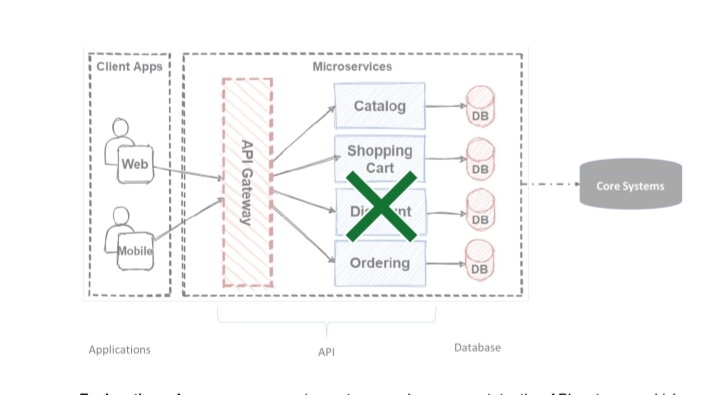
Explanation: An app or corporate system sends a request to the API gateway, which authenticates and routes it. The orchestration layer processes it using endpoints, pulling data from the core system via middleware.
The orchestration layer (behind the gateway) breaks services—like catalog, shopping cart, or ordering—into modular endpoints, like building blocks online shops can share securely. The modular endpoints connect these APIs to core systems, translating the requests into formats that can be processed by the core system. Companies also provide developer portals with clear documentation and sandbox environments, simplifying integration for partners.
This architecture can be built for scale. Banks process millions of transactions daily using load balancing to scale out resources, and distribute traffic in a dynamic fashion. This architecture could incorporate the use of in-memory databases and Queueing technologies to cache frequently used data for swifter processing. More so, this introduces rate limiting features which help isolate any problem areas without affecting the entire service as a whole.
Challenges abound. One of such is the existence of legacy systems as many banks and organizations often rely on decades-old mainframes (core systems), thus requiring a middleware solution to bridge old and new systems—a complex but critical step. Another recent challenge is the need to enforce data privacy expectations, this has made encryption and data masking a necessary action. Encryption in itself comes with its own attendant side-effects especially where applied on data without proper service governance. It can slow performance, so banks and organizations use caching and optimized data flows to balance speed and security. Compliance with CBN guidelines and Nigeria’s data privacy laws demands robust
consent management and audit trails. Versioning APIs (e.g., /v1/payments) prevents disruptions when systems evolve.
Real-world examples highlight APIs’ impact. Coronation Merchant Bank built the Dangote ISOP Collection API to streamline payments for Dangote’s distributors. These payments were previously riddled with slow reconciliations and delayed cash flow. The API integrates payments directly into Dangote’s ERP system and thereby automating the process, reducing errors, and strengthening business ties. Another bank used a KYC API to verify customer identities for loan applications, cutting onboarding time while meeting CBN standards. A third example involves a major Nigerian bank’s payment API, which enables instant corporate transfers for retailers, ensuring funds clear in seconds during peak sales.
APIs are also driving open finance. The CBN’s 2023 guidelines expand APIs to cover credit, investment, and insurance data, enabling embedded finance—loans at retail checkouts or savings tools linked to salary accounts. This makes banking invisible yet ever-present, blending into daily life.
The future is exciting. Banks are adopting API-first design, prioritizing APIs as core interfaces for faster innovation. AI-driven APIs are emerging, enabling fraud detection or tailored loan offers. Blockchain-based APIs promise secure cross-border payments. Event-driven architectures, using tools like Kafka, process real-time events like transaction alerts, boosting efficiency.
At Coronation Merchant Bank, our APIs are business enablers. Our custom solutions, like the Dangote integration, solve real-world problems, while our investment banking desk advises on capital raising and partnerships, helping clients stay competitive. APIs lower barriers, drive growth, and deliver seamless experiences for customers.
Nigeria’s financial future isn’t about who holds the most assets—it’s about who builds the strongest connections between data, money, and people. API architecture is the invisible engine powering that future, creating a connected, inclusive banking ecosystem.
Economy
Nigeria Gets Fresh $500m World Bank Loan for Small Businesses
By Adedapo Adesanya
The World Bank has approved a $500 million facility for Nigeria to expand longer-term lending to small and medium sized businesses.
Approved under the Fostering Inclusive Finance for MSMEs in Nigeria (FINCLUDE) project, the package comprises a $400 million International Bank for Reconstruction and Development (IBRD) loan and a $100 million International Development Association (IDA) credit. Both IBRD and IDA are members of the World Bank Group.
The scheme will be implemented by the Development Bank of Nigeria (DBN), with credit guarantees provided through DBN’s subsidiary, Impact Credit Guarantee Limited (ICGL).
FINCLUDE is designed to address constraints faced by micro, small, and medium enterprises (MSMEs) in Nigeria which despite accounting for most businesses and nearly half of gross domestic product (GDP) face long-standing barriers to formal finance.
Fewer than one in 20 MSMEs have access to bank credit; loans are often short-term and costly; and collateral requirements exclude many viable firms. Women-led enterprises, which make up a substantial portion of MSMEs, are disproportionately affected, facing higher rejection rates and limited tailored products. Agribusinesses, central to food security and rural livelihoods, similarly struggle to obtain more extended‑tenor financing for equipment, processing, storage, and logistics.
However, FINCLUDE seeks to address these constraints by expanding access to affordable, longer-term finance and tailored solutions for segments with the most significant development impact.
Speaking on this, the World Bank Country Director for Nigeria, Mr Mathew Verghis, said, “FINCLUDE is about jobs, opportunity, and inclusion. By expanding access to finance for viable MSMEs—particularly women-led firms and agribusinesses—Nigeria can accelerate growth and deliver tangible benefits across communities nationwide.
“The project will make it easier for deserving small businesses to get the finance they need to grow and hire workers. With better support for lenders that practice inclusive finance and fairer, longer-term loans for entrepreneurs, we are backing the people who power Nigeria’s economy—especially women and those in agriculture.”
The FINCLUDE project will help to mobilise private investment and expand access to and usage of inclusive, innovative financial products for MSMEs nationwide.
Through DBN, the operation will strengthen the capacity of banks, including microfinance banks and non-bank financial institutions such as financial technologies (fintechs), to provide larger loans with more reasonable repayment periods, and—through ICGL—will scale partial credit guarantees so that lenders can extend credit to businesses they might otherwise consider too risky.
Targeted technical assistance will modernise loan appraisal by leveraging AI-enabled digital platforms to accelerate decision-making, improve data quality, strengthen impact measurement, and build capacity for both MSMEs and participating financial institutions.
According to the World Bank, a strong emphasis on inclusion will ensure that women-led businesses and agribusinesses benefit from these improvements.
Also commenting, Task Team Leader for FINCLUDE, Mrs Hadija Kamayo, said, “FINCLUDE will help to mobilize approximately $1.89 billion in private capital, expand debt financing to 250,000 MSMEs—including at least 150,000 women-led businesses and 100,000 agribusinesses—and issue up to $800 million in guarantees to catalyse lending.
“By extending the average maturity of MSME loans to about three years, it will help firms invest in equipment, factories, staff, and productivity, translating finance into jobs and growth.”
Economy
Nigerian Stocks Close 1.13% Higher to Remain in Bulls’ Territory
By Dipo Olowookere
The local stock market firmed up by 1.13 per cent on Friday as appetite for Nigerian stocks remained strong.
Investors reacted well to the 2026 budget presentation of President Bola Tinubu to the National Assembly yesterday, especially because of the more realistic crude oil benchmark of $64 per barrel compared with the ambitious $75 per barrel for 2025. This year, prices have been between $60 and $65 per barrel.
Business Post observed profit-taking in the commodity and energy sectors as they respectively shed 0.14 per cent and 0.03 per cent.
But, bargain-hunting in the others sustained the positive run, with the consumer goods index up by 3.82 per cent.
Further, the industrial goods space appreciated by 1.46 per cent, the banking counter improved by 0.08 per cent, and the insurance industry gained 0.04 per cent.
As a result, the All-Share Index (ASI) increased by 1,694.33 points to 152,057.38 points from 150,363.05 points and the market capitalisation chalked up N1.080 trillion to finish at N96.937 trillion compared with Thursday’s closing value of N95.857 trillion.
A total of 34 shares ended on the advancers’ chart, while 24 were on the laggards’ log, representing a positive market breadth index and bullish investor sentiment.
Austin Laz gained 10.00 per cent to close at N2.42, Union Dicon also jumped 10.00 per cent to N6.60, Tantalizers increased by 9.80 per cent to N2.69, Aluminium Extrusion improved by 9.78 per cent to N12.35, and Champion Breweries grew by 9.71 per cent to N16.95.
Conversely, Sovereign Trust Insurance dipped by 7.42 per cent to N3.87, Royal Exchange lost 6.84 per cent to trade at N1.77, Omatek slipped by 6.84 per cent to N1.09, Eunisell depreciated by 5.88 per cent to N80.00, and Eterna dropped 5.63 per cent to close at N28.50.
Yesterday, traders transacted 1.5 billion units worth N21.8 billion in 25,667 deals compared with the 839.8 million units sold for N32.8 billion in 23,211 deals in the preceding session, showing a surge in the trading volume by 76.61 per cent, an uptick in the number of deals by 10.58 per cent, and a shrink in the trading value by 33.54 per cent.
Economy
FrieslandCampina, Two Others Erase N26bn from NASD OTC Bourse
By Adedapo Adesanya
Three stocks stretched the bearish run of the NASD Over-the-Counter (OTC) Securities Exchange by 1.21 per cent on Friday, December 19, with the market capitalisation giving up N26.01 billion to close at N2.121 billion compared with the N2.147 trillion it ended a day earlier, and the NASD Unlisted Security Index (NSI) dropping 43.47 points to 3,546.41 points from 3,589.88 points.
The trio of FrieslandCampina Wamco Nigeria Plc, Central Securities Clearing System (CSCS) Plc, and NASD Plc overpowered the gains printed by four other securities.
FrieslandCampina Wamco Nigeria Plc lost N6.00 to sell at N54.00 per unit versus N60.00 per unit, NASD Plc shrank by N3.50 to N58.50 per share from N55.00 per share, and CSCS Plc depleted by N2.91 to N33.87 per unit from N36.78 per unit.
On the flip side, Air Liquide Plc gained N1.01 to close at N13.00 per share versus N11.99 per share, Golden Capital Plc appreciated by 70 Kobo to N7.68 per unit from N6.98 per unit, Geo-Fluids Plc added 39 Kobo to sell at N5.50 per share versus N5.11 per share, and IPWA Plc rose by 8 Kobo to 85 Kobo per unit from 77 Kobo per unit.
During the trading day, market participants traded 1.9 million securities versus the previous day’s 30.5 million securities showing a decline of 49.3 per cent. The value of trades went down by 64.3 per cent to N80.3 million from N225.1 million, but the number of deals jumped by 32.1 per cent to 37 deals from 28 deals.
Infrastructure Credit Guarantee Company (InfraCredit) Plc finished the session as the most active stock by value on a year-to-date basis with 5.8 billion units valued at N16.4 billion, followed by Okitipupa Plc with 178.9 million units transacted for N9.5 billion, and MRS Oil Plc with 36.1 million units traded for N4.9 billion.
The most active stock by volume on a year-to-date basis was still InfraCredit Plc with 5.8 billion units worth N16.4 billion, trailed by Industrial and General Insurance (IGI) Plc with 1.2 billion units sold for N420.7 million, and Impresit Bakolori Plc with 536.9 million units traded for N524.9 million.
-
Feature/OPED6 years agoDavos was Different this year
-
Travel/Tourism9 years ago
Lagos Seals Western Lodge Hotel In Ikorodu
-
Showbiz3 years agoEstranged Lover Releases Videos of Empress Njamah Bathing
-
Banking7 years agoSort Codes of GTBank Branches in Nigeria
-
Economy3 years agoSubsidy Removal: CNG at N130 Per Litre Cheaper Than Petrol—IPMAN
-
Banking3 years agoFirst Bank Announces Planned Downtime
-
Banking3 years agoSort Codes of UBA Branches in Nigeria
-
Sports3 years agoHighest Paid Nigerian Footballer – How Much Do Nigerian Footballers Earn