Economy
Market Cap of Top 40 Miners Hit $714b—Report

By Dipo Olowookere
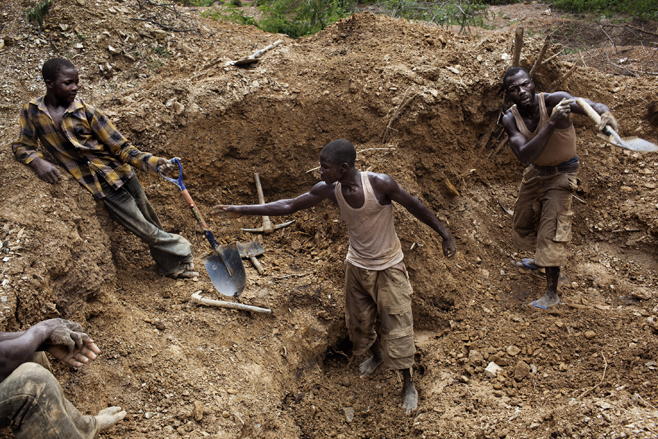
A new report by PwC has revealed that market capitalisation of the top 40 mining companies in the world increased by 45 percent to $714 billion, approaching the 2014 level. This was mainly due to rising commodity prices.
The report, titled PwC Mine 2017 report, noted that the world’s Top 40 miners recovered from a race to the bottom, with bolstered balance sheets and a return to profitability in 2016, giving them much-needed space to pause and draw breath.
As it looks to the future, the 14th edition of PwC’s industry series analysing financial performance and global trends, also outlines the new opportunities and hazards on the horizon – and the impact of intransigent or innovative activity.
Mine 2017 was released by PwC Africa last week at the Junior Indaba conference held in Johannesburg.
Michal Kotzé, Energy, Utilities and Mining Industry Leader for PwC Africa, commented: “The narrative of the Top 40 in 2016 tends to read like a mine site safety mantra: Stop. Think … Act. The industry has moved out of danger but 2016 was not a year of significant action, and we now wait to see who will be bold and step out beyond the fluctuating market confidence.”
The report analysed 40 of the largest listed mining companies by market capitalisation. The financial information for 2016 covers the reporting periods 1 April 2015 to 31 December 2016, with each company’s results included for the 12-month financial reporting period that falls into this time frame.
The number of emerging companies included in the Top 40 has decreased by two and now totals 17. There were seven new entrants from the previous year, five of which had made appearances on previous rankings in either 2014 or 2015. First Quantum and Teck Resources re-emerged on the 2016 list after strengthening their financial positions.
The report recognises a return to profitability in 2016, with an aggregate Top-40 net profit of $20 billion; after an aggregate loss of $28 billion in 2015. The improved fortunes of the industry were then directed to strengthening balance sheets.
Revenue from the Top 40 remained relatively flat – up just one percent from the previous year’s sum of $491 billion – despite a rebound in commodity prices, particularly coal and iron ore in the second half of the year.
Capex fell dramatically again, by a further 41 percent, to a new record low of just $50 billion, the report noted.
After hitting a near-record in 2015, impairment charges tumbled last year to a less-alarming $19 billion.
The report said debt repayments totalled $93 billion, up from $73 billion a year earlier, with most of the debt issued to refinance, rather than fund acquisitions or mine development.
Kotzé added: “We see an improved gearing ratio of 41 per cent, down from the 2015 record of 49 per cent. But this is still well above the 10 year average of 29 per cent. Interestingly, we also found that around half the capex figure was invested in sustaining activities, so the growth capital portion was strikingly small compared with previous years.”
Rapidly rising commodity prices sparked renewed market optimism and improved credit ratings across the Top 40 firms. Valuations also climbed, especially for the traditional miners, with the trend continuing through the first quarter of 2017 even as commodity prices remained flat. But, valuations aside, there is little to suggest that the group made any substantial advances throughout the year.
For the fourth consecutive year, the industry reduced spending on exploration. $7.2 billion was invested in 2016, barely one-third of the record $21.5 billion allocated in 2012, with the funds cautiously targeted at less risky, later stage assets, typically located in politically stable countries.
Limited M&A activity
One of the biggest M&A stories of 2016 concerned the assets that did not sell. Numerous large deals, expected to be completed by early 2017, were withdrawn from the market, possibly due to the rebound in commodity prices and the improving prospects of the companies that owned them. More broadly, asset sales in 2016 were largely strategic rather than fire sales. Mines, especially diversified players, sold minority stakes in non-mining businesses.
China in the driving seat
China remains the exception to the dominant investment behaviour within the Top 40. During the downturn, Chinese companies demonstrated one enormous advantage over other miners from both traditional and emerging countries: access to capital.
With deeper pockets, Chinese players were able to fund more acquisitions than their counterparts, either confidently buying assets at bullish prices or moving quickly on assets made available at the bottom of the price cycle. We also saw an increase in acquisitions by Chinese private equity firms, and we expect China to continue to be active in acquiring global mining assets as a way to reduce its longer term dependency on imports.
Moving into action
Balance sheet clean-ups require discipline, and this has resulted in a tailing-off of impairments, the avoidance of any new bankruptcies, the absence of any significant streaming transactions and a general passing of distress. The market rightly applauded this, reinstating a positive gap between market caps and net book values that was absent in 2015.
All of this provides a platform for decisive action in the future. While many will be willing to ride the waves of industry sentiment, others will see the conditions as ripe for value accretive moves, with market differentiation their immediate goal.
Action might also come in the form of commitments to greenfield projects, M&A or technology – or a combination of these – while others may realign their strategy in response to external forces such as recycling and substation, shareholder activism and government intervention.
Will the digital revolution become an enduring part of the mining psyche?
New technologies promising a boost for the sector include software to optimise asset utilisation, devices to remotely monitor and control activities, and robotics to automate repetitive task.
The benefits of asset optimisation tools are significant. According to an analysis by PwC, it is estimated that maintenance costs can be reduced by 20 to 40 percent, asset utilisation increased by up to 20 percent, capital expenses reduced by 5 to 10 percent, while also delivering improved environmental, health and safety outcomes. A number of Top 40 miners have announced or implemented digital innovations that are already enhancing performance.
Andries Rossouw, PwC Assurance Partner commented: “Mining companies need to combine engineering excellence and know-how with a new open-mindedness to learn from advanced analytics and a need to embrace robotics and platforms that fundamentally challenge decades of doing things the same way…it is as much about behaviour as technology.”
Rossouw concludes: “The key question is, who will act rather than simply react? There will be more advances this year but how impactful they will be, remains to be seen.”
Economy
Investors Gain N333bn Trading Nigerian Equities
By Dipo Olowookere
A 0.31 per cent gain was recorded by the Nigerian Exchange (NGX) Limited on Tuesday, helped by renewed bargain-hunting by investors, with the year-to-date return extending to 6.61 per cent.
It was observed that the growth achieved by Customs Street yesterday was supported by the banking and the industrial goods indices, which went up by 1.32 per cent and 0.69 per cent apiece.
They offset the losses recorded by the three other sectors, with the insurance counter down by 1.32 per cent, the consumer goods segment down by 0.23 per cent, and the energy space down by 0.17 per cent.
At the close of business, the All-Share Index (ASI) increased by 516.94 points to 165,901.57 points from 165,384.63 points and the market capitalization appreciated by N333 billion to N106.495 trillion from N106.162 trillion.
The market breadth index was positive yesterday after the bourse ended with 35 price gainers and 34 price losers, representing bullish investor sentiment.
The quartet of Industrial and Medical Gases (IMG), Union Dicon, Zichis, and Austin Laz chalked up 10.00 per cent each to sell for N34.65, N9.90, N5.06, and N4.07, respectively, while RT Briscoe appreciated by 9.95 per cent to N9.50.
On the flip side, Omatek lost 10.00 per cent to trade at N2.43, Cutix also fell by 10.00 per cent to N3.15, Union Homes shrank by 9.95 per cent to N76.90, Sunu Assurances declined by 9.94 per cent to N4.62, and Deap Capital crashed by 9.93 per cent to N7.62.
During the trading day, 736.4 million stocks worth N24.7 billion exchanged hands in 46,026 deals compared with the 762.8 million stocks valued at N18.4 billion traded in 55,374 deals a day earlier, indicating a rise in the trading value by 34.24 per cent, and a slip in the trading volume and number of deals by 3.46 per cent and 16.88 per cent apiece.
The activity chart was led by volume on the second trading session of the week by GTCO with 65.9 million equities valued at N6.5 billion, Chams transacted 55.7 million shares worth N249.8 million, Custodian Investment traded 49.8 million stocks for N2.2 billion, Universal Insurance sold 36.1 million equities valued at N51.5 million, and Zenith Bank exchanged 35.4 million shares worth N2.6 billion.
Economy
Oil Market Rises 2% on Fresh Iran-US Confrontation
By Adedapo Adesanya
The oil market was up by nearly 2 per cent on Tuesday after the United States shot down an Iranian drone approaching an aircraft carrier and armed boats in the Strait of Hormuz, stoking concerns talks aimed at de-escalating US-Iran tensions could be disrupted.
This action caused the Brent futures to rise by $1.03 or 1.6 per cent to $67.33 per barrel, as the US West Texas Intermediate (WTI) futures jumped by $1.07 or 1.7 per cent to $63.21 a barrel.
Both crude benchmarks dropped more than 4 per cent on Monday after President Donald Trump said Iran was seriously talking with America.
However, the US military shot down an Iranian drone that “aggressively” approached the Abraham Lincoln aircraft carrier in the Arabian Sea on Tuesday.
In the Strait of Hormuz between the Persian Gulf and the Gulf of Oman, Iranian gunboats approached a US-flagged oil tanker in what US and British maritime security sources describe as a failed attempt to interfere with the vessel’s transit.
Members of the Organisation of the Petroleum Exporting Countries (OPEC) including Saudi Arabia, Iran, the United Arab Emirates, Kuwait and Iraq export most of their crude via the strait, mainly to Asia. The Strait of Hormuz, through which roughly a fifth of the world’s oil supply passes, remains Iran’s most obvious pressure point.
Despite the latest development, the UAE urged Iran and the US on Tuesday to use the resumption of nuclear talks this week to resolve a standoff that has led to mutual threats of air strikes. Iran, meanwhile, is demanding that talks be held in Oman not Turkey.
In Ukraine, President Volodymyr Zelenskiy accused Russia on Tuesday of exploiting a US-backed energy truce to stockpile munitions, and using them to attack Ukraine a day before peace talks. This boosted worries that Russia’s oil would remain sanctioned for longer.
On Monday, President Trump announced a trade deal with India, one of the world’s biggest economies and oil importers, on Monday to cut tariffs to 18 per cent from 50 per cent in exchange for the country halting Russian oil purchases and lowering trade barriers.
The American Petroleum Institute (API) estimated that crude oil inventories in the US decreased by 11.1 million barrels in the week ending January 30. Crude oil inventories decreased by 247,000 barrels in the week prior.
Official data from the US Energy Information Administration (EIA) will be published later on Wednesday.
Economy
AFC Commits Support to Transformative Reforms in Nigeria’s Power Sector
By Adedapo Adesanya
The Africa Finance Corporation (AFC), the continent’s leading infrastructure solutions provider, has reiterated its commitment to playing a pivotal role to support transformative reforms in Nigeria’s power sector.
This is as it act as co-Financial Adviser to the Nigerian government on the successful issuance of the recent N501 billion inaugural tranche under the Presidential Power Sector Financial Reforms Programme (PPSFRP), as part of the N4 trillion Power Sector Bond Programme, aimed at resolving over a decade of legacy debt obligations in Nigeria’s electricity supply industry and restoring financial stability across the sector.
AFC provided comprehensive financial advisory services to the federal government, including the design of the Programme’s negotiation strategy framework, support in negotiating and executing Settlement Agreements with Power Generation Companies (GenCos), and structuring the bond issuance. Working in partnership with CardinalStone Partners as co-Financial Advisers, AFC deployed its deep sector expertise and strong local market knowledge to deliver the landmark transaction.
The programme was overseen by the Presidential Power Sector Debt Reduction Committee (PPSDRC), with technical leadership from the Office of the Special Adviser to the President on Energy, and implemented through NBET Finance Company Plc, a special purpose vehicle of Nigerian Bulk Electricity Trading Plc (NBET). Proceeds from the issuance will be used to settle verified, overdue receivables owed to GenCos for electricity supplied between February 2015 and March 2025, injecting liquidity into the power sector and extinguishing long-standing claims.
Commenting on AFC’s involvement, Mr Banji Fehintola, Executive Board Member and Head, Financial Services at Africa Finance Corporation, said: “The successful issuance of the inaugural tranche under the Power Sector Bond Programme underscores AFC’s commitment to supporting transformative reforms in Nigeria’s power sector. By resolving long-standing liquidity challenges and restoring confidence among investors and operators, this transaction lays the foundation for sustainable growth and improved electricity supply across the country.”
When fully implemented, the programme is expected to impact approximately 5,398MW of electricity generation capacity by Nigerian GenCos and finalise settlement for 290,644.84GWh of electricity billed since 2015. It will also strengthen companies serving about 12 million active registered customers, creating a solid platform for new investments in capacity enhancement and expansion.
-
Feature/OPED6 years agoDavos was Different this year
-
Travel/Tourism9 years ago
Lagos Seals Western Lodge Hotel In Ikorodu
-
Showbiz3 years agoEstranged Lover Releases Videos of Empress Njamah Bathing
-
Banking8 years agoSort Codes of GTBank Branches in Nigeria
-
Economy3 years agoSubsidy Removal: CNG at N130 Per Litre Cheaper Than Petrol—IPMAN
-
Banking3 years agoSort Codes of UBA Branches in Nigeria
-
Banking3 years agoFirst Bank Announces Planned Downtime
-
Sports3 years agoHighest Paid Nigerian Footballer – How Much Do Nigerian Footballers Earn