Connect with us

Economy

FG Tasks Agric Varsities on Food Security to Earn Income

Published

on

By Modupe Gbadeyanka

The three federal universities of agriculture in Nigeria have been charged to “scale- up plantations” over time in order to “earn income.”

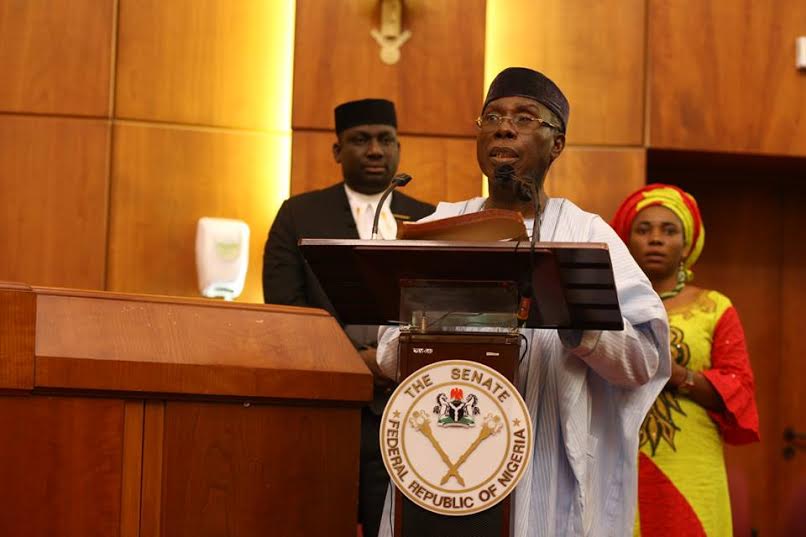
This charge was given last Tuesday in Abuja by the Minister of Agriculture and Rural Development, Mr Audu Ogbeh, when he received members of the governing councils of federal universities of agriculture.

Mr Ogbeh noted that it was important for the institutions to be the “food basket” of their “respective host communities.”

While commending the initiative of the schools in Abeokuta and Umudike on this subject matter, the Minister said, “You have huge parcels of land averaging 10,000 ha each. I enjoin you to put them to use.”

He pointed out that “as institutions of agricultural education and research, you can earn huge revenues from agricultural research, seed and seedling development, extension work, soil mapping and even production of food on campus.”

Mr Ogbeh advised the universities to give greater priority to courses with agriculture-related content.

“We do not forbid the teaching of electives like some accounting, business administration and so on, but only as subsidiaries. The main courses must be agriculture, agronomy, botany, animal husbandry, forestry, fishery, plant entomology, breeding, cattle breed improvement, Agric engineering, veterinary medicine,” he insisted.

He further advised that the schools “should be training graduates who should be going straight into production, with credit support from their alma-mater, produce chicken, eggs, goats, milk, set up meat laboratories, bake bread and above all  produce and sell large quantities of high quality hybrid seeds.

“Farmers are in desperate need of these services and more.  You will make huge profits from innovative agricultural practice.”

The Minister assured lecturers and students engaged in non-agricultural studies in the three universities of agriculture that their careers will not be jeopardized.

According to Mr Ogbeh, “The return of the three universities of agriculture to this Ministry is a rational, just and timely action, necessitated by the new economic realities we are in, to ensure that our institutions are better focused and more efficiently and economically managed.”

The three federal universities of agriculture, he noted, “were established to advance the cause of agricultural transformation and modernization in Nigeria for the development of core competencies in agricultural education, research and training, amongst others.

“It is therefore, expected that the admission policy of these universities will largely be reflective of this overarching goal.

“Our submission is that, in the long run, the universities will be better served if they focus on their core areas of business rather than on the subsidiaries.”

He expressed the consciousness of government on the “fears and anxieties of teachers and the students already enrolled for these subsidiary programmes.”

Accordingly, he said, “we will not be cancelling them immediately. The task before you is to phase them out gradually.”

He assured the universities that there will be “an important and strategic modification” to the existing faculties of medicine.

“The faculties will now be called Colleges of Nutrition and Medical Sciences.”

If attention is paid to the increasing awareness on the importance of nutrition, he said, “we may not only be drastically reducing our national health bill, but also raising the bar of our currently low life expectancy average.”

The Minister disclosed that “the Federal Ministry of Agriculture and Rural Development has already set in motion a machinery to remodel the three universities under our joint care with a view to transforming them into centres of excellence of global reckoning. In this connection, we shall ensure that the institutional structures already enshrined in the Federal Universities of Agriculture Act cap F22 CFN 2010 for their effective management are put in place without delay.”


Modupe Gbadeyanka is a fast-rising journalist with Business Post Nigeria. Her passion for journalism is amazing. She is willing to learn more with a view to becoming one of the best pen-pushers in Nigeria. Her role models are the duo of CNN's Richard Quest and Christiane Amanpour.

Advertisement
Click to comment

Leave a Reply

Your email address will not be published. Required fields are marked *

Economy

Oil Market Climbs on Federal Reserve Rate-Cut Signals, Supply Concerns

Published

on

global oil market

By Adedapo Adesanya

The oil market was up on Friday on increasing expectations the US Federal Reserve will cut interest rates next week, which could boost economic growth and energy demand.

Brent futures rose by 49 cents or 0.8 per cent to $63.75 per barrel and the US West Texas Intermediate (WTI) futures expanded by 41 cents or 0.7 per cent to $60.08 per barrel.

Investors digested a US inflation report and recalibrated expectations for the Federal Reserve to reduce rates at its December 9-10 meeting.

US consumer spending increased moderately in September after three straight months of solid gains, suggesting a loss of momentum in the economy at the end of the third quarter as a lackluster labor market and the rising cost of living curbed demand.

Traders have been pricing in an 87 per cent chance that the US central bank will lower borrowing costs by 25 basis points next week, according to CME Group’s FedWatch Tool.

Investors also focused on news from Russia and Venezuela to determine whether oil supplies from the two sanctioned members of the Organisation of the Petroleum Exporting Countries and allies (OPEC+) will increase or decrease in the future.

The failure of US talks in Moscow to achieve any significant breakthrough over the war in Ukraine has helped to boost oil prices so far this week.

A loss of Venezuelan oil production in case of a US military intervention will materially impact global benchmark prices as the market will have to replace Venezuela’s heavy crude.

Venezuela is estimated to pump about 1.1 million barrels per day of crude oil at present, so if the US-Venezuela tension escalation into an invasion in the South American country, this volume of crude would be at risk.

Reuters reported that the Group of Seven countries and the European Union are in talks to replace a price cap on Russian oil exports with a full maritime services ban in a bid to reduce the oil revenue that helps finance Russia’s war in Ukraine.

Any deal that could lift sanctions on Russia, the world’s second-biggest crude producer after the US, could increase the amount of oil available to global markets, weakening prices.

Continue Reading

Economy

UK Backs Nigeria With Two Flagship Economic Reform Programmes

Published

on

UK Nigeria

By Adedapo Adesanya

The United Kingdom via the British High Commission in Abuja has launched two flagship economic reform programmes – the Nigeria Economic Stability & Transformation (NEST) programme and the Nigeria Public Finance Facility (NPFF) -as part of efforts to support Nigeria’s economic reform and growth agenda.

Backed by a £12.4 million UK investment, NEST and NPFF sit at the centre of the UK-Nigeria mutual growth partnership and support Nigeria’s efforts to strengthen macroeconomic stability, improve fiscal resilience, and create a more competitive environment for investment and private-sector growth.

Speaking at the launch, Cynthia Rowe, Head of Development Cooperation at the British High Commission in Abuja, said, “These two programmes sit at the heart of our economic development cooperation with Nigeria. They reflect a shared commitment to strengthening the fundamentals that matter most for our stability, confidence, and long-term growth.”

The launch followed the inaugural meeting of the Joint UK-Nigeria Steering Committee, which endorsed the approach of both programmes and confirmed strong alignment between the UK and Nigeria on priority areas for delivery.

Representing the Government of Nigeria, Special Adviser to the President of Nigeria on Finance and the Economy, Mrs Sanyade Okoli, welcomed the collaboration, touting it as crucial to current, critical reforms.

“We welcome the United Kingdom’s support through these new programmes as a strong demonstration of our shared commitment to Nigeria’s economic stability and long-term prosperity. At a time when we are implementing critical reforms to strengthen fiscal resilience, improve macroeconomic stability, and unlock inclusive growth, this partnership will provide valuable technical support. Together, we are laying the foundation for a more resilient economy that delivers sustainable development and improved livelihoods for all Nigerians.”

On his part, Mr Jonny Baxter, British Deputy High Commissioner in Lagos, highlighted the significance of the programmes within the wider UK-Nigeria mutual growth partnership.

“NEST and NPFF are central to our shared approach to strengthening the foundations that underpin long-term economic prosperity. They sit firmly within the UK-Nigeria mutual growth partnership.”

Continue Reading

Economy

MTN Nigeria, SMEDAN to Boost SME Digital Growth

Published

on

MTN Nigeria SMEDAN

By Aduragbemi Omiyale

A strategic partnership aimed at accelerating the growth, digital capacity, and sustainability of Nigeria’s 40 million Micro, Small and Medium Enterprises (MSMEs) has been signed by MTN Nigeria and the Small and Medium Enterprises Development Agency of Nigeria (SMEDAN).

The collaboration will feature joint initiatives focused on digital inclusion, financial access, capacity building, and providing verified information for MSMEs.

With millions of small businesses depending on accurate guidance and easy-to-access support, MTN and SMEDAN say their shared platform will address gaps in communication, misinformation, and access to opportunities.

At the formal signing of the Memorandum of Understanding (MoU) on Thursday, November 27, 2025, in Lagos, the stage was set for the immediate roll-out of tools, content, and resources that will support MSMEs nationwide.

The chief operating officer of MTN Nigeria, Mr Ayham Moussa, reiterated the company’s commitment to supporting Nigeria’s economic development, stating that MSMEs are the lifeline of Nigeria’s economy.

“SMEs are the backbone of the economy and the backbone of employment in Nigeria. We are delighted to power SMEDAN’s platform and provide tools that help MSMEs reach customers, obtain funding, and access wider markets. This collaboration serves both our business and social development objectives,” he stated.

Also, the Chief Enterprise Business Officer of MTN Nigeria, Ms Lynda Saint-Nwafor, described the MoU as a tool to “meet SMEs at the point of their needs,” noting that nano, micro, small, and medium businesses each require different resources to scale.

“Some SMEs need guidance, some need resources; others need opportunities or workforce support. This platform allows them to access whatever they need. We are committed to identifying opportunities across financial inclusion, digital inclusion, and capacity building that help SMEs to scale,” she noted.

Also commenting, the Director General of SMEDAN, Mr Charles Odii, emphasised the significance of the collaboration, noting that the agency cannot meet its mandate without leveraging technology and private-sector expertise.

“We have approximately 40 million MSMEs in Nigeria, and only about 400 SMEDAN staff. We cannot fulfil our mandate without technology, data, and strong partners.

“MTN already has the infrastructure and tools to support MSMEs from payments to identity, hosting, learning, and more. With this partnership, we are confident we can achieve in a short time what would have taken years,” he disclosed.

Mr Odii highlighted that the SMEDAN-MTN collaboration would support businesses across their growth needs, guided by their four-point GROW model – Guidance, Resources, Opportunities, and Workforce Development.

He added that SMEDAN has already created over 100,000 jobs within its two-year administration and expects the partnership to significantly boost job creation, business expansion, and nationwide enterprise modernisation.

Continue Reading

Trending