Economy
FG Tasks Agric Varsities on Food Security to Earn Income
By Modupe Gbadeyanka
The three federal universities of agriculture in Nigeria have been charged to “scale- up plantations” over time in order to “earn income.”
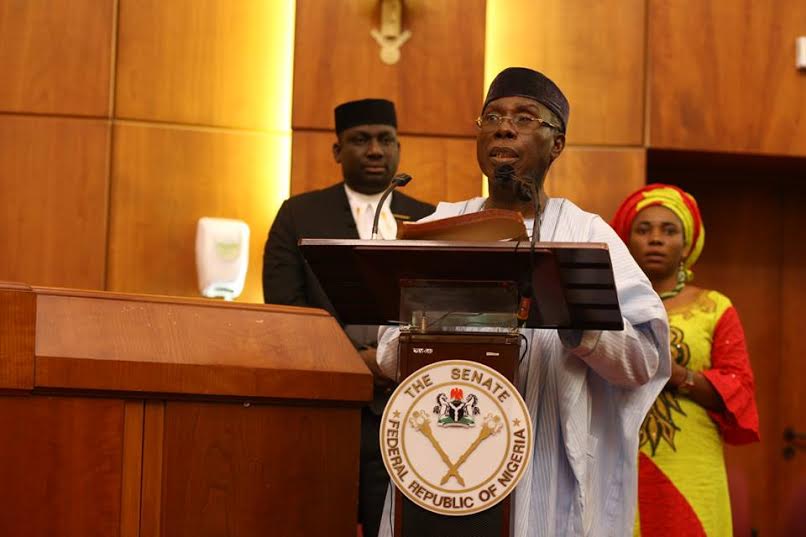
This charge was given last Tuesday in Abuja by the Minister of Agriculture and Rural Development, Mr Audu Ogbeh, when he received members of the governing councils of federal universities of agriculture.
Mr Ogbeh noted that it was important for the institutions to be the “food basket” of their “respective host communities.”
While commending the initiative of the schools in Abeokuta and Umudike on this subject matter, the Minister said, “You have huge parcels of land averaging 10,000 ha each. I enjoin you to put them to use.”
He pointed out that “as institutions of agricultural education and research, you can earn huge revenues from agricultural research, seed and seedling development, extension work, soil mapping and even production of food on campus.”
Mr Ogbeh advised the universities to give greater priority to courses with agriculture-related content.
“We do not forbid the teaching of electives like some accounting, business administration and so on, but only as subsidiaries. The main courses must be agriculture, agronomy, botany, animal husbandry, forestry, fishery, plant entomology, breeding, cattle breed improvement, Agric engineering, veterinary medicine,” he insisted.
He further advised that the schools “should be training graduates who should be going straight into production, with credit support from their alma-mater, produce chicken, eggs, goats, milk, set up meat laboratories, bake bread and above all produce and sell large quantities of high quality hybrid seeds.
“Farmers are in desperate need of these services and more. You will make huge profits from innovative agricultural practice.”
The Minister assured lecturers and students engaged in non-agricultural studies in the three universities of agriculture that their careers will not be jeopardized.
According to Mr Ogbeh, “The return of the three universities of agriculture to this Ministry is a rational, just and timely action, necessitated by the new economic realities we are in, to ensure that our institutions are better focused and more efficiently and economically managed.”
The three federal universities of agriculture, he noted, “were established to advance the cause of agricultural transformation and modernization in Nigeria for the development of core competencies in agricultural education, research and training, amongst others.
“It is therefore, expected that the admission policy of these universities will largely be reflective of this overarching goal.
“Our submission is that, in the long run, the universities will be better served if they focus on their core areas of business rather than on the subsidiaries.”
He expressed the consciousness of government on the “fears and anxieties of teachers and the students already enrolled for these subsidiary programmes.”
Accordingly, he said, “we will not be cancelling them immediately. The task before you is to phase them out gradually.”
He assured the universities that there will be “an important and strategic modification” to the existing faculties of medicine.
“The faculties will now be called Colleges of Nutrition and Medical Sciences.”
If attention is paid to the increasing awareness on the importance of nutrition, he said, “we may not only be drastically reducing our national health bill, but also raising the bar of our currently low life expectancy average.”
The Minister disclosed that “the Federal Ministry of Agriculture and Rural Development has already set in motion a machinery to remodel the three universities under our joint care with a view to transforming them into centres of excellence of global reckoning. In this connection, we shall ensure that the institutional structures already enshrined in the Federal Universities of Agriculture Act cap F22 CFN 2010 for their effective management are put in place without delay.”
Economy
BNB Price Reflects Changing Dynamics in the Digital Asset Market
Economy
NASD Unlisted Security Index Crosses 4,000-point Benchmark Again
By Adedapo Adesanya
The NASD Over-the-Counter (OTC) Securities Exchange achieved a milestone on Friday, April 24, 2026, after five securities on the platform helped with a 1.85 per cent growth.
Data showed that the NASD Unlisted Security Index (NSI) again crossed the 4,000-point benchmark yesterday.
The index chalked up 73.64 points during the trading day to close at 4,052.59 points compared with the preceding session’s 3,978.95 points, while the market capitalisation added N5.38 billion to finish at N2.424 trillion versus Thursday’s closing value of N2.380 trillion.
The price gainers were led by Okitipupa Plc, which grew by N25.00 to sell at N305.00 per share compared with the previous price of N280.00 per share. Central Securities Clearing System (CSCS) Plc gained N6.92 to close at N76.26 per unit versus N69.34 per unit, Afriland Properties Plc appreciated by N1.00 to N17.00 per share from N18.00 per share, FrieslandCampina Wamco Nigeria Plc improved by 55 Kobo to N99.55 per unit from N99.00 per unit, and Food Concepts Plc increased by 5 Kobo to N2.70 per share from N2.65 per share.
However, there was a price loser, MRS Oil, which dipped by N21.75 to N195.75 per unit from N217.50 per unit.
During the final session of the week, the value of securities jumped 75.2 per cent to N41.3 million from N23.6 million units, and the number of deals expanded by 62.9 per cent to 44 deals from 27 deals, while the volume of securities declined marginally by 0.9 per cent to 447,403 units from 451,522 units.
At the close of trades, Great Nigeria Insurance (GNI) Plc was the most traded stock by volume (year-to-date) with 3.4 billion units worth N8.4 billion, trailed by Resourcery Plc with 1.1 billion units valued at N415.7 million, and Infrastructure Guarantee Credit Plc with 400 million units traded for N1.2 billion.
GNI was also the most active stock by value (year-to-date) with 3.4 billion units sold for N8.4 billion, followed by CSCS Plc with 59.6 million units transacted for N4.0 billion, and Okitipupa Plc with 27.8 million units exchanged for N1.9 billion.
Economy
Naira Slips to N1,358/$1 as FX Reserves, Policy Uncertainty Concerns
By Adedapo Adesanya
It was not a good day for the Nigerian Naira in the currency market on Friday, April 24, as its value depreciated against the major foreign currencies at the close of transactions.
In the Nigerian Autonomous Foreign Exchange Market (NAFEX), it lost N4.53 or 0.33 per cent against the United States Dollar yesterday to trade at N1,358.44/$1, in contrast to the N1,353.91/$1 it was exchanged on Thursday.
Equally, the domestic currency slipped against the Pound Sterling in the official market during the session by N8.14 to close at N1,834.02/£1, compared with the previous rate of N1,825.88/£1 and dropped N8.01 against the Euro to sell at N1,590.73/€1 versus N1,582.72/€1.
Also, the Naira depreciated against the US Dollar at the GTBank FX desk on Friday by N4 to quote at N1,370/$1 compared with the previous session’s N1,366/$1, and at the parallel market, it depleted by N5 to settle at N1,380/$1 versus the preceding day’s N1,375/$1.
Data published by the Central Bank of Nigeria (CBN) indicated that NFEM interbank turnover surged to N43.562 million across 68 deals, up from N28.117 million the previous day.
Despite the CBN’s reassurance that the recent drop in external reserves is not worrisome, the market remains unsettled by persistent concerns over liquidity constraints, policy transparency, and weakening confidence in Nigeria’s FX market as gross reserves continue to decline to $48.4 billion.
The outlook for the Dollar appears supported by broader macro risks, including elevated oil prices tied to the tanker traffic disruptions in the Strait of Hormuz and a continued US-Iran standoff over ceasefire negotiations.
A look at the digital currency market showed that investors are sitting on the edge as the US Dollar rebounded amid geopolitical and inflation risks despite continued inflows into US spot bitcoin Exchange Traded Funds (ETFs).
Solana (SOL) rose by 1.2 per cent to sell $86.45, Cardano (ADA) appreciated by 1.1 per cent to $0.2517, Dogecoin (DOGE) grew by 0.9 per cent to $0.0989, Ripple (XRP) improved by 0.3 per cent to $1.43, Ethereum (ETH) soared by 0.2 per cent to $2,316.83, and Binance Coin (BNB) chalked up 0.1 per cent to sell for $637.44.
However, TRON (TRX) depreciated by 1.3 per cent to $0.3235, and Bitcoin (BTC) lost 0.2 per cent to close at $77,562.27, while the US Dollar Tether (USDT) and the US Dollar Coin (USDC) closed flat at $1.00 each.
-
Feature/OPED6 years agoDavos was Different this year
-
Travel/Tourism10 years ago
Lagos Seals Western Lodge Hotel In Ikorodu
-
Showbiz3 years agoEstranged Lover Releases Videos of Empress Njamah Bathing
-
Banking8 years agoSort Codes of GTBank Branches in Nigeria
-
Economy3 years agoSubsidy Removal: CNG at N130 Per Litre Cheaper Than Petrol—IPMAN
-
Banking3 years agoSort Codes of UBA Branches in Nigeria
-
Banking3 years agoFirst Bank Announces Planned Downtime
-
Sports3 years agoHighest Paid Nigerian Footballer – How Much Do Nigerian Footballers Earn