Connect with us

General

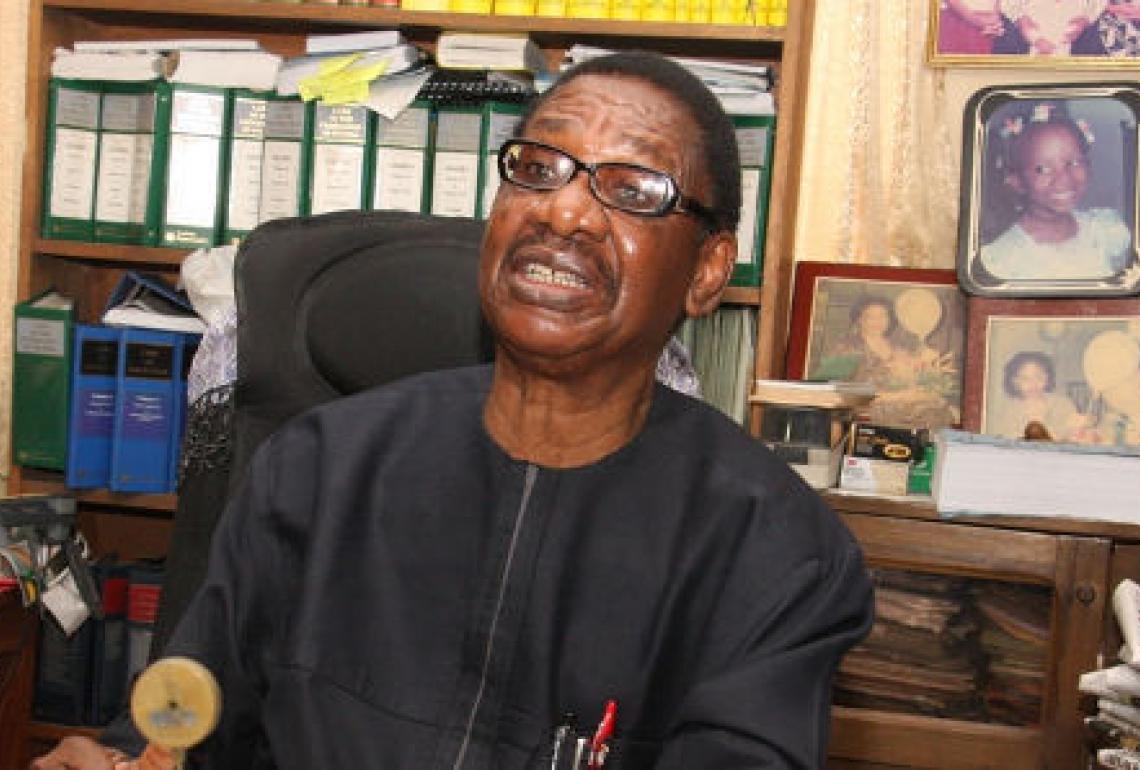
Prof Sagay Behaves Like Tout, Rascal—Senate

Published

on

**Begs Buhari to Tame Him

By Modupe Gbadeyanka

The Nigerian Senate has described legal luminary, Professor Itse Sagay, as someone presenting himself like a rascal.

Chairman, Senate Committee on Media and Public Affairs, Mr Aliyu Sabi Abdullahi, in a statement issued on Thursday, accused Prof Sagay of spreading falsehood and making hate speeches against the National Assembly.

The upper parliament urged President Muhammadu Buhari to rein in the chairman of the Presidential Action Committee on Anti-Corruption (PACAC) and “stop him from further creating needless tension in the relationship between the executive and the legislature.”

The Senate said the former university teacher was fond of using every opportunity he has to make public speeches to disparage the Federal legislature by using uncouth and unprintable words to describe the legislators and the institution they represent.

Mr Abdullahi said in the statement that Mr Sagay had been one of the few divisive elements in the Mr Buhari administration who believe their relevance is enhanced only when they create constant tension between the legislature and the executive while also setting members of the executives against each other.

The Senate spokesman noted that while the legislators had ignored past statements made by the Professor of law, his recent speech at a public lecture in Lagos organized by the Society of International Law where he allegedly gave false details about the salary and allowances of the legislators and the various bills passed bordered on inciting members of the public against the legislators and deliberately circulating hate speech; which the government was working hard to contain.

“Ordinarily, we would ignore Sagay whose statements and attitude present him like a rascal and sadist instead of a former university teacher.

“However, his last speech in Lagos during which he was reeling out false and exaggerated figures about the salaries nod allowances of legislators and also lied about the passage of anti-corruption bills showed that he just deliberately set out to undermine the legislative institution and lower its reputation in the estimation of right thinking members of the society and we therefore believe we should put him in his rightful place.

“As an academic whose creed should be to find facts and make comments based on truth, we believe that Sagay should stop spreading beer parlour rumours about the salaries and allowances of legislators when he could simply get the facts from the Revenue Mobilization and Fiscal Allocation Commission (RMFAC) which is the body constitutionally charged with the responsibility of fixing salaries and allowances of all public officials.

“Let us make it clear that our salaries and allowances are open books and the details can be taken from the RMFAC by any interested party.

“Prof Sagay at his lecture in Lagos also made comparisons which did little credit to his background as a lecturer as he was talking of the salary of the United States President and that of a Nigerian legislator. That is like comparing oranges with apples. Only a senile, jaded, rustic and outdated Professor of Law like Sagay will make such a comparison which falls flat on its face, even to an ordinary lay man. Surely, Sagay is basing his analysis on street talks.

“Sagay could not even check the records before proclaiming that the National Assembly has not passed a single bill for the promotion of anti-corruption war since it commenced business in July 2015.

“First, the 8th National Assembly was inaugurated on June 9, 2015 not July. Also, it is on record that the Senate has passed the Whistle Blowers’ Protection Bill, Witness Protection Bill, Mutual Legal Assistance in Criminal Matters Bill and the Nigerian Financial Intelligence Agency Bill.

“This man talks like a man who is constantly under the influence of some substance and perhaps possessed as he employs the language of a tout with no civility. He is probably constantly excited and incensed by the fact of having his first opportunity to find himself in the corridors of power.

“He pontificates and talks as if the war against corruption of the Buhari administration depends solely on him to survive.

“He once publicly attacked the Attorney General of the Federation and accused him of not doing enough to prosecute the war.

“In the Lagos speech, he took a blanket swipe at the judiciary and rubbished that entire institution which he as a lawyer has the professional, ethical and constitutional duty to respect.

“This is a man who cannot stand for councillorship election and win. We challenge him to state what his contributions are in the election of our amiable President, Muhammadu Buhari and what new ideas he has contributed to making the fight against corruption more effective since his appointment.

“With an easily excited man like him as head of an advisory body, the nation has continued to lose anti-corruption cases in courts due to the failure of his advices. He needs to do more work and talk less because media prosecution cannot win the war on corruption,” Mr Abdullahi stated.


Modupe Gbadeyanka is a fast-rising journalist with Business Post Nigeria. Her passion for journalism is amazing. She is willing to learn more with a view to becoming one of the best pen-pushers in Nigeria. Her role models are the duo of CNN's Richard Quest and Christiane Amanpour.

General

Bill Seeking Creation of Unified Emergency Number Passes Second Reading

Published

on

Unified Emergency Number

By Adedapo Adesanya

Nigeria’s crisis-response bill seeking to establish a single, toll-free, three-digit emergency number for nationwide use passed for second reading in the Senate this week.

Sponsored by Mr Abdulaziz Musa Yar’adua, the proposed legislation aims to replace the country’s chaotic patchwork of emergency lines with a unified code—112—that citizens can dial for police, fire, medical, rescue and other life-threatening situations.

Lawmakers said the reform is urgently needed to address delays, miscommunication and avoidable deaths linked to Nigeria’s fragmented response system amid rising insecurity.

Leading debate, Mr Yar’adua said Nigeria has outgrown the “operational disorder” caused by multiple emergency numbers in Lagos, Abuja, Ogun and other states for ambulance services, police intervention, fire incidents, domestic violence, child abuse and other crises.

He said, “This bill seeks to provide for a nationwide toll-free emergency number that will aid the implementation of a national system of reporting emergencies.

“The presence of multiple emergency numbers in Nigeria has been identified as an impediment to getting accelerated emergency response.”

Mr Yar’adua noted that the reform would bring Nigeria in line with global best practices, citing the United States, United Kingdom and India, countries where a single emergency line has improved coordination, enhanced location tracking and strengthened first responders’ efficiency.

With an estimated 90 per cent of Nigerians owning mobile phones, he said the unified number would significantly widen public access to emergency services.

Under the bill, all calls and text messages would be routed to the nearest public safety answering point or control room.

He urged the Senate to fast-track the bill’s passage, stressing the need for close collaboration with the Nigerian Communications Commission (NCC), relevant agencies and telecom operators to ensure nationwide coverage.

Senator Ali Ndume described the reform as “timely and very, very important,” warning that the absence of a reliable reporting channel has worsened Nigeria’s security vulnerabilities.

“One of the challenges we are having during this heightened insecurity is lack of proper or effective communication with the affected agencies,” Ndume said.

“If we do this, we are enhancing and contributing to solving the security challenges and other related criminalities we are facing,” he added.

Also speaking in support, Senator Mohammed Tahir Monguno said a centralised emergency number would remove barriers to citizen reporting and strengthen public involvement in security management.

He said, “Our security community is always calling on the general public to report what they see.

“There is a need for government to create an avenue where the public can report what they see without any hindrance. The bill would give strength and muscular expression to national calls for vigilance.”

The bill was referred to the Senate Committee on Communications for further legislative work and is expected to be returned for final consideration within four weeks.

Continue Reading

General

Tinubu Swears-in Ex-CDS Christopher Musa as Defence Minister

Published

on

ex-cds christopher musa

By Modupe Gbadeyanka

The former chief of defence staff (CDS), Mr Christopher Musa, has been sworn-in as the new Minister of Defence.

The retired General of the Nigerian Army took the oath of office for his new position on Thursday in Abuja.

The Special Adviser to the President on Information and Strategy, Mr Bayo Onanuga, confirmed this development in a post shared on X, formerly Twitter, today.

“General Christopher Musa takes oath of office as Nigeria’s new defence minister,” he wrote on the social media platform this afternoon.

Earlier, President Bola Tinubu thanked the Senate for confirming Mr Musa when he was screened for the post on Wednesday.

“Two days ago, I transmitted the name of General Christopher G. Musa, our immediate past Chief of Defence Staff and a fine gentleman, to the Nigerian Senate for confirmation as the Federal Minister of Defence.

“I want to commend the Nigerian Senate for its expedited confirmation of General Musa yesterday. His appointment comes at a critical juncture in our lives as a Nation,” he also posted on his personal page X on Thursday.

The former military officer is taking over from Mr Badaru Abubakar, who resigned on Sunday on health grounds.

Continue Reading

General

Presidential Directives Helping to Remove Energy Bottlenecks—Verheijen

Published

on

Cut Energy Costs

By Adedapo Adesanya

The Special Adviser to President Bola Tinubu on Energy, Mrs Olu Verheijen, says Presidential Directives 41 and 42 have emerged as the most transformative policy tools reshaping Nigeria’s oil and gas investment landscape in more than a decade, by helping eliminate bottlenecks.

Mrs Verheijen made this assertion while speaking at the Practical Nigerian Content Forum 2025, noting that the directives issued by her principal in May 2025, are specifically designed to eliminate rent-seeking, slash project timelines, reduce contracting costs, and restore investor confidence in the Nigerian upstream sector.

“These directives are not just policy documents; they are enforceable commitments to make Nigeria competitive again,” she declared.

She noted that before the directives were issued, Nigeria faced chronic delays in contracting cycles, which discouraged capital inflows and stalled major upstream projects.

“For years, investment stagnated because our processes were too slow and too expensive. Presidential Directives 41 and 42 are removing those bottlenecks once and for all,” she said.

According to her, the directives have already begun to shift investor sentiment, unlocking billions of dollars in new commitments from international oil companies.

“We are seeing unprecedented investment inflows. Shell, Chevron and others are returning with confidence because they can now see credible timelines and competitive project economics,” Verheijen said.

Speaking on the link between streamlined contracting and local content development, she stressed that the directives were crafted to reinforce, not weaken, Nigerian participation.

“Local content is not an obstacle; it is a catalyst. It helps us meet national objectives, contain costs, and deliver projects faster when applied correctly,” she explained.

Mrs Verheijen highlighted that the directives complement the government’s data-driven approach to refining local content requirements while ensuring Nigerian talent and enterprises remain central to new investments.

“Our goal is to empower Nigerian companies with opportunities that are commercially sound and globally competitive,” she said.

She pointed to the current spike in industry activity, over 60 active drilling rigs, as evidence that the directives are driving real operational change.

“We have moved from rhetoric to results. These directives have triggered a new cycle of upstream development,” she said.

The energy expert added that the reforms are critical to achieving Nigeria’s production ambition of 3 million barrels of oil and 10 billion standard cubic feet (bscf) of gas per day by 2030.

“To meet these targets, we need speed, efficiency, and collaboration across the value chain. The directives are the foundation for that,” she noted.

She also linked the directives to Nigeria’s broader regional ambitions, including its leadership role in the African Energy Bank.

“With a $100 million facility now launched, we are ensuring that investment translates into jobs, technology transfer, and long-term value for Nigeria,” she said.

Mrs Verheijen concluded by urging the industry to uphold the spirit and letter of the presidential instructions.

“These directives are a collective responsibility. Government, operators, financiers, and host communities must work together to deliver the Nigeria we envision,” she said. “We remain committed to ensuring Nigeria remains Africa’s premier investment destination,” she said.

Continue Reading

Trending