Connect with us

Economy

Stocks to Watch out for This Week

Published

on

Stock Market Watch

By Modupe Gbadeyanka

It is a new trading week and investors are looking up for a rewarding period as they expect the five big boys in the banking industry to release their earnings for the first half of 2018.

Last week, the market depreciated as political tensions heighten ahead of the general elections next year.

As at Friday, August 3, 2018, the Nigerian Stock Exchange (NSE) year-to-date returns closed at -4.56 percent, giving some investors something to worry about.

Business Post reports that while Union Diagnostics & Clinical Services gained 50 percent last week to close at 33 kobo per share, International Breweries recorded the highest loss of 17.57 percent to settle at N30.50k per share.

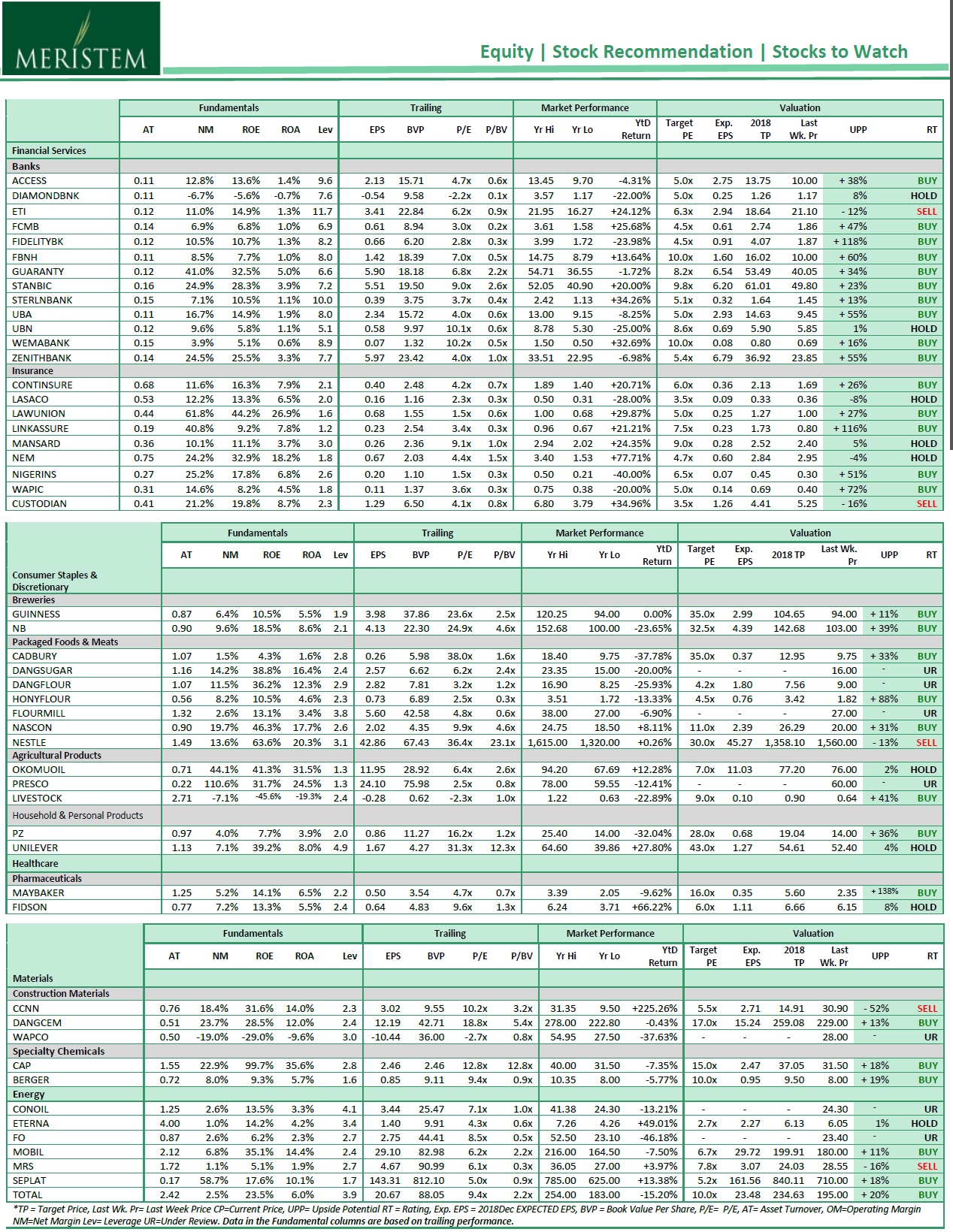
This week, analysts at Meristem Research have released stocks to watch for, which can be viewed in the picture below.
Modupe Gbadeyanka is a fast-rising journalist with Business Post Nigeria. Her passion for journalism is amazing. She is willing to learn more with a view to becoming one of the best pen-pushers in Nigeria. Her role models are the duo of CNN's Richard Quest and Christiane Amanpour.

Economy

Naira Value Weakens to N1,457/$1 at NAFEX

Published

on

Domiciliary Accounts to Naira

By Adedapo Adesanya

The value of the Naira to the US Dollar further weakened in the Nigerian Autonomous Foreign Exchange Market (NAFEX) on Thursday, December 18 amid renewed forex demand pressure.

Data from the Central Bank of Nigeria (CBN) showed that the Nigerian currency lost N2.35 or 0.16 per cent on the greenback to close at N1,457.84/$1 compared with the preceding session’s N1,455.49/$1.

The local currency also moved in the same direction against the Pound Sterling and the Euro in the same market window during the trading session.

It weakened against the British currency by N14.80 to sell for N1,958.03/£1 compared with Wednesday’s closing price of N1,943.28/£1 and tumbled against the European nation’s currency by N5.66 to quote at N1,712.38/€1 versus N1,706.72/€1.

A further N2 was lost by the Naira against the Dollar at the GTBank FX counter yesterday, closing at N1,465/$1 versus the N1,463/$1 it was traded a day earlier, while at the black market, it remained unchanged at N1,475/$1.

FX supply from the central bank, exporters, foreign portfolio investors and non-bank corporate channels remained insufficient to redirect the exchange rate.

Expectations of inflows from Detty December to alleviate need for FX demand have not materialised, as exorbitant local prices seems to be keeping spending at bay.

Despite the depreciation, the Naira outlook remains stable around the trading range even though the local currency has continued to give up early gain.

Meanwhile, the crypto market was down on Thursday due to profit-taking, with about $550 million in liquidations over the past 24 hours on derivatives markets, CoinGlass data shows, flushing out both short and long leveraged trading positions.

Cardano (ADA) gave up 4.3 per cent to sell for $0.35o6, Dogecoin (DOGE) lost 3.9 per cent to trade at $0.1220, Ripple (XRP) depreciated by 3.5 per cent to $1.79, and Solana (SOL) recorded a decline of 3.2 per cent to finish at $119.39.

In addition, Litecoin (LTC) slumped by 2.4 per cent to $74.13, Binance Coin (BNB) fell by 1.5 per cent to $830.55, Bitcoin (BTC) shrank by 0.8 per cent to $85,397.31, and Ethereum (ETH) went down by 0.3 per cent to $2,823.50, while the US Dollar Tether (USDT) and the US Dollar Coin (USDC) remained unchanged at $1.00 each.

Continue Reading

Economy

Oil Prices Rise Despite Mounting Supply Risks

Published

on

oil prices driving up Trump

By Adedapo Adesanya

Oil prices edged marginally higher on Thursday as investors assessed the likelihood of further US sanctions against Russia and the supply risks posed by a blockade of Venezuelan oil tankers.

Brent crude was up 36 cents or 0.6 per cent to $60.04 per barrel  and the US West Texas Intermediate (WTI) crude climbed 52 cents or 0.9 per cent to $56.46 per barrel.

Market analysts noted that crude futures are trying to find support from the Venezuelan oil export blockade, which if it continues will likely cause production in the area to be shut in with no destinations to ship out to.

Bloomberg reported citing unnamed sources that the oil producing nation may be forced to start shutting in oil production as it runs out of storage space amid the US tanker blockade.

According to the sources, the biggest oil storage hub and tankers at Venezuelan ports could fill up within 10 days, prompting production curbs.

Earlier this week, Reuters reported that some 11 million barrels of Venezuelan crude were stuck at sea amid the US escalation, prompting deeper discounts and demands from buyers for changes in the spot contracts, under which the oil was being sold.

The Venezuela blockade could affect 600,000 barrels per day of Venezuelan oil exports, mostly to China, but 160,000 barrels per day of exports to the US would likely continue, ING said. Venezuelan crude makes up around 1 per cent of global supplies.

Meanwhile, the US is preparing another round of sanctions on Russia’s energy sector in the event it does not agree to a peace deal with Ukraine.

Britain imposed sanctions on 24 individuals and entities as part of its Russia sanctions regime, including on Russian oil companies Tatneft and Russneft, a government notice showed on Thursday.

Further measures targeting Russian oil could pose a greater supply risk to the market than President Donald Trump’s announcement on Tuesday that the US would blockade tankers under sanctions entering and leaving Venezuela, ING analysts said in a note.

Oil prices will remain under pressure next year amid persistent concerns about a large oil glut in early 2026.

Continue Reading

Economy

Lekki Deep Sea Port Reaches 50% Designed Operational Capacity

Published

on

Lekki Deep Sea Port

By Adedapo Adesanya

The Managing Director of Lekki Port LFTZ Enterprise Limited, Mr Wang Qiang, says the port has reached half of its designed operational capacity, with steady growth in container throughput since September 2025, reflecting increasing confidence by shipping lines and cargo owners in Nigeria’s first deep seaport.

“We already reached 50 per cent of our capacity now, almost 50 per cent of the port capacity.

“There is consistent improvement in the number of 20ft equivalent units (TEUs) handled monthly,” he said.

Mr Qiang explained further that efficient multimodal connectivity remains critical to sustaining and accelerating growth at the port.

According to him, barge operations have become an important evacuation channel and currently account for about 10 per cent of cargo movement from the port.

Mr Qiang mentioned that the ongoing Lagos–Calabar Coastal Road project would help ease congestion and improve access to the port.

He said that rail connectivity remained essential, particularly given the scale of industrial activities emerging within the Lekki corridor.

He said that Nigeria Government was concerned about the cargoes moving through rail and that the development would enhance more cargoes distribution outside the port.

Mr Qiang reiterated that Lekki port was a fully automated terminal, noting that delays may persist until all stakeholders, including government agencies, fully aligned with end-to-end digital processes.

He explained that customs procedures, particularly physical cargo examinations, and other port services should be fully digitalised to significantly reduce cargo dwell time.

“We must work together very closely with customers and all categories of operations for automation to yield results.

“Integration between the customs system, the terminal operating system and customers is already part of an agreed implementation schedule.

“For automation to work efficiently, all players must be ready — customers, government and every stakeholder. Only then can we have a fantastic system,” Mr Qiang said.

He also stressed that improved connectivity would allow the port to effectively double capacity through performance optimisation without expanding its physical footprint.

Continue Reading

Trending