General
Corporate Governance Society Inducts Polaris Bank Chairman
By Dipo Olowookere
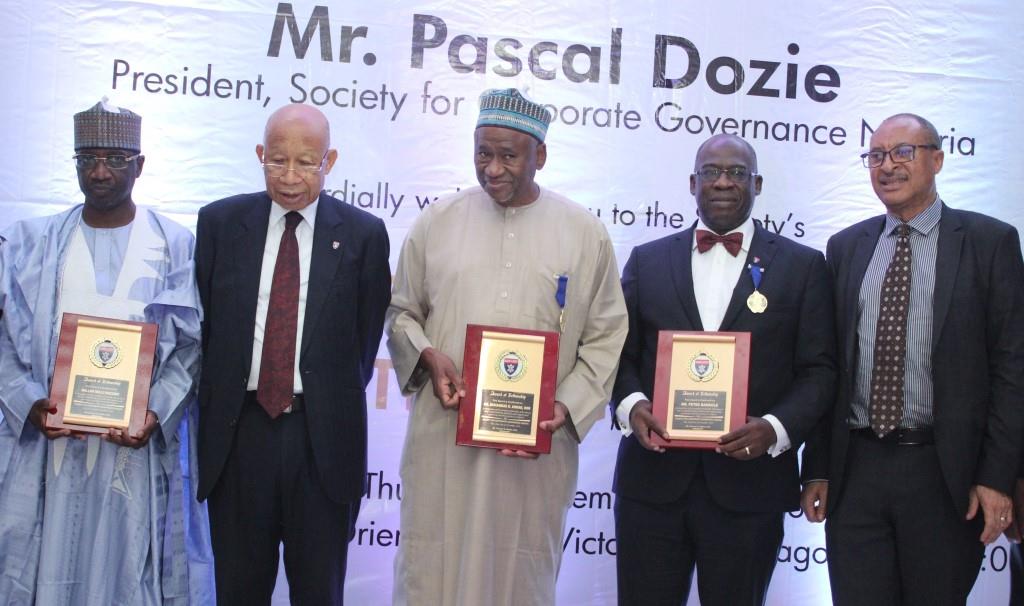
Chairman of Board of Directors of Polaris Bank Limited, Mr Muhammad Ahmad, has been inducted as an honorary fell of the Society for Corporate Governance Nigeria (SCGN).
Mr Ahmad was honoured in recognition of his unblemished professional records in the public and private sectors as well as positive contributions to the socio-economic development of Nigeria, the body said.
During the 2018 President’s Dinner/Induction Ceremony of SCGN held in Lagos recently, the Polaris Bank chairman was described as an astute professional with impressive footprints across various public-sector organisations and financial services institutions where he played strategic roles and acted as the catalyst for the entrenchment of good corporate governance.
Speaking at the ceremony, President of SCGN, Mr Pascal Dozie, said the conferment of the honorary fellowship on Mr Ahmad and three other recipients was in line with the key objective of the body.
“The Society is a registered, not for profit organisation and is committed to the development of corporate governance and best practices. Leadership, accountability, collaboration, diversity and quality, integrity of character remain the pillar of this organisation. Since its inception 13 years ago, the Society has contributed to the development of good corporate governance in this country. The society prides itself in research work some of which have been published in the journal of corporate governance”, he said.
Responding on behalf of the other fellows, Chairman of Polaris Bank expressed delight at the recognition and said they would continue to remain the ambassadors of professional excellence.
“For every society, there are professional standards. And professional standards worldwide are more onerous. Therefore, for us, we are taking additional responsibility. Having been made fellows, what it means is that we should be consistent; we should ensure that whatever the Society for Corporate Governance Nigeria stands for, we should stand for as well”, he affirmed.
Commenting, Group Managing Director/CEO of Polaris Bank, Mr Tokunbo Abiru, said the award was a celebration of the exemplary leadership capabilities of the Polaris Bank’s Chairman.
“On behalf of the management and staff of Polaris Bank, I congratulate our amiable chairman on this well-deserved honour and recognition by the highly respected Society for Corporate Governance Nigeria. Under Ahmad’s leadership, we see a rewarding, bright future for our bank”, he said.
A man of many great accomplishments, Ahmad boasts about 35 years distinguished professional experience leading and working in various public-sector organisations and financial services institutions in Nigeria.
Amongst others, he was the pioneer Director General/Chief Executive Officer of the National Pension Commission, and also a pioneer staff of the Nigeria Deposit Insurance Corporation (NDIC), where he rose through the ranks to become the Managing Director.
He has served on the boards of various corporate and not-for-profit organisations including a Non-Executive Director of FBN Holdings Plc until 2017. He has also served on various presidential committees including a member of the Presidential Committee for the North East Intervention (PCNI).
Mr Ahmad holds a Masters Diploma in Innovation and Strategy from the University of Oxford and has also attended courses and programmes in various first-rate business and management schools, including Harvard Business School, IMD and INSEAD. Ahmad is a recipient of the Nigeria national honour – Officer of the Order of the Niger (OON).
General
Terra Raises Additional $18m to Extend Seed Funds to $52m
By Adedapo Adesanya
Terra Industries, a Nigerian defence technology startup, has raised an additional $18 million, extending its seed round for the second time this year and bringing the total funding it has raised to $51.75 million.
The latest extension follows two funding announcements earlier in 2026. In January, Terra Industries announced an $11.75 million round before raising a further $22 million in February.
Existing investors 8VC and Nova Global participated in both rounds, signalling continued confidence in the company’s strategy and growth prospects.
The latest $18 million extension includes participation from existing investors 8VC, Nova Global, Silent Ventures, Belief Capital, and SV Angel. It also brings two new investors into the company: Norleo Space Investments and angel investor, Mr Grant Gordon.
The company is expected to use all the new funding to scale its manufacturing capacity in Africa and build out its presence abroad.
Part of the expansion plans is to open its first European office in London, the United Kingdom.
In April, Terra also announced its first manufacturing facility outside of Nigeria, a 34,000-square-foot factory in Ghana called Pax-2, which will be Africa’s largest drone factory and where the startup expects to produce 50,000 autonomous systems annually once it’s fully operational in 2028.
Since it was founded in 2024 by Mr Nathan Nwachuku and Mr Maxwell Maduka, who were just 21 and 23, respectively, at the time, Terra has moved fast to roll out a wide range of autonomous systems on their way to building stronger Africa defense systems. So far, some of these techs include Archer: a VTOL drone with a 1,000km range, 13 hours of endurance, a 9-pound payload capacity, and a 26-foot wingspan, as well as Kallon, a solar-powered sentry tower with AI-enabled edge processing and a whole bunch of sensors to detect and track threats several kilometres away.
Others include Iroko, a small quadcopter drone for ISR or one-way attacks; and Kama, a new interceptor drone with a top speed of 300km/h among others.
Valued at over $100 million, Terra also aims to strengthen local sourcing of raw materials, reduce dependence on imports, and enhance domestic industrial capacity and strategic autonomy for Africa.
General
Product Pivots Should Reopen Every Guest Post Brief
Product teams change direction faster than guest-post campaigns close. A homepage can move to a new buyer, retire a feature, or replace its main promise while a publisher is still waiting on a draft. At that point, a Guest Post built from the old brief may contain accurate sentences about a product the company no longer wants to sell. The link can go live and still be wrong.

One BestLinks AI beta customer described changing product direction during the campaign and needing resources picked again. The team adjusted the plan, which exposes an important operating rule: a pivot must reopen upstream choices. Editing a brand name in the last paragraph cannot repair a competitor set, host shortlist, article angle, and target page chosen for the previous product.
The Old Brief Keeps Spending After A Pivot
A campaign brief behaves like a set of instructions. It names the domain, competitors, product claims, target page, anchors, and the audience the company wants to reach. Buyers often treat it as a static form. The publishing queue keeps using those instructions until someone stops it.
That creates a quiet failure after a pivot. The placement fee still buys a real page. The writer still produces a readable article. The publisher may approve it. Yet the page points readers toward an old positioning decision and teaches search engines an association the product team has abandoned. Finance sees a completed order while the growth lead sees rework.
The visible warning is a sentence nobody can approve without adding, “That used to be true.” Treat that sentence as a stop signal. If the product owner could not defend the draft in a current demo, the article should never clear editorial review, even when every link and heading is technically correct.
Find Claims That Belong To Yesterday
Search the queued draft for product category, buyer role, core action, pricing language, and outcome promises. Compare each item with the current homepage and the product screen it describes. A mismatch does not always require a full rewrite, but it always requires an owner. Unowned mismatches survive because every team assumes another person checked them.
Reopen Inputs Before Editing Any Draft
BestLinks AI begins with the buyer’s domain and competitors, then mines candidate publishers from existing and competitor backlink neighborhoods in Ahrefs. A pivot can change both inputs. A tool that moves from consumer photo editing to retail catalog production should not keep benchmarking itself against hobby apps or buying hosts that speak only to casual creators.
Reopening the inputs means more than sending a new tagline. The campaign owner should replace competitors that no longer represent the market, confirm the landing page, mark claims that have changed, and state whether previously approved hosts still fit. The managed team can then rework the shortlist from the new neighborhood rather than forcing the old list to carry a new strategy.
- Freeze unpublished drafts and pending host approvals.
- Write the old position and new position in one sentence each.
- Replace competitors, target page, anchors, and forbidden claims where needed.
- Restart host approval before any writer revises prose.
The order matters. If a writer revises first, the team can spend an afternoon polishing a draft for a host the new product would never choose. Rework belongs after the strategic inputs pass.
Use One Change Ticket Per Decision
A compact change ticket should show the old claim, new claim, affected target page, affected competitors, and which host rows need another decision. Do not bury the change inside a long channel thread. A clean ticket lets the writer, buyer, and publisher coordinator work from the same current state without guessing which message superseded which.
Host Fit Must Survive The New Buyer
The first shortlist was not necessarily bad. It answered an earlier question. After a pivot, each host must answer the new question: does this publication already speak to the buyer and problem the product now serves? DR, traffic, and price remain useful only after that editorial test passes.

| Change | Keep the host when | Reopen the row when |
|---|---|---|
| New homepage wording | The buyer and use case stay the same | The article premise depends on the retired promise |
| New target customer | The host already covers both audiences | The host’s readership belongs to the old segment |
| New product category | The publication has a natural adjacent section | The placement would read like an unrelated advertisement |
| New target URL | The approved angle still leads to that page | The anchor now interrupts the article’s meaning |
A host that fails the new buyer test should be discarded from this campaign, even if the purchase looked attractive before the pivot. Keeping it to avoid a sunk cost often creates a second cost: an article the company will not share and a backlink that reinforces the wrong topic.
Make The Product Owner Approve Again
Final host choice remains with the client in the published BestLinks AI process. Use that ownership again after a pivot. The person who approved the old list may lack authority over the new market, so name the current product owner in the dedicated channel and require a fresh decision. Silence should not count as approval.
Rewrite Claims From Current Product Actions
Once the host survives, the writer needs a current product path. The service says humans use the client’s product and competitors before writing a separate English article for each chosen site. After a pivot, that hands-on step has to start again around the new job. Old notes can preserve terminology, but they cannot serve as proof of the new experience.
A revised Guest Post Service brief should connect each important claim to a screen, action, output, or written rule that exists now. If the new positioning promises team review, the writer needs to see the review action. If the product dropped a consumer mode, the article should not preserve it as a casual example because the paragraph reads well.
This check catches the most expensive kind of stale copy: a sentence that remains plausible. Obvious errors get corrected. Plausible old claims pass through editing and reach a live page, where sales or support discovers them. A public correction then costs more than a fresh draft because a publisher must reopen work that everyone marked complete.
Approve Facts Before Restoring The Voice
Review the factual spine first: buyer, problem, product action, result, target page, and anchor sentence. Style comes second. A fluent article with one retired promise fails the campaign. A plain draft with correct current facts can still be shaped for the host without misleading anyone.
Restart Publishing With A Small Safe Queue
The official process publishes sites one by one. That sequence becomes useful change control after a pivot. Restart with one approved host and inspect the live page before releasing the rest. Check the target, anchor, product category, and current claim language in the published version. A clean first page does not guarantee every later page, but it confirms that the revised instructions survived one full handoff.
Keep the old and new campaign states separate. The shared record should show which rows were frozen, which hosts were retained, which drafts were replaced, and which live URLs belong to the new direction. Without that split, reporting mixes old-position links with new-position work and turns campaign analysis into guesswork.
BestLinks AI continues monitoring live links and can handle broken-link repair, while the client marks indexing in Google Search Console. Neither task should erase the pivot label. A healthy indexed URL can still represent the old product. Status needs both technical health and strategic version.

Give One Person Authority To Restart
A managed campaign can absorb a product pivot when someone has clear authority to freeze and restart it. That person does not need to write every article or inspect every backlink. The job is to declare that the old brief is closed, approve the new inputs, and release work in a controlled order.
BestLinks AI fits teams that want help reselecting resources, rewriting per host, publishing, and tracking, but the provider cannot decide what the new product means. The client must supply that decision. If the company has not settled its buyer or landing page, keep the queue frozen and spend the next hour inside the product discussion rather than inside publisher rows.
A pivot already creates uncertainty. Guest-post operations should not multiply it. Reopen the brief, reapprove the hosts, and let the first new live page prove that the campaign is serving the product that exists today.
General
Blasphemy: Group Renews Call for Probe, Prosecution in Deborah Yakubu’s Demise
By Adedapo Adesanya
The National Coalition Against Mass Killings, Extra-Judicial Killings, Mob Actions and Impunity (NCAMKI) has renewed its call for the investigation and prosecution of those responsible for the death of Miss Deborah Samuel Yakubu at Shehu Shagari College of Education, Sokoto.
Miss Deborah, a 200-level student of the institution, was slain on May 12, 2022, after she was accused of blasphemy. The incident occurred within the school premises and was captured on video, with footage of the killing subsequently circulated widely.
In a statement signed by Mr Tunde Agunbiade on behalf of NCAMKI, the coalition questioned why the case had not led to the prosecution of the alleged principal perpetrators despite the availability of video evidence.
Two suspects, Mr Bilyaminu Aliyu and Mr Aminu Hukunci, were arrested and arraigned before a Sokoto Chief Magistrate’s Court in May 2022 over their alleged involvement in the incident. They were reportedly charged with criminal conspiracy and inciting public disturbance.
However, the case was later struck out and the two suspects discharged after the prosecution failed to diligently pursue the matter. Reports on the proceedings said the prosecution was absent from court, prompting the Chief Magistrate to strike out the case.
The Sokoto State Police Command also said in May 2023 that it was still pursuing some prime suspects allegedly involved in Deborah’s killing.
Against this backdrop, NCAMKI called on the Nigeria Police Force, Sokoto State Government, Ministry of Justice and other relevant authorities to provide a comprehensive update on the status of the investigation.
The coalition demanded clarification on the identities and status of all suspects and persons of interest, an explanation for the collapse of the prosecution against the two arraigned suspects, and details of whether other suspects identified during investigations had been arrested, prosecuted or cleared.
It further called for the preservation and forensic examination of video and other digital evidence connected to the killing.
NCAMKI maintained that an allegation of blasphemy, or any other offence, does not give individuals or mobs the authority to impose punishment outside the law.
It warned that failure to prosecute perpetrators of mob killings could erode public confidence in the justice system and encourage further acts of mob violence.
The coalition said the deceased’s family deserved more than condolences, stressing that her death should not become merely an anniversary issue.
“Condolences cannot replace justice. Outrage cannot replace prosecution. Arrests cannot replace conviction, and four years cannot erase a crime,” the statement said.
NCAMKI urged the authorities to determine what further investigative and prosecutorial steps remain possible and to hold accountable any official whose failure, neglect or obstruction contributed to the collapse of the case.
The coalition also appealed to the authorities and Nigerians not to turn Miss Yakubu’s killing into a religious confrontation, insisting that the matter should be treated as an issue of human rights, the rule of law and accountability.
It said the central question remained whether a person could be publicly killed by a mob and the perpetrators subsequently escape the reach of the law.
NCAMKI l, therefore l, urged the government to ensure that the victim’s case was not forgotten and that every person found responsible was brought before a competent court to face the law.