Connect with us

Banking

EcobankPay Zone Enters South East Market in Grand Style

Published

on

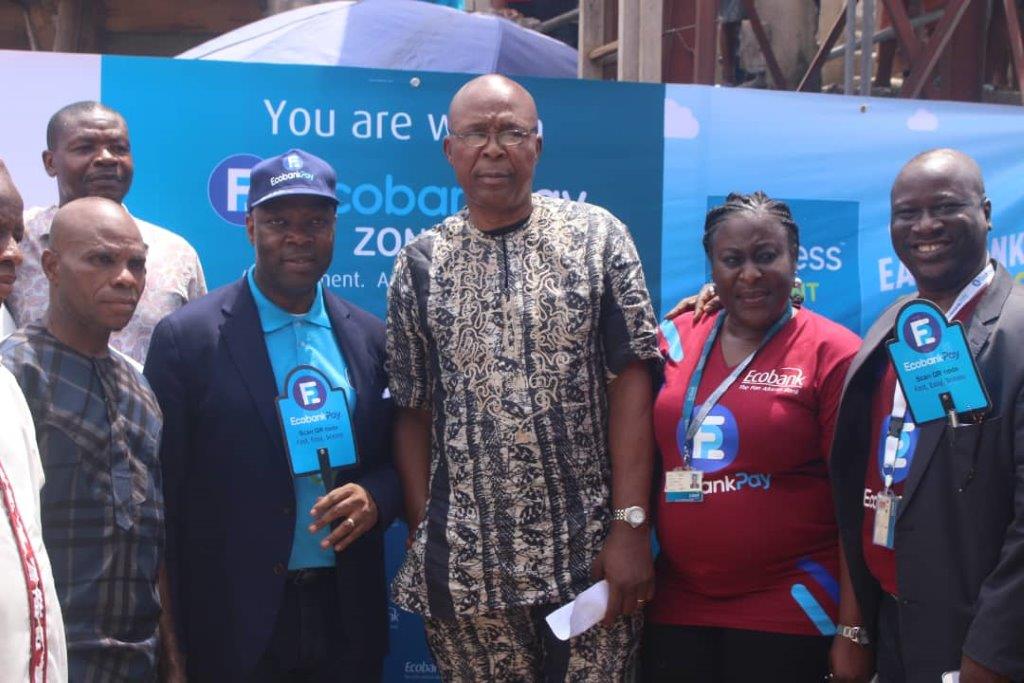
Ecobank Nigeria has taken its digital product, EcobankPay Zone to the South East market with a launch at the popular Ariaria Market, Aba.

Managing Director, Ecobank Nigeria, Patrick Akinwuntan while launching the product at the market said it will facilitate easy, secure and convenient transactions for merchants within Ariaria and other surrounding markets. The EcobankPay Zone is a digital payment hub enabling businesses within a location adopt Ecobank’s wide range of digital products for ease of payments for goods and services.

“It is our determination to create ease of payment and boost economic activities most especially in a town like Aba, renowned for indigenous production of shoes and textiles. Our digital offering will be an opportunity for both buyers and sellers to increase their sales in an enhanced and secured way and without fear.

“The EcobankPay digital hub makes it easy for the seller to be paid instantly and buyers pay with ease and also have rest of mind associated with doing business without carrying cash around. Our Xpress point is also around for you to transact with ease, in as much as you have your phone you can bank with Ecobank.

“The initiative of the Ecobankpay zone is to deepen financial inclusion in the communities and specifically aid business transactions between merchants and clients. EcobankPay’s unique offering is that anyone from any bank in Nigeria can pay with MasterPass, mVISA and mCASH with any phone by scanning QR code or using USSD”.

“If the person that wishes to buy goods from you is coming from a bank that has mVisa and wishes to pay, the same QRcode would accept an mVisa payment and vice versa. That creates synergy between us and the other banks and convenience for the merchants. And as you know, the QRcode is much cheaper than having a point of sale (PoS),” he said.

Mr Akinwuntan made an example of how the EcobankPay works by buying a pair of shoes from one of the Aba traders and make payment through QR scan and the seller received alert instantly.

EcobankPay is a fresh innovative payment solution that enhances transactions between merchants and their customers by eliminating risk of payment rejection and also delivers same day value and sales transparency for merchants. This is unlike the traditional ways that payments are made using cards on PoS where merchant, the small business person, the trader, the supermarket owner, the distributor that is holding a POS needs to wait for at least one day to get the value of the payment. EcobankPay enables the merchant receive credit instantly. This is very important for working capital particularly for small businesses.

Ecobankpay enables easy tracking of customers business profiling for quick access to credit, save faster, reduces the risk of security in terms of exposure to cash or exposure to pilfering of merchant’s credentials. The beauty of the Ecobankpay is in the cost of setting up as the shop owner simply print the QR code on a paper and can stick it anywhere and do not run any risks”.


Dipo Olowookere is a journalist based in Nigeria that has passion for reporting business news stories. At his leisure time, he watches football and supports 3SC of Ibadan. Mr Olowookere can be reached via [email protected]

Advertisement
Click to comment

Leave a Reply

Your email address will not be published. Required fields are marked *

Banking

All Set for Second HerFidelity Apprenticeship Programme

Published

on

HerFidelity Apprenticeship Programme

By Modupe Gbadeyanka

Registration for the second HerFidelity Apprenticeship Programme (HAP 2.0) organised by Fidelity Bank Plc has commenced.

The Divisional Head of Product Development at Fidelity Bank, Mr Osita Ede, informed newsmen that the initiative was designed to empower women with sustainable entrepreneurship skills.

The lender created the flagship women-empowerment initiative to equip women with practical, income‑generating skills and structured pathways to entrepreneurship.

“HerFidelity Apprenticeship Programme 2.0 reflects our commitment to continuous improvement. Having evaluated feedback from the first edition, we have returned with stronger partnerships and deeper mentorship programmes to ensure that women acquire not just skills, but sustainable economic opportunities,” he said.

“At the heart of the programme is guided, real‑world learning. Participants will undergo intensive apprenticeship training under reputable institutions and industry experts across select fields such as hair styling, shoe making, auto mechatronics, and interior decoration,” Mr Ede added.

He noted that HerFidelity Apprenticeship Programme 2.0 goes beyond skills acquisition by offering participants a wide range of business advisory services. These include business and financial literacy training, mentorship support throughout the apprenticeship journey, access to Fidelity Bank’s women‑focused and SME financial solutions, as well as guidance on business formalisation and growth strategies.

Further emphasising the bank’s vision, Mr Ede said, “By integrating structured mentorship with entrepreneurial development, Fidelity Bank is positioning women not just as trainees, but as future employers, innovators, and economic contributors within their communities. This aligns with our mandate to help individuals grow, businesses thrive, and economies prosper.”

Continue Reading

Banking

The Alternative Bank Opens New Branch in Ondo

Published

on

Alternative Bank

By Modupe Gbadeyanka

A new branch of The Alternative Bank (AltBank) has been opened in Ondo State as part of the expansion drive of the financial institution.

A statement from the company disclosed that the new branch would support export-oriented agribusinesses through Letters of Credit and commodity-backed trade finance, ensuring that local producers can scale beyond state borders.

For SMEs, the bank is introducing robust payment rails, asset financing for equipment and inventory, and supply chain-backed facilities that strengthen working capital without trapping businesses in interest-based debt cycles.

The Governor of Ondo State, Mr Lucky Aiyedatiwa, represented by his Chief of

Staff, Mr Olusegun Omojuwa, at the commissioning of the branch, underscored the importance of financial institutions in economic development.

“The pivotal role of financial institutions to economic growth and development of any economy cannot be overemphasised. It provides access to capital, supporting small and medium-scale enterprises and encouraging savings.

“Therefore, I have no doubt in my mind that the presence of The Alternative Bank in Ondo State will deepen financial services, create employment opportunities and stimulate economic activities across various sectors,” he said.

In her remarks, the Executive Director for Commercial and Institutional Banking (Lagos and South West) at The Alternative Bank, Mrs Korede Demola-Adeniyi, commended the state government’s leadership and outlined the lender’s long-term vision for Ondo State.

“As Ondo State steps into its next fifty years, and into the future anchored on the sustainable development championed during the recent anniversary celebrations, The Alternative Bank is here to be the financial engine for that vision. We didn’t come to Akure to hang banners. We came to fund work, farms, shops, and factories.”

With Ondo State’s economy anchored largely on agriculture, particularly cocoa production, poultry farming, and other cash crops, alongside a growing SME and trade ecosystem, AltBank is deploying sector-specific financing solutions tailored to these strengths.

For cocoa aggregators, processors and poultry operators, the bank will provide production financing, facility expansion support, machinery lease structures, and structured trade facilities under its joint venture and cost-plus financing models, with transaction cycles of up to 180 days for commodity trades and longer-term structured asset financing for equipment and infrastructure.

The organisation is a notable national non-interest bank with a physical network now surpassing 170 locations, deploying capital to solve real-world challenges through initiatives such as the Mata Zalla project, which saw to the training of hundreds of women as electric tricycle drivers and mechanics.

Continue Reading

Banking

Recapitalisation: 20 Nigerian Banks Now Fully Compliant—Cardoso

Published

on

Nigerian Banks

By Adedapo Adesanya

The Governor of the Central Bank of Nigeria (CBN), Mr Yemi Cardoso, announced on Tuesday that the country’s banking sector is making strong progress in the recapitalisation drive, with 20 banks now fully compliant.

Mr Cardoso disclosed this during a press conference at the first Monetary Policy Committee (MPC) meeting of 2026, where he also highlighted positive developments in the nation’s foreign reserves.

On March 28, 2024, the apex bank announced an increase in the minimum capital requirements for commercial banks with international licences to N500 billion.

National and regional financial institutions’ capital bases were pegged at N200 billion and N50 billion, respectively.

Also, CBN raised the merchant bank minimum capital requirement to N50 billion for national licence holders.

The banking regulator said the new capital base for national and regional non-interest banks is N20 billion and N10 billion, respectively.

To meet the minimum capital requirements, CBN advised banks to consider the injection of “fresh equity capital through private placements, rights issue and/or offer for subscription”.

Following the development, several banks announced plans to raise funds through share and bond issuances.

In January, Zenith Bank said it had raised N350.46 billion through rights issue and public offer to meet the CBN minimum capital requirement.

Guaranty Trust Holding Company Plc (GTCO), on July 4, said it had successfully priced its fully marketed offering on the London Stock Exchange (LSE).

In September, the CBN governor said 14 banks fully met their recapitalisation requirements — up from eight banks in July.

With one month to the central bank’s March 31, 2026, recapitalisation deadline, 13 Nigerian lenders are yet to cross the finish line.

Additionally, the governor noted that 33 banks have raised funds as part of the ongoing recapitalisation exercise, signalling robust capital mobilisation across the sector.

He stated that gross foreign reserves have climbed to a 13-year high of $50.4 billion as of mid-February 2026.

Continue Reading

Trending