Economy
Nigerians to Expect Tougher Economic Hardship in 2021—Iginla
By Modupe Gbadeyanka
The year 2020 was not good for Nigerians economic-wise as a result of the COVID-19 pandemic but their hopes for a better year in 2021 may have been dashed.
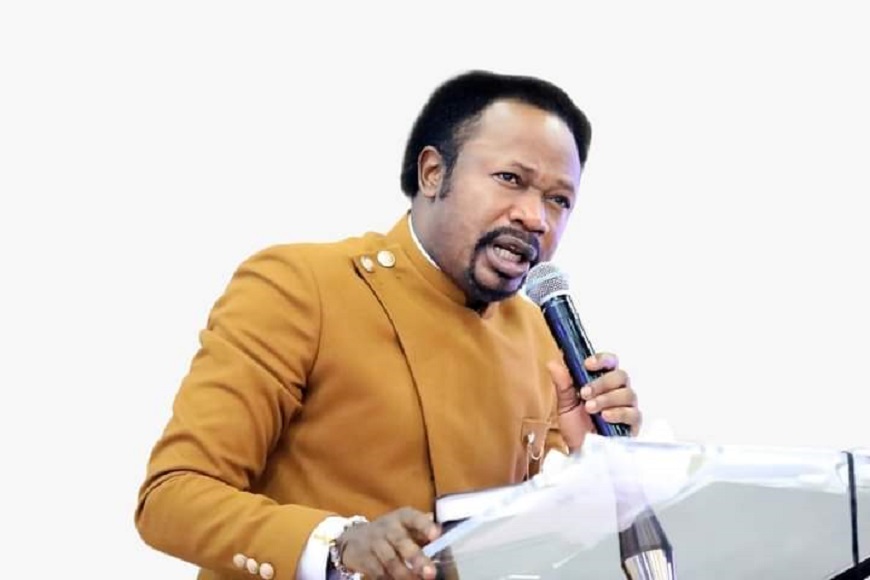
This is because Prophet Joshua Iginla, the senior pastor of Champions Royal Assembly, Abuja, has prophesied that Nigeria will witness a tougher economic hardship in the year.
In his 34 revelations for the year released on New Year eve, the cleric noted that the government will shut down the economy for a second time because of Coronavirus.
In the second quarter of 2020, the federal government imposed a lockdown in Lagos, Abuja and Ogun State in order to control the spread of the virus.
This action caused many Nigerians to lose their jobs and some of them are yet to recover from the lockdown, putting them through untold hardship.
But Mr Iginla has said more will occur this year, though he said “those of you who know your God will be strong and do exploits,” noting that “this year will be better than last year.”
He, however, warned that COVID-19 was not over yet. “We will continue to see its wave. We are not through with it yet. It will take another dimension; be it real, political or scientifically.”
The man of God urged top individuals and wealthy people to “be prayerful” because he sees “a lot of kidnappings [increasing] this year [and] it will be in [a] different form,” noting that “crime rate will increase,” but assured that “the good Lord will keep his own.”
Speaking further, Mr Iginla said, “I see a Governor in Nigeria who needs prayers so that between 2021 and 2023, he should still be there. I don’t know whether it’s sickness, impeachment or death, but I saw that his seat was empty and another person [took] over his stool.”
In his prophecy on the Biafra agitation, the prophet said it will wax very stronger this, asking the government to be careful to avert a massacre.
He also urged the leader of Biafra, Mr Nnamdi Kanu, to be careful of people around him who may sell him out for a huge amount of money.
Economy
Nigeria Saved N15.8trn from Petrol Subsidy Removal—Oyedele
By Adedapo Adesanya
The Minister of Finance and Coordinating Minister of the Economy, Mr Taiwo Oyedele, said the removal of petrol subsidy saved Nigeria N15.8 trillion between June 2023 and December 2025.
Mr Oyedele disclosed this on Wednesday at a press conference, where he provided a breakdown of the financial impact of the federal government’s economic reforms under President Bola Tinubu, the same day that the campaign for the 2027 presidential elections commenced.
He said the subsidy savings were reflected in the resources available to the federation, although they did not appear as a separate credit to the federation account under the description “subsidy savings”.
“Between June 2023 and December 2025, subsidy savings mobilised the sum of N15.8 trillion in resources for the federation.
“Many people will say, where is the subsidy savings? As a matter of fact, there wasn’t any alert to the Federation Account with the description ‘subsidy savings’,” Mr Oyedele said.
According to the minister, the federal government received N5.4 trillion of the N15.8 trillion, while N10.4 trillion was shared among state and local governments through the Federation Account.
Mr Oyedele said the government’s overall financial position during the period also reflected increased independent revenue and borrowing to fund its expenditure.
He said the federal government generated N3.1 trillion in incremental independent revenue, largely from remittances by government-owned entities and increased surpluses from government agencies.
The government also borrowed an additional N11.9 trillion between June 2023 and December 2025.
“People will say, you said you have exceeded your revenue, why are you still borrowing?” Mr Oyedele said, “The additional borrowing that the federal government took for that period of time, June 2023 to December 2025, amounted to N11.9 trillion.”
According to him, the combination of incremental independent revenue and additional borrowing brought the Federal Government’s incremental resources during the period to N20.4 trillion.
However, he said total incremental expenditure stood at N30.64 trillion.
Mr Oyedele said the figures demonstrated the fiscal implications of the reforms, which were introduced to address long-standing economic distortions and reduce pressure on government finances.
“The administration of President Bola Tinubu has embarked on major reforms to address age-long economic challenges,” he said.
He identified the removal of petrol subsidy and the unification of the foreign exchange market as key measures undertaken by the administration.
“The removal of fuel subsidy, which was quietly bankrupting the country, and the unification of an exchange rate system that had become a source of distortion and corruption rather than stability.
“Those decisions came at a cost, and we are not here to implement otherwise. What does reform cost?” Mr Oyedele questioned.
Economy
CSCS, Food Concepts Drag NASD Security Index Down by 1.75%
By Adedapo Adesanya
The NASD Over-the-Counter (OTC) Securities Exchange weakened further by 1.75 per cent on Tuesday, August 18, triggered by losses recorded by the duo of Central Securities Clearing System (CSCS) Plc and Food Concepts Plc.
CSCS Plc, the Nigerian securities depository company, lost N8.48 to settle at N90.02 per share compared with the previous value of N98.50 per share, while Food Concepts Plc, the parent company of fast food franchise, Chicken Republic, dropped 15 Kobo to end at N2.35 per unit versus N2.50 per unit.
Consequently, the NASD Security Index (NSI) further declined by 77.26 points to 4,348.76 points from Monday’s 4,426.02 points, while the market capitalisation dipped by N46.37 billion to N2.610 trillion from N2.656 trillion.
During the session, the volume of securities bought and sold by investors slumped by 82.6 per cent to 113,728 units from the previous session’s 652,081 units, and the value of securities slid by 12.4 per cent to N9.4 million from the preceding day’s N10.7 million, while the number of deals increased by 47.6 per cent to 31 deals from 21 deals.
Great Nigeria Insurance (GNI) Plc remained the most active stock by value on a year-to-date basis, with 3.4 billion units traded for N8.4 billion, followed by Infrastructure Credit Guarantee (Infracredit) Plc with 2.3 billion units sold for N6.5 billion, and CSCS Plc with 79.7 million units transacted for N5.8 billion.
GNI Plc was also the most traded stock by volume on a year-to-date basis, with 3.4 billion units valued at N8.4 billion, trailed by Infracredit Plc with 2.3 billion units worth N6.5 billion, and Resourcery Plc with 1.1 billion units exchanged for N415.7 million.
Economy
Naira Strengthens to to N1,343 Per Dollar at NAFEX
By Adedapo Adesanya
The value of the Nigerian Naira further appreciated against the US Dollar by N6.22 or 0.46 per cent in the Nigerian Autonomous Foreign Exchange Market (NAFEM) on Tuesday, August 18, to N1,343.32/$1 from the previous rate of N1,349.54/$1.
This occurred amid steady growth in Nigeria’s external reserves, rising to $52.32 billion as of August 17, 2026, giving the Central Bank of Nigeria (CBN) enough arsenal to defend the local currency when the need arises in the FX market.
Also, the domestic currency improved its value against the Pound Sterling in the official market yesterday by N10.85 to close at N1,819.26/£1 compared with the previous day’s N1,830.11/£1, and gained N8.55 on the Euro to sell at N1,556.24/€1 versus Monday’s N1,564.79/€1.
In the same vein, the Naira appreciated against the Dollar in the black market during the trading session by N5 to quote at N1,390/$1, in contrast to the N1,395/$1 it was traded a day earlier, and strengthened at the GTBank forex desk by N7 to N1,357/$1 from N1,364/$1.
NAFEM interbank FX turnover declined as financial institutions’ activities moderated. Interbank FX turnover dropped by 16.6 per cent to $364.709 million from $437.529 million, with the number of deals down by 39.3 per cent to 108 deals from 178 deals.
As for the cryptocurrency market, Bitcoin (BTC) traded at $64,120.36, as most other major cryptocurrencies closed in the green amid a global selloff in chip stocks.
An Asian semiconductor gauge dropped more than 3 per cent, following a 5 per cent slide in the Philadelphia Semiconductor Index on Tuesday, its worst session since late July, while investors await US Federal Reserve minutes and are widely expecting no rate change in September.
Solana (SOL) gained 1.4 per cent to sell at $76.66, Cardano (ADA) added 0.9 per cent to trade at $0.1748, Ethereum (ETH) grew by 0.6 per cent to $1,905.54, Ripple (XRP) appreciated by 0.4 per cent to sell at $0.9986, TRON (TRX) improved by 0.3 per cent to $0.3327, and Dogecoin (DOGE) soared by 0.2 per cent to $0.0698.
However, Binance Coin (BNB) depreciated by 0.4 per cent to $600.88, while the US Dollar Tether (USDT) and the US Dollar Coin (USDC) remained unchanged at $1.00 apiece.