Connect with us

Economy

Nigerian Economy on Solid Path to Recovery with 5.01% Growth—FG

Published

on

Zainab Ahmed Nigerian Economy

By Modupe Gbadeyanka

The federal government has expressed satisfaction with the 5.01 per cent growth in the gross domestic product (GDP) for the second quarter of 2021.

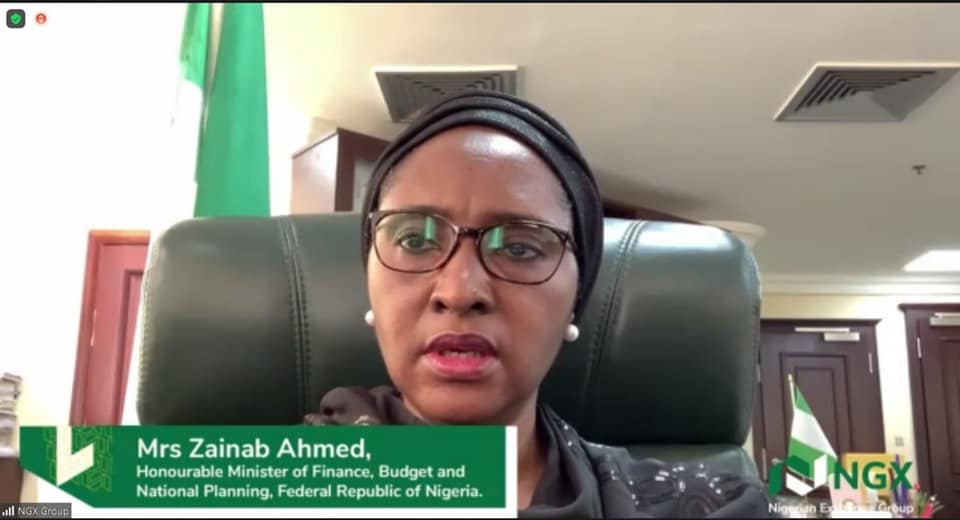
The Minister of Finance, Budget and National Planning, Mrs Zainab Ahmed, said this shows that the Nigerian economy was on the solid path to recovery.

Mrs Ahmed, while speaking at an Executive Intelligence Management Course 14 of the National Institute for Security Studies (NISS), Bwari, Abuja, said the administration of Mr Muhammadu Buhari has shown a strong commitment to sustainable development, governance and security despite the nation’s limited revenues.

At the event themed Governance, Security and Sustainable Development in Africa: Nexus, Challenges and Prospects, the Minister said, “The most recent GDP data which reports real growth of 5.01 per cent in the second quarter of 2021 is very encouraging news as it indicates the Nigerian economy is on a solid path to recovery.

“It is important to note that much of the growth was driven by the expansion of the non-oil sector of the economy where most Nigerians are employed.”

She further said due to its importance to every sector, especially the economy, the central government has made funds available to security.

“As an example, about 86 per cent of the 2021 Supplementary Budget was dedicated to the capital and recurrent expenditure needs of the security agencies to supplement the allocations in the 2021 amended budget,” she said.

While speaking on some key governance and security initiatives spearheaded by the Ministry and its agencies, Mrs Ahmed said that through Project Lighthouse, the federal government has been able to aggregate N5.2 trillion worth of debts owed to the government by third parties, of which N49.7 billion of this amount has been recovered.

She also said another initiative is the Treasury Single Account (TSA), a unified structure of government bank accounts that enables consolidation and optimum utilisation of government cash resources.

In addition, she said her ministry came up with the Government Integrated Financial Management Information System (GIFMIS), an IT-based system for budget management and accounting to improve public financial management processes and enhance accountability and transparency across all ministries, departments and agencies (MDAs) of government.

Mrs Ahmed also said in order to modernise tax administration in Nigeria, the Federal Inland Revenue Service (FIRS) introduced TaxPro Max, while the Nigeria Customs Service (NCS) designed the e-Customs Project meant to fully automate administrative processes by introducing innovative measures that eliminate paper-based functions.

The Minister, in addition, said another policy is the Road Infrastructure Tax Credit Scheme (RITCS) launched by President Buhari through Executive Order Number 7 signed on January 25, 2019.

“It is designed to leverage private sector capital, efficiency and expertise to construct, repair and maintain critical road infrastructure in key economic corridors and industrial clusters in Nigeria. The scheme relieves the government of the burden of funding significant outlays for road projects through the annual budget.

“Essentially, the RITCS utilises tax expenditures, by way of tax credits, to finance the construction of critical road and bridge infrastructure through an innovative public-private partnership (PPP) mechanism that incentivises private sector participation. Since inception, Mr President has approved a total of 33 road projects, totalling 1,564.95 km being undertaken in 19 States across the six geo-political zones of the country,” she said.

She also highlighted the Open Government Partnership (OGP), an international multi-stakeholder initiative focused on improving transparency, accountability, citizen participation and government responsiveness to citizens through technology and innovation.

“Since joining the partnership in July 2016, Nigeria has made progress in deepening transparency, accountability and openness in the management of public resources, especially in terms of the budget process,” she said.

Mrs Ahmed further stated that the Office of the Accountant General of the Federation (OAGF) in December 2019 launched the Open Treasury Portal, a platform aimed to enhance the accountability of government by detailing and tracking federal government spending data through the publishing of monthly fiscal accounts, as well as daily treasury and payment reports amongst others by MDAs.


Modupe Gbadeyanka is a fast-rising journalist with Business Post Nigeria. Her passion for journalism is amazing. She is willing to learn more with a view to becoming one of the best pen-pushers in Nigeria. Her role models are the duo of CNN's Richard Quest and Christiane Amanpour.

Economy

Investors Gain N333bn Trading Nigerian Equities

Published

on

attracted younger investors NGX

By Dipo Olowookere

A 0.31 per cent gain was recorded by the Nigerian Exchange (NGX) Limited on Tuesday, helped by renewed bargain-hunting by investors, with the year-to-date return extending to 6.61 per cent.

It was observed that the growth achieved by Customs Street yesterday was supported by the banking and the industrial goods indices, which went up by 1.32 per cent and 0.69 per cent apiece.

They offset the losses recorded by the three other sectors, with the insurance counter down by 1.32 per cent, the consumer goods segment down by 0.23 per cent, and the energy space down by 0.17 per cent.

At the close of business, the All-Share Index (ASI) increased by 516.94 points to 165,901.57 points from 165,384.63 points and the market capitalization appreciated by N333 billion to N106.495 trillion from N106.162 trillion.

The market breadth index was positive yesterday after the bourse ended with 35 price gainers and 34 price losers, representing bullish investor sentiment.

The quartet of Industrial and Medical Gases (IMG), Union Dicon, Zichis, and Austin Laz chalked up 10.00 per cent each to sell for N34.65, N9.90, N5.06, and N4.07, respectively, while RT Briscoe appreciated by 9.95 per cent to N9.50.

On the flip side, Omatek lost 10.00 per cent to trade at N2.43, Cutix also fell by 10.00 per cent to N3.15, Union Homes shrank by 9.95 per cent to N76.90, Sunu Assurances declined by 9.94 per cent to N4.62, and Deap Capital crashed by 9.93 per cent to N7.62.

During the trading day, 736.4 million stocks worth N24.7 billion exchanged hands in 46,026 deals compared with the 762.8 million stocks valued at N18.4 billion traded in 55,374 deals a day earlier, indicating a rise in the trading value by 34.24 per cent, and a slip in the trading volume and number of deals by 3.46 per cent and 16.88 per cent apiece.

The activity chart was led by volume on the second trading session of the week by GTCO with 65.9 million equities valued at N6.5 billion, Chams transacted 55.7 million shares worth N249.8 million, Custodian Investment traded 49.8 million stocks for N2.2 billion, Universal Insurance sold 36.1 million equities valued at N51.5 million, and Zenith Bank exchanged 35.4 million shares worth N2.6 billion.

Continue Reading

Economy

Oil Market Rises 2% on Fresh Iran-US Confrontation

Published

on

crude oil market

By Adedapo Adesanya

The oil market was up by nearly 2 per cent on Tuesday after the United States shot down an Iranian drone approaching an aircraft carrier and armed boats in the Strait of Hormuz, stoking concerns talks aimed at de-escalating US-Iran tensions could be disrupted.

This action caused the Brent futures to rise by $1.03 or 1.6 per cent to $67.33 per barrel, as the US West Texas Intermediate (WTI) futures jumped by $1.07 or 1.7 per cent to $63.21 a barrel.

Both crude benchmarks dropped more than 4 per cent on Monday after President Donald Trump said Iran was seriously talking with America.

However, the US military shot down an Iranian drone that “aggressively” approached the Abraham Lincoln aircraft carrier in the Arabian Sea on Tuesday.

In the Strait of Hormuz between the Persian Gulf and the Gulf of Oman, Iranian gunboats approached a US-flagged oil tanker in what US and British maritime security sources describe as a failed attempt to interfere with the vessel’s transit.

Members of the Organisation of the Petroleum Exporting Countries (OPEC) including Saudi Arabia, Iran, the United Arab Emirates, Kuwait and Iraq export most of their crude via the strait, mainly to Asia. The Strait of Hormuz, through which roughly a fifth of the world’s oil supply passes, remains Iran’s most obvious pressure point.

Despite the latest development, the UAE urged Iran and the US on Tuesday to use the resumption of nuclear talks this week to resolve a standoff that has led to mutual threats of air strikes. Iran, meanwhile, is demanding that talks be held in Oman not Turkey.

In Ukraine, President Volodymyr Zelenskiy accused Russia on Tuesday of exploiting a US-backed energy truce to stockpile munitions, and using them to attack Ukraine a day before peace talks. This boosted worries that Russia’s oil would remain sanctioned for longer.

On Monday, President Trump announced a trade deal with India, one of the world’s biggest economies and oil importers, on Monday to cut tariffs to 18 per cent from 50 per cent in exchange for the country halting Russian oil purchases and lowering trade barriers.

The American Petroleum Institute (API) estimated that crude oil inventories in the US decreased by 11.1 million barrels in the week ending January 30. Crude oil inventories decreased by 247,000 barrels in the week prior.

Official data from the US Energy Information Administration (EIA) will be published later on Wednesday.

Continue Reading

Economy

AFC Commits Support to Transformative Reforms in Nigeria’s Power Sector

Published

on

power sector liabilities

By Adedapo Adesanya

The Africa Finance Corporation (AFC), the continent’s leading infrastructure solutions provider, has reiterated its commitment to playing a pivotal role to support transformative reforms in Nigeria’s power sector.

This is as it act as co-Financial Adviser to the Nigerian government on the successful issuance of the recent N501 billion inaugural tranche under the Presidential Power Sector Financial Reforms Programme (PPSFRP), as part of the N4 trillion Power Sector Bond Programme, aimed at resolving over a decade of legacy debt obligations in Nigeria’s electricity supply industry and restoring financial stability across the sector.

AFC provided comprehensive financial advisory services to the federal government, including the design of the Programme’s negotiation strategy framework, support in negotiating and executing Settlement Agreements with Power Generation Companies (GenCos), and structuring the bond issuance. Working in partnership with CardinalStone Partners as co-Financial Advisers, AFC deployed its deep sector expertise and strong local market knowledge to deliver the landmark transaction.

The programme was overseen by the Presidential Power Sector Debt Reduction Committee (PPSDRC), with technical leadership from the Office of the Special Adviser to the President on Energy, and implemented through NBET Finance Company Plc, a special purpose vehicle of Nigerian Bulk Electricity Trading Plc (NBET). Proceeds from the issuance will be used to settle verified, overdue receivables owed to GenCos for electricity supplied between February 2015 and March 2025, injecting liquidity into the power sector and extinguishing long-standing claims.

Commenting on AFC’s involvement, Mr Banji Fehintola, Executive Board Member and Head, Financial Services at Africa Finance Corporation, said: “The successful issuance of the inaugural tranche under the Power Sector Bond Programme underscores AFC’s commitment to supporting transformative reforms in Nigeria’s power sector. By resolving long-standing liquidity challenges and restoring confidence among investors and operators, this transaction lays the foundation for sustainable growth and improved electricity supply across the country.”

When fully implemented, the programme is expected to impact approximately 5,398MW of electricity generation capacity by Nigerian GenCos and finalise settlement for 290,644.84GWh of electricity billed since 2015. It will also strengthen companies serving about 12 million active registered customers, creating a solid platform for new investments in capacity enhancement and expansion.

Continue Reading

Trending