Economy
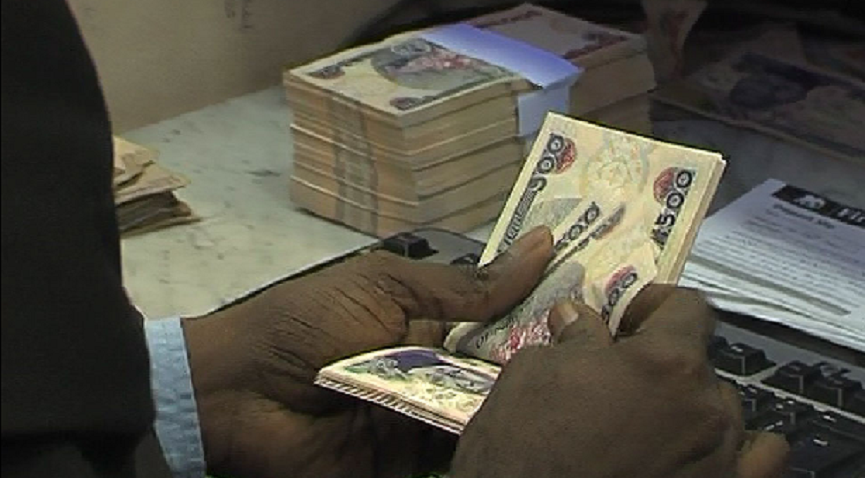
Bearish Sentiment Dominants T-Bills Market as CBN Mops up N189.7b
By Dipo Olowookere
The treasury bills market was slightly depressed on Thursday with bearish sentiment dominating the market space.
According to analysts at Zedcrest Research, most trading activities at the market yesterday were tilted towards the short end of the curve.
The medium to long end of curve remained muted due to the floatation of another OMO auction by the Central Bank of Nigeria (CBN).
This was part of efforts by the central bank to mop up inflows from corresponding maturing OMO T-bills and lingering excess cash from FAAC disbursements.
Business Post reports that during the exercise, the apex bank sold treasury bills worth NN189.73 billion.
The CBN eventually succumbed to investor pressure for higher yields amidst weak subscription, raising the stop rate for the longest offered tenor (182days) to 12.50 percent from 12.15 percent offered previously.
A total of N550 billion worth OMO bills were offered to investors by the bank, but it eventually sold N34.30 billion worth of the 63-day bills at 10 percent, N55.34 billion worth of the 126-day bills at 11.50 percent and N100.09 billion worth of the 182-day bills at 12.50 percent.
The shift in stop rates at the OMO auction will likely lead to bearish sentiments in T-bills market especially at the medium to long end of the curve.
“We expect a lethargic trading session tomorrow to wrap up for the week,” Zedcrest Research said.
Meanwhile, interbank lending rates remained relatively stable, as the OBB and OVN closed at 3 percent and 3.83 percent respectively.
System liquidity is estimated to close yesterday at about N600 billion net positive after the sale of a total of N189.73 billion at the OMO auction, which was not sufficient to offset corresponding inflows from N292.52 billion OMO maturities.
The rates are expected to close on a calm note, with no significant outflows expected closing the week. This is however barring another OMO auction by the CBN due to the high systemic liquidity.
Economy
NGX Rallies 0.53% as Airtel Africa, First Holdco Top Gainers’ Log
By Dipo Olowookere
The Nigerian Exchange (NGX) Limited further appreciated by 0.53 per cent on Tuesday on the back of strong appetite for some large and mid-cap equities.
During the session, Airtel Africa led the gainers’ log after it appreciated by 10.00 per cent to sell for N4,021.20, International Energy Insurance grew by 9.90 per cent to N8.77, Abbey Mortgage Bank advanced by 9.76 per cent to N11.25, Infinity Trust Mortgage Bank improved by 9.63 per cent to N10.25, and First Holdco surged by 8.49 per cent to N69.00.
Conversely, Learn Africa, Trans-Nationwide Express, Okomu Oil, Unilever Nigeria, and NAHCO lost 10.00 per cent each to trade at N9.45, N4.41, N1,575.00, N140.40, and N170.55, respectively.
Business Post reports that the bears and the bulls shared the spoils on the price movement index, after Customs Street ended with 33 price gainers and 33 price losers.
The bourse witnessed sell-offs yesterday, which caused three of the five key sectors to close in the red.
The industrial goods space lost 0.99 per cent, the consumer goods index declined by 0.83 per cent, and the energy sector shed 0.14 per cent.
However, a 1.33 per cent surge posted by the banking counter and the 0.24 per cent growth recorded by the insurance sector offset the losses.
As a result, the All-Share Index (ASI) went up by 990.55 points to 244,697.62 points from 243,707.07 points, and the market capitalisation increased by N636 billion to N156.944 trillion from N156.308 trillion.
A total of 1.3 billion stocks valued at N57.9 billion exchanged hands in 59,956 deals during the trading day versus the 717.2 million stocks worth N56.7 billion traded in 73,321 deals on Monday, indicating an improvement in the trading volume and value by 81.26 per cent and 2.12 per cent, respectively, and a shortfall in the number of deals by 18.23 per cent.
Sterling Holdings transacted 715.7 million shares for N5.4 billion, GTCO sold 49.2 million stocks worth N6.7 billion, FCMB exchanged 34.4 million equities valued at N412.8 million, Veritas Kapital traded 29.1 million shares worth N48.0 million, and Access Holdings exchanged 27.3 million stocks for N680.8 million.
Economy
Oil Market Falls 3% as Trump Signals Confidence in Iran Deal
By Adedapo Adesanya
The oil market fell about 3 per cent to a seven-week low on Tuesday after Iran and Israel said they had halted attacks on each other following an appeal from US President Donald Trump.
Brent futures dropped $2.80 or 3.0 per cent to settle at $91.45 a barrel, while the US West Texas Intermediate (WTI) crude slid $3.10 or 3.4 per cent to trade at $88.20 a barrel.
President Trump said he remained confident a deal with Iran could be reached soon, even as many expressed scepticism. He also said Iran shot down an American helicopter in the Strait of Hormuz, threatening retaliation.
Tensions were still simmering between Israel and Iran, after the two countries struck each other for the first time in weeks, and CNN noted that the American President had promised an impending deal on at least 37 occasions.
Meanwhile, the rift between the US president and Israeli Prime Minister Benjamin Netanyahu widened further, complicating any agreement.
According to Reuters, Iran has so far held back from attacking even though Israel struck the historic port city of Tyre in southern Lebanon, killing at least eight people.
However, Iran continued to block most shipping through the Strait of Hormuz, which, before the war, carried a fifth of the world’s crude oil and liquefied natural gas. The US has imposed its own blockade of Iranian ports.
Market analysts noted that when the strait ultimately reopens, Iran and Oman will set new conditions for passage, including transit fees.
China’s May crude imports slumped 29 per cent to their lowest level in eight years, extending a sharp decline in the world’s largest oil importer that is helping keep a lid on global oil prices.
The American Petroleum Institute (API) estimated that crude oil inventories in the United States fell by 9.119 million barrels in the week ending June 5. Official data from the Energy Information Administration (EIA) will be released later on Wednesday.
The EIA projected the Iran war would slash world petroleum production to an average of 99.0 million barrels per day in 2026, down from a record 106.1 million barrels per day in 2025. The agency also forecast that world oil demand would slide to 102.9 million barrels per day in 2026 from a record 104.0 million barrels per day in 2025.
Economy
IMF Warns Over Nigeria’s Proposed $5bn Swap Deal with First Abu Dhabi Bank
By Adedapo Adesanya
The International Monetary Fund (IMF) has warned of risks surrounding Nigeria’s plan to borrow up to $5 billion through a derivatives agreement with First Abu Dhabi Bank.
In its latest Article IV review following the conclusion of its latest mission in Nigeria, the global lender said such transactions are often opaque and complex.
The Senate in April gave its approval to the agreement put forward by President Bola Tinubu, who said his administration intends to use proceeds from the total return swap to refinance expensive debt and pay for infrastructure.
“Our view is that the transactions in these types of structures carry risks. Usually they are opaque, so the terms are not always very transparent when we reviewed these instruments across countries,” according to the IMF’s mission chief in Nigeria, Mr Christian Ebeke.
Mr Ebeke said Nigeria could instead issue eurobonds to finance its deficits or other means to raise funding, including on concessional terms.
The Fund also praised Nigeria’s sweeping reforms, saying they had strengthened economic stability and investor confidence, but warned that the benefits had yet to reach millions of citizens and could be undermined by global shocks, including the Middle East conflict.
“Strong reforms over the past three years have yielded improved macroeconomic outcomes and built resilience. Still, conditions for many Nigerians remain difficult,” the IMF stated.
However, it cautioned that the reforms were also contributing to social strain, with poverty levels at 63 per cent and millions facing food insecurity, underscoring a widening gap between macro gains and household realities.
“Conditions remain difficult for many Nigerians, with poverty and food insecurity likely to worsen in the current external environment,” the IMF Executive Board stated.
The IMF said improved policy credibility and forex reforms had helped Nigeria regain access to international capital markets and attract portfolio inflows, while reducing risk premiums.
It, however, warned that reliance on volatile foreign portfolio investment poses rollover risks and urged a shift towards more stable, long-term capital such as foreign direct investment.
The lender also warned that non-performing loans had risen to eight per cent in the third quarter of 2025, above prudential limits.
The IMF then urged Nigerian authorities to accelerate structural reforms in electricity, infrastructure, agriculture and human capital development to drive inclusive growth and economic diversification.
-
Feature/OPED6 years agoDavos was Different this year
-
Travel/Tourism10 years ago
Lagos Seals Western Lodge Hotel In Ikorodu
-
Showbiz3 years agoEstranged Lover Releases Videos of Empress Njamah Bathing
-
Banking8 years agoSort Codes of GTBank Branches in Nigeria
-
Economy3 years agoSubsidy Removal: CNG at N130 Per Litre Cheaper Than Petrol—IPMAN
-
Banking3 years agoSort Codes of UBA Branches in Nigeria
-
Banking3 years agoFirst Bank Announces Planned Downtime
-
Sports3 years agoHighest Paid Nigerian Footballer – How Much Do Nigerian Footballers Earn