
Economy
Heritage Bank Is Not In Distress—CBN

By Modupe Gbadeyanka
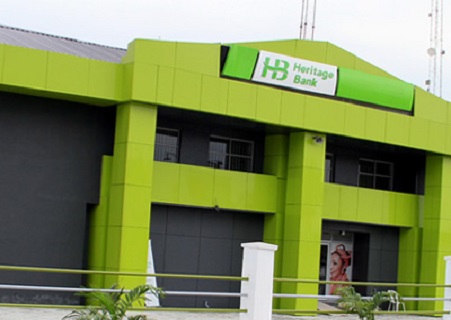
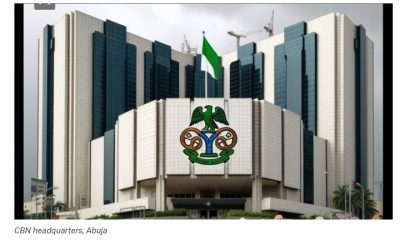
The Central Bank of Nigeria (CBN) has come out to defend Heritage Bank following a report that the financial institution was in distress.
The apex bank, in a press statement issued on Tuesday by its Acting Director of Corporate Communications, Mr Isaac Okorafor, disclosed that the bank “is not in distress” as being speculated and urged its depositors to “go about their transactions without fear.”
CBN said it is also not true that Heritage Bank was “unable to discharge its obligations to its depositors” and insists “no Nigerian Bank is in distress.”
“The CBN, as the industry regulator, has a duty to depositors, in particular, and the economy, in general, to ensure the soundness of all financial institutions.
“We therefore wish to assure all depositors of the safety of their deposits.
“The CBN also wishes to state that it will remain alive to its responsibility of ensuring banking system stability and soundness through constant monitoring and supervision of all licensed institutions.
“The Central Bank of Nigeria wishes to reiterate that the banking system remains resilient enough to weather the current economic storm,” Mr Okorafor said in the statement.
Sahara Reporters had claimed Heritage Bank was in distress and further alleged that the CBN was only covering things up for the bank.
Though Business Post had made efforts on Tuesday to hear from Heritage Bank from its PR agency, Power Light Nigeria, but as at press time, the agency was yet to respond to our enquiry about the issues raised in the story being peddled by the online media.
Below is the controversial report by Sahara Reporters:
Heritage Bank Plc is currently stuck in a debilitating liquidity situation; SaharaReporters has learned.
Our sources disclosed on Monday that the bank is unable to meet customers’ immediate withdrawal requests and has wiped out all foreign currency domiciliary accounts through physical theft of cash by the bank’s directors.
First Bank Plc, which handles Heritage Bank’s universal clearing activities, has threatened to blacklist the bank and stop further clearing transactions if its outstanding deficit of over N5billion is not cleared.
At the weekend, at a meeting held at a secret location between the Managing Director and some top management staff, it was resolved that the Managing Director and two Executive Directors should resign their appointment for their role in throwing the institution into distress.
Sources said the bank’s operations in the Northern part of the country region are sustained by one customer, Rano Oil Limited, which maintains a deposit with Heritage Bank because its Chairman is unaware of the severity of the situation in the bank has slipped into.
Among others, the Managing Director is alleged to have been involved in the laundering of about N12.8billion. Two insurance firms: IEI Insurance Plc, and the National Insurance Commission of Nigeria, are said to be connected to the matter.
SaharaReporters gathered that the Economic and Financial Crimes Commission (EFCC) was prepared to charge the Managing Director to court, but did not, following the intervention of Senate President Bukola Saraki, who is a part-owner of the bank. The EFCC, whose chairman is awaiting confirmation by the Senate, stepped back.
Customers with foreign currency deposits are facing severe difficulties because they no longer have access to those funds.
Because of the magnitude of the bank’s problems and the possibility of prosecution, the Managing Director is said to have taken ill.
Out of about 500 Automated Teller Machines (ATMs) of the bank in the Lagos metropolis, only 138 are currently dispensing cash, the bank lacking money to feed the others.
Bank sources said a sum of N140million is required to supply all the ATM locations, and Heritage struggles to provide N10million for these ATM locations, which is why its machines rarely dispense cash.
The bank’s situation is further worsened by boardroom intrigues, tribal politics and ownership tussle.
The Managing Director and one Executive Director are said to run the bank like sole proprietors. The Managing Director and another Executive Director, Mary Akpobomen, who has been promised the position of the Deputy Managing Director by December, are in the same camp. The Yoruba interest in the bank, with Board Chairman, Mr. Seyi Akinfenwa, also has Mr. Tayo Ayeni and two Executive Directors, Mr. Niyi Adeseun and Mr. Ola Olabimjo on another side. On yet another side are Mr. Godwin Emefiele, Governor of the Central Bank of Nigeria (CBN), who is the main pusher of Delta State/Agbor interest. The battle axes are said to be two other Executive Directors, Mrs. Ada Eze and Mr. Jude.
The three-dimensional feuds have ensured that positions, postings or deployments are made on lines of group loyalty, with competence plainly ignored. The bank’s Treasurer, Mr. Abidemi Shonaiki, was eased out of the bank when the Managing Director was on leave.
Insiders revealed that the bank has been turned into a compost heap by its top management staff, who among other misdeeds, use customers’ naira deposits to finance the acquisition of private properties in Lagos, Abuja, and Port Harcourt. They are also said to award contracts at inflated costs to the Managing Director, relatives, and friends of executive directors; employ top management staff without clearance from the CBN; bribe CBN staff on banking inspection with dollars; and cover up the bank’s liquidity problems by buying cash from other banks without the required documents or due diligence.
The Heritage Bank management portfolio of misdeeds is also said to include paying N100million bribe to pension funds officials for patronage retention; illegal warehousing of N1.2billion that should be in the Treasury Savings Account; as well as illegal clearance of customers’ deposits via issuance and payments of questionable ‘PRs’ in hundreds of millions.
The CBN Governor has ensured that these misdemeanors are kept hidden due to political pressure by the owners of the bank, and because the CBN doesn’t want to give the appearance of further distress in the banking sector following the recent crisis at Skye Bank.
The bank’s ailments have also manifested in the practice of debiting customers’ accounts for transfers without crediting the beneficiaries for days, blaming it on network failure; arbitrary sacking of staff who insist on standards; sacking of staff who exposed the fraud involving the Nigeria Ports Authority through which N7billion was illegally warehoused and diverted in clear violation of TSA directives; and refusal to report fraudulent activities involving relatives and cronies of the Managing and Executive Directors.
Other symptoms of poor corporate governance include the transfer to Abuja, but not sanction, of an Executive Director and General Manager from Lagos for committing fraud; promoting Managing Director’s relatives without appraisal; fraudulent conversion of bank properties by the Managing Director and top management staff; and the procurement of N2billion worth of furniture items and N3billion Toyota cars without passing through tender procedure.
Also, the bank awarded all cleaning contracts to one Mrs. Akpobome, who used different names for contracts, which cover North, South, West, East and Abuja outlets of the bank. The Managing Director and other top management staff also award contracts to their wives and children without due diligence.
The bank, the sources added, employed school certificate holders as officers, assistant managers, deputy managers or managers, even without experience.
http://saharareporters.com/2016/11/14/distress-hits-heritage-bank-cbn-cover-mode










By Dipo Olowookere
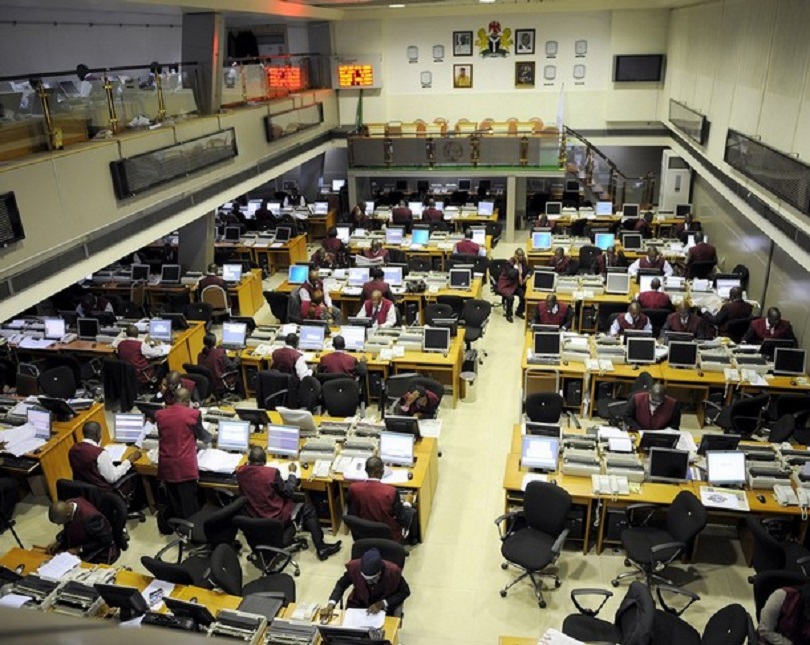
Nigerian stocks shrank by 0.02 per cent as a result of renewed selling pressure, after the consumer goods index crumbled by 0.89 per cent, and the banking space contracted by 0.23 per cent.
Business Post reports that the Nigerian Exchange (NGX) Limited weakened yesterday despite the energy sector closing 1.78 per cent higher, the insurance segment increasing by 0.31 per cent, and the industrial goods counter closing flat.
The All-Share Index (ASI) eased by 44.83 points to 200,913.06 points from 200,957.89 points, and the market capitalisation decreased by N29 billion to N128.969 trillion from N128.998 trillion.
eTranzact lost 10.00 per cent to trade at N20.70, Abbey Mortgage Bank declined by 10.00 per cent to N9.90, Cadbury Nigeria retreated by 10.00 per cent to N63.00, Eterna also fell by 10.00 per cent to N33.75, and DAAR Communications dipped by 9.50 per cent to N1.81.
Conversely, Premier Paints appreciated by 9.97 per cent to N37.50, Zichis gained 9.97 per cent to trade at N13.79, McNichols improved by 9.93 per cent to N7.42, John Holt chalked up 9.86 per cent to close at N18.95, and Trans Nationwide Express went up by 9.75 per cent to N2.59.
On the last day of the week, 595.2 million equities valued at N24.5 billion were transacted in 43,440 deals versus the 678.1 million equities worth N33.1 billion traded in 42,222 deals in the previous session.
This showed an improvement in the number of deals by 2.89 per cent, and a cut in the trading volume and value by 12.22 per cent and 25.98 per cent, respectively.
Wema Bank ended the day as the busiest stock after a turnover of 131.5 million units worth N3.5 billion, Legend Internet traded 41.6 million units valued at N339.2 million, Zichis sold 35.2 million units for N485.6 million, Access Holdings exchanged 29.4 million units worth N764.8 million, and Japaul transacted 21.5 million units valued at N74.6 million.


By Adedapo Adesanya
A loss recorded by market bellwether, Central Securities Clearing System (CSCS) Plc, outweighed the presence of three price gainers, weakening the NASD Over-the-Counter (OTC) Securities Exchange by 0.73 per cent on Friday, March 27.
The Nigerian securities depository firm lost N6.27 during the session to close at N80.10 per share compared with the previous day’s N86.37 per share.
As a result, the market capitalisation shrank by N18.41 billion to N2.512 trillion from the previous session’s N2.531 trillion, and the NASD Unlisted Security Index (NSI) declined by 30.77 points to 4,199.69 points from 4,230.46 points.
The green side of the price movement log showed 11 Plc appreciating by N31.92 to N351.17 per unit from N319.25 per unit, Nigeria Mortgage Refinance Company Plc (NMRC) rose by 55 Kobo to sell at N6.05 per share compared with Thursday’s closing price of N5.50 per share, and IPWA Plc recorded a 50 Kobo growth to end at N5.51per unit, in contrast to the preceding day’s N5.01 per unit.
When the bourse closed for the day, there was a 17,067.5 per cent surge in the voluime of transactions to 58.6 million units from 342,825 units, the value of trades increased by 6,895.4 per cent in the value of securities traded as it closed at N1.6 billion compared to N23.0 million, and the number of deals executed at the session rose 85.2 per cent to 50 deals compared to the preceding session’s 27 deals.
CSCS Plc remained the most active stock by value on a year-to-date basis with 56.2 million units exchanged for N3.8 billion, Infrastructure Guarantee Credit Plc followed with 400 million units valued at N1.2 billion, and Okitipupa Plc came next with 6.5 million units traded at N1.2 billion.
Resourcery Plc closed the trading session as the most traded stock by volume on a year-to-date basis with 1.1 billion units sold for N415.7 million, followed by Infrastructure Credit Plc with 400 million units sold for N1.2 billion, and Geo-Fluids Plc with 133.0 million units at N511.1 million.
By Adedapo Adesanya
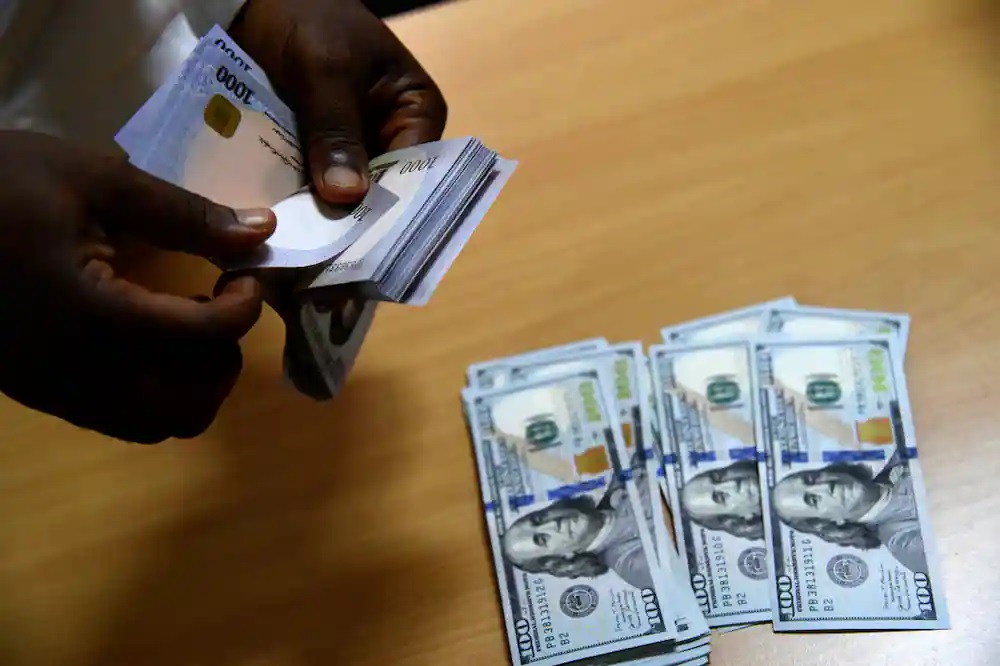
The Naira maintained stability against the United States Dollar in the black market segment of the foreign exchange (FX) market on Friday, March 27, data obtained by Business Post showed. It also remained unchanged at the GTBank FX counter at N1,401/$1.
However, it further appreciated in the Nigerian Autonomous Foreign Exchange Market (NAFEX) during the session by N3.30 or 0.2 per cent to N1,380.58/$1 from the previous day’s rate of N1,383.88/$1.
In the same vein, the domestic currency improved its value against the Pound Sterling in the spot market yesterday by N10.77 to trade at N1,836.99/$1 compared with the preceding session’s N1,847.76/£1, and gained N5.06 against the Euro to sell at N1,592.08/€1 versus N1,597.14/€1.
The Naira remains under pressure, but the current range indicates a form of stability as the Central Bank of Nigeria (CBN) reiterated its promise to anchor reforms around FX rate stability and stronger reserves to support financial markets.
Amid the currency pressures, the apex bank introduced a series of measures aimed at improving liquidity and strengthening the FX market. In a key move, the apex bank removed the cash pooling requirement for International Oil Companies (IOCs), allowing them full access to their repatriated export proceeds from the previous 50 per cent.
However, the country could see less short-term Dollar supply staying in the country and may invite pressure on the Naira if outflows exceed inflows.
The pressure on the currency comes amid a sustained decline in Nigeria’s external reserves, which provide the central bank with the buffer to support the naira. The reserves fell for the ninth consecutive day to $49.48 billion as of March 26, 2026, marking a decline of $540 million, or 1.08 per cent, from $50.02 billion recorded on March 11.
Meanwhile, the cryptocurrency market tumbled on Friday due to a broader sell-off in US equities, which recorded a $17 trillion loss. The Friday plunge fits into a pattern since the war in Iran broke out, with gains on Monday turning into losses by the end of the week.
Ethereum (ETH) depreciated by 3.2 per cent to $2,003.73, Bitcoin (BTC) fell by 3.1 per cent to $66,439.48, Solana (SOL) dropped by 2.9 per cent to $83.44, Cardano (ADA) crashed to $0.2474, Binance Coin (BNB) went down by 2.4 per cent to $613.17, TRON (TRX) dipped 1.5 per cent to $0.3113, Dogecoin (DOGE) declined by 1.4 per cent to $0.0908, and Ripple (XRP) slumped 1.4 per cent to sell at $1.33, while the US Dollar Tether (USDT) and the US Dollar Coin (USDC) closed flat at $1.00 each.










-
 Feature/OPED6 years ago
Davos was Different this year
-
Travel/Tourism10 years ago
Lagos Seals Western Lodge Hotel In Ikorodu
-

 Showbiz3 years ago
Estranged Lover Releases Videos of Empress Njamah Bathing
-
 Banking8 years ago
Sort Codes of GTBank Branches in Nigeria
-

 Economy3 years ago
Subsidy Removal: CNG at N130 Per Litre Cheaper Than Petrol—IPMAN
-

 Banking3 years ago
Sort Codes of UBA Branches in Nigeria
-

 Banking3 years ago
First Bank Announces Planned Downtime
-

 Sports3 years ago
Highest Paid Nigerian Footballer – How Much Do Nigerian Footballers Earn