
Economy
Lagos to Partner ICAN to Boost Informal Sector

By Dipo Olowookere
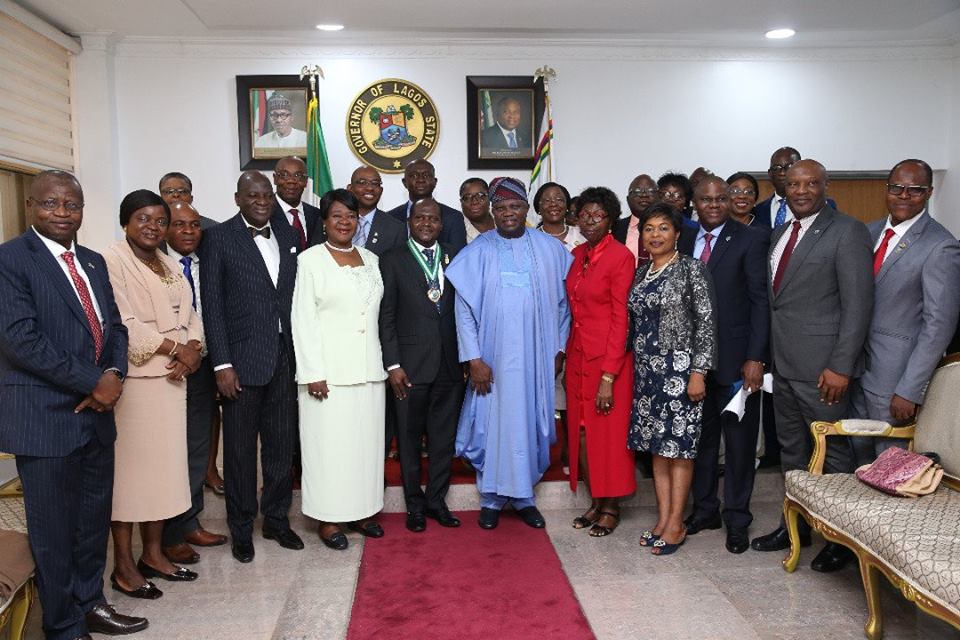
Lagos State Governor, Mr Akinwunmi Ambode, has promised to work in collaboration with the Institute of Chartered Accountants of Nigeria (ICAN) in order to boost the informal sector of the state’s economy.
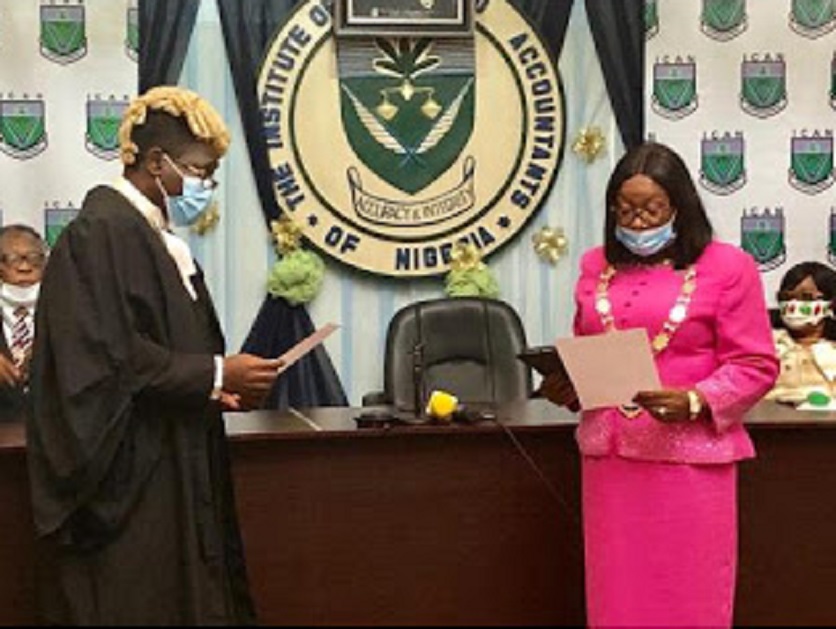
Mr Ambode made this disclosure on Tuesday when the group, led by its President, Mr Ismaila Zakari, paid a courtesy visit to him at the Lagos House in Alausa, Ikeja.
Governor Ambode thanked the institute for the skill sets inculcated in him 30 years ago when he became a professional accountant, saying that those skills were very relevant and still useful in administering the State.
“Yes, there are leaders that come and go at different times, but the wish of God that an ICAN member should be at the helm of affairs of Lagos State at a time when it is so problematic, at a time when revenue is going down and at a time we want to protect our people from unimaginable taxation, but again the skill sets to be able to put all these resources together for the benefit of humanity is encouraging.
“I just want to encourage ICAN that whatever are the ideals and principles of the body are not in vain.
“The products are here for people to see and this is what we want to commend to other people and other professionals that ICAN has come a long way and ICAN has proven also that the leadership of this country is actually in the hands of those who have the public finance expertise to lead this country ahead which we have proven by what we have done in the last two and half years.
“There is no miracle in what we are doing, the fact is that it is about our skills and the knowledge that the Institute has impacted in all of us for which we are proud of,” Mr Ambode said.
Besides, the Governor acknowledged that though his administration was implementing the N25billion ETF, he would nonetheless collaborate with ICAN to boost the informal sector especially in areas of entrepreneurship skills and capital.
According to him, “There are too many people that are unemployed and there are too many people that are creative and innovative but again they don’t have that support or the capital to do the things they ought to do and so if we have collaborators like ICAN, we will also put some money there because it is about Lagosians, it is about employment and it is about growth and development,” Governor Ambode said.
He also pledged to uphold and scale up the partnership that had always existed between the State Government and ICAN.
On his part, President of ICAN, Mr Ismaila Zakari, lauded the various initiatives and programmes of Mr Ambode, saying it confirms that chartered accountants can add value to governance in Nigeria, describing the Governor as a worthy ambassador of the Institute.
MR Zakari said the remarkable achievements of the Governor in office so far were worthy of emulation by other leaders.
He recalled that despite the economic challenges in the country in 2016, Lagos State, under Governor Ambode, raked in N287 billion as internally generated revenue, a figure ranked among the best the State ever generated, while the Governor also fulfilled his major electioneering campaign by implementing the N25 billion Employment Trust Fund (ETF), which he said had immensely scaled up entrepreneurship and reduced unemployment.
While noting the reconstruction of 114 inner roads across the 57 Local Government Councils in the State, Mr Zakari also commended the Light Up Lagos project and the Agric initiative aimed at encouraging local production of rice, saying that the remarkable initiative had greatly reduced rice importation and enhanced foreign exchange of the country.
The ICAN President said, “These momentous achievements are testimonies not only to Governor Ambode’s enviable track record of service to the good people of Lagos State, but they are also indelible evidence of the value that chartered accountants can add to governance.
“We are truly proud of your achievements in office and therefore warmly commend and hold you out as a worthy ambassador of the accounting profession from whom others in governance should take a cue.”
While seeking the incorporation of accountants under the ICAN technician scheme into the N25 billion ETF, Mr Zakari also invited Governor Ambode to deliver a lead paper on the theme: ‘Young Professionals: Emerging Leaders of Change and Nation Building,’ at the 47th edition of the annual Accountant Conference.






By Aduragbemi Omiyale
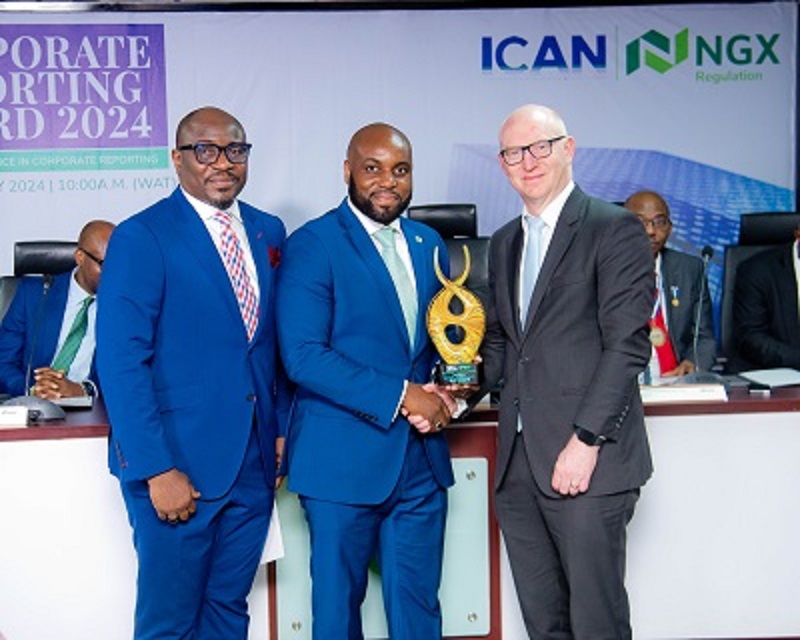
The securities of DN Tyre and Rubber Plc, and Greif Nigeria Plc have been delisted by the regulatory arm of the Nigerian Exchange (NGX) Group Plc, NGX Regulation Limited.
A statement signed by the Head of the Issuer Regulation Department of NGX RegCo, Mr Godstime Iwenekhai, said the delisting became effective on Thursday, April 9, 2026.
In the notice issued yesterday, it was further disclosed that the action complied with the provisions of Clause 14 of the Amended Form of General Undertaking, for Listing on Nigerian Exchange Limited General Undertaking.
According to this clause, “The exchange reserves the right to, at its sole and absolute discretion, suspend trading in any listed securities of the Issuer, delist such securities, or remove the name of the issuer (listed company) from the daily official list of the exchange with or without prior notice to the issuer, upon failure of the issuer to comply with any one or more of the provisions of this General Undertaking, or when in its sole discretion, the exchange determines that such suspension of trading or delisting is in the public interest, or otherwise warranted.”
It was explained that the shares of the two firms were delisted because they fell below the listing standards.
“The securities of DN Tyre and Rubber Plc and Greif Nigeria have been delisted from the facilities of Nigerian Exchange Limited (NGX) effective Thursday, April 9, 2026, on the grounds that the companies are operating below the listing standards of NGX and their securities are no longer considered suitable for continued listing and trading in the market,” the disclosure noted.

By Adedapo Adesanya
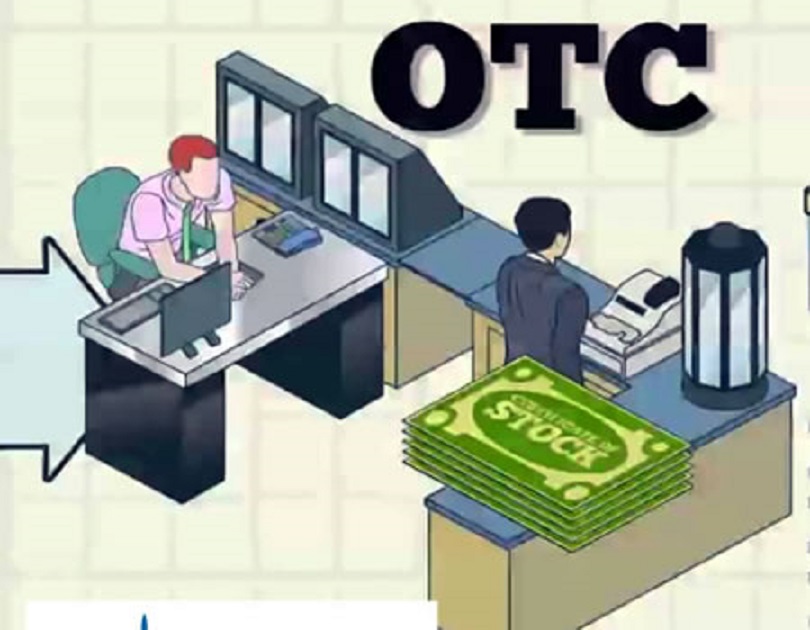
The NASD Over-the-Counter (OTC) Securities Exchange declined by 0.95 per cent on Thursday, April 9, plunging the Unlisted Security Index (NSI) by 37.41 points to 3,893.50 points from 3,930.91 points.
In the same vein, the market capitalisation lost N22.38 billion during the session to N2.329 trillion from the N2.351 trillion it ended at midweek.
The OTC securities exchange was under selling pressure yesterday, resulting in a negative market breadth index after three securities lost weight and one gained weight.
Central Securities Clearing System (CSCS) Plc led the losers’ table after it shed N3.74 to sell at N64.21 per unit versus N67.95 per unit. Food Concepts Plc went down by 19 Kobo to N2.68 per share from N2.87 per share, and Free Range Farms Plc dropped 10 Kobo to settle at 90 Kobo per unit versus N1.00 per unit.
On the flip side, MRS Oil gained N5 to close at N165.00 per share compared with the preceding day’s N160.00 per share.
At the trading session, there was a 23.5 per cent jump in the value of securities to N40.4 million from N32.7 million, but the volume of securities fell by 81.9 per cent to 1.04 million units from 5.7 million units, and the number of deals went down by 29.7 per cent to 26 deals from the preceding session’s 37 deals.
At the close of transactions, Great Nigeria Insurance (GNI) Plc remained the most active stock by value on a year-to-date basis with 3.4 billion units valued at N8.4 billion, followed by CSCS Plc with 57.5 million units exchanged for N3.9 billion, and Okitipupa Plc with 27.5 million units traded for N1.8 billion.
Also, GNI Plc ended the trading day as the most traded stock by volume on a year-to-date basis with the sale of 3.4 billion units worth N8.4 billion, trailed by Resourcery Plc with 1.1 billion units worth N415.7 million, and Infrastructure Guarantee Credit Plc with 400 million units sold for N1.2 billion.
By Adedapo Adesanya
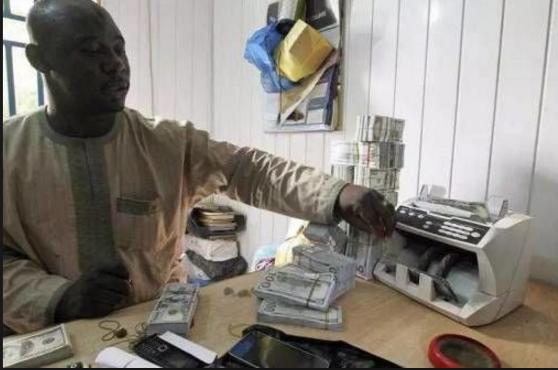
The Naira further appreciated against the US Dollar in the various segments of the foreign exchange (FX) market on Thursday, April 9.
At the black market, the Nigerian currency improved its value yesterday by N20 to quote at N1,390/$1 compared with the previous day’s rate of N1,410/$1.
In the Nigerian Autonomous Foreign Exchange Market (NAFEX) window, the domestic currency gained N12.50 or 0.9 per cent against the greenback to trade at N1,359.32/$1, in contrast to midweek’s price of N1,371.82/$1.
In the same official market, the local currency gained N14.89 against the Euro to sell at N1,589.18/€1 versus N1,604.07/€1, and traded flat against the Pound Sterling at N1,844.83/£1.
Data from the Central Bank of Nigeria (CBN) showed that turnover increased to N71.156 million across 115 deals, suggesting that banks’ customers’ demand for foreign payments eased slightly on the day.
The local currency has been in strong demand from foreign portfolio investors seeking to purchase OMO bills and other fixed-income instruments.
External reserves, which provide the CBN with firepower to support the currency, declined for the 13th consecutive session, falling by about $840 million to $49.18 billion as of April 1 from $50.02 billion recorded on March 11, according to CBN data.
The persistent drawdown reflects mounting external pressures tied to heightened geopolitical tensions in the Middle East, which analysts say have dampened investor appetite for frontier markets and weakened capital inflows into Nigeria.
In the cryptocurrency market, prices tapped into optimism as geopolitical tensions over a fragile Iran ceasefire and a partial reopening of the Strait of Hormuz keep markets cautious and oil prices volatile.
Market analysts noted that if the ceasefire survives through the weekend and the Strait opens further, momentum will build for risk assets like crypto. However, if Iran’s grievances escalate or President Donald Trump’s rhetoric shifts, prices may crater.
Bitcoin (BTC) appreciated by 1.6 per cent to $71,989.47, Dogecoin (DOGE) expanded by 1.5 per cent to $0.0928, Solana (SOL) added 1.4 per cent to sell for $83.34, Ripple (XRP) jumped 1.1 per cent to $1.34, Cardano (ADA) went up by 0.8 per cent to $0.2518, TRON (TRX) grew by 0.7 per cent to $0.3195, Ethereum (ETH) increased by 0.6 per cent to $2,192.07, and Binance Coin (BNB) climbed 0.4 per cent to $601.29, while the US Dollar Tether (USDT) and the US Dollar Coin (USDC) remained unchanged at $1.00 each.
-
 Feature/OPED6 years ago
Davos was Different this year
-
Travel/Tourism10 years ago
Lagos Seals Western Lodge Hotel In Ikorodu
-

 Showbiz3 years ago
Estranged Lover Releases Videos of Empress Njamah Bathing
-
 Banking8 years ago
Sort Codes of GTBank Branches in Nigeria
-

 Economy3 years ago
Subsidy Removal: CNG at N130 Per Litre Cheaper Than Petrol—IPMAN
-

 Banking3 years ago
Sort Codes of UBA Branches in Nigeria
-

 Banking3 years ago
First Bank Announces Planned Downtime
-

 Sports3 years ago
Highest Paid Nigerian Footballer – How Much Do Nigerian Footballers Earn